April 25

What was advertised in a colonial American newspaper 250 years ago this week?

Massachusetts Gazette and Boston Weekly News-Letter (April 22, 1773).

“Garden Seeds, &c. Are to be Sold by the following Persons, who have advertised the Particular Sorts in this Paper.”

Richard Draper, the printer of the Massachusetts Gazette and Boston Weekly News-Letter, did not have room for all of the news, letters, and advertisements submitted to his printing office for the April 22, 1773, edition.  To remedy the matter, he collected together and abbreviated notices about “Peas, Beans, [and] Garden Seeds” peddled by John Adams, Ebenezer Oliver, Elizabeth Greenleaf, Susanna Renken, Elizabeth Clark and Nowell, and Lydia Dyar.  Draper informed readers that the “following Persons, who have advertised the Particular Sorts in this Paper” continued to sell seeds, but “we have not Room this Week.”  Along with each name, the printer provided the location, but did not elaborate on their merchandise except for a note at the end intended to apply to each advertiser, a single line advising prospective customers that “All the Seeds [were] of the last Year’s Growth.”

Indeed, each of those purveyors of seeds had indeed “advertised the Particular Sorts in this Paper” … and in the four other newspapers published in Boston in the spring of 1773.  For two months readers had encountered advertisements placed by Adams, Oliver, Greenleaf, Renken, Clark and Nowell, and Dyar, an annual herald of the arrival of spring in Boston.  Eighteenth-century printers did not usually classify and categorize advertisements according to purpose and then organize them accordingly in the pages of their newspapers.  Advertisements for seeds, however, proved the exception to the rule. In each of the newspapers printed in the city, the compositors often clustered advertisements for seeds together.  When they did so, those advertisements filled entire columns and, sometimes, more than one column.  In the supplement that accompanied the previous edition of the Massachusetts Gazette and Boston Weekly Mercury, the advertisements by Adams, Oliver, Greenleaf, Renken, Clark and Nowell, and Dyar accounted for half the content on the final page, running one after another in the last two columns.

That practice in place, it made sense for Draper to truncate those advertisements when he did not have sufficient space for all of them in the April 22 edition.  He likely assumed that subscribers and others who regularly read his newspapers had already seen those notices on several occasions.  They could even consult previous editions if they needed more information.  Besides, the season for advertising seeds was coming to an end.  The Massachusetts Gazette and Boston Weekly Mercury did not run any more advertisements for seeds in the following weeks, nor did some of the other newspapers.  Some of the seed sellers discontinued their advertising efforts.  The others began tapering off their notices, placing them in fewer newspapers for the overall effect of seeds having less prominence in the public prints in Boston as April came to a close and May arrived.  The annual ritual completed for 1773, it would begin again the following February.

April 24

What was advertised in a colonial American newspaper 250 years ago today?

Providence Gazette (April 24, 1773).

“He has had long Experience in the Practice of Physic and Surgery.”

Shortly after Ebenezer Richmond informed readers of the Providence Gazette that he “proposes to attend to the Practice of Physic and Surgery in this Town” and Thomas Truman renewed his call for “all those who have hitherto neglected to bring in their Accounts against the Estate of Doctor SAMUEL CAREW” and reminded the public that he sold “an Assortment of choice Medicines,” another physician placed an advertisement offering his services.  Daniel Hewes went into much more detail about his “long Experience in the Practice of Physic and Surgery.”

First, he declared that he had a “long Acquaintance with the best of Books, and with the most renowned and worthy People of the same Business.”  Hewes claimed that those colleagues bestowed on him “public Recommendations, and Testimony of Esteem.”  He had the most experience with “curing of Cancers, Falling Sickness, all Kinds of Convulsion, Hysteric and Hypochondriacal Fits, setting of Bones, [and] Midwifery.”  Furthermore, he stated that his “highest Ambition … is to do all the Good he can to his fellow Creatures, and on the most reasonable Terms.”  In other words, he offered medical care at the lowest prices.

Although he claimed extensive experience with midwifery, Hewes stated that he “does not advertise any Design of practising that Branch of Business” because so many “male and female Midwives” already provided those services in the area.  That did not prevent him, however, from offering “to assist all that are engaged therein, who demand his Assistance,” and inserting commentary that promoted his own skill and experience while simultaneously critiquing the practitioners he offered to assist.  Hewes proclaimed that he “has the Vanity to think he can save Multitudes of Lives, by unfolding some plain, safe and easy Methods, which will make the most the most dangerous Case free from all Danger, and prevent almost any Case from becoming dangerous, if seasonably used.”  He asserted that the “Want of Acquaintance with” or ignorance of “the Methods, he fears has occasioned those Deaths and Desolations that have attended Midwifery of late.”  Immediately after alleging that he did not wish to compete with the many practitioners of midwifery in Providence and nearby towns, Hewes presented himself as possessing superior skill and knowledge while playing on anxieties about “Deaths and Desolations” potentially caused by others.

Hewes also shared a gruesome tale from the “early Day of his Practice” when the colonial government in Massachusetts “present[ed] him with the Body of a Negro Malefactor, who was executed for murdering the Wife of Deacon Sanford of Mendon.”  Hewes wired together the bones, “vulgarly called an Anatomy,” and then, he boasted, had a “superior Advantage” in providing medical care, especially “in Bone-setting.”  He advised others “who pretend to set Bones” as well as prospective patients “to learn, by a proper Frame of Bones, how each bone ought to be.”  As an ancillary service, Hewes invited “all those concerned, who have not a Frame of Bones handier, to take a View of his, from Time to Time, Cost-free, except a small Gratuity, to pay the Trouble of Attendance.”  Both his medical practice and this means of generating additional revenue benefited from scrutinizing the remains of a Black man who almost certainly did not consent to having his body put to such use.

As Richmond and Truman competed for patients with their advertisements in the Providence Gazette in the spring of 1773, Hewes placed his own notice that went into even greater detail about his knowledge, skill, and experience “in the Practice of Physic and Surgery.”  The level of detail suggested that he believed prospective patients would be more likely to choose a practitioner who included a significant amount of information in the public prints, not unlike the merchants and shopkeepers who placed lengthy advertisements in their efforts to demonstrate all the different kinds of merchandise and bargains at their stores and shops.  This also gave him an opportunity to undermine his competitors, critiquing both midwives and surgeons “who pretend to set bones,” as well as boast about “the best of Books” and the “Frame of Bones” he consulted to learn how to care for patients.

April 23

Who was the subject of advertisements in colonial American newspapers 250 years ago today?

Connecticut Journal (April 23, 1773).

“TO BE SOLD … A likely Negro Man … Enquire of the Printers.”

TO BE SOLD, A Negro Boy … Enquire of the Printers.”

Timothy Green ran a busy printing office in the early 1770s.  In addition to publishing the New-London Gazette, he sold books, some that he printed but most of them imported.  In the April 23, 1773, edition of his newspaper, Green advertised one of his own imprints, informing readers that “A Faithful HISTORY OF REMARKABLE OCCURRENCES, IN THE Captivity and Deliverances OF Mr. JOHN WILLIAMS, Minister of the Gospel in DEEERFIELD” was “Just Published, and to be Sold.”  Green also did job printing, including broadsides, handbills, and blanks (or forms).  Similarly, Thomas Green and Samuel Green oversaw a bustling printing office where they published the Connecticut Journal and New-Haven Post-Boy.  In the spring of 1773, they distributed subscription proposals for a new edition of “A Discourse on Justification by Faith alone. BY THE REVEREND JONATHAN EDWARDS.”  Those proposals also appeared in the April 23 edition of the New-London Gazette, part of a network of printers and others who cooperated in collecting the names of subscribers who reserved copies.

New-London Gazette (April 23, 1773).

Among their many other responsibilities, all three printers also served as slave brokers.  The same day that they promoted important historical and theological works, they also advised readers to “Enquire of the Printers” to learn more about enslaved people advertised for sale in their newspapers.  In the Connecticut Journal, a brief advertisement announced, “TO BE SOLD, (for no Fault, but for want of Employ,) A likely Negro Man, about 26 Years old, fit for Town or Country. Enquire of the Printers.”  An even shorter, but equally insidious, advertisement in the New-London Gazette stated, “TO BE SOLD, A Negro Boy, about 13 Years old, lately brought into the Country.  Enquire of the Printer.”  In both cases, the advertisers declined to identify themselves, instead instructing interested parties to contact the printers for more information.  In turn, the printers facilitated the sales of enslaved people twice over and generated revenue from the advertisements in the process.  First, they disseminated the notices, undertaking the labor required to print and distribute the advertisements and the rest of the newspapers.  Then, they actively participated in the sale of the “likely Negro Man” and the “Negro Boy, about 13 Years old,” responding to messages they received in the printing office and colonizers who visited to learn more.  As these advertisements demonstrate, printers in New England participated in perpetuating slavery during the era of the American Revolution, alongside their counterparts in Maryland, Virginia, South Carolina, and other colonies with greater numbers of enslaved people.  Such advertisements underwrote the production and dissemination of the news, while those that required readers to “Enquire of the Printers” further enmeshed printers in the slave trade as brokers for sales.

For an extended consideration of such advertisements, see Jordan E. Taylor, “Enquire of the Printer: Newspaper Advertising and the Moral Economy of the North American Slave Trade, 1704-1807,” Early American Studies 18, no. 3 (Summer 2020): 287-323, and the companion website.

Slavery Advertisements Published April 23, 1773

The Slavery Adverts 250 Project chronicles the role of newspaper advertising in perpetuating slavery in the era of the American Revolution. The project seeks to reveal the ubiquity of slavery in eighteenth-century life from New England to Georgia by republishing advertisements about enslaved people – for sale as individuals or in groups, wanted to purchase or for hire for short periods, runaways who liberated themselves, and those who were subsequently captured and confined in jails and workhouses – in daily digests on this site as well as in real time via the @SlaveAdverts250 Twitter feed, utilizing twenty-first-century media to stand in for the print media of the eighteenth century.

The project aims to provide modern audiences with a sense of just how often colonizers encountered these advertisements in their daily lives. Enslaved men, women, and children appeared in print somewhere in the colonies almost every single day. Those advertisements served as a constant backdrop for social, cultural, economic, and political life in colonial and revolutionary America. Colonizers who did not purport to own enslaved people were still confronted with slavery as well as invited to maintain the system by purchasing enslaved men, women, and children or assisting in the capture of so-called “runaways” who sought to free themselves from bondage. The frequency of these newspaper advertisements suggests just how embedded slavery was in colonial and revolutionary American culture in everyday interactions beyond the printed page.

These advertisements also testify to the experiences of enslaved men, women, and children, though readers must consider that those experiences have been remediated through descriptions offered by enslavers rather than enslaved people themselves. Often unnamed in the advertisements, enslaved men, women, and children were not invisible or unimportant in early America.

These advertisements appeared in colonial American newspapers 250 years ago today.

Connecticut Journal (April 23, 1773).

**********

New-London Gazette (April 23, 1773).

**********

New-London Gazette (April 23, 1773).

April 22

What was advertised in a colonial American newspaper 250 years ago today?

Rivington’s New-York Gazetteer (April 22, 1773).

“He will endeavour, to discharge himself in his Function, with Faithfulness to all Mankind.”

After several months of promoting the endeavor, including placing subscription proposals in newspapers in New England, New York, and Pennsylvania, James Rivington published the first issue of Rivington’s New-York Gazetteer; or the Connecticut, New-Jersey, Hudson’s River, and Quebec Weekly Advertiser on April 22, 1773.  In addition to subscribers, the printer sought advertisers for his newspaper … and promised “Gentlemen in Business” in neighboring Connecticut that they would have access to advertisements placed by the “Merchants and Traders of New-York” if they subscribed.

Rivington delivered on that promise, filling five of the twelve columns in the first issue with advertisements.  The revenue from those notices complemented what subscribers paid for their newspapers, an important alternate stream of revenue for the printer.  In the colophon at the bottom of the final page, he solicited more advertisements as well as job printing of blanks, broadsides, handbills, and other items.  Rivington’s roster of advertisers included many entrepreneurs who already placed notices in other newspapers.  They hoped to maintain or increase their share of the market by disseminating advertisements via New York’s newest newspaper.  Among those advertisers who supplemented their marketing efforts in other newspapers, Maxwell and Williams, tobacconists from Bristol, advertised a variety of snuff, John Simnet (in an uncharacteristically subdued notice) informed readers that he repaired watches “VERY cheap and VERY well,” John C. Knapp offered his services as an attorney, broker, and conveyancer at his “Scrivener’s Office,” and William Bayley hawked a “neat and general assortment” of merchandise he recently imported.  Bayley even pledged to insert a more extensive advertisement, encouraging prospective customers to look for it.  He planned to catalog his inventory of hardware, “a full Advertisement of which will be published in a future Paper.”   Nesbitt Deane, the hatmaker, retrieved the woodcut that depicted a tricorne hat with his name in a banner beneath it, from another printing office in order to include it in his advertisement in the first issue of Rivington’s New-York Gazetteer.

Rivington’s New-York Gazetteer (April 22, 1773).

Rivington also published notices from advertisers in other towns.  Rensselaer Williams inserted an advertisement for the Royal Oak Inn adjacent to the Trenton Ferry similar to the one he previously published in the Pennsylvania Gazette.  Given the anticipated circulation of Rivington’s New-York Gazetteer, that certainly made sense, a savvy investment by an innkeeper hoping to serve travelers from many colonies as they passed through New Jersey and Pennsylvania.  Edward Pole, who frequently advertised in newspapers printed in Philadelphia, placed a lengthy notice that listed “Fishing Tackle of all sorts.”  In a note at the end, he declared that “All Orders from Town and Country will be thankfully received, duly attended to, and carefully executed as though the Persons were themselves personally present.”  That signaled his eagerness to serve prospective customers in New York who wished to send orders, yet Pole likely believed that prospective customers in Philadelphia and nearby towns would encounter his advertisement in Rivington’s New-York Gazetteer.  After all, the printer ran subscription notices in the Pennsylvania Chronicle, the Pennsylvania Gazette, the Pennsylvania Journal, and the Pennsylvania Packet.  Pole apparently believed that the newspaper achieved sufficient circulation in his area to make it worth placing an advertisement to supplement those that ran in newspapers printed in his own city.

Advertising accounted for a significant portion of the content of the first issue of Rivington’s New-York Gazetteer … and likely accounted for a significant amount of revenue that helped to defray the costs of printing the newspaper. Although Rivington had presented the presence of advertisements as beneficial to some prospective subscribers, especially merchants in Connecticut, his marketing campaign much more extensively highlighted the news, essays, and speeches that he intended to print.  Still, when he published the first issue, advertising comprised nearly half of the content that subscribers received in Rivington’s New-York Gazetteer … and Weekly Advertiser.

Slavery Advertisements Published April 22, 1773

The Slavery Adverts 250 Project chronicles the role of newspaper advertising in perpetuating slavery in the era of the American Revolution. The project seeks to reveal the ubiquity of slavery in eighteenth-century life from New England to Georgia by republishing advertisements about enslaved people – for sale as individuals or in groups, wanted to purchase or for hire for short periods, runaways who liberated themselves, and those who were subsequently captured and confined in jails and workhouses – in daily digests on this site as well as in real time via the @SlaveAdverts250 Twitter feed, utilizing twenty-first-century media to stand in for the print media of the eighteenth century.

The project aims to provide modern audiences with a sense of just how often colonizers encountered these advertisements in their daily lives. Enslaved men, women, and children appeared in print somewhere in the colonies almost every single day. Those advertisements served as a constant backdrop for social, cultural, economic, and political life in colonial and revolutionary America. Colonizers who did not purport to own enslaved people were still confronted with slavery as well as invited to maintain the system by purchasing enslaved men, women, and children or assisting in the capture of so-called “runaways” who sought to free themselves from bondage. The frequency of these newspaper advertisements suggests just how embedded slavery was in colonial and revolutionary American culture in everyday interactions beyond the printed page.

These advertisements also testify to the experiences of enslaved men, women, and children, though readers must consider that those experiences have been remediated through descriptions offered by enslavers rather than enslaved people themselves. Often unnamed in the advertisements, enslaved men, women, and children were not invisible or unimportant in early America.

These advertisements appeared in colonial American newspapers 250 years ago today.

Maryland Gazette (April 22, 1773).

**********

Massachusetts Gazette and Boston Weekly News-Letter (April 22, 1773).

**********

Massachusetts Gazette and Boston Weekly News-Letter (April 22, 1773).

**********

Massachusetts Gazette and Boston Weekly News-Letter (April 22, 1773).

**********

Virginia Gazette [Purdie and Dixon] (April 22, 1773).

**********

Virginia Gazette [Purdie and Dixon] (April 22, 1773).

**********

Virginia Gazette [Purdie and Dixon] (April 22, 1773).

**********

Virginia Gazette [Purdie and Dixon] (April 22, 1773).

**********

Virginia Gazette [Purdie and Dixon] (April 22, 1773).

**********

Virginia Gazette [Purdie and Dixon] (April 22, 1773).

**********

Virginia Gazette [Rind] (April 22, 1773).

**********

Virginia Gazette [Rind] (April 22, 1773).

**********

Virginia Gazette [Rind] (April 22, 1773).

**********

Supplement to the Virginia Gazette [Rind] (April 22, 1773).

**********

Supplement to the Virginia Gazette [Rind] (April 22, 1773).

**********

Supplement to the Virginia Gazette [Rind] (April 22, 1773).

April 21

What was advertised in a colonial American newspaper 250 years ago today?

Pennsylvania Journal (April 21, 1773).

“A STAGE WAGGON, to go from Great-Egg-Harbour to Philadelphia.”

Newspaper advertisements kept residents of Philadelphia and its hinterlands informed about transportation infrastructure that connected the busy port to other towns in the 1770s.  Shortly after Rensselaer Williams published his advertisement about the Royal Oak Inn adjacent to the Trenton Ferry and Charles Bessonett promoted his “FLYING MACHINE,” a stagecoach between Philadelphia and Princeton with connections to New York, William McCarrell ran his own advertisement to advise the public that he “has fitted a STAGE WAGGON, to go from Great-Egg-Harbour” in New Jersey “to Philadelphia once every week.”

McCarrell provided a schedule so passengers could plan their journeys.  The stage “set off from Ann Risleys, at Abseekam [Absecon], on Monday mornings” and passed by “Thomas Clark’s mill and the Forks” on its way to the Blue Anchor.  The stage likely stopped at that inn for the night before continuing to Longacoming and Haddonsfield and arriving at Samuel Cooper’s ferry on Tuesday afternoon.  After crossing the Delaware River via the ferry, the stage paused in Philadelphia until Thursday morning before retracing its route and returning to Absecon on Friday afternoon.

In addition to passengers, McCarrell’s stage also carried freight, such as “dry goods or other articles” as well as newspapers and letters, charging four pence each.  McCarrell sought to generate additional revenue with that ancillary service, declaring that “persons that live convenient” to the route “may have the news-papers regular” if they contacted him to make arrangements.  Although his advertisement ran in the Pennsylvania Journal, McCarrell transported any of the newspapers published in Philadelphia at the time, including the Pennsylvania Chronicle, the Pennsylvania Gazette, and the Pennsylvania Packet.  Each of those publications owed some of its circulation beyond the city to post riders and stage operators.  As a result, McCarrell and his counterparts not only carried passengers and freight but also helped disseminate information throughout the colonies.

Slavery Advertisements Published April 21, 1773

The Slavery Adverts 250 Project chronicles the role of newspaper advertising in perpetuating slavery in the era of the American Revolution. The project seeks to reveal the ubiquity of slavery in eighteenth-century life from New England to Georgia by republishing advertisements about enslaved people – for sale as individuals or in groups, wanted to purchase or for hire for short periods, runaways who liberated themselves, and those who were subsequently captured and confined in jails and workhouses – in daily digests on this site as well as in real time via the @SlaveAdverts250 Twitter feed, utilizing twenty-first-century media to stand in for the print media of the eighteenth century.

The project aims to provide modern audiences with a sense of just how often colonizers encountered these advertisements in their daily lives. Enslaved men, women, and children appeared in print somewhere in the colonies almost every single day. Those advertisements served as a constant backdrop for social, cultural, economic, and political life in colonial and revolutionary America. Colonizers who did not purport to own enslaved people were still confronted with slavery as well as invited to maintain the system by purchasing enslaved men, women, and children or assisting in the capture of so-called “runaways” who sought to free themselves from bondage. The frequency of these newspaper advertisements suggests just how embedded slavery was in colonial and revolutionary American culture in everyday interactions beyond the printed page.

These advertisements also testify to the experiences of enslaved men, women, and children, though readers must consider that those experiences have been remediated through descriptions offered by enslavers rather than enslaved people themselves. Often unnamed in the advertisements, enslaved men, women, and children were not invisible or unimportant in early America.

These advertisements appeared in colonial American newspapers 250 years ago today.

Pennsylvania Gazette (April 21, 1773).

**********

Pennsylvania Gazette (April 21, 1773).

**********

Pennsylvania Journal (April 21, 1773).

April 20

What was advertised in a colonial American newspaper 250 years ago today?

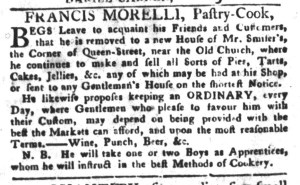
South-Carolina Gazette and Country Journal (April 20, 1773).

“He likewise proposes keeping an ORDINARY, every Day.”

When Francis Morelli, a pastry cook, moved to a new location in the spring of 1773, he informed “his Friends and Customers” in Charleston with an advertisement in the South-Carolina. Gazette and Country Journal.  He assured them that he continued to offer the same services, baking “all Sorts of Pies, Tarts, Cakes, Jellies,” and other pastries that customers could purchase at his shop or have “sent to any Gentleman’s House on the shortest Notice.”

Morelli also took the opportunity to announce that he “proposes keeping an ORDINARY, every Day, where Gentlemen who please to favour him with their Custom, may depend on being provided with the best the Markets can afford.”  He also served “Wine, Punch, Beer,” and other beverages.  The context makes clear to modern readers that Morelli served food.  The Oxford English Dictionary gives additional information about how the term “ordinary” was used in the British Atlantic world in the eighteenth century.

Three related definitions concern foods, including “customary fare; a regular daily meal or allowance of food; (hence, by extension) a fixed portion, an allowance of anything,” and “a meal regularly available at a fixed price in a restaurant, public house, tavern, etc. Formerly also: the company frequenting such a meal, the ‘table.’”  The OED describes the former as “Obsolete” and the latter as “Now chiefly historical.”

The third definition captures the term “ordinary” as used by Morelli in his advertisement: “an inn, public house, tavern, etc., where meals are provided at a fixed price; the room in such a building where this type of meal is provided.”  Similar to the other entries associated with foods and serving meals, this definition is “Now historical and archaic.”  The entry includes more than a dozen examples of the word in use, the earliest dating from 1590, as well as additional notes about its usage.  “In Britain in the 17th-18th centuries,” the entry explains, “the more expensive ordinaries were frequented by men of fashion, and the dinner was usually followed by gambling; hence the term was often used as synonymous with ‘gambling-house.’”  Another note addresses the use of the word in America: “In the U.S., the southern states, esp. Virginia, continued to use ordinary in this sense into the 19th cent., while other states used tavern.”

I plan to file away this advertisement for teaching purposes because it is such a great example of the English language as spoken and written in the eighteenth century sometimes requires “translation” when twenty-first century readers encounter “historical and archaic” terms, even when the words look familiar.  In addition, it presents an opportunity for teaching students how to use the Oxford English Dictionary as a “translation tool.”  I envision an in-class exercise in which I direct students to the entry for “ordinary” but allow them to seek out the relevant definitions (in this case 12a, 12b, and, especially, 12c) on their own before having a discussion about what we all learn from examining the various elements of those definitions provided by the OED.

Slavery Advertisements Published April 20, 1773

The Slavery Adverts 250 Project chronicles the role of newspaper advertising in perpetuating slavery in the era of the American Revolution. The project seeks to reveal the ubiquity of slavery in eighteenth-century life from New England to Georgia by republishing advertisements about enslaved people – for sale as individuals or in groups, wanted to purchase or for hire for short periods, runaways who liberated themselves, and those who were subsequently captured and confined in jails and workhouses – in daily digests on this site as well as in real time via the @SlaveAdverts250 Twitter feed, utilizing twenty-first-century media to stand in for the print media of the eighteenth century.

The project aims to provide modern audiences with a sense of just how often colonizers encountered these advertisements in their daily lives. Enslaved men, women, and children appeared in print somewhere in the colonies almost every single day. Those advertisements served as a constant backdrop for social, cultural, economic, and political life in colonial and revolutionary America. Colonizers who did not purport to own enslaved people were still confronted with slavery as well as invited to maintain the system by purchasing enslaved men, women, and children or assisting in the capture of so-called “runaways” who sought to free themselves from bondage. The frequency of these newspaper advertisements suggests just how embedded slavery was in colonial and revolutionary American culture in everyday interactions beyond the printed page.

These advertisements also testify to the experiences of enslaved men, women, and children, though readers must consider that those experiences have been remediated through descriptions offered by enslavers rather than enslaved people themselves. Often unnamed in the advertisements, enslaved men, women, and children were not invisible or unimportant in early America.

These advertisements appeared in colonial American newspapers 250 years ago today.

Essex Gazette (April 20, 1773).

**********

Essex Gazette (April 20, 1773).

**********

South-Carolina Gazette and Country Journal (April 20, 1773).

**********

South-Carolina Gazette and Country Journal (April 20, 1773).

**********

South-Carolina Gazette and Country Journal (April 20, 1773).

**********

South-Carolina Gazette and Country Journal (April 20, 1773).

**********

South-Carolina Gazette and Country Journal (April 20, 1773).

**********

South-Carolina Gazette and Country Journal (April 20, 1773).

**********

South-Carolina Gazette and Country Journal (April 20, 1773).

**********

South-Carolina Gazette and Country Journal (April 20, 1773).

**********

South-Carolina Gazette and Country Journal (April 20, 1773).

**********

South-Carolina Gazette and Country Journal (April 20, 1773).

**********

South-Carolina Gazette and Country Journal (April 20, 1773).

**********

South-Carolina Gazette and Country Journal (April 20, 1773).

**********

South-Carolina Gazette and Country Journal (April 20, 1773).