What was advertised in a colonial American newspaper 250 years ago today?
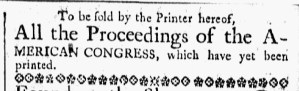
“All the Proceedings of the AMERICAN CONGRESS.”
Among the several advertisements that ran in the December 2, 1774, edition of the Connecticut Gazette, a brief notice announced that “All the Proceedings of the AMERICAN CONGRESS, which have yet been printed” were “sold by the Printer hereof.” That expanded the options that readers had for learning more about the meetings held by the First Continental Congress in Philadelphia from September 5 through October 26. The Connecticut Gazette and other newspapers provided coverage. In addition, printers throughout the colonies began publishing, advertising, and selling Extracts from the Votes and Proceedings of the American Continental Congress shortly after delegates concluded their business. Within a month, William Bradford and Thomas Bradford advertised a “JOURNAL OF THE PROCEEDINGS OF THE CONGRESS,” an even more complete account to keep colonizers informed about current events.
Timothy Green, the printer of the Connecticut Gazette, was among the printers who produced a local edition of the Extracts, yet when he advertised “All the Proceedings … which have yet been printed” he did not refer to a volume from his own press. Although printers far and wide quickly created and marketed local editions of the Extracts, only a couple opted to print the more extensive Journal. The Bradfords advertised their Philadelphia edition. Hugh Gaine, the printer of the New-York Gazette and Weekly Mercury, printed the only other edition. Green likely sold Gaine’s edition at his printing office in New Haven, given the proximity of that town to New York, though the Bradfords could have dispatched copies via a ship bound from Philadelphia to New England. No matter which printer supplied Green with copies of the Proceedings, he advertised the journal of the meetings of the First Continental Congress to readers in Connecticut a little over a week after the Bradfords first promoted their edition in the Pennsylvania Journal. He did so the day after the Continental Association, a nonimportation pact intended to unite the colonies in resisting the Coercive Acts, went into effect. As readers made decisions about what they would buy and sell, Green presented them with another option for learning about the political principles behind the Continental Association and the other actions taken by the First Continental Congress.