December 31

What was advertised in a revolutionary American newspaper 250 years ago this week?

Connecticut Journal (December 27, 1775).

“He will publish No. I. of a News-Paper … THE NEW-YORK PACKET; OR THE AMERICAN ADVERTISER.”

The American Revolution resulted in an explosion of print.  The disruptions of the war led to the demise of some newspapers, but others continued, joined by new publications during the war and, especially, even more newspapers after the war ended.  The major port cities had one or more newspapers before the Revolutionary War.  Many minor ports also had a newspaper.  Once the new nation achieved independence, printers commenced publishing newspapers in many more towns.  Thoughtful citizenship depended in part on the widespread dissemination of news.  Samuel Loudon’s New York Packet was part of that story.

In December 1775, Loudon announced that he “will publish No. I. of a News-paper, (To be continued weekly)” on Thursday, January 4.  He initially advertised in other newspapers printed in New York, but by the end of the month others carried his proposals, including the Connecticut Journal, published in New Haven, and the Pennsylvania Gazette, published in Philadelphia.  Newspapers circulated far beyond their places of publication.  Printers wanted them to supply content for their own newspapers.  The proprietors of coffeehouses and taverns acquired them for their patrons.  Merchants used them for updates about both commerce and politics.  Loudon had a reasonable expectation of attracting subscribers beyond New York.  A nota bene at the end of his advertisement in the Connecticut Journal noted that “Subscriptions [were] taken by the Printers, and all the Post Riders,” a network of local agents that assisted in distributing Loudon’s newspaper.

Pennsylvania Gazette (December 27, 1775).

To entice potential subscribers, Loudon explained that he “is encouraged to undertake this arduous work by the advice and promised literary assistance of a numerous circle of warm friends to our (at present much distressed) country.”  That signaled to readers that Loudon supported the American cause.  It also offered assurances that he had the means to acquire sufficient content to publish a weekly newspaper.  To that end, Loudon pledged “to do everything in his power to render it a complete and accurate NEWS-PAPER, that the Public may thereby receive the earliest intelligence of the state of our public affairs, and of the several interesting occurrences which may occasionally happen whether at home or abroad.”  In the spirit of newspaper providing the first draft of history, the printer declared that he “flatters himself that the NEW YORK PACKET, will influence every discerner of real merit, who may encourage the work, to preserve it in volumes, as a faithful Chronicle of our own time.”

In addition to expressing such ideals, Loudon also tended to the business aspects of establishing a newspaper.  He reported that he “already possessed himself of a neat and sizeable set of TYPES … together with every other necessary for carrying on a splendid News Paper.”  Soon enough, “the best of hands shall be procured to perform the mechanical part.”  Subscribers could expect the New York Packet “will be printed … on a large Paper, of a good Quality, and equal in Size to the other News-Papers published in this City.”  Subscriptions cost twelve shillings per year.  Loudon also solicited advertisements, indicating that they “will be inserted at the usual Price of Five Shillings, when of a moderate Length, and continued Four Weeks.”  As was the practice in other printing offices, “longer Advertisements to be charged accordingly.”

Loudon did indeed launch the New York Packet on January 4, 1776.  It lasted only eight months in New York, suspended after the August 29 edition, as Clarence S. Brigham explains, “immediately prior to the entry of the British into New York.  Loudon re-established the paper at Fishkill in January, 1777, and at the close of the War returned to New York.”[1]  Without changing the volume numbering, he continued publishing the New York Packet from November 13, 1783, through January 26, 1792.  By then, Loudon published the newspaper three times a week, part of that explosion of print that occurred during the era of the American Revolution.  Shortly after closing the New York Packet, Loudon and his son, Samuel, established a daily newspaper, The Diary; or Loudon’s Register.  Unfortunately, the issues of the New York Packet published in 1776 have not been digitized for greater access, though the run for 1783 through 1792 is available via Readex’s America’s Historical Newspapers.  That means that advertisements and other content from that newspaper will not be featured in the Adverts 250 Project, its story confined to the subscription proposals that ran in other newspapers.

**********

[1] Clarence S. Brigham, History and Bibliography of American Newspapers, 1690-1820 (Worcester, Massachusetts: American Antiquarian Society, 1947), 675.
December 30

What was advertised in a revolutionary American newspaper 250 years ago today?

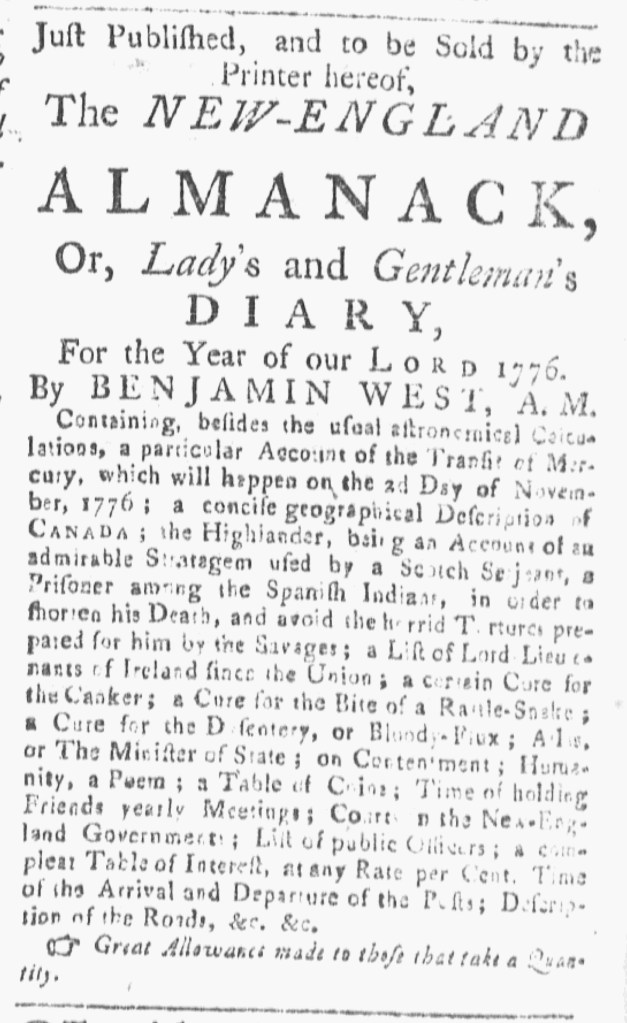
Providence Gazette (December 30, 1775).

Great Allowance made to those that take a Quantity.”

The collaboration between John Carter, the printer of the Providence Gazette, and Benjamin West, an astronomer and mathematician, continued for another year.  An advertisement in the final issue of the Providence Gazette for 1775 alerted readers that the “NEW-ENGLAND ALMANACK, Or, Lady’s and Gentleman’s DIARY, For the Year of our LORD 1776” by Benjamin West was “Just Published, and to be Sold by the Printer hereof.”  At the end of the advertisement, a manicule directed attention to a note that informed shopkeepers and others of a “Great Allowance made to those that take a Quantity.”  In other words, Carter offered steep discounts to retailers who purchased a significant number of copies to sell to their own customers.  That pricing scheme allowed them to turn a profit by setting prices that competed with customers acquiring the almanac at the printing office.

To entice customers of every sort, Carter provided an overview of the contents of the almanac.  In addition to the “usual astronomical Calculations,” it included “a particular Account of the Transit of Mercury, which will happen on the 2d Day of November, 1776.”  Carter stoked anticipation for that event, making it even more appealing by providing those who purchased the almanac detailed information to help them understand it.  The almanac also contained useful reference material, including “a Table of Coins, Time of holding Friends yearly Meetings; Courts in the New-England Government; List of public Officers; a compleat Table of Interest, at any Rate per Cent. Time of the Arrival and Departure of the Posts; [and] Description of the Roads.”  The almanac also served as a medical manual with several remedies, such as “a certain Cure for the Canker, a Cure for the Bite of a Rattle-Snake; [and] a Cure for the Dysentery, or Bloody-Flux.”  In addition to all that, the almanac had items selected to entertain or to educate readers, including a short essay “on Contentment,” “Humanity, a Poem,” and “a concise geographical Description of CANADA.”  That last item may have been of particular interest given the American invasion of Canada in hopes of winning support for the American cause.  Despite capturing Montreal in November, the attack on Quebec City failed in late December.  American forces withdrew.  The “concise geographical Description of CANADA” would not serve the intended purpose once word arrived in New England, though readers could consult it to supplement reports they read in the Providence Gazette and heard from others.  Overall, Carter aimed to convince prospective customers that this almanac has an array of features that merited selecting it for use throughout the new year.

Slavery Advertisements Published December 30, 1775

GUEST CURATOR: Massimo Sgambati

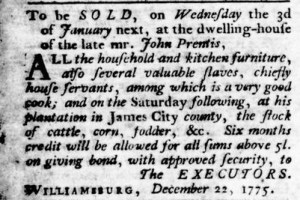
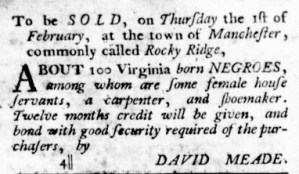
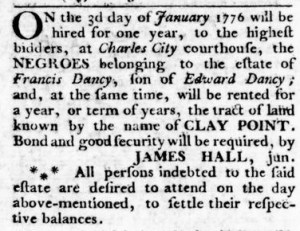
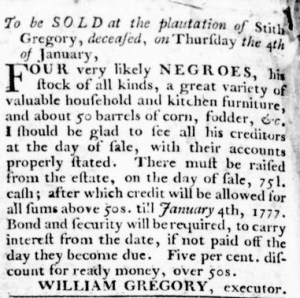
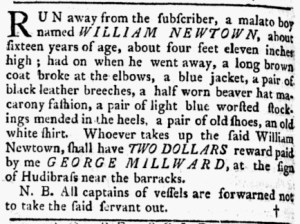
The Slavery Adverts 250 Project chronicles the role of newspaper advertising in perpetuating slavery in the era of the American Revolution. The project seeks to reveal the ubiquity of slavery in eighteenth-century life from New England to Georgia by republishing advertisements about enslaved people – for sale as individuals or in groups, wanted to purchase or for hire for short periods, runaways who liberated themselves, and those who were subsequently captured and confined in jails and workhouses – in daily digests on this site as well as in real time via the @SlaveAdverts250 Twitter feed, utilizing twenty-first-century media to stand in for the print media of the eighteenth century.

The project aims to provide modern audiences with a sense of just how often colonizers encountered these advertisements in their daily lives. Enslaved men, women, and children appeared in print somewhere in the colonies almost every single day. Those advertisements served as a constant backdrop for social, cultural, economic, and political life in colonial and revolutionary America. Colonizers who did not purport to own enslaved people were still confronted with slavery as well as invited to maintain the system by purchasing enslaved men, women, and children or assisting in the capture of so-called “runaways” who sought to free themselves from bondage. The frequency of these newspaper advertisements suggests just how embedded slavery was in colonial and revolutionary American culture in everyday interactions beyond the printed page.

These advertisements also testify to the experiences of enslaved men, women, and children, though readers must consider that those experiences have been remediated through descriptions offered by enslavers rather than enslaved people themselves. Often unnamed in the advertisements, enslaved men, women, and children were not invisible or unimportant in early America.

From compiling an archive of digitized eighteenth-century newspapers to identifying advertisements about enslaved men, women, and children in those newspapers to preparing images of each advertisement to posting this daily digest, Massimo Sgambati served as guest curator for this entry. He completed this work as part of the Summer Scholars Program, funded by a fellowship from the D’Amour College of Liberal Arts and Sciences at Assumption University in Worcester, Massachusetts, in Summer 2025.

These advertisements appeared in colonial American newspapers 250 years ago today.

Pennsylvania Ledger (December 30, 1775)

**********

Providence Gazette (December 30, 1775)

**********

Virginia Gazette [Dixon and Hunter] (December 30, 1775)

**********

Virginia Gazette [Dixon and Hunter] (December 30, 1775)

**********

Virginia Gazette [Dixon and Hunter] (December 30, 1775)

**********

Virginia Gazette [Dixon and Hunter] (December 30, 1775)

**********

Virginia Gazette [Dixon and Hunter] (December 30, 1775)

**********

Virginia Gazette [Dixon and Hunter] (December 30, 1775)

**********

Virginia Gazette [Dixon and Hunter] (December 30, 1775)

**********

Virginia Gazette [Dixon and Hunter] (December 30, 1775)

December 29

What was advertised in a revolutionary American newspaper 250 years ago today?

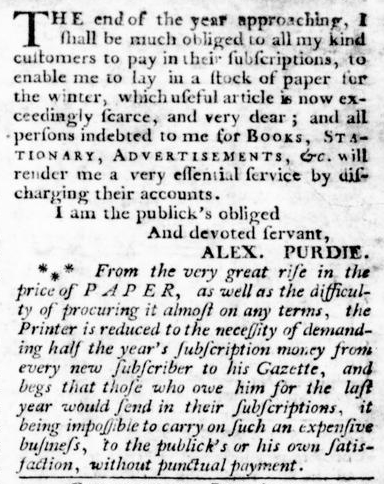
Virginia Gazette [Purdie] (December 29, 1775).

“All persons indebted to me for BOOKS, STATIONARY, ADVERTISEMENTS …”

As 1775 drew to a close, Alexander Purdie placed a notice in his own Virginia Gazette to tend to the business of running that newspaper.  A year earlier, he and his former partner, John Dixon, ended their partnership.  Dixon took a new partner, William Hunter, and continued printing the Virginia Gazette that he and Purdie had produced together for the last nine years.  Purdie immediately announced that he would commence printing a newspaper, that one also named the Virginia Gazette.  John Pinkney printed a third Virginia Gazette in Williamsburg.

Purdie’s experience and reputation apparently earned him enough customers to make his Virginia Gazette a viable enterprise, though he had to call on them to do their part by paying for the goods and services they purchased on credit.  “The end of the year approaching,” the printer explained, “I shall be much obliged to all my kind customers to pay in their subscriptions, to enable me to lay in a stock of paper for the winter, which useful article is now exceedingly scarce, and very dear.”  A variety of factors contributed to the scarcity of paper, including disruptions in trade with England due to the Continental Association and the outbreak of hostilities at Lexington and Concord in April.

Purdie did not call on subscribers alone to settle accounts.  Instead, he declared that “all persons indebted to me for BOOKS, STATIONARY, ADVERTISEMENTS, &c. will render me a very essential service by discharging their accounts.”  Yet, he placed the greatest emphasis on subscribers, adding a note that underscored the price and scarcity of paper.  “From the very great rise in the price of PAPER, as well as the difficulty of procuring it almost on any terms,” he proclaimed, “the Printer is reduced to the necessity of demanding half the year’s subscription money from every new subscriber to his Gazette.”  Such instructions deviated from the standard narrative about how early American printers ran their businesses.

Historians have often asserted that printers extended credit for subscriptions while requiring advertisers to pay in advance, recognizing advertising as the more significant revenue stream.  Throughout the colonies, many printers did frequent place notices asking, cajoling, and even threatening legal action in their effort to get subscribers to pay.  However, many also specified that subscribers were supposed to pay for half the year “upon entering.”  Difficult times forced Purdie to make that a condition for new subscribers.  He also seems to have extended credit for advertisements, though his notice did not make clear whether he meant newspaper notices or job printing (like handbills and broadsides) or both.  Even as printers followed standard practices, how they actually applied them varied from printing office to printing office.

Slavery Advertisements Published December 29, 1775

GUEST CURATOR: Massimo Sgambati

The Slavery Adverts 250 Project chronicles the role of newspaper advertising in perpetuating slavery in the era of the American Revolution. The project seeks to reveal the ubiquity of slavery in eighteenth-century life from New England to Georgia by republishing advertisements about enslaved people – for sale as individuals or in groups, wanted to purchase or for hire for short periods, runaways who liberated themselves, and those who were subsequently captured and confined in jails and workhouses – in daily digests on this site as well as in real time via the @SlaveAdverts250 Twitter feed, utilizing twenty-first-century media to stand in for the print media of the eighteenth century.

The project aims to provide modern audiences with a sense of just how often colonizers encountered these advertisements in their daily lives. Enslaved men, women, and children appeared in print somewhere in the colonies almost every single day. Those advertisements served as a constant backdrop for social, cultural, economic, and political life in colonial and revolutionary America. Colonizers who did not purport to own enslaved people were still confronted with slavery as well as invited to maintain the system by purchasing enslaved men, women, and children or assisting in the capture of so-called “runaways” who sought to free themselves from bondage. The frequency of these newspaper advertisements suggests just how embedded slavery was in colonial and revolutionary American culture in everyday interactions beyond the printed page.

These advertisements also testify to the experiences of enslaved men, women, and children, though readers must consider that those experiences have been remediated through descriptions offered by enslavers rather than enslaved people themselves. Often unnamed in the advertisements, enslaved men, women, and children were not invisible or unimportant in early America.

From compiling an archive of digitized eighteenth-century newspapers to identifying advertisements about enslaved men, women, and children in those newspapers to preparing images of each advertisement to posting this daily digest, Massimo Sgambati served as guest curator for this entry. He completed this work as part of the Summer Scholars Program, funded by a fellowship from the D’Amour College of Liberal Arts and Sciences at Assumption University in Worcester, Massachusetts, in Summer 2025.

These advertisements appeared in colonial American newspapers 250 years ago today.

Virginia Gazette [Purdie] (December 29, 1775)

**********

Virginia Gazette [Purdie] (December 29, 1775)

**********

Virginia Gazette [Purdie] (December 29, 1775)

**********

Virginia Gazette [Purdie] (December 29, 1775)

**********

Virginia Gazette [Purdie] (December 29, 1775)

**********

Virginia Gazette [Purdie] (December 29, 1775)

December 28

What was advertised in a revolutionary American newspaper 250 years ago today?

New-England Chronicle (December 28, 1775).

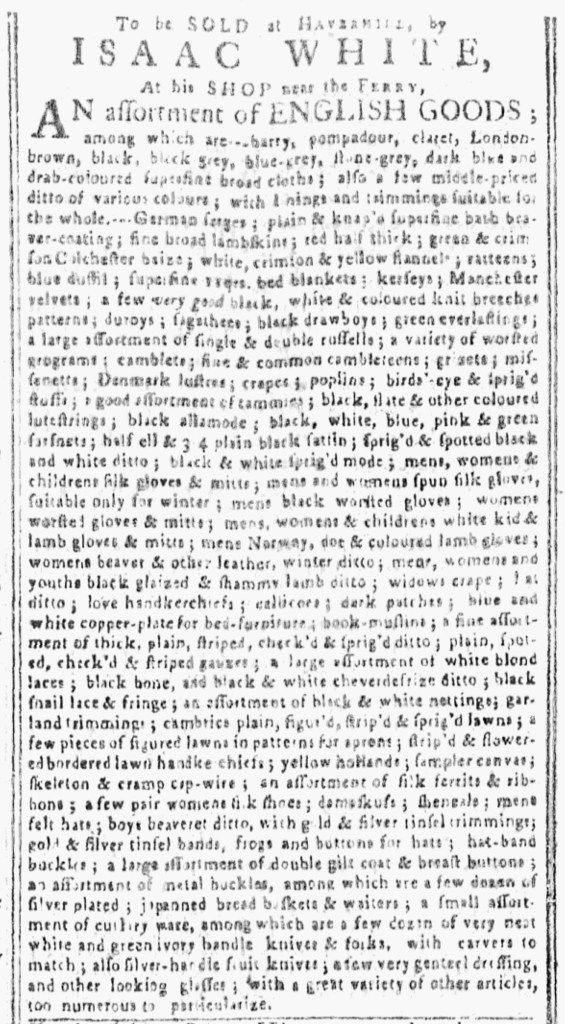
“AN assortment of ENGLISH GOODS … too numerous to particularize.”

Isaac White placed an advertisement for an “assortment of ENGLISH GOODS” available at “his SHOP near the FERRY” in Haverhill, Massachusetts, in the December 28, 1775, edition of the New-England Chronicle.  Despite the outbreak of hostilities at Lexington and Concord eight months earlier and the Continental Association remaining in effect, his advertisement looked much like those that so frequently appeared in American newspapers at times when colonizers did not attempt to use nonimportation agreements as political leverage in their contest with Parliament.  White listed dozens of items, including many varieties and colors of textiles, ribbons, “a large assortment of double gilt coat & breast buttons,” “a few very genteel dressing, and other looking glasses,” and “a small assortment of cutlery ware, among which are a few dozen of very neat white and green ivory handle knives & forks, with carvers to match.”  As if that was not enough, White concluded his catalog with a promise of “a great variety of other articles, too numerous to particularize.”

The shopkeeper did not mention when he acquired his merchandise, whether all those items arrived in the colonies before the Continental Association went into effect, yet he did rely on a familiar marketing strategy by presenting readers with an array of choices and inviting them to imagine themselves visiting his shop, examining his inventory, selecting the goods they desired, and displaying their style and taste to others after they made their purchases.  Consumption certainly had political dimensions during the imperial crisis, but even after the Revolutionary War began habits that had developed (and that advertisers like White had helped in cultivating) did not easily fade.  In the same issue of the New-England Chronicle, Martin Bicker ran an advertisement about a “fresh supply” of “ENGLISH GOODS … just received from New-York and Philadelphia … now selling off at his store in Cambridge.”  Though not as extensive as White’s notice, Bicker’s advertisement listed several kinds of textiles and handkerchiefs.  It concluded with “&c. &c. &c.”  Repeating the common abbreviation for et cetera made the same promise of even more items as White’s assertions about “a great variety of other articles, too numerous to particularize.”  In addition, Bicker declared, “Those that intend to purchase must speedily apply, otherwise they will be disappointed.”  He expected to do brisk business.

That colonizers continued consuming during the Revolutionary War does not necessarily merit attention.  After all, people needed goods.  Then as now, warfare disrupted commerce but did not eliminate it.  Yet the advertisements placed by White and Bicker did not suggest that they served customers who merely sought to purchase necessities.  Instead, they continued to cater to the desires of consumers who continued to shop for many of the reasons they did before the war began.  Some may have had a new purpose, seeking distractions from current events.  How readers responded, these advertisements do not reveal, yet they do indicate that White and Bicker saw opportunities for business as usual.

Slavery Advertisements Published December 28, 1775

GUEST CURATOR: Massimo Sgambati

The Slavery Adverts 250 Project chronicles the role of newspaper advertising in perpetuating slavery in the era of the American Revolution. The project seeks to reveal the ubiquity of slavery in eighteenth-century life from New England to Georgia by republishing advertisements about enslaved people – for sale as individuals or in groups, wanted to purchase or for hire for short periods, runaways who liberated themselves, and those who were subsequently captured and confined in jails and workhouses – in daily digests on this site as well as in real time via the @SlaveAdverts250 Twitter feed, utilizing twenty-first-century media to stand in for the print media of the eighteenth century.

The project aims to provide modern audiences with a sense of just how often colonizers encountered these advertisements in their daily lives. Enslaved men, women, and children appeared in print somewhere in the colonies almost every single day. Those advertisements served as a constant backdrop for social, cultural, economic, and political life in colonial and revolutionary America. Colonizers who did not purport to own enslaved people were still confronted with slavery as well as invited to maintain the system by purchasing enslaved men, women, and children or assisting in the capture of so-called “runaways” who sought to free themselves from bondage. The frequency of these newspaper advertisements suggests just how embedded slavery was in colonial and revolutionary American culture in everyday interactions beyond the printed page.

These advertisements also testify to the experiences of enslaved men, women, and children, though readers must consider that those experiences have been remediated through descriptions offered by enslavers rather than enslaved people themselves. Often unnamed in the advertisements, enslaved men, women, and children were not invisible or unimportant in early America.

From compiling an archive of digitized eighteenth-century newspapers to identifying advertisements about enslaved men, women, and children in those newspapers to preparing images of each advertisement to posting this daily digest, Massimo Sgambati served as guest curator for this entry. He completed this work as part of the Summer Scholars Program, funded by a fellowship from the D’Amour College of Liberal Arts and Sciences at Assumption University in Worcester, Massachusetts, in Summer 2025.

These advertisements appeared in colonial American newspapers 250 years ago today.

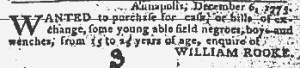
Maryland Gazette (December 28, 1775)

**********

Maryland Gazette (December 28, 1775)

**********

Maryland Gazette (December 28, 1775)

**********

Maryland Gazette (December 28, 1775)

**********

Maryland Gazette (December 28, 1775)

**********

Maryland Gazette (December 28, 1775)

**********

Maryland Gazette (December 28, 1775)

**********

Maryland Gazette (December 28, 1775)

**********

New-England Chronicle (December 28, 1775)

**********

New-England Chronicle (December 28, 1775)

**********

New-York Journal (December 28, 1775)

December 27

What was advertised in a revolutionary American newspaper 250 years ago today?

Pennsylvania Gazette (December 27, 1775).

“I DO hereby give Information / A BULL broke into my Plantation.”

A stray bull that came to a farm was a nuisance, at best, and placing a newspaper advertisement in hopes of identifying the owner was even more of an inconvenience, yet Thomas Paxson of Middletown in Bucks County, Pennsylvania, decided to have some fun with it.  Rather than write a standard notice, the type that appeared in newspapers throughout the colonies, he composed half a dozen rhyming couplets:

I DO hereby give Information,
A BULL broke into my Plantation,
About three Months before this Date,
Whose natural Marks I shall relate;
His Face is white, his Sides are black,
With a white List along his Back;
I think the strange mischievous Beast,
Must be three Years of Age at least;
And if the Owner does appear,
Before the last Day of the Year,
And prove his Right and Charges pay,
Then he may drive his Beast away.

Though certainly not the belles lettres popular among the better sorts in the eighteenth century, the poem likely drew the attention of readers from various backgrounds as they perused the December 27, 1775, edition of the Pennsylvania Gazette.  The compositor indented each line of the poem, creating white space that differentiated Paxson’s advertisement from any other notices or news in that issue.  The format likely inspired readers to give the advertisement an initial glance out of curiosity, then the novelty of the rhymes may have encouraged them to spend just a moment reading through it.

News covered elsewhere in that issue included updates about the Revolutionary War from Massachusetts, New York, Maryland, and Virginia as well as a smattering of news from Pennsylvania.  Some readers may have appreciated Paxson’s creativity and the moment of levity that he introduced among more serious news.  Unlike other newspapers that regularly printed a “Poets Corner” on the final page, the Pennsylvania Gazette did not have that feature.  When he paid to insert his advertisement, Paxson made an editorial decision to remedy it, at least for one issue.

Slavery Advertisements Published December 27, 1775

GUEST CURATOR: Massimo Sgambati

The Slavery Adverts 250 Project chronicles the role of newspaper advertising in perpetuating slavery in the era of the American Revolution. The project seeks to reveal the ubiquity of slavery in eighteenth-century life from New England to Georgia by republishing advertisements about enslaved people – for sale as individuals or in groups, wanted to purchase or for hire for short periods, runaways who liberated themselves, and those who were subsequently captured and confined in jails and workhouses – in daily digests on this site as well as in real time via the @SlaveAdverts250 Twitter feed, utilizing twenty-first-century media to stand in for the print media of the eighteenth century.

The project aims to provide modern audiences with a sense of just how often colonizers encountered these advertisements in their daily lives. Enslaved men, women, and children appeared in print somewhere in the colonies almost every single day. Those advertisements served as a constant backdrop for social, cultural, economic, and political life in colonial and revolutionary America. Colonizers who did not purport to own enslaved people were still confronted with slavery as well as invited to maintain the system by purchasing enslaved men, women, and children or assisting in the capture of so-called “runaways” who sought to free themselves from bondage. The frequency of these newspaper advertisements suggests just how embedded slavery was in colonial and revolutionary American culture in everyday interactions beyond the printed page.

These advertisements also testify to the experiences of enslaved men, women, and children, though readers must consider that those experiences have been remediated through descriptions offered by enslavers rather than enslaved people themselves. Often unnamed in the advertisements, enslaved men, women, and children were not invisible or unimportant in early America.

From compiling an archive of digitized eighteenth-century newspapers to identifying advertisements about enslaved men, women, and children in those newspapers to preparing images of each advertisement to posting this daily digest, Massimo Sgambati served as guest curator for this entry. He completed this work as part of the Summer Scholars Program, funded by a fellowship from the D’Amour College of Liberal Arts and Sciences at Assumption University in Worcester, Massachusetts, in Summer 2025.

These advertisements appeared in colonial American newspapers 250 years ago today.

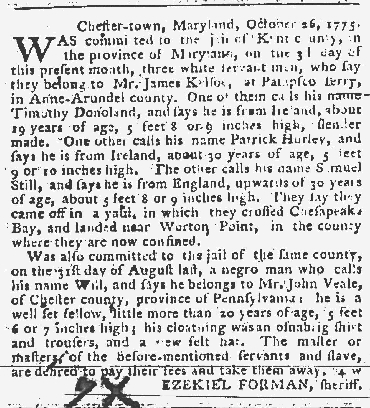
Connecticut Journal (December 27, 1775)

**********

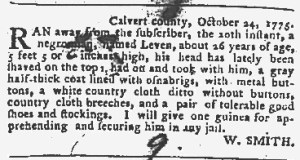
Maryland Journal (December 27, 1775).

**********

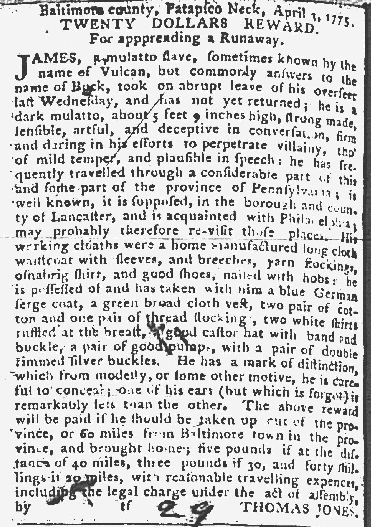
Maryland Journal (December 27, 1775)

December 26

Who was the subject of an advertisement in a revolutionary American newspaper 250 years ago today?

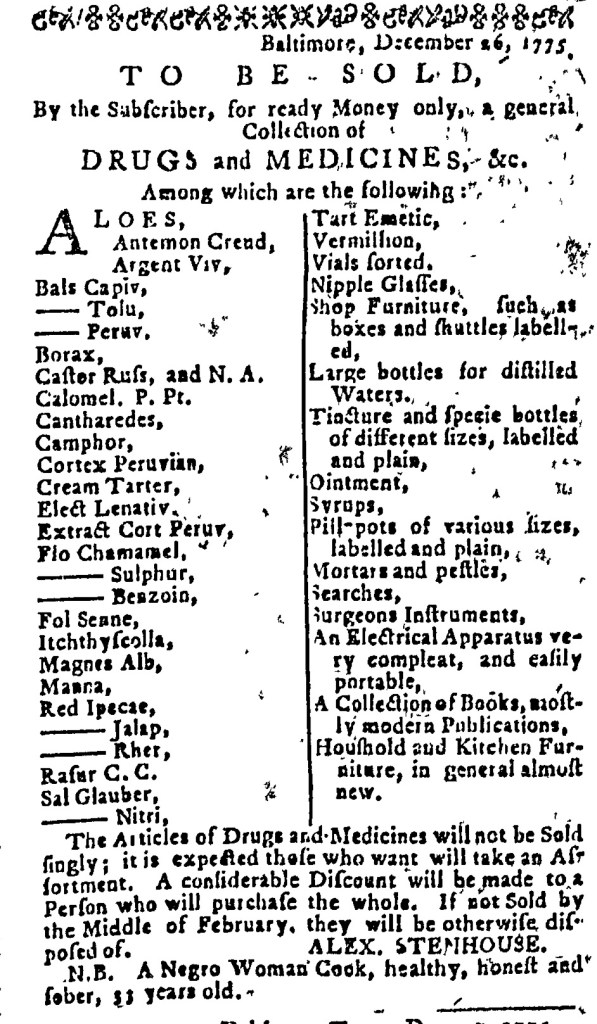
Dunlap’s Maryland Gazette (December 26, 1775).

“N.B. A Negroe woman Cook, healthy honest and sober, 33 years old.”

Alexander Stenhouse apparently wished to discontinue his medical supply business in Baltimore.  In the final week of December 1775, he placed advertisements in both Dunlap’s Maryland Gazette and the Maryland Journal that listed a “general Collection of DRUGS and MEDICINES” available for sale.  He added vials, “Large bottles for Distilled Waters,” “Pill pots of various sizes, labelled and plain,” “Mortars and pestles,” “Surgeons Instruments,” and other medical equipment.  He even included “Shop Furniture,” suggesting that he no longer needed it because he would no longer pursue that trade.  In addition, he declared that the “Drugs and Medicines will not be sold singly, so it is expected those who want will take an assortment.”  To make the offer even more attractive, Stenhouse promised a “considerable discount … to a person who will purchase the whole.”  Perhaps Stenhouse even intended to leave Baltimore.  His inventory concluded with a “Collection of Books, mostly modern publications,” and “Houshold and kitchen furniture, in general almost new.”

Stenhouse offered more than just the contents of his shop and home for sale.  In a nota bene that followed his signature, he described a “Negroe woman Cook, healthy honest and sober, 33 years old.”  The sale of that woman whose name was once known testifies to the widespread use of the early American press to perpetuate slavery and the slave trade.  At a glance, the phrases “TO BE SOLD” and “DRUGS and MEDICINES,” dominated Stenhouse’s advertisement.  The list of items for sale, divided into two columns, unlike any of the other in either newspaper, likely caught readers’ eyes as well.  Those aspects of Stenhouse’s advertisement overshadowed but did not eclipse the portion that offered an enslaved woman for sale.  The format did not indicate that Stenhouse felt any shame or embarrassment about selling a “Negroe woman Cook” and wanted to downplay it; instead, the format demonstrated just how casually enslavers incorporated such transactions into everyday advertising and routine business.  “N.B.” or nota bene, after all, meant “take note.”  Stenhouse wished for readers to “take note” that he wished to sell an enslaved woman as he “disposed of” the contents of his shop and home.