What was advertised in a revolutionary American newspaper 250 years ago today?
New-York Gazette and Weekly Mercury (September 2, 1776).
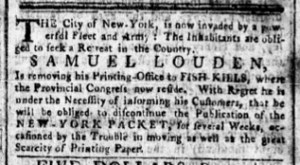
“THE City of New-York, is now invaded by a powerful Fleet and Army.”
Samuel Loudon summarized recent events in the first line of his advertisement in the September 2, 1776, edition of the New-York Gazette and Weekly Mercury. Residents of the city and nearby towns already knew that the British had captured New York. Most other readers likely learned about the British occupation of New York before reading Loudon’s advertisement, probably hearing about it before reading about it in any newspaper.
Still, delivering the news was an important precursor for what Loudon needed to share with subscribers to his newspaper, the New York Packet. Due to the occupation, the “Inhabitants [of New York] are obliged to seek a Retreat in the Country.” Among those who sight refuge in the countryside, Loudon “remov[ed] his Printing-Office to FISH KILLS, where the Provincial Congress now reside.” That location offered safety as well as access to news about the state government, once he managed to open a printing office there. “With regret,” Loudon continued, “he is under the Necessity of Informing his Customers, that he will be obliged to discontinue the Publication of the NEW-YORK PACKET, for several Weeks, occasioned. By the Trouble of moving as well as the great Scarcity of Printing Paper.”
Loudon had been publishing the New York Packet for only eight months before circumstances caused him to retreat to Fishkill. He distributed the first issue on January 4, 1776, and suspended it with the August 29 edition, just before the British entered the city. It took longer than he anticipated to resume publication. According to Clarence S. Brigham, “The first Fishkill issue was undoubtedly that of Jan. 16, 1777, vol. 1, no. 36, but the earliest located is that of Feb. 6, 1777, vol. 1, no. 39.”[1] Loudon continued the volume and issue numbering uninterrupted despite the suspension and relocation. The British occupied New York throughout the remainder of the war. Loudon remained in Fishkill, publishing his newspaper there until the end of August 1783. He then returned to New York and continued the newspaper without changing the volume numbering in November 1783. The war disrupted publication of the New York Packet, yet Loudon persevered. He managed to continue supplying subscribers and other readers with news (and advertisements) despite the challenges of “removing his Printing-Office” beyond occupied New York.
**********
[1] Clarence S. Brigham, History and Bibliography of American Newspapers, 1690-1820 (Worcester, Massachusetts: American Antiquarian Society, 1947), 570.
Like other early American printers, Samuel Loudon cultivated multiple revenue streams. He sold subscription to the New York Packet and collected fees for the advertisements in that newspaper. In addition, he sold a variety of books, pamphlets, and almanacs, only some of them produced in his printing office, as well as stationery and writing supplies. Loudon also operated a circulating library, a venture that only a few printers and booksellers incorporated into their portfolios. Clubs or corporations formed for the purpose of operating libraries oversaw most of those institutions established before and during the era of the American Revolution.
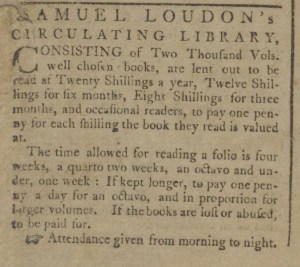
Loudon promoted his circulating library “CONSISTING of Two Thousand Vols. [of] well chosen books” in the August 15, 1776, edition of the New York Packet. Unlike modern public libraries that allow access to books and other materials for free, circulating libraries charged subscription fees to readers. Loudon offered discounts for those who subscribed for longer periods. A three-month subscription cost eight shillings while a six-month subscription cost twelve shillings. Subscribers gained access for an entire year for twenty shillings, a significant savings over purchasing consecutive subscriptions for shorter periods. Rather than completely exclude readers who did not purchase subscriptions, Loudon allowed “occasional readers” to borrow books upon paying a fee of “one penny for each shilling the book they read is valued at.” Readers interested in a particular title could peruse it for a lower price without having to make a larger investment in a subscription.
Loudon established some interesting guidelines for how long subscribers could borrow books, making the determination based on the sizes of the sheets (not to be confused with the length of the book). “The time allowed for reading a folio,” he explained, “is four weeks,” but only two weeks for a quarto and just one week for “an octavo and under.” Subscribers (and occasional readers) who kept their books longer had “to pay one penny a day for an octavo, and in proportion for larger volumes.” Whatever the quirks of this system, it meant that readers could not hoard titles and make them unavailable to other subscriber, at least not without paying penalties for doing so. In addition, borrowers had to pay for books that were “lost or abused.”
“SAMUEL LOUDON’s CIRCULATING LIBRARY” gave residents of New York access to thousands of books without having to purchase them, making them more accessible to many readers. Loudon operated the library as a public service while simultaneously generating revenue to supplement his other ventures as a printer and bookseller.
Who was the subject of an advertisement in a revolutionary American newspaper 250 years ago today?
Maryland Gazette (July 4, 1776).
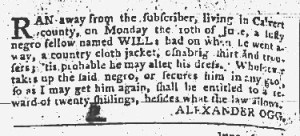
“RUN AWAY … [a] negro fellow named WILL.”
On July 4, 1776, the delegates to the Continental Congress in Philadelphia voted to approve a revised version of a declaration of independence written by Thomas Jefferson, John Adams, Benjamin Franklin, and others appointed for that task. In the 250 years that have passed since that momentous event, the document they approved has become known as the Declaration of Independence and July 4 has been celebrated as the day the colonies, now states, declared their independence from Great Britain. Celebrations and commemorations of that event often overlook other declarations of independence made on July 4, 1776. On that day, American newspapers published more than half a dozen advertisements concerning enslaved people who declared their independence by running away from their enslavers.
Maryland Gazette (July 4, 1776).
The Maryland Gazette, published in Annapolis, carried two such notices. In one, Alexander Ogg of Calvert County offered a reward for the capture and return of Will, a “negro fellow” who liberated himself three weeks earlier on June 10. Ogg described what Will wore when he departed, but he also reported that “‘tis probable he may alter his dress” to avoid detection. In so doing, Ogg acknowledged that Will was clever as well as courageous. In the other advertisement, Anne Gaither of Annapolis sought the return of “a negro fellow named FLANDERS.” She mentioned that he “has been used to go by water,” indicating that he had experience working on boats or ships just like many other enslaved men who lived on or near the Chesapeake Bay. Gaither also reported that Flanders “has no toes,” though she did not elaborate on that detail. Flanders, no doubt, would have told a much more robust story about who he was and what he had experienced if given the opportunity.
New-York Journal (July 4, 1776).
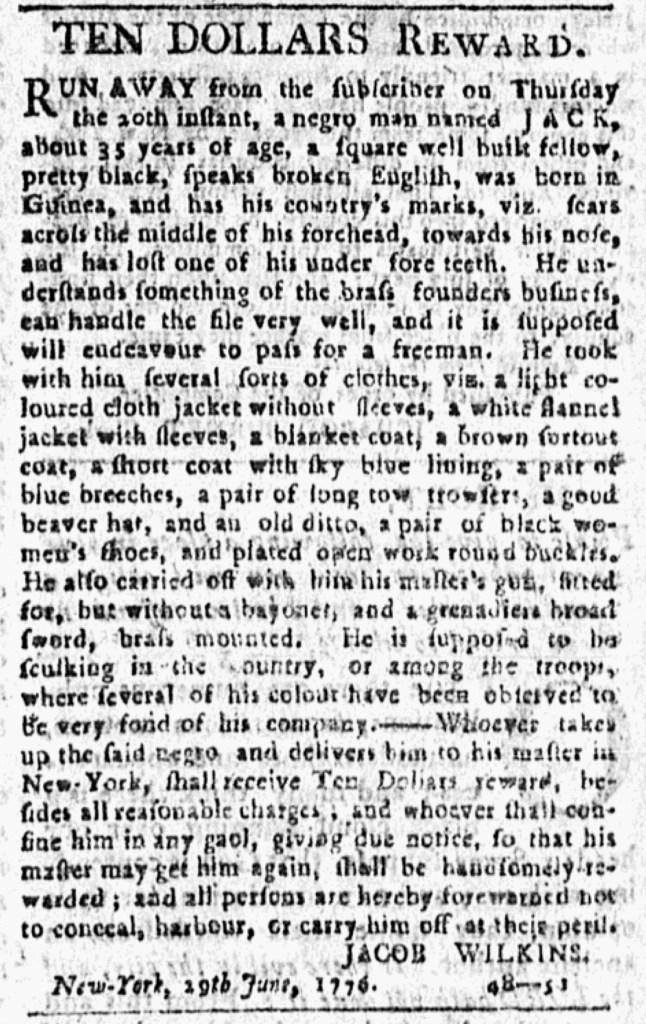
Enslaved people in southern colonies were not the only ones who liberated themselves by running away at the same time that the Continental Congress voted to declare independence. The New-York Journal carried Jacob Wilkins’s advertisement regarding “a negro man named JACK” who liberated himself from his enslaver on June 20. Jack “carried off with him his master’s gun, fitted for, but without a bayonet, and a grenadiers broad sword, brass mounted.” Wilkins suspected that Jack made his way out of the city and was “sculking in the country, or among the troops, where several of his colour have been observed to be very fond of his company.” The many disruptions caused by the war presented opportunities for enslaved people to free themselves by fleeing from their enslavers. To help readers recognize Jack, Wilkins gave his age, “about 35 years,” and mentioned some distinguishing physical characteristics. Having been “born in Guinea,” Jack had “his country’s marks” or ritual scarring “across the middle of his forehead, [and] towards his nose.” At some point, he “lost one of his under fore teeth.” During his enslavement, Jack learned to speak “broken English.” He also developed valuable skills: he “understands something of the brass founders business, [and] can handle the file very well.” Many enslaved people were skilled artisans. Wilkins lamented that Jack “will endeavour to pass for a freeman.” Jack made himself a free man with his decision to escape from Wilkins.
New-York Packet (July 4, 1776).
The New York Packet carried another advertisement, this one regarding “a Negro Man, named BEN,” placed by John Taylor of “New Germantown, Hunterdon county, West Jersey.” Ben liberated himself on June 5 and had evaded capture for a month. Taylor focused primarily on describing Ben and his clothing, noting the young man’s height, age (“twenty-two years old”), and a left leg “considerably larger than the other, with a large scar on the small of said leg.” Ben wore a blue coat, red jacket, black breeches, and “calf skin shoes, [with] a pair of carved silver buckles,” though he also took another coat and jacket, “a fine shirt with ruffles at the bosom, a pair of woollen trowsers, [and] a half worn wool hat” in a bag “marked I.T. near the mouth.” Given a chance to write about himself, Ben certainly would have chosen to a tell a different story than the one that Taylor relayed. If readers detected a young black man carrying a bag with his former enslaver’s initials, Taylor offered a reward for securing him in any jail until he could retrieve him.
Continental Journal (July 4, 1776).
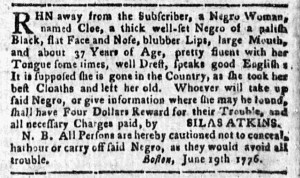
The Continental Journal, published in Boston after the siege of that city ended, carried two advertisements about enslaved people who liberated themselves. Silas Atkins described Cloe, “a Negro Woman” who was “likely gone in the Country, as she took her best Cloaths and left her old.” Atkins gave Cloe’s age (“37 Years’), provided a physical description, and noted that she “speaks good English,” all characteristics that would aid readers in identifying her. Cloe had been gone since the middle of June. Atkins promised that anyone who “will take up said Negro, or give information where she may be found, shall have Four Dollars for their Trouble” as well as any expenses they incurred. In a nota bene, he added a standard warning that appeared in many such advertisements: “All Persons are hereby cautioned not to conceal, harbour or carry off said Negro, as they would avoid all trouble.” The “trouble” would not come from Cloe but rather from legal action undertaken by Atkins.
Continental Journal (July 4, 1776).
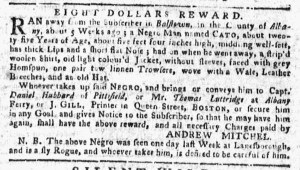
The other advertisement in the Continental Journal concerned “a Negro Man named CATO, about twenty-five Years of Age,” who liberated himself from Andrew Mitchel of “Balstown [Ballston], in the County of Albany, about 5 Weeks ago.” Mitchel described Cato’s features and clothing, but he did not provide other details. He devoted nearly as much space to the network of associates who agreed to aid him by holding Cato until he could retrieve him if a reader managed to capture him. Those seeking the reward could deliver Cato “to Capt. Daniel Hubbard of Pittsfield, [Massachusetts], or Mr. Thomas Luttridge at Albany Ferry, or J. GILL, Printer in Queen Street, BOSTON, or secure him in any Goal [Jail]” and notify Mitchel. In a nota bene, the enslaver reported that Cato “was seen one day last Week at Lanesborough [in western Massachusetts], and is a sly Rogue, and whoever takes him, is desired to be careful of him.” Mitchel meant “sly Rogue” as an insult, not intending to compliment Cato on the ingenuity and perseverance he expected the young Black man to demonstrate in attempting to escape if captured.
New-England Chronicle (July 4, 1776).
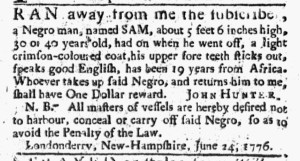
One more advertisement in a newspaper published in Boston, the New-England Chronicle, identified an enslaved man who liberated himself by running away from his enslaver. This one concerned Sam, “a Negro man” who escaped from John Hunter of Londonderry, New Hampshire, in late June. Hunter did not know Sam’s age, estimating that he was “30 or 40 years old,” but he did know that Sam “has been 19 years from Africa” and in that time learned to speak “good English.” Readers might recognize Same from his “upper fore teeth” that stuck out or by the “light crimson-coloured coat” that he wore. Hunter inserted a nota bene with a warning like the one that appeared in Atkins’s advertisement about Cloe: “All masters of vessels are hereby desired not to harbour, conceal or carry off said Negro, so as to avoid the Penalty of the Law.” Hunter included an evocative phrase when he said that Sam “has been 19 years from Africa.” What kind of stories would Sam have told about his own life and his decision to liberate himself after so many years of bondage?
The men who gathered in the Pennsylvania State House (now known as Independence Hall) to declare independence from Great Britain are often called the founders of the nation, yet they were not the only ones who envisioned freedom from oppression. They were members of a founding generation that included soldiers and farmers, women and youth, and many others from diverse backgrounds who contributed to the American cause. Will, Flanders, Jack, Ben, Cloe, Cato, and Sam were all founders as well. They made their own declarations of independence during the era of the American Revolution and their former enslavers published those declarations of independence on July 4, 1776. Will, Flanders, Jack, Ben, Cloe, Cato, and Sam joined countless other enslaved men and women who seized their liberty during the seventeenth, eighteenth, and nineteenth centuries. Those courageous and resilient men and women sought freedom long before the American Revolution and continued seeking freedom long after the American Revolution. Their stories matter and must be told alongside the stories of other founders as we celebrate and commemorate 250 years of independence.
For other stories of enslaved people liberating themselves originally published on July 4 during the era of the American Revolution, see:
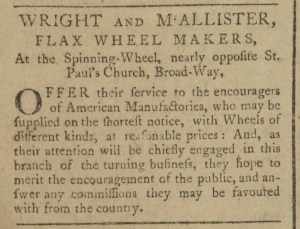
“WRIGHT AND McALLISTER, FLAX WHEEL MAKERS, … OFFER their service to the encouragers of American Manufactories.”
Wright and McAllister, “FLAX WHEEL MAKERS,” marked their location “nearly opposite St. Paul’s Church, Broad-Way,” in New York with a sign depicting a spinning wheel. The placed an advertisement in the June 27, 1776, edition of the New York Packet to “OFFER their service to the encouragers of American Manufactories.” In so doing, they echoed the language that so often appeared in editorials about producing goods in the colonies rather than importing them from Great Britain, in advertisements that promoted such products, and in nonimportation agreements adopted as acts of resistance. The eighth article of the Continental Association, the most significant of the nonimportation agreements, for instance, stated, “That we will, in our several Stations, encourage Frugality, Economy, and Industry; and promote Agriculture, Arts, and the Manufactures of this Country.” That meant producing homespun textiles as alternatives to the array of imported fabrics that dominated newspaper advertisement for imported goods, yet colonizers could not focus solely on the final product. Purchasing and wearing homespun depended on having the equipment necessary for producing it.
Wright and McAllister aimed to do their part in such a worthy endeavor. They made “Wheels of different kinds” that they sold “at reasonable prices.” Under other circumstances they might have described themselves as turners rather than “FLAX WHEEL MAKERS,” but they decided that “their attention will be chiefly engaged in this branch of the turning business” on the eve of the Second Continental Congress declaring independence. They joined other entrepreneurs who marketed American-made equipment for producing textiles, including Robert White and David Poe, who both made spinning wheels, and Fergus McIllroy, who made looms. Given the service that they undertook on behalf of the American cause, Wright and McAllister “hope[d] to merit the encouragement of the public” in New York as well as “answer any commissions they may be favoured with from the county.” In turn, their work would enable others, especially women, to participate in politics through their activities in the marketplace, not only as consumers but also as producers of the thread necessary for producing homespun textiles.
What was advertised in a revolutionary American newspaper 250 years ago today?
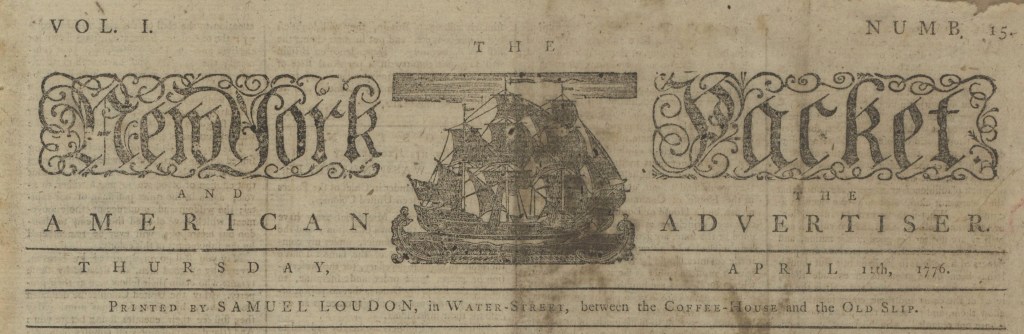
New-York Packet (April 11, 1776).
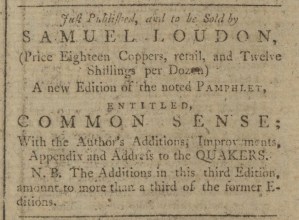
“Just Published … by SAMUEL LOUDON.”
Samuel Loudon launched a new newspaper, the New York Packet, on January 4, 1776. It lasted for about eight months before closing down just before the British occupation of New York. The Adverts 250 Project featured subscription proposals for the newspaper that ran in the Connecticut Journal and the Pennsylvania Gazette on December 27, 1775, and an announcement that Loudon “published the first Number of his News Paper” that ran in the New-York Journal on January 11, 1776. In that latter entry, I stated that “surviving issues have not been digitized for greater access, so advertisements and other content from the New-York Packet will not appear in the Adverts 250 Project.” I have since learned that the New York Packet has indeed been digitized and made available via the Library of Congress’s Chronicling America: Historic American Newspapers. When I discovered it there, I also learned that advertisements referred to the newspaper as the New-York Packet (hyphenating “New-York” like other newspapers published during the era of the American Revolution) yet the elaborate script in the masthead presented it as the New York Packet (without the hyphen).
New-York Packet (April 11, 1776).
Throughout the decade I have been producing the Adverts 250 Project, I have relied on four databases of digitized eighteenth-century American newspapers. Archives of Maryland Online, sponsored by the Maryland State Archives, provides access to issues of the Maryland Gazette published in Annapolis between 1728 and 1839. Colonial Williamsburg provides access to three newspapers, each named the Virginia Gazette, published in Williamsburg between 1736 and 1780. In the 1760s and 1770s, two and sometimes three operated simultaneously. Accessible Archives, now part of History Commons, provides access to several newspapers published in Charleston, including the South-Carolina Gazette, the South-Carolina Gazette and Country Journal, and the South-Carolina and American General Gazette. Readex/Newsbank’s America’s Historical Newspapers & Periodicals provides the most comprehensive access to early American newspapers, incorporating dozens of newspapers published throughout the colonies and new nation in the eighteenth century. That collection, however, does not include the New York Packet. I neglected to consult Chronicling America before declaring that the New York Packet has not been digitized.
Since then, I have acquired digital copies of all the issues of the New York Packet available via Chronicling America, examined them to identify advertisements that belong in the Slavery Adverts 250 Project and special features chronicling advertisements for Thomas Paine’s Common Sense, and made updates and revisions as necessary. As I continue with the Adverts 250 Project, I will cross reference issues of early American newspapers available via Chronicling America with those in the other databases that have made this project possible.
What was advertised in a revolutionary American newspaper 250 years ago today?
New-York Journal (January 11, 1776).
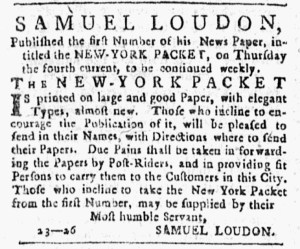
“SAMUEL LOUDON, Published the first Number of his News Paper, intitled the NEW-YORK PACKET.”
After spending several weeks distributing subscription proposals for a new newspaper, the New-York Packet, Samuel Loudon released the first issue on schedule on January 4, 1776. On that day, Loudon’s notice that he planned to establish the newspaper appeared for the fourth and final time in the New-York Journal. A week later, a new advertisement promoting the New-York Packet ran in the New-York Journal. The notation at the end, “23-26” (corresponding to the issue numbers), indicated that Loudon planned for that notice to run for four consecutive weeks as well.
In it, the printer announced that he “Published the first Number of his News Paper … on Thursday the fourth current, to be continued weekly.” He then provided an abbreviated version of the subscription proposal, stating that the New-York Packet “IS printed on large and good Paper, with elegant Types, almost new.” For readers who did not subscribe in time to receive that “first Number,” it was not too late to start a subscription that included the first issue and all subsequent issues. “Those who incline to encourage the Publication of it,” Loudon advised, “will be pleased to send in their Names, with Directions where to send their Papers.” Loudon had disseminated the subscription proposals widely, including in the Connecticut Journal and the Pennsylvania Gazette. He hoped to gain subscribers far beyond the city where he printed the New-York Packet. To that end, he promised that “Due Pains shall be taken in forwarding the Papers by Post-Riders, and in providing fit Persons to carry them to the Customers in this City.” That was a necessary part of satisfying both subscribers and advertisers.
Despite the fanfare around its founding, the New-York Packet lasted only eight months. Loudon suspended the newspaper shortly before the British occupation of New York. Unfortunately, surviving issues have not been digitized for greater access, so advertisements and other content from the New-York Packet will not appear in the Adverts 250 Project, though advertisements about the newspaper inserted in other publications testify to its short run at the beginning of the Revolutionary War.
What was advertised in a revolutionary American newspaper 250 years ago this week?
Connecticut Journal (December 27, 1775).
“He will publish No. I. of a News-Paper … THE NEW-YORK PACKET; OR THE AMERICAN ADVERTISER.”
The American Revolution resulted in an explosion of print. The disruptions of the war led to the demise of some newspapers, but others continued, joined by new publications during the war and, especially, even more newspapers after the war ended. The major port cities had one or more newspapers before the Revolutionary War. Many minor ports also had a newspaper. Once the new nation achieved independence, printers commenced publishing newspapers in many more towns. Thoughtful citizenship depended in part on the widespread dissemination of news. Samuel Loudon’s New York Packet was part of that story.
In December 1775, Loudon announced that he “will publish No. I. of a News-paper, (To be continued weekly)” on Thursday, January 4. He initially advertised in other newspapers printed in New York, but by the end of the month others carried his proposals, including the Connecticut Journal, published in New Haven, and the Pennsylvania Gazette, published in Philadelphia. Newspapers circulated far beyond their places of publication. Printers wanted them to supply content for their own newspapers. The proprietors of coffeehouses and taverns acquired them for their patrons. Merchants used them for updates about both commerce and politics. Loudon had a reasonable expectation of attracting subscribers beyond New York. A nota bene at the end of his advertisement in the Connecticut Journal noted that “Subscriptions [were] taken by the Printers, and all the Post Riders,” a network of local agents that assisted in distributing Loudon’s newspaper.
Pennsylvania Gazette (December 27, 1775).
To entice potential subscribers, Loudon explained that he “is encouraged to undertake this arduous work by the advice and promised literary assistance of a numerous circle of warm friends to our (at present much distressed) country.” That signaled to readers that Loudon supported the American cause. It also offered assurances that he had the means to acquire sufficient content to publish a weekly newspaper. To that end, Loudon pledged “to do everything in his power to render it a complete and accurate NEWS-PAPER, that the Public may thereby receive the earliest intelligence of the state of our public affairs, and of the several interesting occurrences which may occasionally happen whether at home or abroad.” In the spirit of newspaper providing the first draft of history, the printer declared that he “flatters himself that the NEW YORK PACKET, will influence every discerner of real merit, who may encourage the work, to preserve it in volumes, as a faithful Chronicle of our own time.”
In addition to expressing such ideals, Loudon also tended to the business aspects of establishing a newspaper. He reported that he “already possessed himself of a neat and sizeable set of TYPES … together with every other necessary for carrying on a splendid News Paper.” Soon enough, “the best of hands shall be procured to perform the mechanical part.” Subscribers could expect the New York Packet “will be printed … on a large Paper, of a good Quality, and equal in Size to the other News-Papers published in this City.” Subscriptions cost twelve shillings per year. Loudon also solicited advertisements, indicating that they “will be inserted at the usual Price of Five Shillings, when of a moderate Length, and continued Four Weeks.” As was the practice in other printing offices, “longer Advertisements to be charged accordingly.”
Loudon did indeed launch the New York Packet on January 4, 1776. It lasted only eight months in New York, suspended after the August 29 edition, as Clarence S. Brigham explains, “immediately prior to the entry of the British into New York. Loudon re-established the paper at Fishkill in January, 1777, and at the close of the War returned to New York.”[1] Without changing the volume numbering, he continued publishing the New York Packet from November 13, 1783, through January 26, 1792. By then, Loudon published the newspaper three times a week, part of that explosion of print that occurred during the era of the American Revolution. Shortly after closing the New York Packet, Loudon and his son, Samuel, established a daily newspaper, The Diary; or Loudon’s Register. Unfortunately, the issues of the New York Packet published in 1776 have not been digitized for greater access, though the run for 1783 through 1792 is available via Readex’s America’s Historical Newspapers. That means that advertisements and other content from that newspaper will not be featured in the Adverts 250 Project, its story confined to the subscription proposals that ran in other newspapers.
**********
[1] Clarence S. Brigham, History and Bibliography of American Newspapers, 1690-1820 (Worcester, Massachusetts: American Antiquarian Society, 1947), 675.