What was advertised in a revolutionary American newspaper 250 years ago today?
Constitutional Gazette (January 31, 1776).
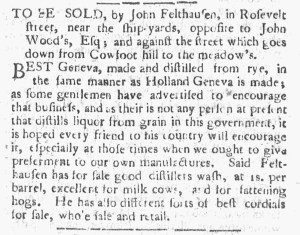
“BEST Geneva, made and distilled from rye.”
Advertisements for consumer goods and services crowded the pages of early American newspaper. Did they work? Unfortunately, that question is difficult to answer. The advertisements reveal what kinds of marketing appeals merchants, shopkeepers, artisans, and other entrepreneurs thought would resonate with consumers and influence them to make purchases, but they rarely indicated how readers responded.
That so many entrepreneurs advertised and that they invested in advertising regularly suggests that they believed that they received a sufficient return on their investment to make the expense worth it. Consider John Felthausen and his advertisement for “BEST Geneva [or Jenever, a type of gin], made and distilled from rye,” in the January 31, 1776, edition of the Constitutional Gazette. That was not the first time that Felthausen placed that advertisement. Three months earlier, he ran an advertisement with nearly identical copy in the New-York Gazette and Weekly Mercury. If Felthausen believed that previous advertisement had not yielded results, would he have run it again in another newspaper a few months later?
That new advertisement had nearly identical copy, though the compositor for the Constitutional Gazette made very different decisions about the format than the compositor for the New-York Gazette and Weekly Mercury. Felthausen may have even clipped the advertisement from one newspaper and delivered it to the printing office for the other, making marks on it to indicate copy he wished to update. Those revisions amounted to adding a sentence at the end: “He has also different sorts of best cordials for sale, wholesale and retail.” He retained his appeal to “every friend to this country” to “encourage” or support his business, “especially at those times when we ought to give preferment to our own manufactures.” The distiller apparently believed that his previous advertisement met with sufficient success to merit repeating it to hawk both his “BEST Geneva” and additional products not previously included.
The Slavery Adverts 250 Project chronicles the role of newspaper advertising in perpetuating slavery in the era of the American Revolution. The project seeks to reveal the ubiquity of slavery in eighteenth-century life from New England to Georgia by republishing advertisements about enslaved people – for sale as individuals or in groups, wanted to purchase or for hire for short periods, runaways who liberated themselves, and those who were subsequently captured and confined in jails and workhouses – in daily digests on this site as well as in real time via the @SlaveAdverts250 Twitter feed, utilizing twenty-first-century media to stand in for the print media of the eighteenth century.
The project aims to provide modern audiences with a sense of just how often colonizers encountered these advertisements in their daily lives. Enslaved men, women, and children appeared in print somewhere in the colonies almost every single day. Those advertisements served as a constant backdrop for social, cultural, economic, and political life in colonial and revolutionary America. Colonizers who did not purport to own enslaved people were still confronted with slavery as well as invited to maintain the system by purchasing enslaved men, women, and children or assisting in the capture of so-called “runaways” who sought to free themselves from bondage. The frequency of these newspaper advertisements suggests just how embedded slavery was in colonial and revolutionary American culture in everyday interactions beyond the printed page.
These advertisements also testify to the experiences of enslaved men, women, and children, though readers must consider that those experiences have been remediated through descriptions offered by enslavers rather than enslaved people themselves. Often unnamed in the advertisements, enslaved men, women, and children were not invisible or unimportant in early America.
Massimo Sgambati made significant contributions to this entry as part of the Summer Scholars Program, funded by a fellowship from the D’Amour College of Liberal Arts and Sciences at Assumption University in Worcester, Massachusetts, in Summer 2025.
These advertisements appeared in revolutionary American newspapers 250 years ago today.
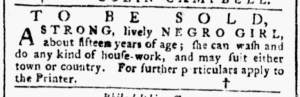
Supplement to the Pennsylvania Gazette (January 31, 1776).
**********
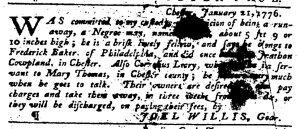
Supplement to the Pennsylvania Gazette (January 31, 1776).
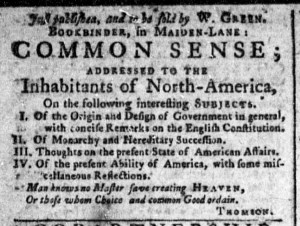
Historians consider Thomas Paine’s Common Sense, published anonymously on January 9, 1776, the most influential political pamphlet that circulated in the colonies during the era of the American Revolution. Written in plain language accessible to readers of all backgrounds, the pamphlet made a bold case for declaring independence at a time that many colonizers still sought a redress their grievances by George III and Parliament. Paine’s pamphlet played a vital role in swaying public opinion in favor of declaring independence.
Common Sense was an eighteenth-century bestseller, though Paine wildly overestimated how many copies were published, claiming 150,000 circulated in 1776, and historians later made even more dubious claims that American printing presses produced as many as 500,000 copies. Contrary to those exaggerations, American printers most likely published between 35,000 and 50,000 copies in 1776. Scholars have identified twenty-five American editions, more than twice as many as any other American book or pamphlet published in the eighteenth century.
Colonizers certainly discussed Paine’s pamphlet … and printers, booksellers, and others advertised it widely. As a special feature, the Adverts 250 Projectchronicles those advertisements, starting with newspaper notices for Robert Bell’s first edition published in Philadelphia and then subsequent advertisements for that and other editions published and sold throughout the colonies.
These advertisements for Common Sense appeared in American newspapers 250 years ago today.
What was advertised in a revolutionary American newspaper 250 years ago today?
Pennsylvania Evening Post (January 30, 1776).
“The said gentlemen have not yet been able to settle with Robert Bell.”
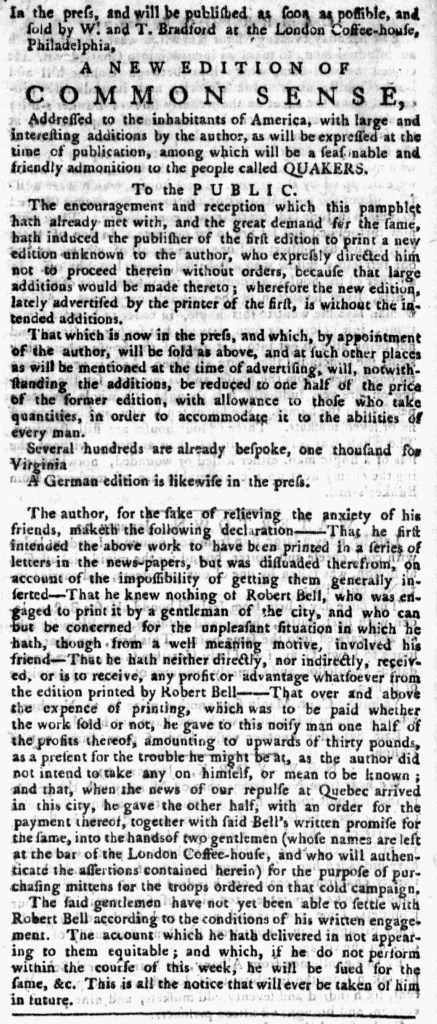
The feud between the Thomas Paine, the author of Common Sense, and Robert Bell, the publisher of the first edition of Common Sense, intensified in the January 30, 1776, edition of the Pennsylvania Evening Post. Advertisements for Bell’s unauthorized “SECOND EDITION” and a “NEW EDITION” currently “In the press, and [to] be published as soon as possible” by William Bradford and Thomas Bradford dominated the final page of that newspaper. Variations of both advertisements appeared in the Pennsylvania Evening Post three days earlier, each of them stirring the pot and inspiring Bell and Paine to submit new material to Benjamin Towne, the printer of that newspaper, to incorporate into their advertisements.
The advertisement for the Bradfords’ edition still included an address “To the PUBLIC,” but it doubled in length with a “declaration” made by the author “for the sake of relieving the anxiety of his friends.” At this point, Paine remained anonymous, at least as far as associating his name with the political pamphlet in the public prints was concerned. He explained that his original plan for Common Sense had been to have it “printed in a series of newspapers,” but others, including Benjamin Rush, convinced him that was impractical and that even printers who supported the American cause would shy away from such radical content. Rush recommended Robert Bell, the noted bookseller as an alternative to the several printers who published newspapers in Philadelphia, acting as an intermediary between Paine and Bell. In this new “declaration,” Paine explained that “he knew nothing of Robert Bell, who was engaged to print it by a gentleman of this city,” referring to Rush but not naming him. Though Rush acted “from a well meaning motive,” his suggestion eventually embroiled Paine in “the unpleasant situation.”
Paine did not hesitate to name Bell, proclaiming that he “hath neither directly, nor indirectly, received, or is to receive, any profit or advantage from the edition printed by Robert Bell.” In the agreement negotiated by Rush, Paine paid for the expense of printing the pamphlet whether it sold or not. In addition, that “noisy man,” Bell, would receive “one half of the profits” if the pamphlet was a success. Paine estimated that amount should have been “upwards of thirty pounds.” Furthermore, the author did not intend to keep his half of the profits. Instead, “when news of our repulse at Quebec arrived in this city,” he committed his share “for the purpose of purchasing mittens for the troops ordered on that cold campaign.” An assault on Quebec City, part of the invasion of Canada undertaken by American forces, had failed on New Year’s Eve. The patriotic Paine wanted to send supplies, especially mittens, to the American soldiers who continued the siege of that city, but Bell did not turn over any money “into the hands of two gentlemen” that Paine designated as his intermediaries. Paine claimed that he had “Bell’s written promise” for that arrangement. Anyone who wished to do so could verify that by consulting with them since their “names are left at the bar of the London Coffee-house” for that purpose.
“The said gentlemen,” Paine continued, “have not yet been able to settle with Robert Bell according to the conditions of his written engagement.” In addition, when they examined his account of the expenses and sales, they did not consider it “equitable” according to that agreement. Paine warned that Bell had a week to make good on their agreement or else “he will be sued for the same.” He concluded by stating, “This is all the notice that will ever be taken of him in future.” Given the ferocity of the advertisements already published, readers may have doubted that.
The advertisement for the Bradfords’ edition featured far more new material than Bell’s advertisement. He added a few lines to the nota bene that ran in the previous edition of the Pennsylvania Evening Post, though he had been so anxious to publish his updated advertisement that he inserted it in the January 29 edition of Dunlap’s Pennsylvania Packetrather than waiting for it to appear in the Pennsylvania Evening Post on January 30. In Dunlap’s Pennsylvania Packet, Bell’s expanded advertisement ran next to the shorter version of the advertisement for the Bradfords’ edition of Common Sense, the one that included an address “TO THE PUBLIC” but not the additional “declaration” by the author.
Bell took the opportunity to demean the “NEW EDITION” the Bradfords were printing. He declared that “the public may be certain” that the “smallness of print and scantiness of paper” meant that it would be an inferior edition “when compared with Bell’s second edition.” Why would readers wait for the Bradfords’ edition “yet in the press” when Bell’s second edition was “out of the press” and available for sale? As a final insult, he trumpeted that comparing the Bradfords’ forthcoming edition to his own second edition was like the difference “in size and value” between a “British shilling” and a “British half-crown.” His second edition, Bell claimed, was the better value in so many ways. Even though Paine pledged that he had nothing more to say about Bell, that made it seem unlikely that the author and the publisher of the first edition would quietly discontinue their attacks in the public prints. In three short weeks since the first advertisement for Common Sense appeared in the Pennsylvania Evening Post, the controversy between Bell and Paine became its own commotion!
The Slavery Adverts 250 Project chronicles the role of newspaper advertising in perpetuating slavery in the era of the American Revolution. The project seeks to reveal the ubiquity of slavery in eighteenth-century life from New England to Georgia by republishing advertisements about enslaved people – for sale as individuals or in groups, wanted to purchase or for hire for short periods, runaways who liberated themselves, and those who were subsequently captured and confined in jails and workhouses – in daily digests on this site as well as in real time via the @SlaveAdverts250 Twitter feed, utilizing twenty-first-century media to stand in for the print media of the eighteenth century.
The project aims to provide modern audiences with a sense of just how often colonizers encountered these advertisements in their daily lives. Enslaved men, women, and children appeared in print somewhere in the colonies almost every single day. Those advertisements served as a constant backdrop for social, cultural, economic, and political life in colonial and revolutionary America. Colonizers who did not purport to own enslaved people were still confronted with slavery as well as invited to maintain the system by purchasing enslaved men, women, and children or assisting in the capture of so-called “runaways” who sought to free themselves from bondage. The frequency of these newspaper advertisements suggests just how embedded slavery was in colonial and revolutionary American culture in everyday interactions beyond the printed page.
These advertisements also testify to the experiences of enslaved men, women, and children, though readers must consider that those experiences have been remediated through descriptions offered by enslavers rather than enslaved people themselves. Often unnamed in the advertisements, enslaved men, women, and children were not invisible or unimportant in early America.
Massimo Sgambati made significant contributions to this entry as part of the Summer Scholars Program, funded by a fellowship from the D’Amour College of Liberal Arts and Sciences at Assumption University in Worcester, Massachusetts, in Summer 2025.
These advertisements appeared in revolutionary American newspapers 250 years ago today.
Historians consider Thomas Paine’s Common Sense, published anonymously on January 9, 1776, the most influential political pamphlet that circulated in the colonies during the era of the American Revolution. Written in plain language accessible to readers of all backgrounds, the pamphlet made a bold case for declaring independence at a time that many colonizers still sought a redress their grievances by George III and Parliament. Paine’s pamphlet played a vital role in swaying public opinion in favor of declaring independence.
Common Sense was an eighteenth-century bestseller, though Paine wildly overestimated how many copies were published, claiming 150,000 circulated in 1776, and historians later made even more dubious claims that American printing presses produced as many as 500,000 copies. Contrary to those exaggerations, American printers most likely published between 35,000 and 50,000 copies in 1776. Scholars have identified twenty-five American editions, more than twice as many as any other American book or pamphlet published in the eighteenth century.
Colonizers certainly discussed Paine’s pamphlet … and printers, booksellers, and others advertised it widely. As a special feature, the Adverts 250 Projectchronicles those advertisements, starting with newspaper notices for Robert Bell’s first edition published in Philadelphia and then subsequent advertisements for that and other editions published and sold throughout the colonies.
These advertisements for Common Sense appeared in American newspapers 250 years ago today.
What was advertised in a revolutionary American newspaper 250 years ago today?
Norwich Packet (January 29, 1776).
“CASH GIVEN FOR Clean Linen Rags.”
Nathaniel Patten’s advertisement in the January 29, 1776, edition of the Norwich Packet was neither as lengthy nor as visually stimulating as some of his previous advertisements, but that may have been because he had a different purpose in running it. The “BOOKBINDER and STATIONER, at the East End of the Green,” did not provide a list of titles that he sold in this notice. Instead, he announced, “CASH GIVEN FOR Clean Linen Rags, Of any Kind, Old Sail Cloth,” and other remnants of textiles that could be recycled into paper. Similar calls for rags appeared frequently in early American newspapers, most often placed by the printers of those newspapers. Such advertisements often consisted of only one or two lines. Printers offered cash for rags without further explanation because readers knew exactly why they wanted the rags and how they would be used.
The proprietors of paper mills sometimes ran more elaborate advertisements requesting rags. Especially when colonizers enacted nonimportation agreements that disrupted the supply of paper coming from England, those advertisements depicted saving rags to produce paper as a patriotic duty and a means for all colonizers, including women, to support the American cause. Patten did not go into as much detail as John Keating did when promoting ‘THE FIRST Paper Manufactory Established in the city of New-York,” but he did say more than most printers. “As Paper is one of the most necessary Articles now wanted,” the bookbinder and stationer asserted, “it is hoped that all true Friends to America, will exert their utmost Endeavours to promote and encourage such Manufactory” in Connecticut. A lack of paper had indeed caused some printers to sometimes reduce the size of their weekly newspapers to half sheets (two pages) instead of full sheets (four pages) or miss publishing for a week or two. That was the situation in New England and beyond. Two days before Patten issued his call for rags in the Norwich Packet, for instance, John Pinkney, the printer of one Virginia Gazette, ran a notice in another Virginia Gazette to explain that he could not print his newspaper that week because he could not acquire paper.
The Slavery Adverts 250 Project chronicles the role of newspaper advertising in perpetuating slavery in the era of the American Revolution. The project seeks to reveal the ubiquity of slavery in eighteenth-century life from New England to Georgia by republishing advertisements about enslaved people – for sale as individuals or in groups, wanted to purchase or for hire for short periods, runaways who liberated themselves, and those who were subsequently captured and confined in jails and workhouses – in daily digests on this site as well as in real time via the @SlaveAdverts250 Twitter feed, utilizing twenty-first-century media to stand in for the print media of the eighteenth century.
The project aims to provide modern audiences with a sense of just how often colonizers encountered these advertisements in their daily lives. Enslaved men, women, and children appeared in print somewhere in the colonies almost every single day. Those advertisements served as a constant backdrop for social, cultural, economic, and political life in colonial and revolutionary America. Colonizers who did not purport to own enslaved people were still confronted with slavery as well as invited to maintain the system by purchasing enslaved men, women, and children or assisting in the capture of so-called “runaways” who sought to free themselves from bondage. The frequency of these newspaper advertisements suggests just how embedded slavery was in colonial and revolutionary American culture in everyday interactions beyond the printed page.
These advertisements also testify to the experiences of enslaved men, women, and children, though readers must consider that those experiences have been remediated through descriptions offered by enslavers rather than enslaved people themselves. Often unnamed in the advertisements, enslaved men, women, and children were not invisible or unimportant in early America.
Massimo Sgambati made significant contributions to this entry as part of the Summer Scholars Program, funded by a fellowship from the D’Amour College of Liberal Arts and Sciences at Assumption University in Worcester, Massachusetts, in Summer 2025.
These advertisements appeared in revolutionary American newspapers 250 years ago today.
Dunlap’s Pennsylvania Packet (January 29, 1776).
**********
Dunlap’s Pennsylvania Packet (January 29, 1776).
**********
Dunlap’s Pennsylvania Packet (January 29, 1776).
**********
Dunlap’s Pennsylvania Packet (January 29, 1776).
**********
New-York Gazette and Weekly Mercury (January 29, 1776).
Historians consider Thomas Paine’s Common Sense, published anonymously on January 9, 1776, the most influential political pamphlet that circulated in the colonies during the era of the American Revolution. Written in plain language accessible to readers of all backgrounds, the pamphlet made a bold case for declaring independence at a time that many colonizers still sought a redress their grievances by George III and Parliament. Paine’s pamphlet played a vital role in swaying public opinion in favor of declaring independence.
Common Sense was an eighteenth-century bestseller, though Paine wildly overestimated how many copies were published, claiming 150,000 circulated in 1776, and historians later made even more dubious claims that American printing presses produced as many as 500,000 copies. Contrary to those exaggerations, American printers most likely published between 35,000 and 50,000 copies in 1776. Scholars have identified twenty-five American editions, more than twice as many as any other American book or pamphlet published in the eighteenth century.
Colonizers certainly discussed Paine’s pamphlet … and printers, booksellers, and others advertised it widely. As a special feature, the Adverts 250 Projectchronicles those advertisements, starting with newspaper notices for Robert Bell’s first edition published in Philadelphia and then subsequent advertisements for that and other editions published and sold throughout the colonies.
These advertisements for Common Sense appeared in American newspapers 250 years ago today.
Dunlap’s Pennsylvania Packet (January 29, 1776).
**********
Dunlap’s Pennsylvania Packet (January 29, 1776).
**********
New-York Gazette and Weekly Mercury (January 29, 1776).
Though Benjamin Franklin is often considered the patron saint of American advertising in the popular press, I believe that his efforts pale in comparison to the contributions made by Mathew Carey (1760-1839) in the final decades of the eighteenth century. Franklin is rightly credited with experimenting with the appearance of newspaper advertising, mixing font styles and sizes in the advertisements that helped to make him a prosperous printer, but Mathew Carey introduced and popularized an even broader assortment of advertising innovations, ranging from inventive appeals that targeted potential consumers to a variety of new media to networks for effectively distributing advertising materials. In the process, his efforts played an important role in the development of American capitalism by enlarging markets for the materials sold by printers, booksellers, and publishers as well as a host of other goods marketed by merchants, shopkeepers, and artisans who eventually adopted many of Carey’s innovative advertising methods. Mathew Carey will probably never displace Benjamin Franklin as the founder of American advertising in the popular imagination, but scholars of early American history and culture should recognize his role as the most important leader in eighteenth-century advertising among the many other activities and accomplishments of his long career in business and public life.
Mathew Carey (January 28, 1760 – September 16, 1839). Portrait by John Neagle, 1825. Library Company of Philadelphia.
Carey’s efforts as an advertiser were enmeshed within transatlantic networks of print and commerce. Though he did not invent the advertising wrapper printed on blue paper that accompanied magazines in the eighteenth century, he effectively utilized this medium to an extent not previously seen in America, Ireland, or the English provinces outside of London. The wrappers distributed with his American Museum (1787-1792) comprised the most extensive collection of advertising associated with any magazine published in North America in the eighteenth century, both in terms of the numbers of advertisements and the diversity of occupations represented in those advertisements. In Carey’s hands, the American Museum became a vehicle for distributing advertising media: inserts that included trade cards, subscription notices, testimonials, and book catalogues in addition to the wrappers themselves.
Located at the hub of a network of printers and booksellers, Carey advocated the use of a variety of advertising materials, some for consumption by the general public and others for use exclusively within the book trade. Subscription notices and book catalogues, for instance, could stimulate demand among potential customers, but exchange catalogues were intended for printers and booksellers to manage their inventory and enlarge their markets by trading surplus copies of books, pamphlets, and other printed goods. Working with members of this network also facilitated placing advertisements for new publications in the most popular newspapers published in distant towns and cities.
Carey also participated in the development of advertising appeals designed to stimulate demand among consumers in eighteenth-century America. He targeted specific readers by stressing the refinement associated with some of his publications, while simultaneously speaking to general audiences by emphasizing the patriotism and virtue associated with purchasing either books about American history, especially the events of the Revolution and the ratification of the Constitution, or books published in America. In his advertising, Carey invoked a patriotic politics of consumption that suggested that the success of the republican experiment depended not only on virtuous activity in the realm of politics but also on the decisions consumers made in the marketplace.
For my money, Carey is indeed the father of American advertising. Happy 266th birthday, Mathew Carey!