April 30

What was advertised in a revolutionary American newspaper 250 years ago today?
Pennsylvania Evening Post (April 30, 1776).

“Apply for tickets … at a Pistole each, or one Shilling each time bathing.”

With the arrival of spring in 1776, Joseph Jewell opened the “COLD BATH, AT Bathtown, in Second-street, about a quarter of a mile from the Barracks in the Northern liberties” on the outskirts of Philadelphia.  Readers sometimes encountered promotions for spas, baths, and mineral springs as they perused newspapers in the decade before the Revolutionary War, including the “Cold-Bath at Jackson’s Mineral Well” in Boston and a “NEW and CONVENIENT BATH” in Perth Amboy, New Jersey.  The New-York Chronicle carried an advertisement for the “Chalybeat Springs, in the Borough of Bristol, in Pennsylvania.”  The facility “answers the Description of the celebrated GERMAN SPAW.”  In addition to the bath and mineral spring at Perth Amboy, residents of Philadelphia who read local newspapers encountered invitations to partake of “ABINGTON MINERAL WATER” when they visited the “most healthy Part of the Province of Pennsylvania.”  The “COLD BATH, AT Bathtown,” however, was a more convenient location that offered greater access to those who wished to purchase admission.

In an advertisement in the April 30, 1776, edition of the Pennsylvania Evening Post, Jewell announced that the facility was “now in the possession of the subscriber,” indicating a transfer of ownership since the previous season.  William Drewet Smith, an apothecary, previously operated the bath.  Regardless of who ran it, the “COLD BATH” was “in complete order, and fit for immediate use.”  Jewell instructed “[l]adies and gentlemen who are inclined to make use of it for the season” to acquire tickets directly from him or “at the bar of the London Coffee-house,” a popular place for socializing and conducting business in the bustling urban port.  Just as advertisers frequently enlisted printers in supplying additional information to readers who followed directions to “enquire of the printer,” some also made arrangements for the proprietor of the coffeehouse to act as their agent.  Such convenience likely increased sales.  Jewell charged the same amount for a season pass, “a Pistole each,” as Smith had the previous year, but he also allowed for day passes at “one Shilling each time bathing.”  Smith may have done so as well, though he did not promote it as an option in his advertisement.  Jewell may have hoped that highlighting a less expensive option would stimulate greater demand and more visitors to the “COLD BATH.”

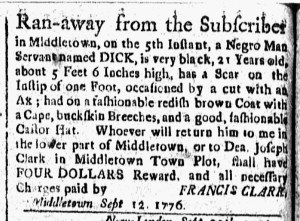
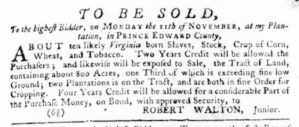
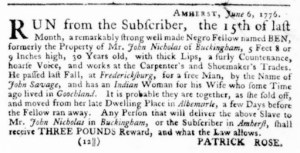
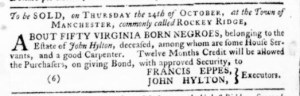
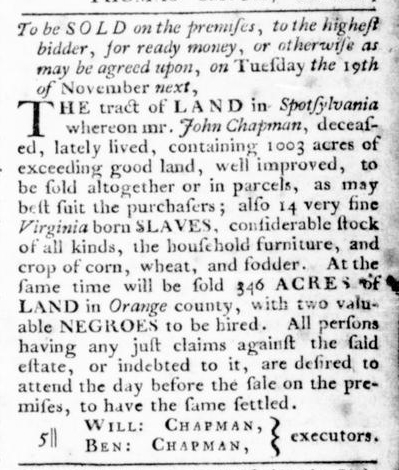
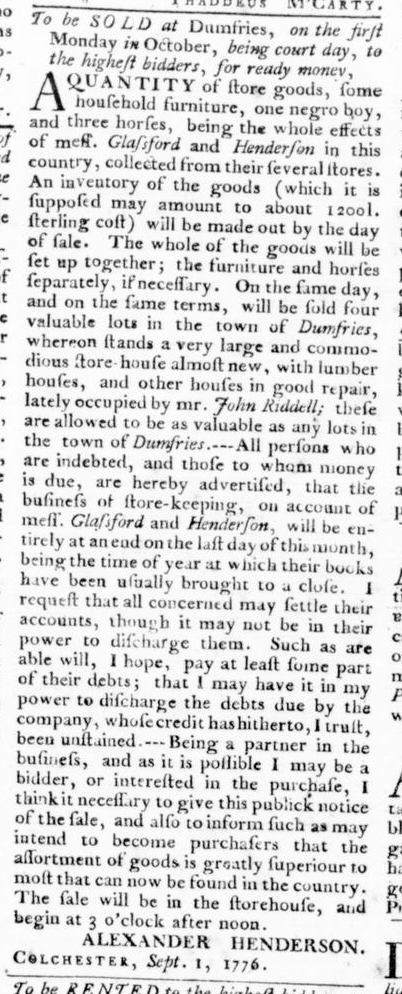
Slavery Advertisements Published April 30, 1776

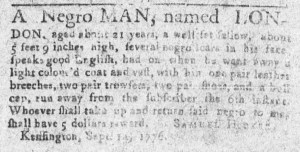
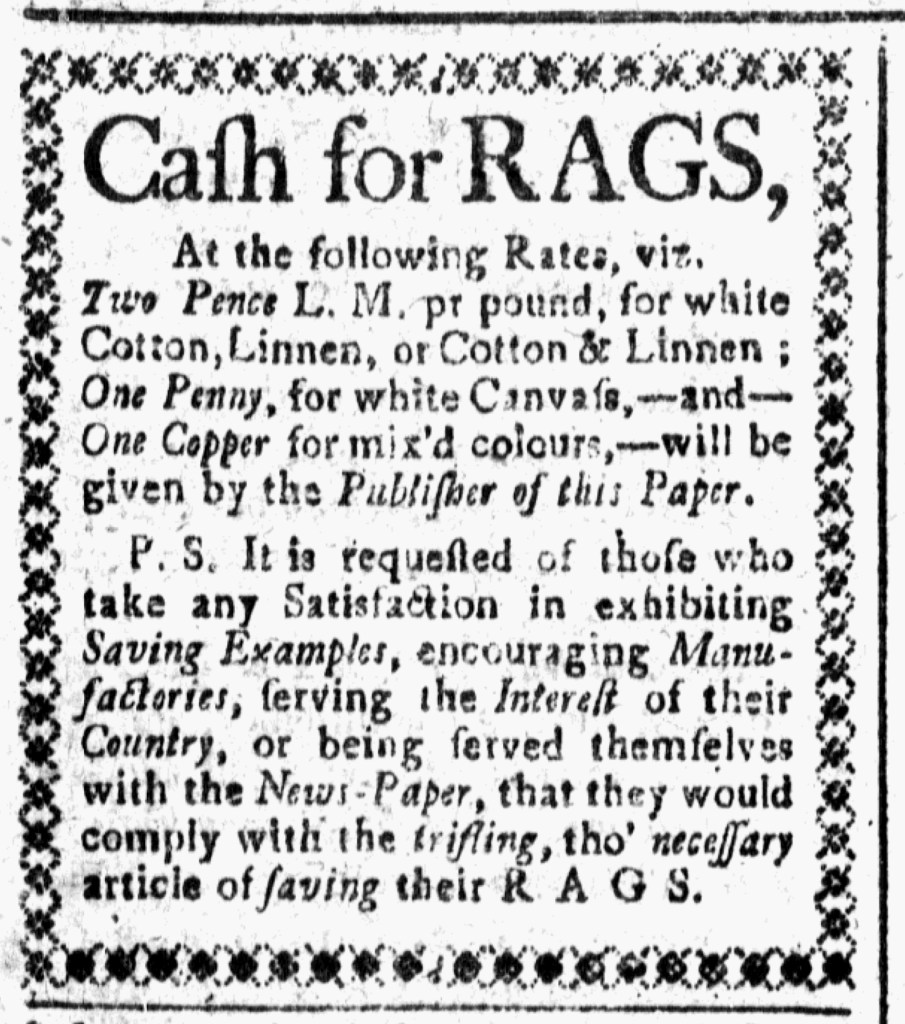
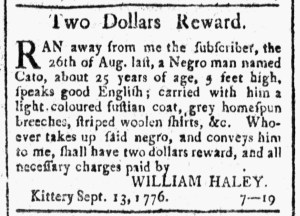
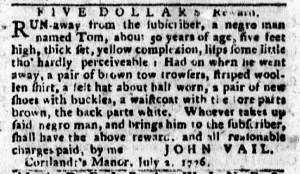
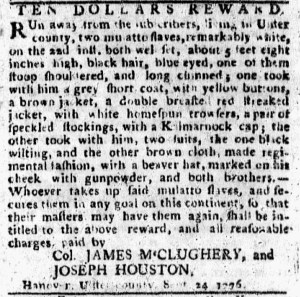
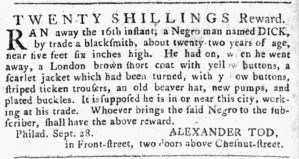
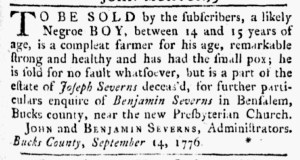
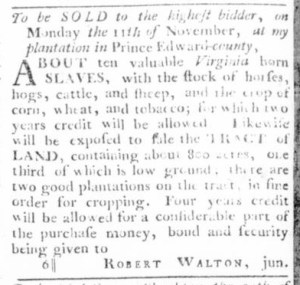
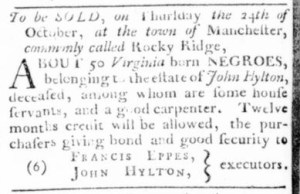
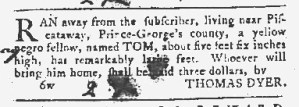
The Slavery Adverts 250 Project chronicles the role of newspaper advertising in perpetuating slavery in the era of the American Revolution. The project seeks to reveal the ubiquity of slavery in eighteenth-century life from New England to Georgia by republishing advertisements about enslaved people – for sale as individuals or in groups, wanted to purchase or for hire for short periods, runaways who liberated themselves, and those who were subsequently captured and confined in jails and workhouses – in daily digests on this site as well as in real time via the @SlaveAdverts250 Twitter feed, utilizing twenty-first-century media to stand in for the print media of the eighteenth century.

The project aims to provide modern audiences with a sense of just how often colonizers encountered these advertisements in their daily lives. Enslaved men, women, and children appeared in print somewhere in the colonies almost every single day. Those advertisements served as a constant backdrop for social, cultural, economic, and political life in colonial and revolutionary America. Colonizers who did not purport to own enslaved people were still confronted with slavery as well as invited to maintain the system by purchasing enslaved men, women, and children or assisting in the capture of so-called “runaways” who sought to free themselves from bondage. The frequency of these newspaper advertisements suggests just how embedded slavery was in colonial and revolutionary American culture in everyday interactions beyond the printed page.

These advertisements also testify to the experiences of enslaved men, women, and children, though readers must consider that those experiences have been remediated through descriptions offered by enslavers rather than enslaved people themselves. Often unnamed in the advertisements, enslaved men, women, and children were not invisible or unimportant in early America.

These advertisements appeared in revolutionary American newspapers 250 years ago today.

Dunlap’s Maryland Gazette (April 30, 1776).

April 29

What was advertised in a revolutionary American newspaper 250 years ago today?

Connecticut Courant (April 29, 1776).

“His assortment would be too large for a news-paper.”

The April 29, 1776, edition of the Connecticut Courant featured a series of advertisements for imported “ENGLISH GOODS.”  George Merrill, for instance, advertised an “Assortment of English and India GOODS” available “At the Sign of the UNICORN and MORTAR” in Hartford.  An anonymous advertiser offered “ENGLISH GOODS, By WHOLESALE,” instructing interested parties to “Enquire of the Printer” for more information.  None of the advertisements indicated when the imported goods had arrived in the colonies, but they had presumably done so before the Continental Association went into effect.  In his advertisement for “English, India, and home goods,” Leonard Chester of Weathersfield declared, “Shops that mean to keep themselves alive, ‘till trade opens again, may be supplied with several articles in the wholesale way.”  That suggested that the advertisers sold goods that had been imported before the Revolutionary War began and perhaps some time before that.

Apart from James Lamb and Son, advertisers who hawked imported goods did not publish lengthy advertisements that listed their merchandise in an effort to entice prospective customers, yet that did not mean that they refrained from emphasizing the choices they made available to consumers.  Jacob Sebor claimed that he stocked the “largest and genteelest assortment of ENGLISH GOODS this day in the colony.”  Rather than naming any of them, he resorted to a nota bene to explain that he “would give a more particular advertisement, but his assortment would be too large for a news-paper.”  Merchants and shopkeepers sometimes made such claims, some even stating that it would be “too tedious” to enumerate their wares or impossible to do.  Instead, they invited, usually implicitly, readers to visit their shops and warehouses to discover what they had in stock.  Sebor extended that invitation explicitly, proclaiming that he “begs the ladies and gentlemen to call and see” his extensive inventory.  He sought to activate their curiosity about what they might find at his store and encouraged them to examine the merchandise themselves rather than rely on brief descriptions in newspaper advertisements.

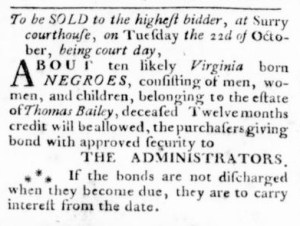
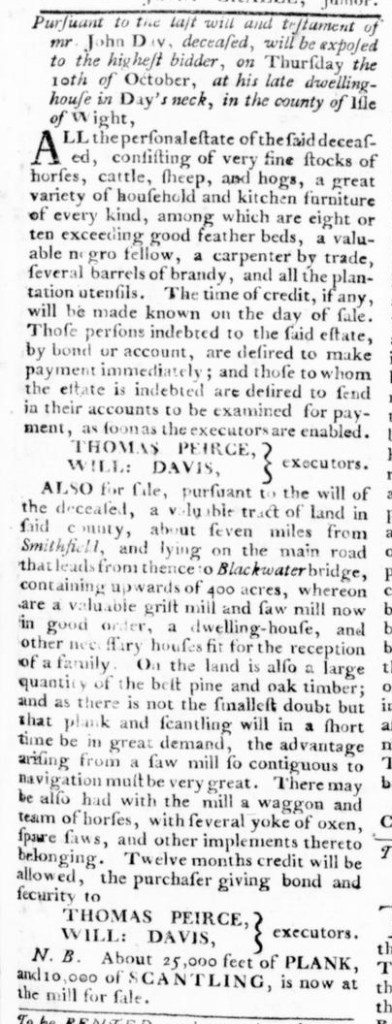
Slavery Advertisements Published April 29, 1776

The Slavery Adverts 250 Project chronicles the role of newspaper advertising in perpetuating slavery in the era of the American Revolution. The project seeks to reveal the ubiquity of slavery in eighteenth-century life from New England to Georgia by republishing advertisements about enslaved people – for sale as individuals or in groups, wanted to purchase or for hire for short periods, runaways who liberated themselves, and those who were subsequently captured and confined in jails and workhouses – in daily digests on this site as well as in real time via the @SlaveAdverts250 Twitter feed, utilizing twenty-first-century media to stand in for the print media of the eighteenth century.

The project aims to provide modern audiences with a sense of just how often colonizers encountered these advertisements in their daily lives. Enslaved men, women, and children appeared in print somewhere in the colonies almost every single day. Those advertisements served as a constant backdrop for social, cultural, economic, and political life in colonial and revolutionary America. Colonizers who did not purport to own enslaved people were still confronted with slavery as well as invited to maintain the system by purchasing enslaved men, women, and children or assisting in the capture of so-called “runaways” who sought to free themselves from bondage. The frequency of these newspaper advertisements suggests just how embedded slavery was in colonial and revolutionary American culture in everyday interactions beyond the printed page.

These advertisements also testify to the experiences of enslaved men, women, and children, though readers must consider that those experiences have been remediated through descriptions offered by enslavers rather than enslaved people themselves. Often unnamed in the advertisements, enslaved men, women, and children were not invisible or unimportant in early America.

These advertisements appeared in revolutionary American newspapers 250 years ago today.

New-York Gazette and Weekly Mercury (April 29, 1776).

**********

New-York Gazette and Weekly Mercury (April 29, 1776).

**********

New-York Gazette and Weekly Mercury (April 29, 1776).

**********

Norwich Packet (April 29, 1776).

Advertisements for Common Sense Published April 29, 1776

Historians consider Thomas Paine’s Common Sense, published anonymously on January 9, 1776, the most influential political pamphlet that circulated in the colonies during the era of the American Revolution.  Written in plain language accessible to readers of all backgrounds, the pamphlet made a bold case for declaring independence at a time that many colonizers still sought a redress their grievances by George III and Parliament.  Paine’s pamphlet played a vital role in swaying public opinion in favor of declaring independence.

Common Sense was an eighteenth-century bestseller, though Paine wildly overestimated how many copies were published, claiming 150,000 circulated in 1776, and historians later made even more dubious claims that American printing presses produced as many as 500,000 copies.  Contrary to those exaggerations, American printers most likely published between 35,000 and 50,000 copies in 1776.  Scholars have identified twenty-five American editions, more than twice as many as any other American book or pamphlet published in the eighteenth century.

Colonizers certainly discussed Paine’s pamphlet … and printers, booksellers, and others advertised it widely.  As a special feature, the Adverts 250 Project chronicles those advertisements, starting with newspaper notices for Robert Bell’s first edition published in Philadelphia and then subsequent advertisements for that and other editions published and sold throughout the colonies.

These advertisements for Common Sense appeared in American newspapers 250 years ago today.

Boston-Gazette (April 29, 1776).

**********

Connecticut Courant (April 29, 1776).

April 28

What was advertised in a revolutionary American newspaper 250 years ago this week?

Thomas’s Massachusetts Spy (April 26, 1776).

“He … most earnestly requests that all who are indebted to him for News-Papers, Advertisements, &c. would pay him.”

The April 26, 1776, edition of Thomas’s Massachusetts Spy opened with a notice from the printer, Isaiah Thomas.  “THE Printer hereby gives notice,” he declared, “that, for the present he shall continue his business in Worcester.”  Thomas had arrived in town a year earlier.  In the spring of 1775, he advertised his intention to establish Worcester’s first printing office and newspaper and entrust both to a junior partner.  As the imperial crisis intensified, however, he departed Boston just before the battles at Lexington and Concord, relocated to Worcester beyond the reach of the British, and set himself up as the town’s new printer.  On May 3, 1775, he published the first issue of the Massachusetts Spy printed in Worcester.  A year later, he considered whether he wished to remain following the British evacuation of Boston.  Although he announced that “for the present he shall continue his business in Worcester,” a month later he leased the newspaper to William Stearns and Daniel Bigelow.  Thomas moved to Salem “with an intention to commence business in that place; but many obstructions to the plan arising in consequence of the war, he sold the printing materials which he carried to that town, and, in 1778, returned to Worcester, took into possession the press which he had left there, and resumed publication of the Spy.”[1]

In late April 1776, Thomas had not yet decided to leave Worcester.  In hopes of maintaining he business he pursued there, he issued a call for customers to pay their bills.  Throughout the colonies, printers (and other entrepreneurs) frequently ran similar notices.  Thomas did so occasionally and “once more, earnestly requests that all those who are indebted to him for News-Papers, Advertisements, &c. would pay him.”  Like other printers, he extended generous credit to subscribers and other customers.  Doing so put his business in a difficult position: “Although the sum due from each person is small, yet his accounts of this kind are so numerous, they were they paid, it would enable him to support his business with credit, and satisfaction to his readers and himself.”  Thomas emphasized the benefits to readers and the public – the quality of the newspaper – rather than taking a more common approach, threatening legal action against those who disregarded his notice.  In the era of the American revolution, printers often proclaimed that their communities should give them credit for publishing newspapers as a public service.

Thomas indicated that customers owed him for both newspapers and advertisements.  Historians of the early American press sometimes assert that printers allowed credit for subscriptions but insisted that advertisers pay for notice in advance.  Thomas’s notice may suggest that he took a different approach, but it depends on what he meant by “Advertisements.”  He could have referred to newspaper notices, though not necessarily.  He might have meant broadsides, handbills, and other advertising materials printed separately.  Thomas’s account books and correspondence may clarify which kinds of advertisements qualified for credit and which had to be paid before they went to press.

**********

[1] Isaiah Thomas, The History of Printing in America: With a Biography of Printers and an Account of Newspapers (1810; New York: Weathervane Books, 1970), 181.

April 27

What was advertised in a revolutionary American newspaper 250 years ago today?

Providence Gazette (April 27, 1776).

“He is persuaded that none of his Readers will think him unreasonable in adding a Shilling to the Price per Year.”

The first advertisement in the April 27, 1776, edition of the Providence Gazette featured news for subscribers.  John Carter, the printer, informed them of an imminent price increase.  His own expenses had gone up in the year since the war began at Lexington and Concord.  “THE increased Price of Paper (the chief Article of a Printer’s Stock) and of almost every Necessary of Life, has been so great,” he explained, “that it must have naturally fallen within the Notice of every Reader of this Gazette.”  Given the circumstances that Carter believed honest readers acknowledged, he was “thereforecompelled to acquaint his Customers, that the Price thereof in future will be Eight Shillings per Annum.”

He emphasized that the situation “compelled” him to take this action rather than doing so willingly or eagerly.  Carter also noted that other printers had recently done the same, so he was not alone in seeking such a remedy to his financial woes.  “He likewise begs leave to inform [subscribers],” the printer stated, “that for the same Reason the Price of the Cambridge Paper,” the New-England Chronicle, “has been raised to Eight Shillings” and “the Philadelphia Evening-Post to Two Dollars.”  (Carter meant the Pennsylvania Evening Post.)  In addition, John Dunlap had recently advertised a price increase from ten to fifteen shillings for Dunlap’s Maryland Gazette; or, the Baltimore General Advertiser.  In consideration of those recent precedents, Carter was “persuaded that none of his Readers will think him unreasonable in adding a Shilling to the Price per Year, which is not quite a Farthing on each Gazette” or each issue of the newspaper.[1]

The printer pledged to honor the previous price for current subscribers “till the Year, or other Time for which each Subscriber contracted, shall be expired.”  Once their current year (or other amount of time previously agreed between printer and subscriber) came to an end, the new price went into effect.  Those who did not wish to continue their subscriptions “at the Price above mentioned, … are requested to give Notice to the Printer.”  Carter understood that money was also tight for his subscribers, but he hoped that they would accept a small increase in the annual subscription fee in order to continue receiving the news (about the war, politics, and other matters), editorials, advertisements, and other content he published and disseminated each week.

**********

[1] A farthing was worth one-quarter of a penny.  Carter published the Providence Gazette weekly.  An additional farthing for fifty-two issues amounted to thirteen pence … or one shilling and one penny.  Carter raised the price by only one shilling, so indeed “not quite a Farthing” for each issue.

Slavery Advertisements Published April 27, 1776

The Slavery Adverts 250 Project chronicles the role of newspaper advertising in perpetuating slavery in the era of the American Revolution. The project seeks to reveal the ubiquity of slavery in eighteenth-century life from New England to Georgia by republishing advertisements about enslaved people – for sale as individuals or in groups, wanted to purchase or for hire for short periods, runaways who liberated themselves, and those who were subsequently captured and confined in jails and workhouses – in daily digests on this site as well as in real time via the @SlaveAdverts250 Twitter feed, utilizing twenty-first-century media to stand in for the print media of the eighteenth century.

The project aims to provide modern audiences with a sense of just how often colonizers encountered these advertisements in their daily lives. Enslaved men, women, and children appeared in print somewhere in the colonies almost every single day. Those advertisements served as a constant backdrop for social, cultural, economic, and political life in colonial and revolutionary America. Colonizers who did not purport to own enslaved people were still confronted with slavery as well as invited to maintain the system by purchasing enslaved men, women, and children or assisting in the capture of so-called “runaways” who sought to free themselves from bondage. The frequency of these newspaper advertisements suggests just how embedded slavery was in colonial and revolutionary American culture in everyday interactions beyond the printed page.

These advertisements also testify to the experiences of enslaved men, women, and children, though readers must consider that those experiences have been remediated through descriptions offered by enslavers rather than enslaved people themselves. Often unnamed in the advertisements, enslaved men, women, and children were not invisible or unimportant in early America.

These advertisements appeared in revolutionary American newspapers 250 years ago today.

Constitutional Gazette (April 27, 1776).

Advertisements for Common Sense Published April 27, 1776

Historians consider Thomas Paine’s Common Sense, published anonymously on January 9, 1776, the most influential political pamphlet that circulated in the colonies during the era of the American Revolution.  Written in plain language accessible to readers of all backgrounds, the pamphlet made a bold case for declaring independence at a time that many colonizers still sought a redress their grievances by George III and Parliament.  Paine’s pamphlet played a vital role in swaying public opinion in favor of declaring independence.

Common Sense was an eighteenth-century bestseller, though Paine wildly overestimated how many copies were published, claiming 150,000 circulated in 1776, and historians later made even more dubious claims that American printing presses produced as many as 500,000 copies.  Contrary to those exaggerations, American printers most likely published between 35,000 and 50,000 copies in 1776.  Scholars have identified twenty-five American editions, more than twice as many as any other American book or pamphlet published in the eighteenth century.

Colonizers certainly discussed Paine’s pamphlet … and printers, booksellers, and others advertised it widely.  As a special feature, the Adverts 250 Project chronicles those advertisements, starting with newspaper notices for Robert Bell’s first edition published in Philadelphia and then subsequent advertisements for that and other editions published and sold throughout the colonies.

These advertisements for Common Sense appeared in American newspapers 250 years ago today.

Providence Gazette (April 27, 1776).

April 26

What was advertised in a revolutionary American newspaper 250 years ago today?

Essex Journal (April 26, 1776).

“A NEW WEEKLY PAPER ENTITLED The FREEMAN’s JOURNAL, OR New-Hampshire GAZETTE.”

A year after the battles at Lexington and Concord, Benjamin Dearborn issued “PROPOSALS, FOR PRINTING BY SUBSCRIPTION … A NEW WEEKLY PAPER ENTITLED The FREEMAN’s JOURNAL, OR New-Hampshire GAZETTE.”  Dated April 20, 1776, the subscription proposals appeared in the April 26 edition of the Essex Journal, printed in Newburyport, Massachusetts, though they may have circulated separately as well.  Dearborn intended to publish the Freeman’s Journal in Portsmouth, making it the only newspaper printed in the colony since Daniel Fowle suspended the New-Hampshire Gazette earlier in the year.  The printer asserted that “As soon as a sufficient number of Subscribers appear, the first number will be publish’d.”  A month later, he distributed the first issue on May 25.

The title of the Freeman’s Journal made the editorial stance clear.  So did the explanation that Dearborn gave for establishing the newspaper: “As the Publisher determines to use his utmost efforts to serve the PUBLIC, and the GLORIOUS CAUSE they are so ardently, so unitedly engaged in, he flatters himself he shall meet with their friendly encouragement.”  He took on this service despite the “extraordinary expences which necessarily attend the Printing Business at this time,” simultaneously asking prospective subscribers to “excuse the publication of half a sheet, sometimes,” when “accidents … prevent supplying our kind customers with a whole sheet.”  During the first year of the war, shortages of paper, fears of impending attacks by British forces, post riders arriving behind schedule, and other “accidents” disrupted publication of the newspapers in New England and beyond.

The “CONDITIONS” in Dearborn’s subscription proposals outlined the expectations for the printer and subscribers.  A subscription cost “Eight Shillings Lawful Money per year, (exclusive of postage),” with half due immediately and the other half due in six months.  Newspaper printers often extended generous credit to subscribers, but circumstances did not permit Dearborn to do so for the Freeman’s Journal.  He pledged, “Advertisements impartially inserted at the customary price,” though he did not specify what that was.  He apparently expected that prospective advertisers knew the going rate for running notices in newspapers in the region.  He did declare that advertisements had “to be paid on receiving them.”  The printer did not allow any credit for advertisements.

New issues would circulate “every Monday morning” for as long as “the post arrives on Fridays.”  That allowed time for Dearborn to peruse other newspapers to select items to reprint in the Freeman’s Journal, sift through his own correspondence, and collaborate with others who received letters containing news.  The printer would collate “all authentic domestic intelligence worth notice; together with the most material Extracts from the Southern and other papers.”  He also solicited “[i]nteresting, instructive, and entertaining Poetry Speculations,” presumably for “Poet’s Corner,” a standard feature in many colonial newspapers, that he would publish “gratis” with “grateful acknowledgments for the favour.”

Dearborn accepted subscriptions at his printing office in Portsmouth.  John Mycall, the printer of the Essex Journal, also gathered subscriptions at the printing office in Newburyport.  Dearborn also expected that “most of the Printers on the Continent” would forward any subscriptions they received, signaling to the public that he was part of an expansive network that exchanged news for the benefit of “the PUBLIC, and the GLORIOUS CAUSE.”  Despite the upheavals of the war (or perhaps because of them), Dearborn and other printers established new newspapers during the summer of 1776.