What was advertised in a revolutionary American newspaper 250 years ago today?

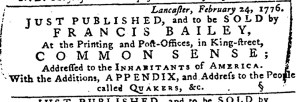
“Lancaster … JUST PUBLISHED … by FRANCIS BAILEY … COMMON SENSE.”
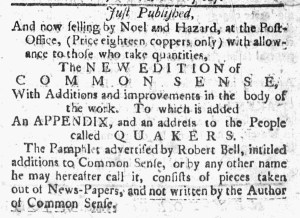
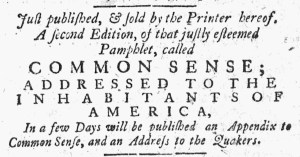
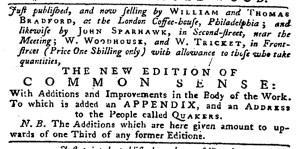
Readers encountered advertisements for Thomas Paine’s Common Sense on the first and final pages of the February 28, 1776, edition of the Pennsylvania Gazette. Two of those advertisements looked familiar to anyone who had been perusing the public prints in recent weeks. One of them promoted the “NEW EDITION OF COMMON SENSE: With Additions and Improvements in the Body of the Work.” Paine penned that material as well as “an APPENDIX, and an ADDRESS to the People called QUAKERS” for an edition that he worked with William Bradford and Thomas Bradford to publish. The Bradfords and other members of the book trades in Philadelphia stocked and sold Paine’s approved edition. Meanwhile, Robert Bell, the publisher of the first edition, continued hawking “Large Additions to COMMON SENSE,” a collection of essays drawn from newspapers, none of them by Paine, to accompany his unauthorized second edition of Common Sense. The compositor conveniently placed the advertisements one after the other on the final page, seemingly not taking a side in the dispute.
Another advertisement for Common Sense appeared on the first page of that issue of the Pennsylvania Gazette. It announced the publication of a local edition published by Francis Bailey in Lancaster, Pennsylvania. It was the first time that an advertisement for Bailey’s edition appeared in any newspaper. Bearing the dateline, “Lancaster, February 24, 1776,” it informed readers that Bailey sold “COMMON SENSE; Addressed to the INHABITANTS of AMERICA. With the Additions, APPENDIX, and Address to the People called QUAKERS” at his “Printing and Post-Offices, in King-street.” Although other publishers of Common Sense provided a preview by listing the pamphlet’s section headings the first time they ran advertisements, Bailey did not do so. Perhaps he did not consider it necessary considering that the Pennsylvania Gazette and other newspapers printed in Philadelphia that already carried advertisements for the various editions by Bell and the Bradfords circulated in Lancaster and served that town as local and regional newspapers. Lancaster would not have its own newspaper until John Dunlap temporarily relocated his Pennsylvania Packet during the British occupation of Philadelphia in 1777. Bailey’s advertisement and his edition of Common Sense were for residents of Lancaster and nearby towns, not readers in Philadelphia who had ready access to other editions, but since they shared local-regional newspapers that already carried many advertisements that included the contents of the pamphlet Bailey did not need to incorporate that information into his own advertisement. He saved money on advertising by publishing a streamlined notice.