March 11

What was advertised in a revolutionary American newspaper 250 years ago today?
Norwich Packet (March 11, 1776).

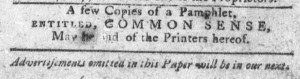
“A few Copies of a Pamphlet, ENTITLED, COMMON SENSE, May be had of the Printers hereof.”

Alexander Robertson, James Robertson, and John Trumbull, the printers of the Norwich Packet, ran out of space for all the content intended for the March 11, 1776, edition of their newspaper.  They inserted a brief notice advising, “Advertisements omitted in this Paper will be in our next.”  They did have just enough space to insert a revised advertisement for Thomas Paine’s Common Sense immediately above that notice: “A few Copies of a Pamphlet, ENTITLED, COMMON SENSE, May be had of the Printers hereof.”
Norwich Packet (March 11, 1776).

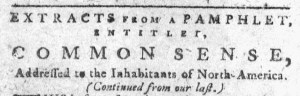
The printers first ran a variation of that advertisement on February 26, but that was not the extent of the notice that Common Sense received in that issue.  Nathanel Patten, a bookbinder and stationer, inserted a separate advertisement that provided an overview of the contents by listing the section headings.  That replicated advertisements for Common Sensethat previously appeared in other newspapers.  In addition, the Robertsons and Trumbull published “EXTRACTS from aPamphlet entitled COMMON SENSE; addressed to the INHABITANTS of AMERICA” on the third page.  In making their selection, they passed over the first section of the pamphlet, “Of the Origin and Design of Government in general, with concise Remarks on the English Constitution,” and went directly to the second section, “Of MONARCHY and hereditary succession.”  The printers devoted half a column to the “EXTRACTS” and promised, “[To be continued.]” They were more generous the following week, allowing nearly two columns for “EXTRACTS FROM A PAMPHLET, ENTITLED, COMMON SENSE.”  In the issue that “omitted” advertisements and promised publication “in our next,” the printers designated two columns for further “EXTRACTS.”  They sacrificed valuable advertising revenue as they disseminated a portion of the popular political pamphlet to readers, though they may have recouped some of that lost revenue by enticing readers to purchase the pamphlet.  The Robertsons and Trumbull continued publishing “EXTRACTS” in another two columns on March 18 and just over two columns on March 25.  On April 1, they gave over the entire first page and another two columns on the last page to continuing the “EXTRACTS.”  On April 8, they concluded the extracted portion of Common Sense, once again featuring it on the first page along with nearly two columns on the last page.  They also promised more material related to the pamphlet, “Additions to the above,” in the next issue.  The Robertsons and Trumbull made it possible for colonizers to engage with Common Sense along multiple trajectories. They could purchase the entire pamphlet and read it for themselves, peruse the extracts in the Norwich Packet, and discuss what they read with others who debated the merits of declaring independence.

February 26

What was advertised in a revolutionary American newspaper 250 years ago today?

Norwich Packet (February 26, 1776).

“A few Copies of a Pamphlet ENTITLED, Common Sense.”

As February 1776 came to a close, more printers and booksellers made copies of Thomas Paine’s Common Sense available to local readers.  Two advertisements for the popular political pamphlet appeared in the February 26 edition of the Norwich Packet.  In one, the very first advertisement that appeared in that issue, Alexander Robertson, James Robertson, and John Trumbull announced that “A few Copies of a Pamphlet ENTITLED, Common Sense; ADDRESSED TO THE INHABITANTS OF NORTH AMERICA, May be had of the Printers hereof.”  They did not provide any other details.  In contract, Nathaniel Patten, a bookbinder and stationer, inserted a notice that resembled many others that appeared in newspapers in other towns, including the advertisements for the first edition published by Robert Bell in Philadelphia.  It gave the title, previewed the contents with a list of the section headings, and concluded with an epigraph from “Liberty,” a poem by James Thomson.

Norwich Packet (February 26, 1776).

Which editions of Common Sense did the printers and Patten sell?  Three days earlier, Timothy Green, the printer of the Connecticut Gazette in New London, announced the imminent publication of a local edition jointly undertaken with Judah P. Spooner in Norwich.  Curiously, Spooner did not place his own advertisement in the Norwich Packet.  The “few Copies” that the Robertsons and Trumbull stocked may have been sent to them by the industrious Bell who had previously supplied William Green, a bookbinder in New York, with copies of the first edition and an unauthorized second edition.  The printers could have also received copies of a New York edition published by John Anderson, the printer of the Constitutional Gazette, or a Providence edition, published by John Carter, the printer of the Providence Gazette, that went to press even more recently.  By the time the Robertsons and Trumbull ran their advertisement, the paths of circulation for the various editions crisscrossed each other.  Similarly, Patten could have sold any of those editions.  His advertisement declared, “Just published and sold by Nathaneil Patten,” yet eighteenth-century readers knew to separate the phrases “Just published” and “sold by.”  The latter referred to Patten, but not necessarily the former. Instead, “Just published” meant “Now available.”  Patten very well have promoted the local edition produced by Spooner.  According to Richard Gimbel, Spooner and Green produced the only editions of Common Sense published in Norwich in 1776.[1]  Whatever the origins of the copies advertised in the Norwich Packet, the printers and Patten participated in the widespread dissemination of the most influential political pamphlet published during the era of the American Revolution.

**********

[1] Richard Gimbel, Thomas Paine: A Bibliographical Check List of Common Sense with an Account of Its Publication (New Haven: Yale University Press, 1956), 90.

November 27

What was advertised in a revolutionary American newspaper 250 years ago today?

Norwich Packet (November 27, 1775).

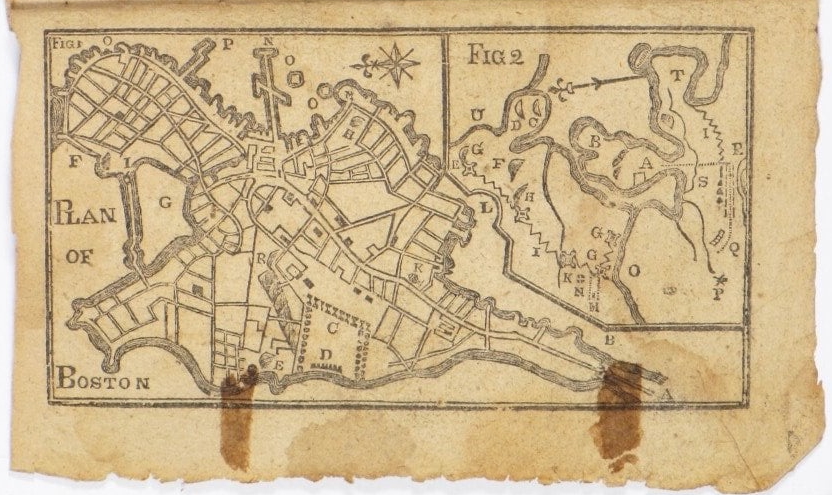
“Illustrated with a beautiful PLAN OF BOSTON, AND THE PROVINCIAL CAMP.”

When Alexander Robertson, James Robertson, and John Trumbull, printers of the Norwich Packet, advertised Bickerstaff’s New-England Almanack, For the Year of Our Lord, 1776, they promoted the “beautiful PLAN OF BOSTON, AND THE PROVINCIAL CAMP” that accompanied the handy reference volume.  Like many other almanacs for 1776 (published in the final months of 1775), this one featured items related to the events that had transpired since the battles at Lexington and Concord on April 19.  In addition to the map of Boston, it also contained the “Method of making Gun-Powder, which at this Juncture may be carried into Execution in a small Way, by almost every Farmer in his own Habitation.”  In a resolution passed in late June, the Second Continental Congress encouraged colonizers to contribute to the American cause by manufacturing gunpowder and saltpeter in small batches.

As a marketing strategy, the printers highlighted the “PLAN OF BOSTON, AND THE PROVINCIAL CAMP” that depicted the ongoing siege of Boston by the American army under the command of George Washington.  Along with the headline in the advertisement, they listed the elements of the “very neat Plan of the Town of Boston, shewing at one View, the Provincial Camp, Boston Neck, Fortifications, Commons, Battery, Magazine, … Liberty Tree, … Bunker’s Hill, … Provincial Lines, … Roxbury Hill Lines, Ministerial Army’s Lines,” and many other significant sites in the area.  The Robertsons and Trumbull declared that this map was “Equally accurate with that sold in the southern Colonies at one Spanish Dollar.”  Consumers did indeed have other options for purchasing similar maps, either separately or inserted in the Pennsylvania Magazine or inserted in another almanac.  Indeed, the map that accompanied Bickerstaff’s New-England Almanack looked almost identical to the one that illustrated “HUTCHIN’s Improv’d,” printed and sold by Hugh Gaine in New York.  Maps of Boston proliferated in 1775 as printers sought to generate revenues while keeping the public informed about current events and consumers sought materials beyond news reports to help them envision and understand what occurred in Massachusetts as resistance became revolution.

“Plan of Boston,” in Bickerstaff’s New-England Almanack, for the Year of Our Lord, 1776 (Norwich, Connecticut: Robertsons and Trumbull, 1775). Courtesy Boston Rare Maps.