
What was advertised in a revolutionary American newspaper 250 years ago today?
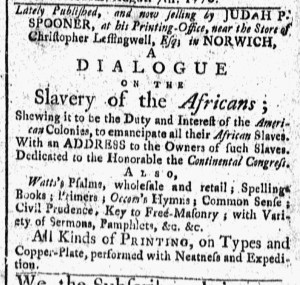
“A DIALOGUE ON THE Slavery of the Africans.”
Newspapers published during the era of the American Revolution contributed to the perpetuation of slavery. Throughout the colonies and the new nation, newspapers regularly carried advertisements that presented enslaved people for sale or offered rewards for the capture and return of enslaved people who liberated themselves by running away from their enslavers. News items and editorials also stoked fear of enslaved people to justify keeping them in bondage.
On occasion, however, the public prints carried advertisements, news, or editorials that advocated for the liberty of certain enslaved people or emancipating all enslaved people. In April 1776, for instance, an advertisement announced that “DICK (a Negro) … [was] now made free from Slavery by the Charity of the People” of Middletown, Connecticut, “and by virtue of his Freedom, has Liberty to procure the necessaries of Life by his own Industry, as other free born Subjects have.” In June 1775, William Henshaw published an advertisement on behalf of the Committees of Correspondence in Worcester County, Massachusetts. Upon receiving a petition from “the NEGROES in the counties of Bristol and Worcester,” the Committees of Correspondence passed a resolution stating that “we abhor the enslaving of any of the human race, and particularly of the NEGROES in this county.” They pledged to “use our influence” to aid in efforts for “emancipating the NEGROES.” They applied the rhetoric of the American Revolution to the literal enslavement of Africans and African Americans instead of considering only the figurative enslavement of colonizers.
In the summer of 1776, Judah P. Spooner published and sold A Dialogue, Concerning the Slavery of the Africans: Shewing It To Be the Duty and Interest of the American Colonies to Emancipate All Their African Slaves at his printing office in Norwich Connecticut. The book included “an ADDRESS to the Owners of such Slaves.” The author, Samuel Hopkins, a Congregationalist minister in Newport, dedicated the volume “to the Honorable the Continental Congress.” Like the Committees of Correspondence in Worcester County, Hopkins recognized the contradictions inherent in revolutionary rhetoric that espoused liberty for colonizers but did not include calling for the abolition of slavery.
That an advertisement for A Dialogue, Concerning the Slavery of Africans appeared in the August 16, 1776, edition of the Connecticut Gazette did not mean, however, that Timothy Green, the printer of that newspaper, endorsed anything that Hopkins wrote about slavery. In the previous issue, Green published an advertisement that described Sy, “a Mustee Fellow,” and offered a reward to “Whoever takes up said Negro, and secures him, or returns him to his Master.” Similarly, Spooner, the printer of both the Norwich Packet and A Dialogue, Concerning the Slavery of Africans, published a similar advertisement about “a Negro MAN Servant, named FORTEN,” in the August 5 issue and regularly generated revenue by printing other advertisements about enslaved people. Even as Hopkins attempted to use the power of the press to advocate for abolition, enslavers and printers continued perpetuating slavery with the advertisements they published.