
What was advertised in a revolutionary American newspaper 250 years ago today?
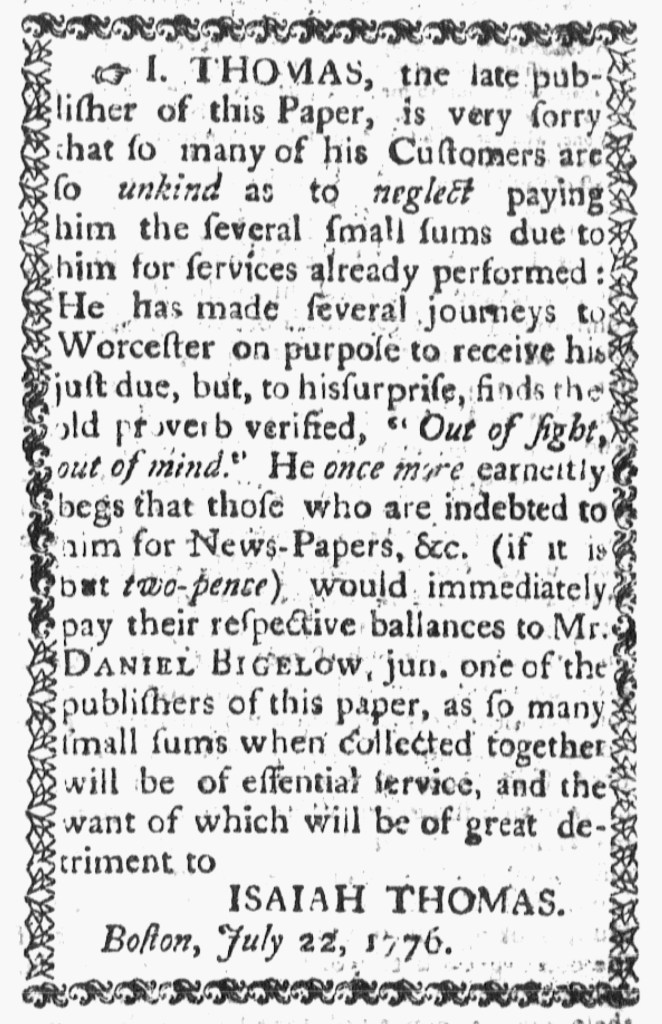
“He once more earnestly begs that those who are indebted to him for News-Papers … would immediately pay their respective ballances.”
When Isaiah Thomas transferred the Massachusetts Spy to William Stearns and Daniel Bigelow and returned to Boston in the summer of 1776, he had difficulty collecting payments from his former customers. Even though he made several trips to Worcester to tie up loose ends, that was not enough so he resorted to placing advertisements in the newspaper he formerly printed.
“I. THOMAS, the late publisher of this Paper,” he declared, “is very sorry that so many of his Customers are so unkind as to neglect paying him the several small sums due to him for services already performed.” In addition to newspaper subscriptions, those services likely ranged from job printing of handbills and blanks to purchases of books, pamphlets, stationery supplies, and even patent medicines. Thomas may even have allowed credit for newspapers advertisements. He expressed exasperation that he “made several journeys to Worcester on purpose to receive his just due” for the services he had rendered to the public in printing the first newspaper in the town and establishing its first printing office, “but, to his surprise, finds the old proverb verified, ‘Out of sight, out of mind.’” In case his former customers considered what they owed so inconsequential that Thomas would not miss it, he made a plea that “that those who are indebted to him for News-Papers, &c. (if it is but two-pence) would immediately pay their respective ballances … as so many small sums when collected together will be of essential service” to him. In contrast, “the want of which will be of great detriment” as he pursued new endeavors.
That advertisement, dated “Boston, July 22, 1776,” was not the first that Thomas ran in the Massachusetts Spy. He previously inserted a shorter notice, dated “Worcester, June 14, 1776.” When it did not have the desired effect, Stearns and Bigelow enclosed Thomas’s new advertisement with a border of ornamental type and gave it a privileged place as the first item in the first column on the first page of the July 24 edition of the Massachusetts Spy. Thomas may have instructed or insisted that the inexperienced printers do so rather than leaving it completely to their discretion. In subsequent issue, the notice moved to the final page, but the border remained, distinguishing the advertisement from all other content in the newspaper. The format demanded the attention of readers who had treated Thomas as “Out of sight, out of mind.”