
What was advertised in a revolutionary American newspaper 250 years ago today?
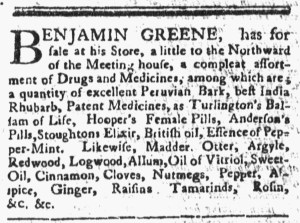
“Patent Medicines … Turlington’s Balsam of Life, Hooper’s Female Pills.”
In the summer of 1776, Benjamin Greene advertised a “compleat assortment of Drugs and Medicines” available “at his Store, a little to the Northward of the Meeting house,” in Worcester. He listed some of the items he stocked, including “a quantity of excellent Peruvian Bark, best India Rhubarb, … British oil, [and] Essence of Pepper-Mint.” Greene also carried popular patent medicines, such as “Turlington’s Balsam of Life, Hooper’s Female Pills, Anderson’s Pills, [and] Stoughtons Elixir.” Consumers were so familiar with those products that he did not need to say anything about their uses. In addition, Greene sold a variety of spices, from cinnamon and cloves to allspice and pepper. Whatever illnesses readers experienced, Green could supply some sort of medicine to alleviate their symptoms.
Greene’s notice was one of the few advertisements that appeared in the June 28 edition of the Massachusetts Spy. Isaiah Thomas had published the newspaper in Worcester for more than a year after relocating from Boston just as the Revolutionary War began, but, after the siege of Boston ended, he decided to seek opportunities in a larger town on the coast once again. He opted for Salem rather than returning to Boston, perhaps because of a smallpox outbreak in the colony’s largest port. William Stearns and Daniel Bigelow began printing the Worcester Spy on June 21. Greene advertised in that issue and again the following week, one of the few who trusted that the Massachusetts Spy had a large enough circulation under new management to justify the fee for purchasing space in the newspaper. He was the only purveyor of goods and services to place an advertisement in either issue. Joseph Jaseph advertised a stolen horse on June 21 and Solomon Jones advertised a lost pocketbook on June 28. The printers inserted a call for rags to recycle into paper in both issues, echoing their counterparts in towns throughout the colonies. That meant that Stearns and Bigelow generated some revenue from advertisements, but not much. Just as they had to convince residents of Worcester and other towns in central Massachusetts to become subscribers, they also had to build a clientele of advertisers following Thomas’s departure. For a while, it had been uncertain whether the newspaper would continue so advertisers fell away during its suspension. As they started the process, Greene experienced a lack of competition in the public prints, something that may have benefited his business as much as the advertising copy that he composed.