
What was advertised in a revolutionary American newspaper 250 years ago today?
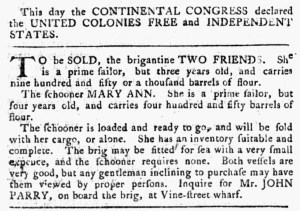
“TO be SOLD, the brigantine TWO FRIENDS.”
The most significant news from the Continental Congress first appeared in just three lines between an update from Pennsylvania’s Committee of Safety and an advertisement offering a brigantine and a schooner for sale in the June 2, 1776, edition of the Pennsylvania Evening Post. At the end of the news and before the paid notices, Benjamin Towne, the printer, informed readers that “[t]his day the CONTINENTAL CONGRESS declared the UNITED COLONIES FREE and INDEPENDENT STATES.” The following day, the Pennsylvania Gazette and the Pennsylvania Journaleach carried the news in their weekly issues, though neither provided many more details. The Pennsylvania Gazette replicated what appeared in the Pennsylvania Evening Post almost exactly, changing “This day” to “Yesterday” and placing the news first among the updates from Philadelphia but after news from London, Halifax, Charleston, Williamsburg, Watertown (outside of Boston), Providence, and New York. The Pennsylvania Journal have the news similar treatment, but did note that “the Congress Unanimously Resolved to Declare the UNITED COLONIES FREE AND INDEPENDANT STATES.”
Three newspapers reported that the Continental Congress declared independence before July 4, 1776. How does that square with the most common narrative about the American Revolution and the long practice of celebrating Independence Day on July 4? On July 2, the Continental Congress approved the Lee Resolution. On June 7, Richard Henry Lee, a delegate from Virginia, acting on instructions received from the Virginia Convention, proposed that the colonies declare independence, seek foreign alliances, and form a confederation for their mutual benefit. The Second Continental Congress did not immediately vote on Lee’s resolution since many delegates were waiting for instructions from their own colonies. Even though they delayed the vote, they established three committees to work on the elements of the resolution, including a committee to draft a declaration of independence. On July 2, the Continental Congress approved this resolution: “That these united colonies are and of right ought to be free and independent states; that they are absolved from all allegiance to the british crown and that all political connection between them and the state of great Britain is and out to be totally dissolved.”
The following day, John Adams included the news in a letter to his wife, Abigail. “The Second Day of July 1776,” he proclaimed, “will be the most memorable Epocha, in the History of America. I am apt to believe that it will be celebrated, by succeeding Generations, as the great anniversary Festival. It ought to be commemorated, as the Day of Deliverance by solemn Acts of Devotion to God Almighty. It ought to be solemnized with Pomp and Parade, with Shews, Games, Sports, Guns, Bells, Bonfires and Illuminations from one End of this Continent to the other from this Time forward forever more.” Yet history did not work out that way. On July 4, 1776, the Continental Congress approved a revised draft of a declaration of independence submitted by Thomas Jefferson and the other members of that committee. The Declaration of Independence then circulated in newspapers and on broadsides, each bearing the date July 4, 1776, the date that became associated with declaring independence.
News that the Continental Congress declared independence was much more substantial than the details of the sale of the brigantine Two Friends and the schooner Mary Ann that appeared immediately below it in the Pennsylvania Evening Post on July 2, 1776, yet such a momentous event has been largely overlooked in the narrative most familiar to the public. Historians of early America chronicle what occurred, but the importance of July 2 is not widely recognized in the popular memory of the events of the imperial crisis and the American Revolution.
[…] Continental Congress made a momentous decision when it voted to declare independence on July 2, 1776. News would spread as quickly as it could via the communication infrastructure in place in the […]
[…] the first to publish the Declaration of Independence in a newspaper. His newspaper had also been the first to inform the public that the Continental Congress voted in favor of independence on July …. Unlike other newspapers published in Philadelphia and most other newspapers published in America […]
[…] and the readers of the Freeman’s Journal did not yet know that the Continental Congress voted to declare independence on July 2 and then voted to approve a declaration of independence drafted by a committee that included Thomas […]