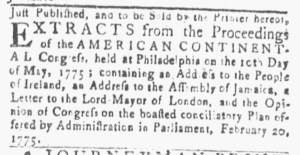
What was advertised in a revolutionary American newspaper 250 years ago today?
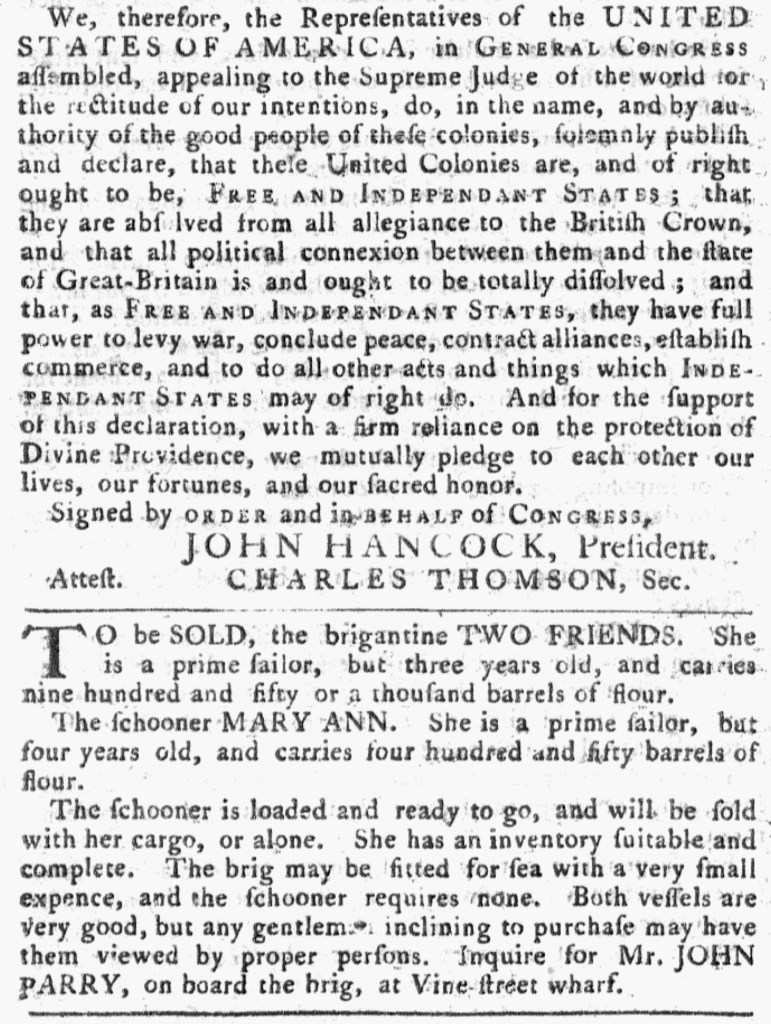
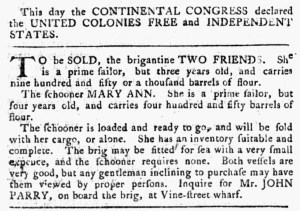
“TO be SOLD, the brigantine TWO FRIENDS.”
After the Continental Congress approved the Declaration of Independence on July 4, 1776, John Dunlap, the printer of Dunlap’s Pennsylvania Packet, set about printing approximately two hundred broadside copies. By the next morning, they were ready to dispatch to colonial assemblies, provincial conventions, and military commanders to inform them of the reasons and rationale for declaring independence. The Dunlap Broadside was the first printing of the Declaration of Independence … but Dunlap was not the first printer to publish the Declaration of Independence in a newspaper. He did indeed print it in the next edition of his weekly newspaper on July 8, but he did not move up the publication day, nor did he issue a supplement or extraordinary issue to disseminate the Declaration of Independence to his subscribers before the usual publication day.
Benjamin Towne, the printer of the Pennsylvania Evening Post, was the first to publish the Declaration of Independence in a newspaper. His newspaper had also been the first to inform the public that the Continental Congress voted in favor of independence on July 2. Unlike other newspapers published in Philadelphia and most other newspapers published in America at the time, the Pennsylvania Evening Post was not a weekly newspaper. Instead, Towne distributed new issues on Tuesday, Thursday, and Saturday. Without deviating from its usual publication schedule, the Pennsylvania Evening Post was the first newspaper to (twice!) deliver momentous news about independence to the public.
This timeline shows when the news circulated in newspapers printed in Philadelphia and cities with their own newspapers nearest Philadelphia:
Tuesday, July 2 – The Pennsylvania Evening Post reports, “This day the CONTINENTAL CONGRESS declared the UNITED COLONIES FREE and INDEPENDENT STATES.”
Wednesday, July 3 – The Pennsylvania Gazette and the Pennsylvania Journal both report that the Continental Congress declared independence from Great Britain.
Thursday, July 4 – The Pennsylvania Evening Post makes no mention of a declaration of independence. Towne does not repeat the same-day scoop he managed two days earlier.
Friday, July 5 – Henrich Millers Pennsylvanischer Staatsbote, published in German, reports that the Continental Congress declared independence and makes first mention of the Declaration of Independence in a newspaper: “Die Declaration in Englisch ist jetzt in der Presse; sie ist datirt, den 4ten July, 1776, und wird beut order morgen im deuct erscheinen.” [The Declaration in English is now in the press; it is dated July 4, 1776, and will appear in German today or tomorrow.]
Saturday, July 6 – The Pennsylvania Evening Post publishes the Declaration of Independence. The Pennsylvania Ledger does not.
Monday, July 8 – Dunlap’s Pennsylvania Packet publishes the Declaration of Independence and announces a public reading: “THIS DAY, at Twelve o’clock, the DECLARATION of INDEPENDENCE, will be PROCLAIMED at the STATE-HOUSE.”
Tuesday, July 9 – The Pennsylvania Evening Post reports, “Yesterday, at twelve o’clock, INDEPENDANCY was declared at the State-House in this city, in the presence of many thousand spectators, who testified their approbation of it by repeated acclamations of joy.” Henrich Millers Pennsylvanischer Staatsbote publishes a translation of the Declaration of Independence in German. Dunlap’s Maryland Gazette, printed in Baltimore, publishes the Declaration of Independence. News quickly spread beyond Philadelphia. Newspapers in Philadelphia adhered to their regular publication schedules. That meant that some did not publish the Declaration of Independence until after it appeared in newspapers in other cities.
Wednesday, July 10 – The Pennsylvania Gazette and the Pennsylvania Journal publish the Declaration of Independence. The Maryland Journal, another newspaper printed in Baltimore, publishes the Declaration of Independence. The Constitutional Gazette becomes the first newspaper in New York to publish the Declaration of Independence.
Thursday, July 11 – The New-York Journal and the New York Packet publish the Declaration of Independence. The Pennsylvania Evening Post reports on the reception the “DECLARATION OF INDEPENDANCY” received in Easton, Pennsylvania. After a public reading, a “great number of spectators … gave their hearty assent with three loud huzzas.”
Saturday, July 13 – The Pennsylvania Ledger publishes the Declaration of Independence a week after it appeared in the Pennsylvania Evening Post. The Pennsylvania Ledger was the last newspaper published in Philadelphia to print the Declaration of Independence. On the same day, the Pennsylvania Evening Post carries a report of “INDEPENDANCY proclaimed under a triple volley of musketry” in Princeton, New Jersey. It met with “universal acclamation for the prosperity of the UNITED STATES.”
What was the connection to advertisements that appeared in the Pennsylvania Evening Post on July 6 when it became the first newspaper to publish the Declaration of Independence? John Parry’s advertisement for the sale of two ships, the brigantine Two Friends and the schooner Mary Ann, followed the Declaration of Independence, immediately below the signature of “JOHN HANCOCK, President.” Parry’s advertisement previously appeared right after that newspaper’s announcement on July 2, the first in print, that the “CONTINENTAL CONGRESS declared the UNITED COLONIES FREE and INDEPENDENT STATES.” That was almost certainly by coincidence rather than by design. Quite by accident, Parry’s advertisement twice followed the first publication of one of the most consequential stories ever reported in American newspapers.