What was advertised in a revolutionary American newspaper 250 years ago today?
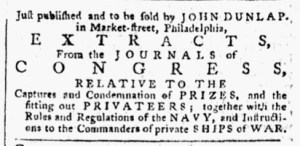
Dunlap’s Pennsylvania Packet (August 27, 1776).
“EXTRACTS … relative to the … fitting out PRIVATEERS; together with the Rules and Regulations of the NAVY.”
During the imperial crisis and the Revolutionary War, printers regularly published news from the Continental Congress and local assemblies in their newspapers. Sometimes they compiled the proceedings into books that they marketed and sold to consumers who wanted convenient access to that sort of overview of current events. Printers in many towns, for instance, published local editions of “EXTRACTS FROM THE VOTES AND PROCEEEDINGS OF THE AMERICAN CONTINENTAL CONGRESS” in the fall of 1774.
The printer apparently believed that a market for this item existed in the largest city in the new nation. Philadelphia was, after all, a busy port and many owners of vessels who pursued maritime commerce during times of peace contemplated how they could aid the war effort while simultaneously getting their share of prize money when they outfitted their ships for privateering. Dunlap made this handy manual available alongside an array of military manuals published in Philadelphia and other cities. Rather than hundreds of pages, like some of volumes containing the proceedings of the Continental Congress, this octavo pamphlet consisted of only forty-eight pages. That made it a convenient size for officers on both privateers and naval vessels to stow among their possessions when they went to sea and then consult as necessary. Dunlap printed this practical guide as a service, yet he also generated revenue from its sale.
What was advertised in a revolutionary American newspaper 250 years ago today?
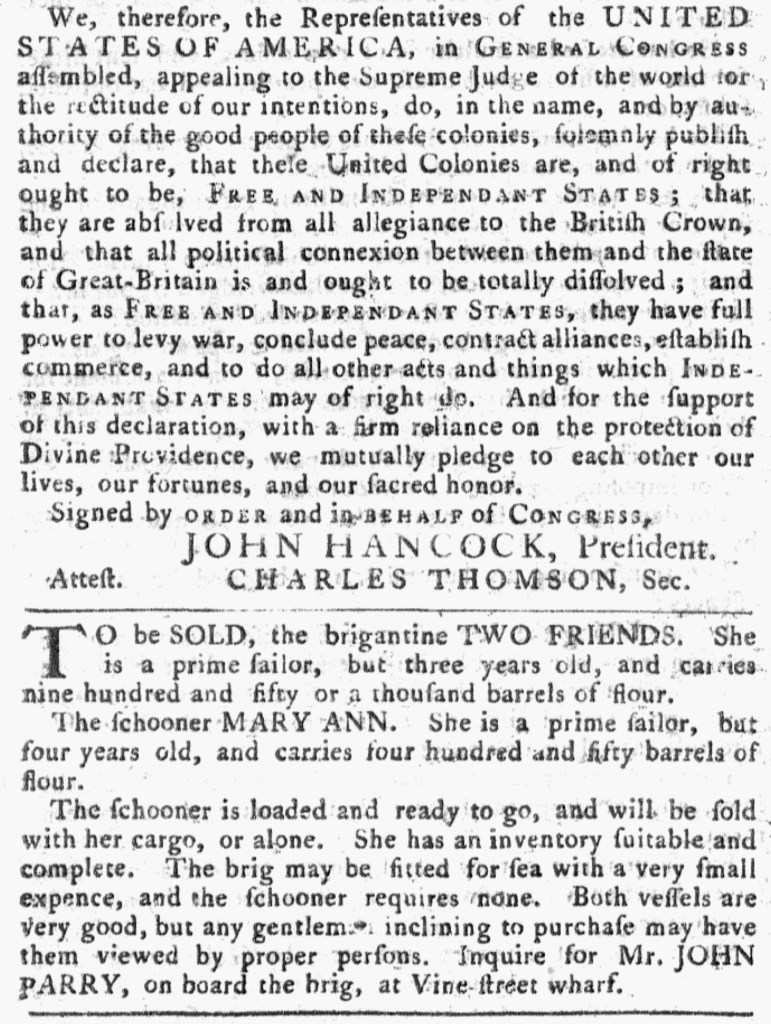
Pennsylvania Evening Post (July 6, 1776).
“TO be SOLD, the brigantine TWO FRIENDS.”
After the Continental Congress approved the Declaration of Independence on July 4, 1776, John Dunlap, the printer of Dunlap’s Pennsylvania Packet, set about printing approximately two hundred broadside copies. By the next morning, they were ready to dispatch to colonial assemblies, provincial conventions, and military commanders to inform them of the reasons and rationale for declaring independence. The Dunlap Broadside was the first printing of the Declaration of Independence … but Dunlap was not the first printer to publish the Declaration of Independence in a newspaper. He did indeed print it in the next edition of his weekly newspaper on July 8, but he did not move up the publication day, nor did he issue a supplement or extraordinary issue to disseminate the Declaration of Independence to his subscribers before the usual publication day.
Benjamin Towne, the printer of the Pennsylvania Evening Post, was the first to publish the Declaration of Independence in a newspaper. His newspaper had also been the first to inform the public that the Continental Congress voted in favor of independence on July 2. Unlike other newspapers published in Philadelphia and most other newspapers published in America at the time, the Pennsylvania Evening Post was not a weekly newspaper. Instead, Towne distributed new issues on Tuesday, Thursday, and Saturday. Without deviating from its usual publication schedule, the Pennsylvania Evening Post was the first newspaper to (twice!) deliver momentous news about independence to the public.
This timeline shows when the news circulated in newspapers printed in Philadelphia and cities with their own newspapers nearest Philadelphia:
Wednesday, July 3 – The Pennsylvania Gazette and the Pennsylvania Journal both report that the Continental Congress declared independence from Great Britain.
Thursday, July 4 – The Pennsylvania Evening Post makes no mention of a declaration of independence. Towne does not repeat the same-day scoop he managed two days earlier.
Friday, July 5 – Henrich Millers Pennsylvanischer Staatsbote, published in German, reports that the Continental Congress declared independence and makes first mention of the Declaration of Independence in a newspaper: “Die Declaration in Englisch ist jetzt in der Presse; sie ist datirt, den 4ten July, 1776, und wird beut order morgen im deuct erscheinen.” [The Declaration in English is now in the press; it is dated July 4, 1776, and will appear in German today or tomorrow.]
Saturday, July 6 – The Pennsylvania Evening Post publishes the Declaration of Independence. The Pennsylvania Ledger does not.
Monday, July 8 – Dunlap’s Pennsylvania Packet publishes the Declaration of Independence and announces a public reading: “THIS DAY, at Twelve o’clock, the DECLARATION of INDEPENDENCE, will be PROCLAIMED at the STATE-HOUSE.”
Tuesday, July 9 – The Pennsylvania Evening Post reports, “Yesterday, at twelve o’clock, INDEPENDANCY was declared at the State-House in this city, in the presence of many thousand spectators, who testified their approbation of it by repeated acclamations of joy.” Henrich Millers Pennsylvanischer Staatsbote publishes a translation of the Declaration of Independence in German. Dunlap’s Maryland Gazette, printed in Baltimore, publishes the Declaration of Independence. News quickly spread beyond Philadelphia. Newspapers in Philadelphia adhered to their regular publication schedules. That meant that some did not publish the Declaration of Independence until after it appeared in newspapers in other cities.
Wednesday, July 10 – The Pennsylvania Gazette and the Pennsylvania Journal publish the Declaration of Independence. The Maryland Journal, another newspaper printed in Baltimore, publishes the Declaration of Independence. The Constitutional Gazette becomes the first newspaper in New York to publish the Declaration of Independence.
Thursday, July 11 – The New-York Journal and the New York Packet publish the Declaration of Independence. The Pennsylvania Evening Post reports on the reception the “DECLARATION OF INDEPENDANCY” received in Easton, Pennsylvania. After a public reading, a “great number of spectators … gave their hearty assent with three loud huzzas.”
Saturday, July 13 – The Pennsylvania Ledger publishes the Declaration of Independence a week after it appeared in the Pennsylvania Evening Post. The Pennsylvania Ledger was the last newspaper published in Philadelphia to print the Declaration of Independence. On the same day, the Pennsylvania Evening Post carries a report of “INDEPENDANCY proclaimed under a triple volley of musketry” in Princeton, New Jersey. It met with “universal acclamation for the prosperity of the UNITED STATES.”
What was the connection to advertisements that appeared in the Pennsylvania Evening Post on July 6 when it became the first newspaper to publish the Declaration of Independence? John Parry’s advertisement for the sale of two ships, the brigantine Two Friends and the schooner Mary Ann, followed the Declaration of Independence, immediately below the signature of “JOHN HANCOCK, President.” Parry’s advertisement previously appeared right after that newspaper’s announcement on July 2, the first in print, that the “CONTINENTAL CONGRESS declared the UNITED COLONIES FREE and INDEPENDENT STATES.” That was almost certainly by coincidence rather than by design. Quite by accident, Parry’s advertisement twice followed the first publication of one of the most consequential stories ever reported in American newspapers.
What was advertised in a revolutionary American newspaper 250 years ago today?
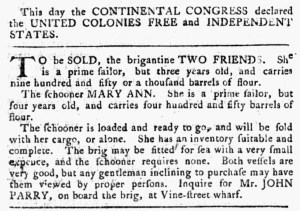
Pennsylvania Evening Post (July 2, 1776).
“TO be SOLD, the brigantine TWO FRIENDS.”
The most significant news from the Continental Congress first appeared in just three lines between an update from Pennsylvania’s Committee of Safety and an advertisement offering a brigantine and a schooner for sale in the June 2, 1776, edition of the Pennsylvania Evening Post. At the end of the news and before the paid notices, Benjamin Towne, the printer, informed readers that “[t]his day the CONTINENTAL CONGRESS declared the UNITED COLONIES FREE and INDEPENDENT STATES.” The following day, the Pennsylvania Gazette and the Pennsylvania Journaleach carried the news in their weekly issues, though neither provided many more details. The Pennsylvania Gazette replicated what appeared in the Pennsylvania Evening Post almost exactly, changing “This day” to “Yesterday” and placing the news first among the updates from Philadelphia but after news from London, Halifax, Charleston, Williamsburg, Watertown (outside of Boston), Providence, and New York. The Pennsylvania Journal have the news similar treatment, but did note that “the Congress Unanimously Resolved to Declare the UNITED COLONIES FREE AND INDEPENDANT STATES.”
Three newspapers reported that the Continental Congress declared independence before July 4, 1776. How does that square with the most common narrative about the American Revolution and the long practice of celebrating Independence Day on July 4? On July 2, the Continental Congress approved the Lee Resolution. On June 7, Richard Henry Lee, a delegate from Virginia, acting on instructions received from the Virginia Convention, proposed that the colonies declare independence, seek foreign alliances, and form a confederation for their mutual benefit. The Second Continental Congress did not immediately vote on Lee’s resolution since many delegates were waiting for instructions from their own colonies. Even though they delayed the vote, they established three committees to work on the elements of the resolution, including a committee to draft a declaration of independence. On July 2, the Continental Congress approved this resolution: “That these united colonies are and of right ought to be free and independent states; that they are absolved from all allegiance to the british crown and that all political connection between them and the state of great Britain is and out to be totally dissolved.”
The following day, John Adams included the news in a letter to his wife, Abigail. “The Second Day of July 1776,” he proclaimed, “will be the most memorable Epocha, in the History of America. I am apt to believe that it will be celebrated, by succeeding Generations, as the great anniversary Festival. It ought to be commemorated, as the Day of Deliverance by solemn Acts of Devotion to God Almighty. It ought to be solemnized with Pomp and Parade, with Shews, Games, Sports, Guns, Bells, Bonfires and Illuminations from one End of this Continent to the other from this Time forward forever more.” Yet history did not work out that way. On July 4, 1776, the Continental Congress approved a revised draft of a declaration of independence submitted by Thomas Jefferson and the other members of that committee. The Declaration of Independence then circulated in newspapers and on broadsides, each bearing the date July 4, 1776, the date that became associated with declaring independence.
News that the Continental Congress declared independence was much more substantial than the details of the sale of the brigantine Two Friends and the schooner Mary Ann that appeared immediately below it in the Pennsylvania Evening Post on July 2, 1776, yet such a momentous event has been largely overlooked in the narrative most familiar to the public. Historians of early America chronicle what occurred, but the importance of July 2 is not widely recognized in the popular memory of the events of the imperial crisis and the American Revolution.