
Who was the subject of an advertisement in a revolutionary American newspaper 250 years ago today?
On July 26, 1776, Alexander Purdie’s Virginia Gazette became one of the last American newspapers to print the Declaration of Independence in its entirety. That issue and the supplement that accompanied it also carried several advertisements about enslaved people, yet it was not the only American newspaper that simultaneously disseminated the Declaration of Independence and published advertisements that contributed to the perpetuation of slavery in the new nation. Advertisements presenting enslaved people for sale, seeking to purchase enslaved people, offering rewards for the capture and return of enslaved people who liberated themselves by running away, and describing Black people imprisoned as suspected fugitives seeking freedom ran alongside the Declaration of Independence in newspapers from New Hampshire to Virginia. (All the newspapers in Georgia, North Carolina, and South Carolina had been suspended or ceased publication by July 1776. The South-Carolina and American General Gazette printed the Declaration of Independence when it resumed publication on August 2, 1776, but no copies of that exceptionally rare issue have been digitized for greater access. Given the content that usually appeared in that newspapers and others printed in Charleston, the August 2 edition almost certainly included advertisements about enslaved people.)
This timeline provides a census of advertisements about enslaved people that appeared in the same issues of American newspapers that printed the Declaration of Independence.
Dunlap’s Maryland Gazette; Or, the Baltimore General Advertiser printed the Declaration of Independence on the second page. On the first page, Thomas Nicholls described “Dickison, otherwise Joe,” an enslaved man “frequently used to both names” who liberated himself by running away. Nicholls offered “TWENTY DOLLARS REWARD” for the capture and return of Dickison.
The Constitutional Gazette, published in New York, printed the Declaration of Independence on the first and second pages. A reader wrote, “A Good thing” in the margin above the masthead on the first page of the copy digitized for America’s Historical Newspapers. On the fourth page, Goodheart Siegler advertised “a negro boy named PRINCE” who may have “entered into the Continental Army.” Siegler offered “FORTY SHILLING REWARD” to whoever “will bring [Prince] to his master.”
The Maryland Journal and the Baltimore Advertiser printed the Declaration of Independence on the first and second pages. It was one of the few newspapers to devise a separate headline: “THE THIRTEEN United STATES OF AMERICA, Have declared INDEPENDENCY.” Clement Brooke advertised “a negro man named GEORGE” on the fourth page. Brooke suspected that George might be “harboured by some person in the neighbourhood.”
The Pennsylvania Gazette, published in Philadelphia, printed the Declaration of Independence in the first two columns on the first page. Alexander McCallum’s advertisement describing “a dark Mulattoe Slave, named HARRY” and offering “TEN DOLLARS Reward” appeared in the third column on the same page as the Declaration of Independence. Another advertisement about an enslaved man who liberated himself by running away ran on the fourth page. In it, Charles Heath described Ben and offered “EIGHT DOLLARS Reward.” The advertisement immediately above it offered a “strong healthy NEGROE Man” for sale with instructions to “Enquire of the PRINTERS” for more information.
The Pennsylvania Journal, published in Philadelphia, printed the Declaration of Independence on the first and second pages. On the third page, Thomas Wild, the jailer in Dover, Delaware, described a Black man “who calls himself SAMBO” who had been captured and imprisoned as a suspected fugitive seeking freedom. Wild called on Sambo’s enslaver to claim him immediately “or else he will be sold out for his prison charges.” On the fourth page, George Slacom, Sr., advertised “THREE country born NEGRO MEN, all brothers,” who liberated themselves. He offered rewards for Tom, Jim, and Phill.
The Maryland Gazette, published in Baltimore, printed the Declaration of Independence on the third page. Three advertisements about enslaved men appeared on the fourth page. James Smith described “a negro man called PHIL” and offered a reward for his capture and return. Similarly, Alexander Ogg sought to enslave a “negro fellow named WILL” who had liberated himself by running away. Hugh Hopewell, the sheriff of St. Mary’s County, advertised that he held “Negro Adam,” who says he belongs to Levin Woolford,” in his custody.
John Holt printed the Declaration of Independence as a broadside within his newspaper, the New-York Journal, devoting the entire third page to it. Three advertisements offering rewards for enslaved men who liberated themselves by running away from their enslavers appeared on the fourth page. Those advertisements appeared on the same sheet of page, but on opposite sides. Jacob Wilkins described “a negro man named JACK,” William Conary, Jr., described “a negro man, named PRINCE,” and Benjamin Pitney described “a negro man named SAMSON.” They offered rewards varying from one dollar to ten dollars.
The New York Packet printed the Declaration of Independence on the second page. John Taylor described “a Negro Man, named BEN,” who liberated himself from his enslaver in New Germantown, New Jersey, in an advertisement on the fourth page. Taylor described the clothes Ben wore when he made his escape and the clothes that he took with him to aid readers in recognizing the fugitive for freedom if he changed his apparel or attempted to sell any of the items.
The Connecticut Gazette, published in New London, printed the Declaration of Independence in the second and third columns on the second page. The third column concluded with an advertisement in which Joseph Farnham, Jr., described “a negro man servant named JACK” who liberated himself by running away. Farnham warned that “all masters of vessels and others are hereby cautioned not to carry off nor conceal said negro.” That issue consisted of two pages rather than the usual four pages. The printer found room for both the Declaration of Independence and an advertisement placed for the purpose of re-enslaving Jack.
The New-York Gazette and Weekly Mercury printed the Declaration of Independence on the first page. Three advertisements about enslaved people ran on the second page. Henry Wyckhoff described “two Negro Men.” Nathaniel and Jacob were brothers who worked together to liberate themselves from Wyckhoff, Nathaniel’s enslaver, and Jeromus Remsen, Jacob’s enslaver. Goodheart Siegler placed the same advertisement offering a reward for the capture and return of Prince that previously appeared in the Constitutional Gazette. An anonymous advertiser “WANTED, AN handsome well made Mulatto Waiting-Man, who can be recommended for his Honesty and Sobriety.” Anyone willing to sell such a slave was instructed to “Enquire of the Printer.”
Solomon Southwick, the printer of the Newport Mercury, announced the sale of a broadside edition of the Declaration of Independence in an advertisement near the bottom of the second column on the third page. He also noted that he would print the founding document in the newspaper within a week. The anonymous advertiser who placed the notice that started the next column sought to purchase an enslaved boy: “WANTED a likely, sprightly NEGRO BOY, about ten or twelve years old: – Inquire of the printer.”
The Norwich Packet; and the Connecticut, Massachusetts, New-Hampshire and Rhode Island Weekly Advertiser printed the Declaration of Independence on the second page. On the third page, facing the Declaration of Independence, Joshua Chappell offered a reward for the capture and return of “a Negro MAN Servant, named FORTEN.” He cautioned that “All Persons are forbid harbouring said Negro.”
The American Gazette, published in Salem, Massachusetts, printed the Declaration of Independence on the first and fourth pages. A woodcut depicting an enslaved person on the run adorned Benjamin Raymond’s advertisement about “a Negro Man named CAESAR” on the third page. Raymond offered “TWO DOLLARS Reward” for the capture and return of Caesar. In another advertisement on the third page, John White, Jr., announced that he “HAS a Negro Woman to part with” and instructed that “Any Person inclining to have her, may treat with him at his House in Salem.”
The Continental Journal, published in Boston, printed the Declaration of Independence on the first page. Three advertisements about enslaved people appeared on the fourth page. One offered “A Negro Woman” for sale, using the printer as an intermediary and broker in the transaction. The enslaved woman “understands Housework, common Cooking,” and other domestic tasks. Andrew Mitchel offered “EIGHT DOLLARS REWARD” for the capture and return of “a Negro Man named CATO.” He even designated local agents in Albany, Boston, and Pittsfield who would confine Cato if delivered to any of them. Another advertisement concerned plans to sell a brigantine “retaken” from the British and now at Portsmouth, New Hampshire. “There were four Negroes taken with said Brigantine,” a nota benebegan. It then listed two men, Adam and Scip, and two women, Bilinder and Brada, and identified the enslavers who could claim them.
In an extraordinary issue of the Newport Mercury, Solomon Southwick printed the Declaration of Independence on the second and third pages. He was the only printer to deviate from the usual publication schedule by issuing a supplement or extraordinary to disseminate the founding document to readers. The advertisement seeking “a likely, sprightly NEGRO BOY, about ten or twelve years old,” ran once again, this time immediately above the colophon on the fourth page.
Alexander Purdie’s Virginia Gazette, published in Williamsburg, printed the last three paragraphs of the Declaration of Independence as an “Abstract from the minutes of the General Congress” on the second page. Purdie promised that the entire document “will be published at full length in next week’s Gazette.” William Browne’s advertisement describing “a mulatto servant man, named John Newton,” and offering “TEN DOLLARS REWARD” appeared on the fourth page. Among Newton’s skills, he “shaves and dresses well.” The two-page supplement that accompanied that issue featured five more advertisements about enslaved people. One offered “about forty NEGROES” for sale at the same time as a “VALUABLE tract of land” and the livestock and equipment on that plantation. Two concerned enslaved men who liberated themselves by running away. John Nicholas advertised three “Virginia born NEGRO men slaves,” named Harry, York, and Adam, while Mungo Harvey offered a reward for the capture and return of “two men slaves, both Virginia born,” named Billy and Kitt. The other two advertisements concerned Black men who had been captured and committed to jail as suspected runaways. According to James Bowdrie, Abraham was “TAKEN up at Layton’s warehouse, in Essex county.” Abraham may have been “sent here in a ship with many others from Barbados … to fight for lord Dunmore,” the last royal governor of Virginia. John Harwood, the jailer “of Charles City county,” advertised that he held Hampton and Robert. He asked their enslavers “to fetch them away, and pay charges” for the expense of confining them.
The Declaration of Independence appeared as a broadside within a newspaper on the fourth page of the Freeman’s Journal, published in Portsmouth, New Hampshire. The notice concerning the captured brigantine and the four enslaved people aboard the vessel that previously appeared in the Continental Journal ran on the third page, the reverse side of the page devoted to the Declaration of Independence.
John Dixon and William Hunter printed the Declaration of Independence on the second page of their Virginia Gazette, published in Williamsburg. Printed on a smaller sheet than most other American newspapers, that issue consisted of six pages rather than the usual four. On the fourth page, Nicholas Scouvemont inserted and advertisement that described Bagley, “a Negro man” who “has several Relations in Gloucester County, and … may have gone that way.” Scouvemont offered “TEN SHILLINGS Reward” for the capture and return of Bagley. Two more advertisements about enslaved people appeared on the sixth page. William Brown described John Newton, “an Asiatic Indian by Birth” who had been “about twelve Months in Virginia.” Brown reported that Newton was “a good Barber and Hairdresser,” so “it is probable he many endeavour to follow those Occupations as a free Man.” John Nicholas published the advertisement about Harry, York, and Adam that previously appeared in Purdie’s Virginia Gazette, making a significant investment in recovering the Black men who had liberated themselves by running away.
The Boston-Gazette and Country Journal, published in Watertown, printed the Declaration of Independence on the first page. An anonymous advertisements instructing interested parties to “Enquire of the printer” offered a “strong healthy negro man” for sale on the third page. The notice concerning the captured brigantine and the four enslaved people aboard the vessel that previously appeared in the Continental Journal and the Freeman’s Journal ran on the fourth page.
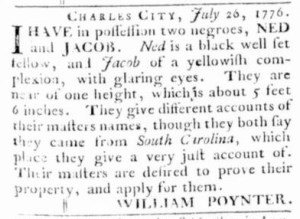
As promised in the previous issue, Alexander Purdie printed the Declaration of Independence on the first and second pages of his Virginia Gazette. Two new advertisements about enslaved men appeared on the third page. Miles Selden described “a negro man named GEORGE” who took a horse with him when he liberated himself by running away from his enslaver. Selden offered rewards for both George and the horse. William Poynter gave descriptions of Ned and Jacob, two Black men in his custody in Charles City. According to Poynter, “they both say they came from South Carolina.” They tried to put as much distance as possible between themselves and their former enslavers. A two-page supplement accompanied that issue of Purdie’s Virginia Gazette. Each of them ran in the supplement the previous week: Thomas M. Randolph’s advertisement offering “about forty NEGROES” for sale, Bowdrie’s advertisement about Abraham, supposedly sent from Barbados to fight with Dunmore, and Nicholas’s advertisement about Harry, York, and Adam who liberated themselves from their enslavers together.
Overall, advertisements about enslaved people appeared in two-thirds of the issues of American newspapers that printed the Declaration of Independence. As newspapers reported on the dissemination and reception of the Declaration of Independence, especially public readings held in cities throughout the new nation, they continued to publish advertisements about enslaved people side by side the proclamations of liberty. Early American newspapers simultaneously promoted freedom (for some people) while helping to perpetuate slavery (for other people).