
What was advertised in a revolutionary American newspaper 250 years ago today?
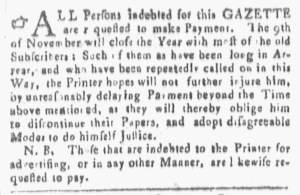
“They will oblige him to discontinue their Papers, and adopt disagreeable Modes to do himself Justice.”
During the era of the American Revolution, newspaper printers frequently ran advertisements calling on subscribers to pay for their subscriptions. They could do so at any time, but the end of one subscription year and the beginning of another presented a good opportunity to take care of that business. Such was the case for John Carter, the printer of the Providence Gazette, in the fall of 1776. “ALL persons indebted for this GAZETTE,” he declared, “are requested to make Payment.” He then noted that the “9th of November will close the Year with most of the old Subscribers.” That may seem like an unusual date for beginning and ending annual subscriptions. Why not January 1 or at least the first of any month? Carter became the sole publisher of the Providence Gazette with the November 12, 1768, edition. When he and Sarah Goddard dissolved their partnership and closed the books, Carter entered into new subscription agreements with his customers. In 1776, November 9 fell on a Saturday, the same day that Carter published the weekly edition of the Providence Gazette and that issue thus “close[d] the Year” with many subscribers.
As was often the case in such advertisements, Carter expressed frustration with recalcitrant subscribers who refused to pay their bills: “Such of them as have been long in Arrear, and who have been repeatedly called on in this Way, the Printer hopes will not further injure him, by unreasonably delaying Payment beyond the Time above mentioned.” Sometimes printers left it at that. That made their plea and hoped that subscribers would settle accounts. This time, however, Carter threatened consequences for those who did not heed his request. Those who refused to pay “will thereby oblige him to discontinue their Papers.” Yet that was not all. The printer also threatened that he would “adopt disagreeable Modes to do himself Justice.” On rare occasions, printers threatened to publish the names of subscribers who did not pay. More often, however, they stated that they would sue those subscribers. That was probably what Carter intended, but he left the “disagreeable Modes to do himself Justice” to the imaginations of subscribers who knew that they owed him money.
In a nota bene, Carter also asserted that “[t]hose that are indebted to the Printer for advertising, or in any other Manner, are likewise requested to pay.” The colophon on the final page of each edition noted that “Printing in general is performed with Care and Expedition” at Carter’s printing office. Some customers had overdue accounts for job printing. Others likely purchased books, pamphlets, stationery, writing supplies, and other items on credit. The reference to advertising, however, raises questions. Did Carter mean newspaper notices? If so, then he deviated from what many historians describe as a common practice of allowing credit to subscribers but demanding payment in advance for advertisements. Instead, he may have meant handbills, broadsides, trade cards, and other job printing. If so, that testifies to the presence of ephemeral advertisements that circulated in revolutionary Providence but have not been survived in archives, research libraries, and other collections.