
What was advertised in a revolutionary American newspaper 250 years ago this week?
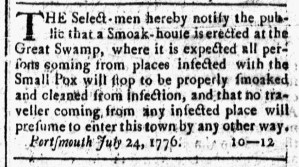
“All persons coming from places infected with the Small Pox will stop to be properly smoaked.”
It was important news, but it appeared among the advertisements in the July 27, 1776, edition of the Freeman’s Journal, or New Hampshire Gazette. The selectmen for the town of Portsmouth placed the advertisement to “notify the public that a Smoak-house is erected at the Great Swamp, where it is expected all persons coming from places infected with the Small Pox,” such as Boston, “will stop to be properly smoaked and cleaned from infection.” In addition, the selectmen demanded “that no traveller coming from any infected place will presume to enter this town by any other way.”
The notice could have appeared with the local news from Portsmouth that Benjamin Dearborn, the printer of the Freeman’s Journal, selected for that issue. Instead, it ran as an advertisement in another column, to the right of the header for news from “PORTSMOUTH,” below an advertisement that offered a “LARGE commodious BRICK HOUSE in York” for rent, and above an advertisement about a horse left at the Globe Tavern. The notation at the end of the notice, “10—12,” indicated that it was indeed an advertisement. It first appeared in issue “No. 10” on July 27 and would run in each issue through “No. 12” on August 10 before being discontinued. The notation was meant for the compositor who set the type rather than for readers. Dearborn presumably generated revenue from the advertisement. Treating it as an advertisement had the benefit of disseminating such an important announcement multiple times and increasing the chances that travelers learned about the policy for entering Portsmouth before approaching the town. Still, Dearborn could have chosen to insert the notice among the news in several consecutive issues of the Freeman’s Journal rather than consigning it to the space reserved for advertisements. Instead, he followed the same practice as other early American printers who published newspapers. Within the past week, a notice concerning voting for delegates to attend a convention “for the express purpose of forming a New Government” in Maryland appeared as an advertisement in Dunlap’s Maryland Gazette and a notice instructing Committees of Safety in Worcester County to “transmit … the Names of such Persons … who are deemed to be notoriously inimical to the rights of America” ran as an advertisement in the Massachusetts Spy. Subscribers and other readers knew that important news updates sometimes took the form of advertisements. They perused notices placed for all sorts of purposes to keep informed about local news.