June 1

Who was the subject of an advertisement in a revolutionary American newspaper 250 years ago today?

Freeman’s Journal (June 1, 1776).

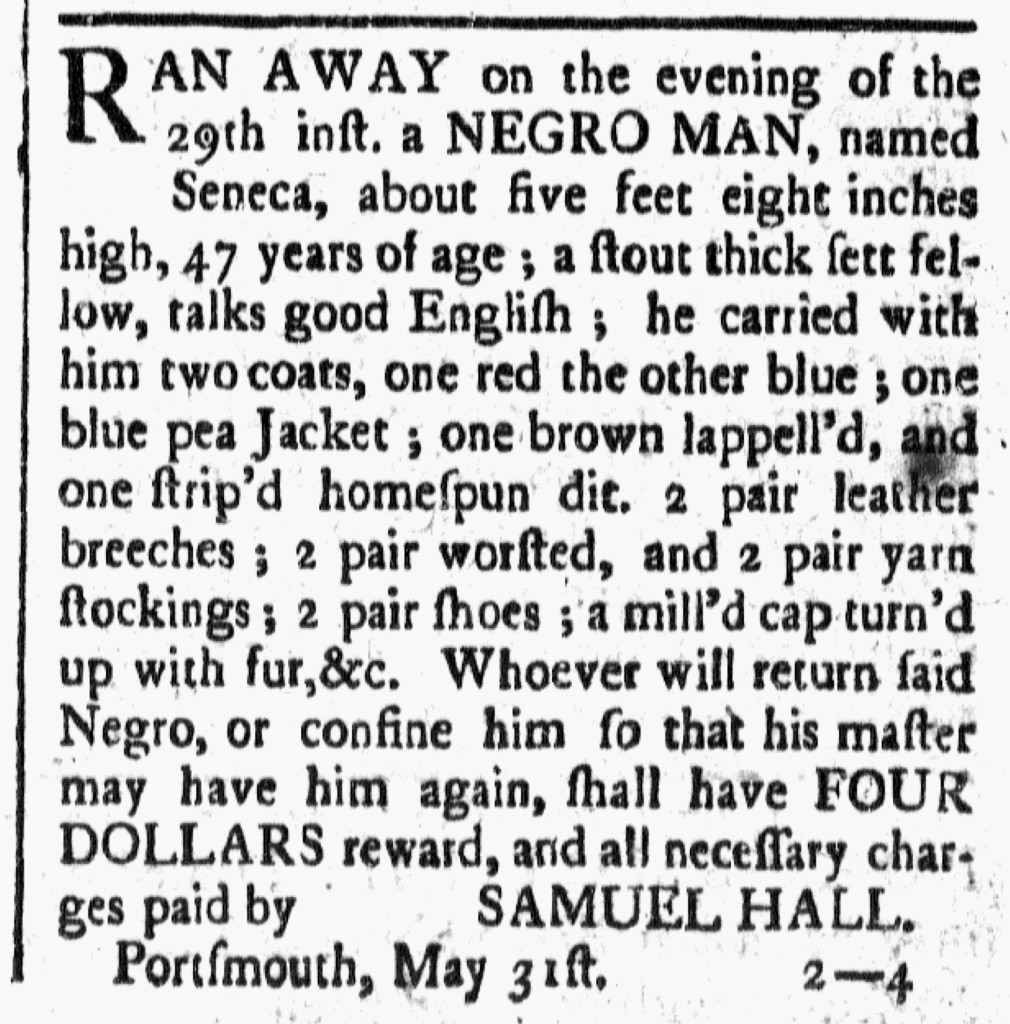
“RAN AWAY … a NEGRO MAN, named Seneca.”

Benjamin Dearborn published the first issue of the Freeman’s Journal or New-Hampshire Gazette on May 25, 1776.  In a note that followed his address to readers, he “requested that those who would have advertisements, &c. [including letters and poetry] inserted in this paper will send them” to the printing office in Portsmouth “before the Post arrives, (which is on Friday afternoon) as it’s proposed to publish the paper on Saturday mornings.”  Several advertisers heeded those instructions.  The following week the second issue of the Freeman’s Journal featured more than half a dozen advertisements, a good start for a printer seeking to establish multiple revenue streams for his new newspaper.

Samuel Hall of Portsmouth was among those advertisers.  He published a notice that described Seneca, a “NEGRO MAN” who liberated himself by running away from his enslaver, and offered a reward for his capture and return.  Such advertisements encouraged readers to engage in surveillance of Black men and women to determine whether they matched the descriptions that appeared in the public prints.  In this case, Hall included Seneca’s age and height, noting as well that he was “a stout thick sett fellow.”  Readers might also recognize him by the clothing that he wore and took with him, including “two coats, one red the other blue; one blue pea Jacket; … 2 pair leather breeches; 2 pair worsted, and 2 pair yarn stockings; [and] a mill’d cap turn’d up with fur.”  In addition, Seneca “talks good English.”  Hall intended for all those details in aid in identifying the fugitive from slavery.

Enslaved men and women liberated themselves by running away from their enslavers throughout the seventeenth and eighteenth centuries.  Advertisements describing Black men and women who emancipated themselves in this way began appearing in newspapers soon after the Boston News-Letter commenced publication in 1704.  Seneca likely knew of other enslaved people who escaped from slavery by fleeing from their enslavers.  He may have taken advantage of the disruptions caused by the Revolutionary War to increase his chances of evading detection.  At the same time Seneca made his decision, Dearborn set about a new venture made possible in part by the war, establishing a newspaper called the Freeman’s Journal.  The title made a political statement about liberty on the eve of the colonies declaring independence, yet in the second issue Dearborn joined every other American newspaper printer, Patriots and Tories, who generated revenues and played a role in perpetuating slavery by publishing advertisements about enslaved people.

May 25

What was advertised in a revolutionary American newspaper 250 years ago today?

Freeman’s Journal (May 25, 1776).

“The Printing-Business, in its different branches carried on with care and fidelity.”

When Benjamin Dearborn circulated subscription proposals for establishing a “NEW WEEKLY PAPER ENTITLED The FREEMAN’s JOURNAL, OR New-Hampshire GAZETTE” in April 1776, he stated that “[a]s soon as a sufficient number of Subscribers appear, the first number will be publish’d.”  It did not take long for him to gain enough subscribers to begin publishing the newspaper.  On May 25, he distributed the first issue.

It may have worked to Dearborn’s advantage that Daniel Fowle, the printer of the New-Hampshire Gazette, suspended his newspaper in January or February.  It had been the only newspaper printed in the colony, which meant that residents relied even more on newspapers printed in Massachusetts and other colonies to supply them with news about current events, including the progress of the war and meetings of the Second Continental Congress in Philadelphia and provincial conventions throughout the colonies.  In the subscription proposals, Dearborn declared that the Freeman’s Journal would include “all authentic domestic intelligence worth notice; together with the most material Extracts from the Southern and other papers.”  He may have received some of those newspapers via exchange networks with other printers, though, like other printers, he would have also participated in a process of reprinting news from one newspaper to another in a chain of disseminating information.

The inaugural issue of the Freeman’s Journal featured a small number of advertisements, enough to fill the final column on the last page.  As many other printers did, Dearborn used the colophon that ran across the bottom of that page as an advertisement for his printing office that concluded each issue week after week: “PORTSMOUTH: Printed by BENJAMIN DEARBORN, near the Parade, where this Paper may be had at Eight Shillings L[awful]. M[oney]. Per year, one half at entrance.  The Printing-Business, in its different branches carried on with care and fidelity.”  New subscribers had to pay four shillings when they began their subscription.  Customers of all sorts could have job printing, such as handbills and broadsides, done at Dearborn’s printing office.  That gave the printer another revenue stream to supplement subscriptions and advertisements.

April 26

What was advertised in a revolutionary American newspaper 250 years ago today?

Essex Journal (April 26, 1776).

“A NEW WEEKLY PAPER ENTITLED The FREEMAN’s JOURNAL, OR New-Hampshire GAZETTE.”

A year after the battles at Lexington and Concord, Benjamin Dearborn issued “PROPOSALS, FOR PRINTING BY SUBSCRIPTION … A NEW WEEKLY PAPER ENTITLED The FREEMAN’s JOURNAL, OR New-Hampshire GAZETTE.”  Dated April 20, 1776, the subscription proposals appeared in the April 26 edition of the Essex Journal, printed in Newburyport, Massachusetts, though they may have circulated separately as well.  Dearborn intended to publish the Freeman’s Journal in Portsmouth, making it the only newspaper printed in the colony since Daniel Fowle suspended the New-Hampshire Gazette earlier in the year.  The printer asserted that “As soon as a sufficient number of Subscribers appear, the first number will be publish’d.”  A month later, he distributed the first issue on May 25.

The title of the Freeman’s Journal made the editorial stance clear.  So did the explanation that Dearborn gave for establishing the newspaper: “As the Publisher determines to use his utmost efforts to serve the PUBLIC, and the GLORIOUS CAUSE they are so ardently, so unitedly engaged in, he flatters himself he shall meet with their friendly encouragement.”  He took on this service despite the “extraordinary expences which necessarily attend the Printing Business at this time,” simultaneously asking prospective subscribers to “excuse the publication of half a sheet, sometimes,” when “accidents … prevent supplying our kind customers with a whole sheet.”  During the first year of the war, shortages of paper, fears of impending attacks by British forces, post riders arriving behind schedule, and other “accidents” disrupted publication of the newspapers in New England and beyond.

The “CONDITIONS” in Dearborn’s subscription proposals outlined the expectations for the printer and subscribers.  A subscription cost “Eight Shillings Lawful Money per year, (exclusive of postage),” with half due immediately and the other half due in six months.  Newspaper printers often extended generous credit to subscribers, but circumstances did not permit Dearborn to do so for the Freeman’s Journal.  He pledged, “Advertisements impartially inserted at the customary price,” though he did not specify what that was.  He apparently expected that prospective advertisers knew the going rate for running notices in newspapers in the region.  He did declare that advertisements had “to be paid on receiving them.”  The printer did not allow any credit for advertisements.

New issues would circulate “every Monday morning” for as long as “the post arrives on Fridays.”  That allowed time for Dearborn to peruse other newspapers to select items to reprint in the Freeman’s Journal, sift through his own correspondence, and collaborate with others who received letters containing news.  The printer would collate “all authentic domestic intelligence worth notice; together with the most material Extracts from the Southern and other papers.”  He also solicited “[i]nteresting, instructive, and entertaining Poetry Speculations,” presumably for “Poet’s Corner,” a standard feature in many colonial newspapers, that he would publish “gratis” with “grateful acknowledgments for the favour.”

Dearborn accepted subscriptions at his printing office in Portsmouth.  John Mycall, the printer of the Essex Journal, also gathered subscriptions at the printing office in Newburyport.  Dearborn also expected that “most of the Printers on the Continent” would forward any subscriptions they received, signaling to the public that he was part of an expansive network that exchanged news for the benefit of “the PUBLIC, and the GLORIOUS CAUSE.”  Despite the upheavals of the war (or perhaps because of them), Dearborn and other printers established new newspapers during the summer of 1776.