
What was advertised in a revolutionary American newspaper 250 years ago today?
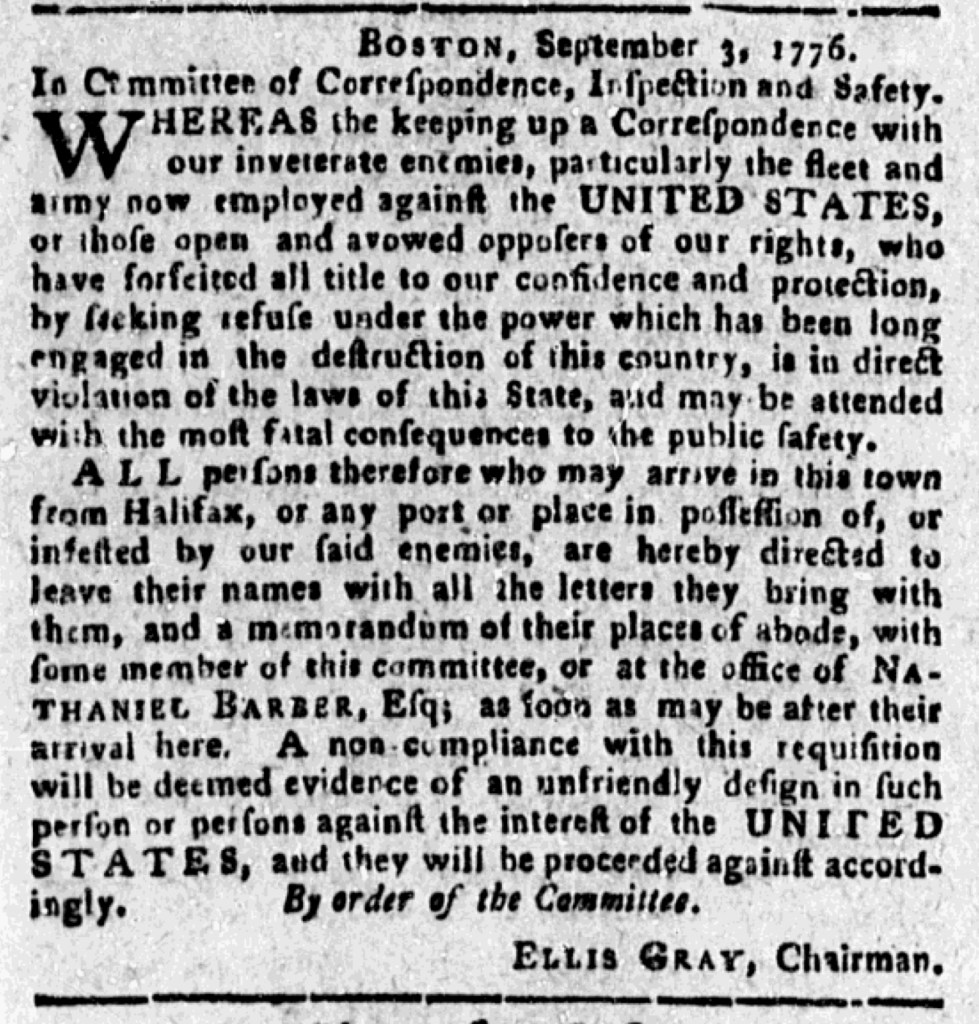
“Keeping up a Correspondence with our inveterate enemies … is in direct violation of the laws of this State.”
The Committee of Correspondence, Inspection, and Safety had a message for new arrivals in Boston. They used an advertisement in the Continental Journal to let them know that they needed to identify themselves to the committee and surrender any letters they carried with them.
“WHEREAS the keeping up a Correspondence with our inveterate enemies,” Ellis Gray explained on behalf of the committee, “is in direct violation of laws of this State, … ALL persons theretofore who may arrive in this town from Halifax, or any port or place in possession of, or infested by our said enemies, are hereby directed to leave their names with all the letters they bring with them … with some member of this committee.” That included contact with “the fleet and army now employed against the UNITED STATES,” referring to British forces, and “those open and avowed opposers of our rights, who have forfeited all title to our confidence and protection, by seeking refu[g]e under the power which has long been engaged in the destruction of this country,” referring to Loyalists, especially those who joined the British when they evacuated from Boston to Halifax. In addition to turning over the letters they carried with them, new arrivals had to leave “a memorandum of their place of abode” so the committee knew where to find them. They were to do so “as soon as may be after their arrival here.” Gray warned that “non-compliance with this requisition will be deemed evidence of an unfriendly design … against the interest of the UNITED STATES” and those in violation “will be proceeded against accordingly.”
This important message appeared as an advertisement, first in the September 5, 1776, edition of the Continental Journal and again in the September 26 edition. The printer interspersed it among paid notices placed for a variety of purposes rather than featuring it as a news item. Like many other advertisements that ran in American newspapers during the era of the American Revolution, this notice from Boston’s Committee of Correspondence, Inspection, and Safety delivered news that did not appear elsewhere in the newspaper. Readers perused advertisements as well as articles and editorials to learn about current events, including, on occasion, new regulations enacted in their communities.