
What was advertised in a revolutionary American newspaper 250 years ago today?
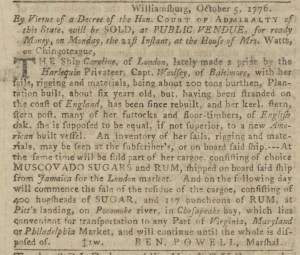
“THE Ship Caroline, of London, lately made a prize by the Harlequin Privateer.”
I rely on several databases of digitized copies of early American newspapers in the research and production of the Adverts 250 Project and the Slavery Adverts 250 Project. America’s Historical Newspapers and Periodicals from Readex, a division of NewsBank, provides the most extensive coverage of newspapers published in eighteenth-century America. It requires a subscription to access. Other databases contain fewer newspapers but extend the geographic coverage in important ways. Moving from north to south, the Maryland Gazette Collection from the Archives of Maryland Online, maintained by the Maryland State Archives, provides access to the Maryland Gazette, published in Annapolis. Anyone with an internet connection may access this database. Through its Digital Collections platform, the John D. Rockefeller Jr. Library grants access to several newspapers published in Williamsburg, each named the Virginia Gazette, from Colonial Williamsburg, the Library of Virginia, and the Swem Library at the College of William and Mary. Anyone with an internet connection may access this database. Accessible Archives, now a part of History Commons, includes several newspapers published in Charleston, South Carolina, in the eighteenth century. It requires a subscription to access.
Recently, I have started consulting Chronicling America: Historic American Newspapers from the Library of Congress. Anyone with an internet connection many access this database. So far, Chronicling America focuses primarily on newspapers published in the nineteenth and twentieth centuries. Through an ongoing partnership with the National Endowment for the Humanities and partner archives and research libraries in many states, the National Digital Newspaper Program, it continues to add newspapers, including newspapers published during the era of the American Revolution. I now consult Chronicling America to see whether it includes any newspapers not available through any of the other databases. I was able to include the New York Packet during its short run (January 4 – August 29, 1776) in the Adverts 250 Project and the Slavery Adverts 250 Project thanks to Chronicling America. That database also duplicates some of the newspapers available via other databases.
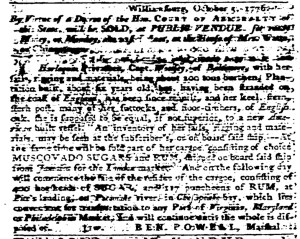
Duplicates can be helpful. Not all copies of newspapers that are digitized are in the same condition. Not all remediation achieves the same quality. Consider Benjamin Powell’s advertisement for an auction of prize ship and its cargo that ran in the October 16, 1776, edition of the Pennsylvania Gazette. Portions of it are difficult to read or even illegible in the digital image from America’s Historical Newspapers. That is certainly the exception, not the rule. The vast, vast majority of newspapers in America’s Historical Newspapers, including other issues of the Pennsylvania Gazette, are easy to read. This example is not representative of the collection as whole, but instead illustrative that sometimes a second copy can be very helpful. The National Digital Newspaper Project sets high standards for producing digitized images of historical newspapers. Production involves technologies that were not available when other databases created the images in their collections.[1] Accordingly, I start with America’s Historical Newspapers, an incredible database, and then consult Chronicling America when necessary. That more than one database includes some newspapers is not superfluous or redundant. It enhances research and access to these sources in important ways.
**********
[1] On a related note, the Rockefeller Library recently updated its Digital Collections to grant access to both black-and-white images from microfilm and high-quality color images created with modern digital technologies. The black-and-white images constitute the largest part of that collection. The color images are an important supplement.