
What was advertised in a revolutionary American newspaper 250 years ago today?
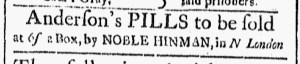
“Anderson’s PILLS.”
The advertisement consisted of only two lines: “Anderson’s PILLS to be sold / at 6s a Box, by NOBLE HINMAN, in N London.” Yet Hinman did not need to provide additional information to readers of the Connecticut Gazette in the fall of 1776. Although very few products were known by brand names in the late eighteenth century, patent medicines were the exception. Prospective customers in New London and nearby towns knew that Anderson’s Pills helped cleanse the system, especially after overindulgence. Today, they would be considered a mild laxative.
Prospective customers recognized a variety of patent medicines by name, in large part because, as the Royal College of Physicians of Edinburgh explains, “far more medicines received royal patents than any other invention” in the 1700s. “Anyone could get a royal patent for a medicine – its formula had to be unique, but there was no need to prove that it worked.” American consumers likely did not know that Anderson’s Pills were first marketed by Patrick Anderson, a physician born in Edinburgh, sometime around 1635, but they did know which symptoms the pills treated. At the same time that Hinman advertised Anderson’s Pills in the Connecticut Gazette, Nicholas Brooks promoted “KEYSERS pills, Maredant’s drops, … Anderson’s Scotch pills, Hooper’s female pills, Turlington’s drops, Bateman’s drops, Stoughton’s bitters, … [and] Dr. Hill’s balsam of honey” for sale at his “Picture, Jewellery, and Dry Goods Shop” in Philadelphia in the November 23, 1776, edition of the Pennsylvania Ledger. Consumers recognized all those brands. The Royal College of Physicians of Edinburgh also notes that “[a]pothecary shops sold these medicines, but so did booksellers, hairdressers and stationers.” In America, printers also advertised and sold them. In another advertisement of just two lines, James Humphreys, Jr., hawked “Genuine Keyser’s Pills, / To be had of the Printer” in the Pennsylvania Ledger on November 16, 1776. Although newspaper advertisements for “branded medical products grew in both quantity and complexity over the course of the 1700s,” not all such advertisements featured elaborate appeals to consumers. Hinman, Brooks, and Humphreys all simply gave the names of patent medicines and told prospective customers where to buy them.