
What was advertised in a revolutionary American newspaper 250 years ago today?
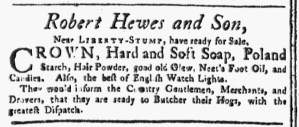
“Near LIBERTY-STUMP.”
When Robert Hewes and Son placed an advertisement for “CROWN, Hard and Soft Soap, Poland Starch, Hair Powder,” and other items in the November 14, 1776, edition of the Independent Chronicle, they advised prospective customers to find them “Near LIBERTY-STUMP,” the remnants of the former Liberty Tree, in Boston. One of the elms in a grove near Boston Neck became known as the Liberty Tree after colonizers hung an effigy of Andrew Oliver, the proposed tax collector, in protest of the Stamp Act on August 14, 1765. Oliver resigned from the position and Parliament repealed the Stamp Act in March 1766. When news arrived in Boston, colonizers gathered at the elm to celebrate. They “installed a copper sign designating it the Liberty Tree … and hung up 150 lanterns.”
The Liberty Tree became an important symbol to supporters of the American cause. It also served as a landmark for advertisers to direct prospective customers to their businesses. In March 1766, before Boston received news about the repeal of the Stamp Act, Adam Collson advertised fleece wool that he sold “Under the TREE of LIBERTY.” In 1767, both John Gore, Jr., and John Greenlaw gave directions that featured the Liberty Tree in their advertisements. Gore continued doing so in 1769 and 1770, emphasizing that he sold “North American Manufactures” rather than goods imported from Britain. Quite appropriately, he paired the famous landmark with the nonimportation strategy that colonizers first adopted as economic leverage against the Stamp Act and then again against the duties on certain goods imposed by the Townshend Acts. Even when the nonimportation agreements lapsed after Parliament repealed most of those duties, Gore continued to give his location as “Opposite LIBERTY-TREE” in an advertisement for a “large and general Assortment of English and India Goods.” Similarly, Rosannah Moore advertised a “general Assortment of Wines, as are commonly imported to America,” that she sold “near LIBERTY TREE” in the spring of 1771.
During the siege of Boston that followed the battles at Lexington and Concord, the British occupied the city. British soldiers cut down the Liberty Tree and used it for firewood, yet the stump remained and became an important symbol of resistance and resilience. The tree was gone, but so were the British, who evacuated Boston in March 1776 when they determined that breaking the siege would be too costly. They learned that lesson at the Battle of Bunker Hill. Patriots reclaimed the city … and the stump remained. The British had not removed the entire tree, so the portion that endured took on new significance. The stump no longer remains today, but the city established Liberty Tree Plaza at its former site in 2018. In 1776, just months after the British left, Robert Hewes and Son joined other Bostonians in reclaiming the Liberty Stump, foiling the attempts of British soldiers to remove a powerful symbol of revolution.