
What was advertised in a revolutionary American newspaper 250 years ago today?
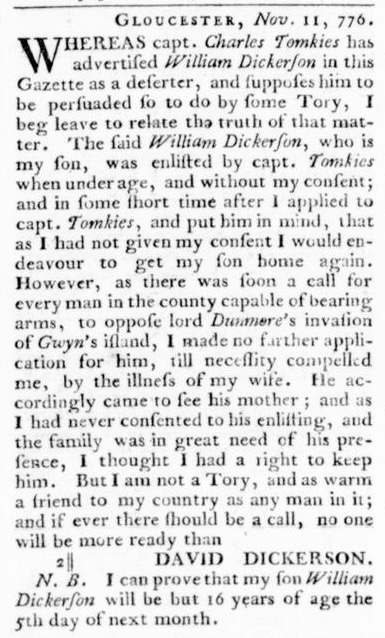
It was a concerned father who took to the pages of Alexander Purdie’s Virginia Gazette with an advertisement intended to set the record straight. Desertion notices appeared frequently in the public prints during the Revolutionary War. David Dickerson of Gloucester was concerned when his son, William, was the subject of one of such advertisement placed by Captain Charles Tomkies on October 25, 1776. “DESERTED about three weeks ago, from my company of regulars stationed at York,” Tomkies declared, “William Dickerson, a likely young fellow.” Tomkies explained that the young Dickerson “was born in Gloucester county, where I suppose he is still lurking.” Not only had Dickerson deserted, but he also acted on advice from the enemy, at least according to Tomkies. “I have some reason to believe,” the captain stated, “he was persuaded by some Tory that he could not be compelled to continue in the service than [his] pleasure.” Tomkies offered ten dollars as a reward “for the deserter, and the same on full conviction of the Tory.” He concluded by warning others not to harbor or employ “the said deserter, as they shall answer at their peril.”
The elder Dickerson was having none of it. He placed his own advertisement that purported to tell the “truth of the matter.” It seemed that Tomkies had enlisted the young William “when under age” and without his father’s consent. In turn, the father contacted the captain to “put him in mind, that as I had not given my consent I would endeavour to get my son home again.” Yet circumstances intervened. Dickerson contended that “soon a call for every man in the county capable of bearing arms, to oppose lord Dunmore’s invasion of Gwyn’s island.” That was not an opportune time to withdraw Charles from Tomkies’s company. David allowed him to continue serving, not raising the matter again “till necessity compelled me, by the illness of my wife.” Charles then visited his mother and remained with his family. His father underscored that since “I had never consented to his enlisting” and, furthermore, “the family was in great need of his presence” so “I thought I had a right to keep him. He boldly proclaimed, “I am not a Tory,” but instead “as warm a friend to my country as any man in it.” To prove the point, he asserted that “if ever there should be a call, no one will be more ready than DAVID DICKERSON.” Perhaps not feeling confident that “I thought I had a right to keep him” because “the family was in great need” was a convincing argument, Dickerson added a nota bene that once again made clear that William was underaged when Tomkies enlisted him and the young man never should have been part of the company at all. “I can prove,” he insisted, “that my son William Dickerson will be but 16 years of age the 5th day of next month.” What Tomkies had advertised as a desertion was much more complicated. Dickerson used an advertisement to circulate the real story and restore the reputations of his son and himself.