
What was advertised in a revolutionary American newspaper 250 years ago today?
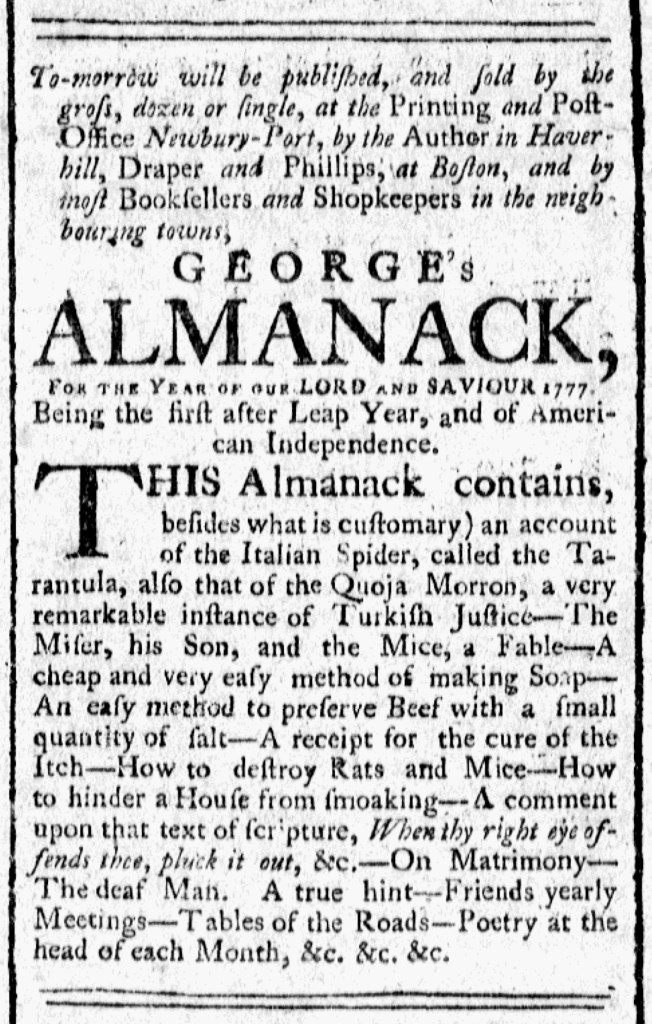
“GEORGE’s ALMANACK, FOR … 1777, Being the first after Leap Year, and of American Independence.”
On November 20, 1776, John Mycall, the printer of the Essex Journal, announced that “George’s ALMANACKS, For the Year 1777” would be published within the next week and would be available for sale “by the large or small quantity” at his printing office in Newburyport, Massachusetts. He noted that the contents would include “(Besides what is usual for Almanacks) many things instructive and entertaining, which will be particularized in out next paper.” He may not have been able to elaborate on the contents because even though he was listed on the title page as one of the primary purveyors of the almanac to the public, he received second billing after “DRAPER and PHILLIPS, at the new Printing Office, next Door but one to the Sign of the Lamb-Tavern, in Newbury-Street, Boston.” Although Mycall partnered with Draper and Phillips in publishing, marketing, and selling the almanac, he likely did not undertake the printing but instead sold copies that Draper and Phillips shipped to him. From his correspondence, he knew when the almanacs would be available for sale, but he did not yet know the contents.
As anticipated, Mycall’s advertisement in the next issue of his newspaper did feature a lengthy list of the contents, including “an account of the Italian Spider, called the Tarantula, … The Miser, His Son, and the Mice, a Fable – A cheap and very easy method of making Soap – An easy method to preserve Beef with a small quantity of salt,” and an essay “On Matrimony.” In addition, it included practical information, such as “Tables of the Roads” and dates for “Friends yearly Meetings,” as well as “Poetry at the head of each Month.” In contract, an advertisement in the Independent Chronicle, published in Boston on the same day, simply stated, “May be had, BICKERSTAFF and GEORGE’s ALMANACKS, Of POWARS and WILLIS, JOHN BOYLE, and DRAPER and PHILLIPS.” Mycall hoped that the list of contents would entice readers to purchase An Almanack for the Year of Our Lord and Saviour, 1777 by Daniel George. Unlike his previous advertisement, he relied on the contents to make a sale rather than commenting on the young mathematician and astronomer’s disability. Similarly, the advertisement in the Independent Chronicle did not make any note of George’s disability but instead treated him and his almanac as familiar to the public without meriting additional commentary. Deviating from the title page, Mycall did describe 1777 as “the first after Leap Year, and of American Independence,” a patriotic nod consistent with the content of George’s first almanac published the previous year.