September 28

What was advertised in a colonial American newspaper 250 years ago today?
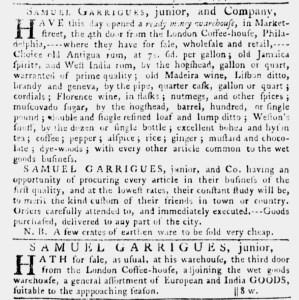
Pennsylvania Gazette (September 28, 1774).

“Goods purchased, delivered to any part of the city.”

As fall arrived in 1774, Samuel Garrigues, Jr., placed a brief advertisement in the Pennsylvania Gazette to remind readers that he sold a variety of imported goods “as usual at his warehouses, the third door from the London Coffee-house” in Philadelphia.  He supplemented that notice with a longer advertisement informing the public that he and his partners, doing business as Samuel Garrigues, Jr., and Company, just opened a “wet goods warehouse” right next door at “the 4th door from the London Coffee-house.”  There they stocked “Choice old Antigua rum,” “old Jamaica spirits, and West India rum,” “old Madeira wine,” “brandy and geneva,” as well as sugar, spices, snuff, coffee, chocolate, and “every other article common to the wet goods business.”  The inventory curiously included “excellent bohea and hyson tea” despite the controversy associated with that commodity.

In addition to listing the merchandise, Garrigues and Company sought to entice prospective customers by explaining that they had “an opportunity of procuring every article in their business of the first quality, and at the lowest prices,” suggesting that they would pass along the savings while also assuring consumers that they did not need to be wary of such bargains meaning inferior goods.  They pledged to make it their “constant study … to merit the kind custom of their friends in town or country” by “carefully attend[ing] to orders” and “immediately execut[ing]” them.  The partnership promised superior customer service.  They also offered a valuable service, delivering purchases “to any part of the city,” whether just a gallon or quart or an entire hogshead or pipe.  They hoped that ancillary service, provided gratis, would sway customers to shop with them to take advantage of both the convenience and the cost.  Eighteenth-century entrepreneurs sometimes experimented with free services as marketing strategies to convince consumers to choose them over their competitors.  For Garrigues and Company, doing so was one aspect of their “constant study” in serving their customers.
Slavery Advertisements Published September 28, 1774

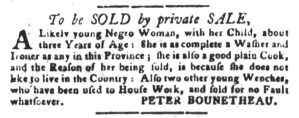
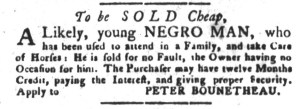
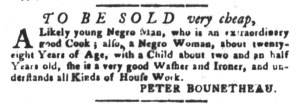
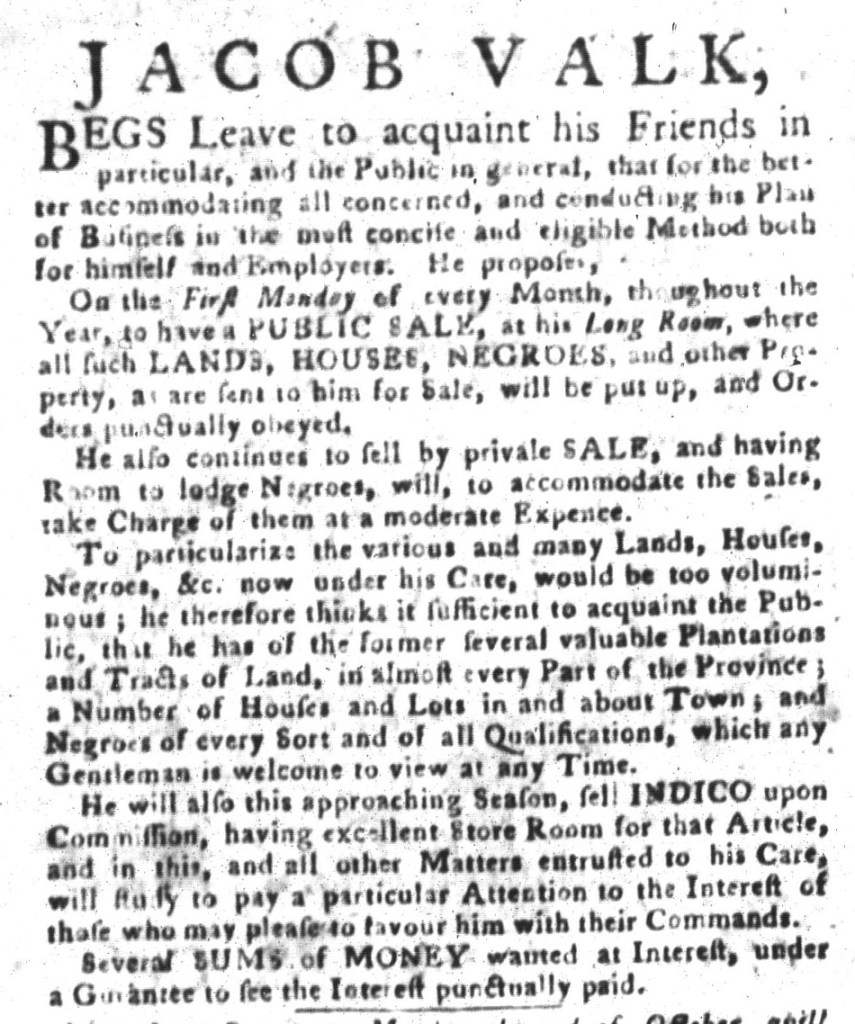
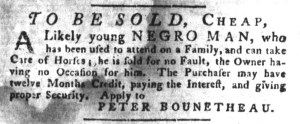
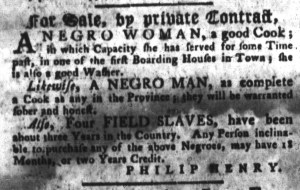
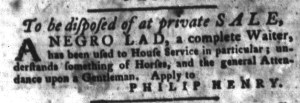
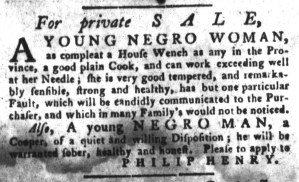
The Slavery Adverts 250 Project chronicles the role of newspaper advertising in perpetuating slavery in the era of the American Revolution. The project seeks to reveal the ubiquity of slavery in eighteenth-century life from New England to Georgia by republishing advertisements about enslaved people – for sale as individuals or in groups, wanted to purchase or for hire for short periods, runaways who liberated themselves, and those who were subsequently captured and confined in jails and workhouses – in daily digests on this site as well as in real time via the @SlaveAdverts250 Twitter feed, utilizing twenty-first-century media to stand in for the print media of the eighteenth century.

The project aims to provide modern audiences with a sense of just how often colonizers encountered these advertisements in their daily lives. Enslaved men, women, and children appeared in print somewhere in the colonies almost every single day. Those advertisements served as a constant backdrop for social, cultural, economic, and political life in colonial and revolutionary America. Colonizers who did not purport to own enslaved people were still confronted with slavery as well as invited to maintain the system by purchasing enslaved men, women, and children or assisting in the capture of so-called “runaways” who sought to free themselves from bondage. The frequency of these newspaper advertisements suggests just how embedded slavery was in colonial and revolutionary American culture in everyday interactions beyond the printed page.

These advertisements also testify to the experiences of enslaved men, women, and children, though readers must consider that those experiences have been remediated through descriptions offered by enslavers rather than enslaved people themselves. Often unnamed in the advertisements, enslaved men, women, and children were not invisible or unimportant in early America.

These advertisements appeared in colonial American newspapers 250 years ago today.

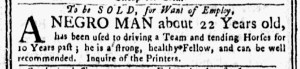
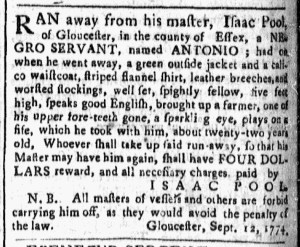
Essex Journal (September 28, 1774).

September 27

What was advertised in a colonial American newspaper 250 years ago today?

Supplement to the South-Carolina Gazette and Country Journal (September 27, 1774).

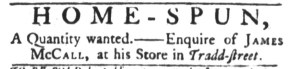
“HOME-SPUN, A Quantity wanted.”

In so many ways, James McCall’s advertisement appeared as a stark contrast compared to others in the September 27, 1774, edition of the South-Carolina Gazette and Country Journal.  In just three lines, it proclaimed, “HOME-SPUN, A Quantity wanted. – Enquire of JAMES McCALL, at his Store in Tradd-street.”  The word “HOME-SPUN” in all capitals in a significantly larger font occupied a line on its own, calling attention to the commodity that McCall sought.  He referred to linen and wool textiles produced in the colonies as an alternative to imported fabrics.  Spinning, a domestic chore undertaken by women, took on political significance when colonizers enacted nonimportation agreements in response to the duties imposed in the Townshend Acts in the late 1760s.  The homespun cloth that resulted from their efforts became a visible symbol of support for the Patriot cause.  McCall did not need to elaborate on the political principles associated with homespun when he placed his advertisement seeking a quantity of it.  In other advertisements, he had previously demonstrated that how well he understood consumer politics.

Elsewhere in the same issue of the South-Carolina Gazette and Country Journal, merchants who imported “fashionable” textiles from London and other English ports ran lengthy advertisements that listed and described their merchandise.  Edwards, Fisher, and Company, for instance, ran their notice about receiving “PART of their FALL GOODS.”  Mansell and Corbett inserted an even more lengthy advertisement that featured imported fabrics, emphasizing “the most fashionable colours” and “an entire new pattern,” as well as housewares.  Other advertisers were a bit more restrained in terms of length, but not their exuberance for imported textiles.  In addition to leading his list of merchandise with a “LARGE Assortment of printed Muslins, Linens, and Calicoes,” Z. Kingsley concluded with a nota bene that explained, “The printed Muslins and Linens, are all the newest Patterns.”  These merchants considered it necessary to offer assurances to prospective customers that their wares did indeed follow the latest styles, simultaneously emphasizing all the choices available to them.  Homespun cloth, on the other hand, turned fashion on its head.  What was the newest and the most sophisticated did not matter as much as the simple political message that producing, purchasing, and wearing homespun communicated during the imperial crisis.

Slavery Advertisements Published September 27, 1774

The Slavery Adverts 250 Project chronicles the role of newspaper advertising in perpetuating slavery in the era of the American Revolution. The project seeks to reveal the ubiquity of slavery in eighteenth-century life from New England to Georgia by republishing advertisements about enslaved people – for sale as individuals or in groups, wanted to purchase or for hire for short periods, runaways who liberated themselves, and those who were subsequently captured and confined in jails and workhouses – in daily digests on this site as well as in real time via the @SlaveAdverts250 Twitter feed, utilizing twenty-first-century media to stand in for the print media of the eighteenth century.

The project aims to provide modern audiences with a sense of just how often colonizers encountered these advertisements in their daily lives. Enslaved men, women, and children appeared in print somewhere in the colonies almost every single day. Those advertisements served as a constant backdrop for social, cultural, economic, and political life in colonial and revolutionary America. Colonizers who did not purport to own enslaved people were still confronted with slavery as well as invited to maintain the system by purchasing enslaved men, women, and children or assisting in the capture of so-called “runaways” who sought to free themselves from bondage. The frequency of these newspaper advertisements suggests just how embedded slavery was in colonial and revolutionary American culture in everyday interactions beyond the printed page.

These advertisements also testify to the experiences of enslaved men, women, and children, though readers must consider that those experiences have been remediated through descriptions offered by enslavers rather than enslaved people themselves. Often unnamed in the advertisements, enslaved men, women, and children were not invisible or unimportant in early America.

These advertisements appeared in colonial American newspapers 250 years ago today.

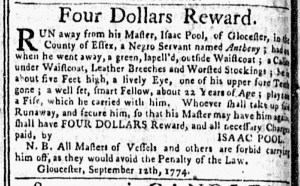
Essex Gazette (September 27, 1774).

**********

Essex Gazette (September 27, 1774).

**********

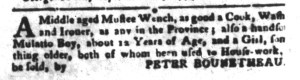
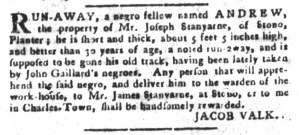
South-Carolina Gazette and Country Journal (September 27, 1774).

**********

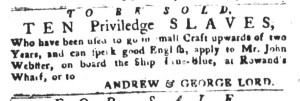
South-Carolina Gazette and Country Journal (September 27, 1774).

**********

South-Carolina Gazette and Country Journal (September 27, 1774).

**********

South-Carolina Gazette and Country Journal (September 27, 1774).

**********

South-Carolina Gazette and Country Journal (September 27, 1774).

**********

South-Carolina Gazette and Country Journal (September 27, 1774).

**********

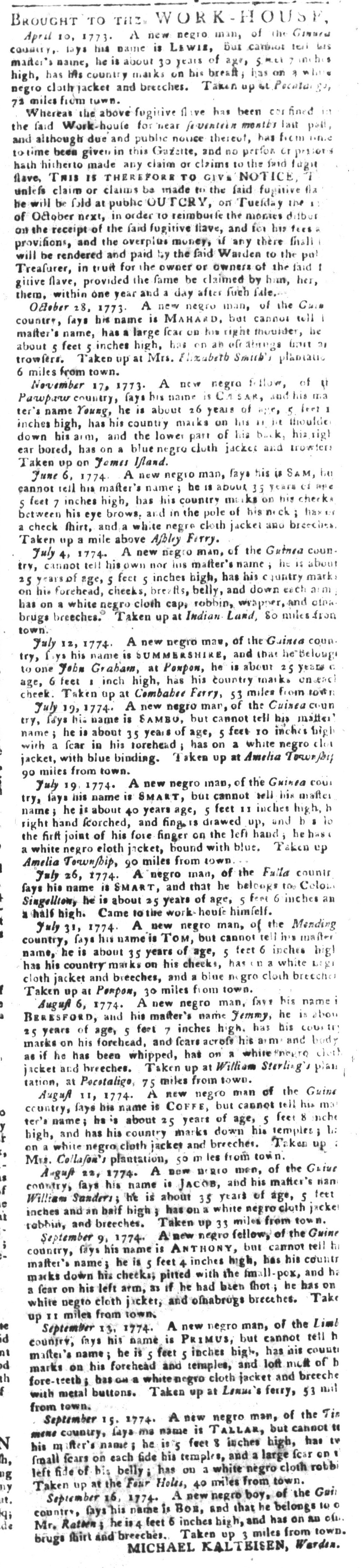
Supplement to the South-Carolina Gazette and Country Journal (September 27, 1774).

**********

Supplement to the South-Carolina Gazette and Country Journal (September 27, 1774).

**********

Supplement to the South-Carolina Gazette and Country Journal (September 27, 1774).

**********

Supplement to the South-Carolina Gazette and Country Journal (September 27, 1774).

**********

Supplement to the South-Carolina Gazette and Country Journal (September 27, 1774).

**********

Supplement to the South-Carolina Gazette and Country Journal (September 27, 1774).

**********

Supplement to the South-Carolina Gazette and Country Journal (September 27, 1774).

**********

Supplement to the South-Carolina Gazette and Country Journal (September 27, 1774).

**********

Supplement to the South-Carolina Gazette and Country Journal (September 27, 1774).

**********

Supplement to the South-Carolina Gazette and Country Journal (September 27, 1774).

**********

Supplement to the South-Carolina Gazette and Country Journal (September 27, 1774).

September 26

What was advertised in a colonial American newspaper 250 years ago today?

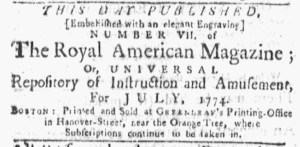
Boston Evening-Post (September 26, 1774).

“NUMBER VII. of The Royal American Magazine.”

The Royal American Magazine experienced a disruption in publication during the summer of 1774.  In a notice in the June issue, Isaiah Thomas, the founder of the magazine, reported that the “Distresses of the Town of Boston” that resulted from the Boston Port Act forced him to suspend publication for a few months.  He hoped to resume once “the Affairs of this Country are a little better settled.”  Not long after making that announcement, however, he took to the pages of his own newspaper, the Massachusetts Spy, to inform subscribers and the public that he transferred the magazine to Joseph Greenleaf.  An address from Greenleaf appeared immediately below Thomas’s advertisement.  They were the latest entries in a marketing campaign that commenced when Thomas first revealed his intention to circulate subscription proposals in May 1773 and subsequent newspaper advertisements in June, July, August, September, October, November, and December 1773 and January, February, March, April, May, and June 1774.  The “Distresses” meant no newspaper advertisements for the magazine in July 1774, but they resumed with the notices from Thomas and Greenleaf in August.

Those notices each made four more appearances in September.  Not surprisingly, the Massachusetts Spy accounted for three of them.  For four weeks, Thomas used his own newspaper to advise subscribers and others of the change in publisher for the magazine.  The companion notices also ran once in the Boston Evening-Post on September 5.  Greenleaf’s address indicated that the July issue of the magazine “is now in the Press, and will be published without Delay.”  On September 15, the last day that they ran in the Massachusetts Spy, that newspaper also carried a new advertisement from Greenleaf, one that declared, “THIS DAY PUBLISHED … NUMBER VII. of The Royal American Magazine.”  The July issue finally became available in September!  Greenleaf’s advertisement was brief and restrained compared to many that Thomas had inserted.  It stated that the issue was “Embellished with an elegant Engraving,” but did not give a description or even a name for Paul Revere’s engraving of “Spanish Treatment at Carthagena,” nor did the advertisement incorporate an extensive list of the contents to entice readers.  Instead, it succinctly noted that the magazine was “Printed and Sold at GREENLEAF’S Printing-Office … where Subscriptions continue to be taken in.” The new publisher hoped to expand the magazine’s circulation despite a less ambitious advertising strategy than Thomas sometimes deployed.  The announcement about the July issue ran only once in the Massachusetts Spy.  It appeared in the Boston Evening-Post for the first time in its next edition four days later and again the following week.  Amid the “Distresses of the Town of Boston,” Greenleaf’s first issue of the Royal American Magazine had less fanfare than many of the issues that Thomas published.
**********

To the Subscribers of the ROYAL AMERICAN MAGAZINE”

  • September 1 – Massachusetts Spy (second appearance)
  • September 5 – Boston Evening-Post (first appearance)
  • September 8 – Massachusetts Spy (third appearance)
  • September 15 – Massachusetts Spy (fourth appearance)

“To the PUBLIC, and in particular to the Subscribers”

  • September 1 – Massachusetts Spy (second appearance)
  • September 5 – Boston Evening-Post (first appearance)
  • September 8 – Massachusetts Spy (third appearance)
  • September 15 – Massachusetts Spy (fourth appearance)

“THIS DAY PUBLISHED … NUMBER VII”

  • September 15 – Massachusetts Spy (first appearance)
  • September 19 – Boston Evening-Post (first appearance)
  • September 26 – Boston Evening-Post (second appearance)

Slavery Advertisements Published September 26, 1774

The Slavery Adverts 250 Project chronicles the role of newspaper advertising in perpetuating slavery in the era of the American Revolution. The project seeks to reveal the ubiquity of slavery in eighteenth-century life from New England to Georgia by republishing advertisements about enslaved people – for sale as individuals or in groups, wanted to purchase or for hire for short periods, runaways who liberated themselves, and those who were subsequently captured and confined in jails and workhouses – in daily digests on this site as well as in real time via the @SlaveAdverts250 Twitter feed, utilizing twenty-first-century media to stand in for the print media of the eighteenth century.

The project aims to provide modern audiences with a sense of just how often colonizers encountered these advertisements in their daily lives. Enslaved men, women, and children appeared in print somewhere in the colonies almost every single day. Those advertisements served as a constant backdrop for social, cultural, economic, and political life in colonial and revolutionary America. Colonizers who did not purport to own enslaved people were still confronted with slavery as well as invited to maintain the system by purchasing enslaved men, women, and children or assisting in the capture of so-called “runaways” who sought to free themselves from bondage. The frequency of these newspaper advertisements suggests just how embedded slavery was in colonial and revolutionary American culture in everyday interactions beyond the printed page.
These advertisements also testify to the experiences of enslaved men, women, and children, though readers must consider that those experiences have been remediated through descriptions offered by enslavers rather than enslaved people themselves. Often unnamed in the advertisements, enslaved men, women, and children were not invisible or unimportant in early America.

These advertisements appeared in colonial American newspapers 250 years ago today.

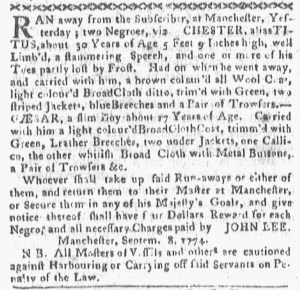
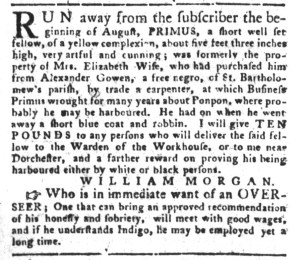
Boston Evening-Post (September 26, 1774).

**********

Boston-Gazette (September 26, 1774).

**********

Boston-Gazette (September 26, 1774).

**********

Dunlap’s Pennsylvania Packet (September 26, 1774).

**********

Dunlap’s Pennsylvania Packet (September 26, 1774).

**********

Dunlap’s Pennsylvania Packet (September 26, 1774).

**********

Dunlap’s Pennsylvania Packet (September 26, 1774).

**********

Postscript to Dunlap’s Pennsylvania Packet (September 26, 1774).

**********

Newport Mercury (September 26, 1774).

**********

New-York Gazette and Weekly Mercury Mercury (September 26, 1774).

**********

New-York Gazette and Weekly Mercury Mercury (September 26, 1774).

**********

South-Carolina Gazette (September 26, 1774).

**********

South-Carolina Gazette (September 26, 1774).

**********

South-Carolina Gazette (September 26, 1774).

**********

South-Carolina Gazette (September 26, 1774).

**********

South-Carolina Gazette (September 26, 1774).

**********

South-Carolina Gazette (September 26, 1774).

**********

South-Carolina Gazette (September 26, 1774).

**********

South-Carolina Gazette (September 26, 1774).

**********

South-Carolina Gazette (September 26, 1774).

**********

South-Carolina Gazette (September 26, 1774).

**********

Supplement to the South-Carolina Gazette (September 26, 1774).

**********

Supplement to the South-Carolina Gazette (September 26, 1774).

**********

Supplement to the South-Carolina Gazette (September 26, 1774).

**********

Supplement to the South-Carolina Gazette (September 26, 1774).

**********

Supplement to the South-Carolina Gazette (September 26, 1774).

**********

Supplement to the South-Carolina Gazette (September 26, 1774).

**********

Supplement to the South-Carolina Gazette (September 26, 1774).

**********

Supplement to the South-Carolina Gazette (September 26, 1774).

**********

Supplement to the South-Carolina Gazette (September 26, 1774).

**********

Supplement to the South-Carolina Gazette (September 26, 1774).

**********

Supplement to the South-Carolina Gazette (September 26, 1774).

September 25

What was advertised in a colonial American newspaper 250 years ago this week?

Boston Evening-Post (September 19, 1774).

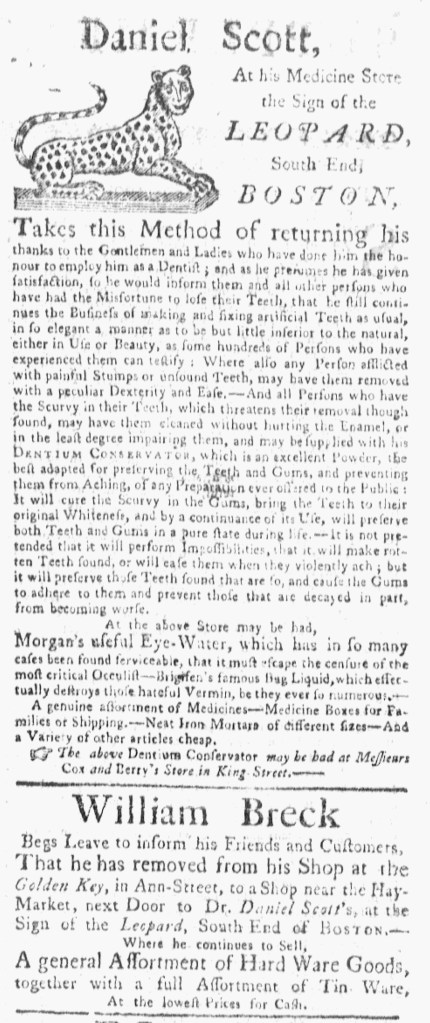
“Next Door to Dr. Daniel Scott’s, at the Sign of the Leopard.”

In the fall of 1774, William Breck ran an advertisement “to inform his Friends and Customers” that he had moved to a new location.  They would no longer find him at his shop “at the Golden Key, in Ann-street” but instead at a shop “near the Hay-Market, next Door to Dr. Daniel Scott’s at the Sign of the Leopard, South-End of BOSTON.”  Even though he moved, he “continues to sell, as usual, A general Assortment of Hard-Ware GOODS … at the lowest Prices.”

Breck’s advertisement documented some of the visual culture of commerce that residents and visitors encountered as they traversed the streets of the busy port.  Both devices, the Golden Key and the Sign of the Leopard, had also circulated more widely via other media.  Breck distributed an engraved trade card that included an image of an ornate key suspended within a cartouche above a list of the merchandise he stocked “at the Golden Key near the draw-Bridge.”  Paul Revere produced the trade card in the late 1760s, yet Breck might have given out copies well into the 1770s.  (Mary Symonds, a milliner in Philadelphia, commissioned a similar trade card in 1768.  She wrote a receipted bill on the back of one of them in 1770.)  Breck’s advertisement ran on its own in the September 22 edition of the Massachusetts Gazette and Boston Weekly News-Letter, but it just happened to appear immediately below Scott’s advertisement for his “Medicine Store” at “the Sign of the LEOPARD” featuring a woodcut depicting a leopard in the September 19 edition of the Boston Evening-Post.  That image had been circulating in that newspaper for several months, making the Sign of the Leopard an attractive option when Breck decided to include a familiar landmark to help orient customers to his new location.

Breck did not mention whether the Golden Key moved with him or remained as a fixture on Ann Street, marking the location for the next tenant in his former shop.  He had previously made quite an investment in associating the image with his business.  Engraved trade cards, after all, were much more expensive than newspaper advertisements, handbills, and broadsides.  Did he surrender an aspect of the branding associated with his business for many years when he relocated?

September 24

What was advertised in a colonial American newspaper 250 years ago today?

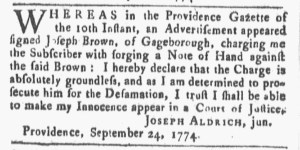
Providence Gazette (September 24, 1774).

“I am determined to prosecute him for the Defamation.”

Defamation!  That was the defense Joseph Aldrich, Jr., made against allegations that appeared in the September 10, 1774, edition of the Providence Gazette.  The original accusation and Aldrich’s response both ran as advertisements.  It started with one that read, “I JOSEPH BROWN, of Gageborough, in the County of Berkshire, and Province of the Massachusetts-Bay, give this public Notice, that Joseph Aldrich, jun. of Gloucester, in the County of Providence, hath forged or counterfeited a Note of Hand against me the said Joseph Brown, for Ninety odd Pounds Lawful Money.”  The notice offered a warning: “All Persons are therefore cautioned against taking any Assignment of said Note, as I am determined to prosecute for the Forgery, instead of paying the Contents.”

Aldrich apparently did not become aware of what Brown charged right away since he did not respond in the next issue of Providence Gazette, but not much time passed before he either read Brown’s advertisement or someone told him about it. That spurred the aggrieved Aldrich into action.  He placed his own advertisement that cited the notice “charging me the Subscriber with forging a Note of Hand against the said Brown” and asserting that “the Charge is absolutely groundless.”  Just as Brown stated that he intended to take the matter to court, so did Aldrich.  “I am determined to prosecute him for the Defamation,” he declared, confident that “I shall be able to make my Innocence appear in a Court of Justice.”

Yet it was not a “Court of Justice” that mattered immediately; it was the court of public opinion that Aldrich sought to sway.  Brown had damaged his reputation, perhaps imperiling his ability to conduct business and support his family.  For Aldrich, the most important news in the September 10 edition of the Providence Gazette appeared among the advertisements, not among the articles and editorials that so animated readers as the imperial crisis intensified.  Paying to run a notice gave Brown access to the public prints to share his version of events involving the supposedly forged and counterfeit note.  In turn, taking out his own notice allowed Aldrich to defend himself against that calumny.  In both instances, advertisements doubled as local news.

September 23

What was advertised in a colonial American newspaper 250 years ago today?

South-Carolina and American General Gazette (September 23, 1774).

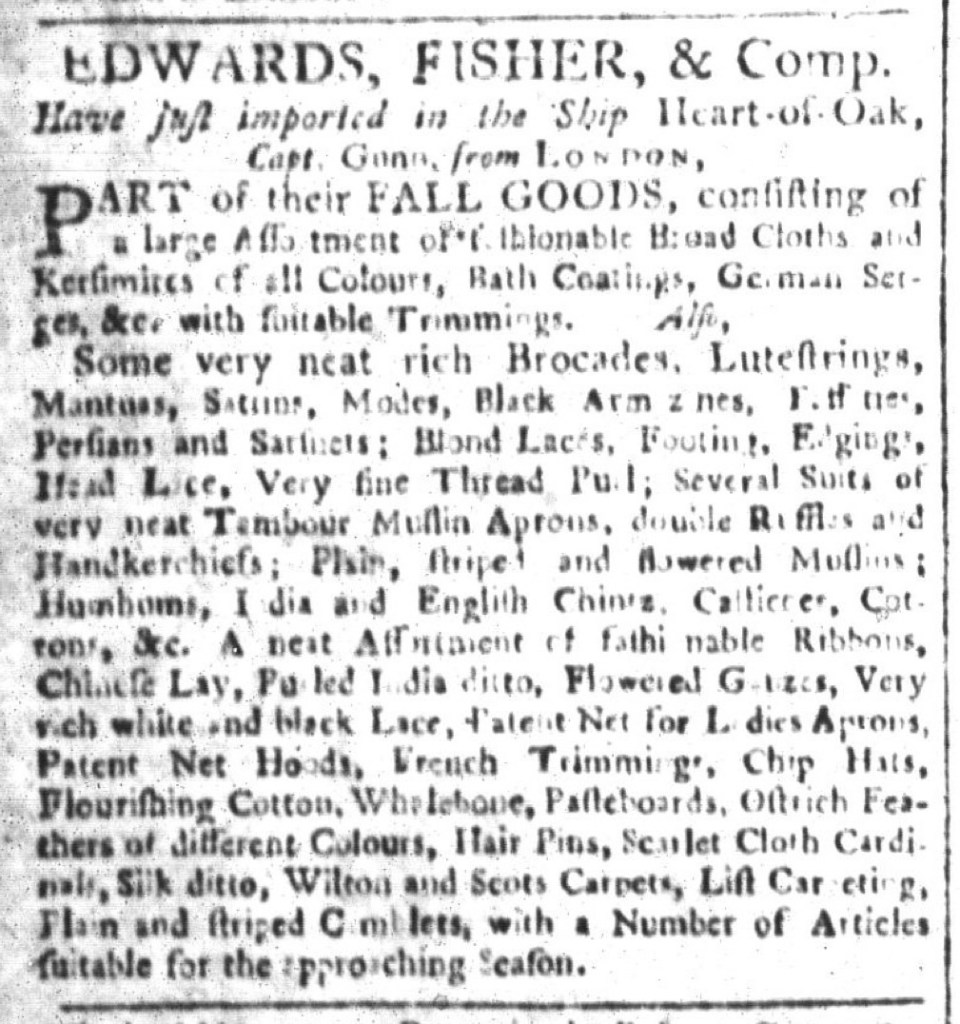
“Just imported … from LONDON, PART of their FALL GOODS.”

Like many other merchants and shopkeepers, Edwards, Fisher, and Company in Charleston updated their merchandise with the changing of the seasons.  With the arrival of fall in 1774, they ran advertisements in the South-Carolina and American General Gazette, the South-Carolina Gazette, and the South-Carolina Gazette and Country Journal to announce that they had “just imported” a “large Assortment” of textiles and other items.  This new inventory accounted for “PART of their FALL GOODS,” suggesting that they would continue to supplement their wares as ships arrived from London.

Edwards, Fisher, and Company may have believed that they had a narrow window of opportunity to import and sell these goods.  Earlier in the month, a competitor acknowledged that “a Non-importation Agreement will undoubtedly soon take Place here,” encouraging consumers (“Ladies” in particular) to shop while they had the chance.  The First Continental Congress had recently convened in Philadelphia to discuss coordinated measures in response to the Coercive Acts.  Their deliberations would result in the Continental Association, a nonimportation, nonconsumption, and nonexportation agreement set to go into effect on December 1.  In late September, merchants, shopkeepers, and consumers in Charleston and other American cities and towns did not yet know exactly which measures the First Continental Congress would adopt, but they reasonably anticipated that importing and purchasing goods would be constrained in the coming months.

That gave Edwards, Fisher, and Company an opportunity to sell the “Number of Articles suitable for the approaching Season” that had already arrived as “PART of their FALL GOODS.”  They probably kept their fingers crossed that other shipments would arrive from London before news of a nonimportation agreement arrived from Philadelphia.  They sought to entice prospective customers with an extensive list of their wares, describing them as “fashionable” more than once.  What consumers would consider fashionable, however, evolved when nonimportation agreements went into effect.  Homespun textiles produced in the colonies rather than “very neat rich Brocades” and other imported fabrics became fashionable because of the political principles they communicated.  Edwards, Fisher, and Company would have to content with that another day; for the moment, they could continue following familiar strategies for marketing imported textiles and other goods.

Slavery Advertisements Published September 23, 1774

The Slavery Adverts 250 Project chronicles the role of newspaper advertising in perpetuating slavery in the era of the American Revolution. The project seeks to reveal the ubiquity of slavery in eighteenth-century life from New England to Georgia by republishing advertisements about enslaved people – for sale as individuals or in groups, wanted to purchase or for hire for short periods, runaways who liberated themselves, and those who were subsequently captured and confined in jails and workhouses – in daily digests on this site as well as in real time via the @SlaveAdverts250 Twitter feed, utilizing twenty-first-century media to stand in for the print media of the eighteenth century.

The project aims to provide modern audiences with a sense of just how often colonizers encountered these advertisements in their daily lives. Enslaved men, women, and children appeared in print somewhere in the colonies almost every single day. Those advertisements served as a constant backdrop for social, cultural, economic, and political life in colonial and revolutionary America. Colonizers who did not purport to own enslaved people were still confronted with slavery as well as invited to maintain the system by purchasing enslaved men, women, and children or assisting in the capture of so-called “runaways” who sought to free themselves from bondage. The frequency of these newspaper advertisements suggests just how embedded slavery was in colonial and revolutionary American culture in everyday interactions beyond the printed page.

These advertisements also testify to the experiences of enslaved men, women, and children, though readers must consider that those experiences have been remediated through descriptions offered by enslavers rather than enslaved people themselves. Often unnamed in the advertisements, enslaved men, women, and children were not invisible or unimportant in early America.

These advertisements appeared in colonial American newspapers 250 years ago today.

Connecticut Journal (September 23, 1774).

**********

Connecticut Journal (September 23, 1774).

**********

South-Carolina and American General Gazette (September 23, 1774).

**********

South-Carolina and American General Gazette (September 23, 1774).

**********

South-Carolina and American General Gazette (September 23, 1774).

**********

South-Carolina and American General Gazette (September 23, 1774).