September 25

What was advertised in a colonial American newspaper 250 years ago this week?
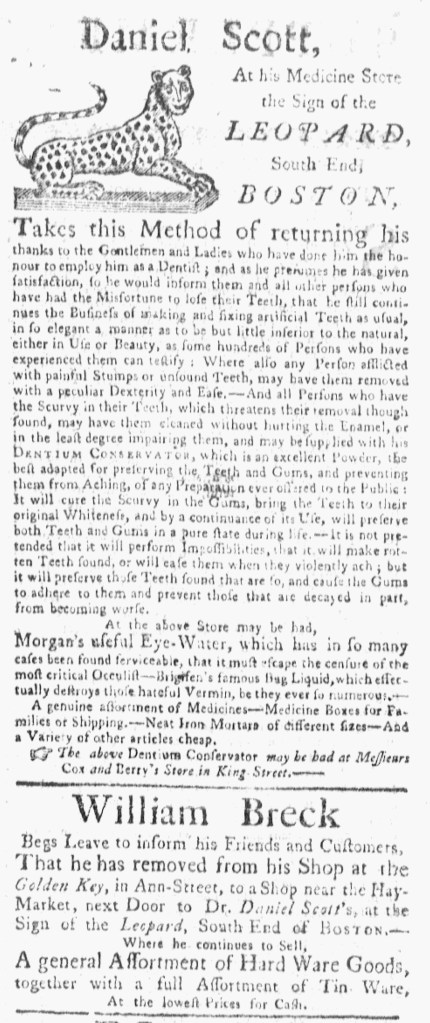
Boston Evening-Post (September 19, 1774).

“Next Door to Dr. Daniel Scott’s, at the Sign of the Leopard.”

In the fall of 1774, William Breck ran an advertisement “to inform his Friends and Customers” that he had moved to a new location.  They would no longer find him at his shop “at the Golden Key, in Ann-street” but instead at a shop “near the Hay-Market, next Door to Dr. Daniel Scott’s at the Sign of the Leopard, South-End of BOSTON.”  Even though he moved, he “continues to sell, as usual, A general Assortment of Hard-Ware GOODS … at the lowest Prices.”

Breck’s advertisement documented some of the visual culture of commerce that residents and visitors encountered as they traversed the streets of the busy port.  Both devices, the Golden Key and the Sign of the Leopard, had also circulated more widely via other media.  Breck distributed an engraved trade card that included an image of an ornate key suspended within a cartouche above a list of the merchandise he stocked “at the Golden Key near the draw-Bridge.”  Paul Revere produced the trade card in the late 1760s, yet Breck might have given out copies well into the 1770s.  (Mary Symonds, a milliner in Philadelphia, commissioned a similar trade card in 1768.  She wrote a receipted bill on the back of one of them in 1770.)  Breck’s advertisement ran on its own in the September 22 edition of the Massachusetts Gazette and Boston Weekly News-Letter, but it just happened to appear immediately below Scott’s advertisement for his “Medicine Store” at “the Sign of the LEOPARD” featuring a woodcut depicting a leopard in the September 19 edition of the Boston Evening-Post.  That image had been circulating in that newspaper for several months, making the Sign of the Leopard an attractive option when Breck decided to include a familiar landmark to help orient customers to his new location.

Breck did not mention whether the Golden Key moved with him or remained as a fixture on Ann Street, marking the location for the next tenant in his former shop.  He had previously made quite an investment in associating the image with his business.  Engraved trade cards, after all, were much more expensive than newspaper advertisements, handbills, and broadsides.  Did he surrender an aspect of the branding associated with his business for many years when he relocated?

July 11

What was advertised in a colonial American newspaper 250 years ago today?

Boston Evening-Post (July 11, 1774).

“The Sign of the LEOPARD.”

When Daniel Scott advertised his “Medicine Store [at] the Sign of the LEOPARD, South End” in the July 11, 1774, edition of the Boston Evening-Post, he adorned his notice with a woodcut depicting that exotic animal.  The device that he chose to represent his store gave colonizers greater access to faraway places that were part of global networks of trade and (often involuntary) migration.  Residents of the busy port spotted the leopard when they passed by Scott’s store.  His advertisement disseminated an image of an animal native to Africa and Asia even more widely, reaching readers who encountered such creatures mainly through descriptions rather than images.  Something similar occurred with the “Sign of the ELEPHANT” that marked the location of “HILL’s ready Money Variety Store” in Providence and the woodcut of an elephant in Hill’s advertisements in the Providence Gazette in the spring and summer of 1774.  That these entrepreneurs used these animals as their emblems suggests that colonizers were familiar enough with their descriptions to recognize them when they saw them, yet the signs and woodcuts helped clarify their visualizations.

Colonizers did have some opportunities to view exotic animals transported to British North America.  In August 1768, for instance, Abraham Van Dyck advertised that he had on display “one of the most beautiful Animals, call’d, The LEOPARD” that had “JUST ARRIVED” in New York.  Assuming readers had limited familiarity with this large cat, Van Dyck provided a description: “adorned all over with very neat and different spots, black and white [and] much in Shape, Nature, and Colour, like unto a Panther.”  To further entice prospective audiences, he included a woodcut depicting the creature.  He also stated that he had “several other Animals” on display “in the Broad-Way,” but did not indicate which species.  Although colonizers in New York could pay one shilling for a “full View of the Leopard,” most did not have chances to observe this animal very often.  Their most regular access to visual images of leopards, elephants, and other exotic animals would have been shop signs and, occasionally, advertising media, such as trade cards and newspaper notices, that incorporated woodcuts.  Scott offered lengthy descriptions of some of the medicines he sold, but many readers may have considered the image of the leopard the most engaging part of his advertisement.