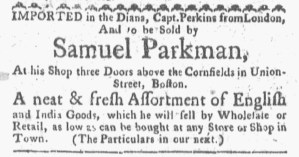
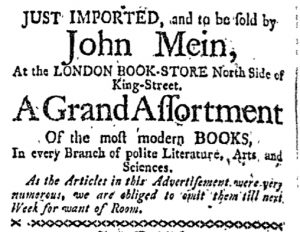
What was advertised in a colonial American newspaper 250 years ago today?
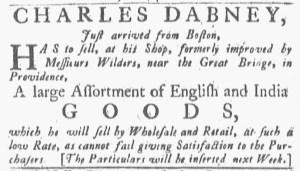
“[The Particulars will be inserted next Week.]”
Charles Dabney took out an advertisement in the Providence Gazette to announce that he stocked a “large Assortment of English and India GOODS” at his shop near the Great Bridge. He offered his wares “Wholesale and Retail, at such a low Rate, as cannot fail giving Satisfaction to the Purchasers.” In other words, customers would be happy with the bargains they got when they visited Dabney’s shop. He intended to provide a list of his merchandise to demonstrate the choices he made available to consumers, but his initial advertisement in the May 14, 1774, edition did not include “The Particulars.” Instead, the notice stated that those details “will be inserted next Week.” Who made that decision? Perhaps Dabney did not have time to draw up a list of that “large Assortment” before the May 14 edition went to press. Perhaps John Carter, the printer of the Providence Gazette, determined that he did not have space for all the content submitted that week. Dabney’s advertisement may have been the item easiest to truncate.
Whatever the explanation, the complete advertisement did not appear the following week. Politics and current events crowded out most advertisements, including even the short version of Dabney’s notice. A note from the printer advised, “To make Room for the interesting Advices in this Day’s Gazette, we are obliged to omit several Advertisements.” Those “interesting Advices” included the “Substance of the DEBATES on the BOSTON PORT-BILL” in the House of Commons in London. Parliament closed the port of Boston in retribution for the destruction of the tea that occurred the previous December. That news, which filled the entire front page and overflowed onto the second, arrived in Boston via several vessels from London. Carter then reprinted it from Boston’s newspapers. The second page also featured an editorial by “JUSTICE” that ran in the London’s Public Advertiser” and news from Philadelphia and Boston. The updates from Boston continued on third page, followed by a resolution in support of “the Province of the Massachusetts Bay” adopted at a “Town-Meeting held at Providence, on the 17th Day of May.” Advertising filled only two-thirds of the final column. More coverage of the debate over the Boston Port Act filled almost the entire final page. Two advertisements appeared at the bottom of the last column.
Dabney’s advertisement did finally appear in its entirety on May 28, but news about the imperial crisis, especially the repercussions of the Boston Tea Party, took priority. That arrangement may have helped to draw more eyes to Dabney’s notice when it did run. Colonizers looking for more news about the Boston Port Act and reactions to it in other colonies, including those who were not subscribers or regular readers, may have eagerly perused new issues of the Providence Gazette. They certainly found more news on May 28, but they also encountered Dabney’s advertisement with its extensive list of merchandise.