December 30

What was advertised in a colonial American newspaper 250 years ago today?

Massachusetts Spy (December 30, 1773).

“THE Editor of the ROYAL AMERICAN MAGAZINE, presents his most respectful Compliments.”

After advertising the Royal American Magazine more widely than in any previous month in November 1773, Isaiah Thomas placed fewer advertisements in December.  In total, he ran twenty advertisements in seven newspapers in six towns in five colonies, compared to the forty-three advertisements he published in November.  The success of his marketing efforts in June, July, August, September, October, and November likely explains the decline in the number of advertisements for December.  Thomas distributed subscription proposals to determine whether or not he could entice enough subscribers to make the magazine a viable venture and, if so, how many copies he needed to print.  Once he determined that sufficient interest existed to merit moving forward with the project, he did not need to disseminate the subscription proposals or notices about submitting them to his printing office as widely.  He could instead devote more attention to launching a newspaper, the Essex Journal, in Newburyport in partnership with Henry-Walter Tinges.

Thomas also shifted his attention to the production of the magazine, including gathering contents.  His advertisement addressed to the “generous Patrons and Promoters of useful KNOWLEDGE throughout AMERICA” solicited “the Favour of their LUCUBRATIONS” or essays to publish in the magazine.  In November, that notice appeared only in Boston, but in December it ran in newspapers published in Boston and Newburyport, Massachusetts; Portsmouth, New Hampshire; and Newport, Rhode Island.  Still, Thomas’s own publications carried the notice six of the twelve times it ran in December, five times in the Massachusetts Spy, where it originated, and once in the free inaugural issue of the Essex Journal.  That advertisement included a request for “PRINTERS of all the Public Papers in America” to insert it “as soon as may be,” but fewer took note of it than a notice asserting that “subscription papers will be returned to the intended publisher in a few days.”  That advertisement appeared five times in October, thirty-two times in November, and eight more times in December.  Only two newspapers, the Maryland Gazette and the Norwich Packet, carried it in December.  Having commenced publication the previous month, the Norwich Packet may have been eager for both the content and, especially, advertising revenue.

Thomas continued to advertise the Royal American Magazine in 1774.  He regularly announced the publication of new issues each month.  He did not, however, place such advertisements as widely as the subscription proposals and other notices calling on subscribers to submit their names as soon as possible or risk missing out on the magazine.  His marketing campaign concentrated on establishing the magazine rather than promoting it once it began publication.

**********

“Subscription Papers will be returned” Update

  • December 2 – Maryland Gazette (fifth appearance)
  • December 2 – Norwich Packet (third appearance)
  • December 9 – Maryland Gazette (sixth appearance)
  • December 9 – Norwich Packet (fourth appearance)
  • December 16 – Maryland Gazette (seventh appearance)
  • December 16 – Norwich Packet (fifth appearance)
  • December 23 – Maryland Gazette (eighth appearance)
  • December 30 – Maryland Gazette (ninth appearance)

“generous Patrons” Update

  • December 2 – Massachusetts Spy (second appearance)
  • December 3 – New-Hampshire Gazette (first appearance)
  • December 4 – Essex Journal (first appearance)
  • December 6 – Newport Mercury (first appearance)
  • December 9 – Massachusetts Spy (third appearance)
  • December 13 – Boston-Gazette (third appearance)
  • December 13 – Newport Mercury (second appearance)
  • December 16 – Massachusetts Spy (fourth appearance)
  • December 20 – Newport Mercury (third appearance)
  • December 23 – Massachusetts Spy (fifth appearance)
  • December 24 – New-Hampshire Gazette (second appearance)
  • December 30 – Massachusetts Spy (sixth appearance)

November 27

What was advertised in a colonial American newspaper 250 years ago today?

Providence Gazette (November 27, 1773).

“The Introduction to the Royal American Magazine … will be published on the first Day of January next.”

Isaiah Thomas’s efforts to promote the Royal American Magazine in the public prints intensified in November 1773.  The Adverts 250 Project has traced his marketing efforts, starting with an announcement, in May, that he would soon publish proposals for the magazine and the first insertion of those proposals in Thomas’s newspaper, the Massachusetts Spy, at the end of June.  The printer ran ten advertisements in July, thirteen in August, fourteen in September, twenty in October, and forty-three in November.

Boston Evening-Post (November 1, 1773).

The month began with the Boston-Evening Post running Thomas’s “To be, or not to be” update for the first time and the Massachusetts Gazette and Boston Post-Boy carrying it a second time on November 1.  Every newspaper then discontinued that notice, likely an acknowledgement of a note at the end of the version in the Boston Evening-Post: “by the appearance of the Subscription Papers in [Thomas’s] possession, there is great probability of [the magazine] going forward.”  Three days later, Thomas published an advertisement that appeared only three times, each time in his own Massachusetts Spy.  That brief notice called on local agents to send lists of subscribers to Thomas: “THOSE gentlemen, in this and the other provinces, who have subscription papers in their hands for the ROYAL AMERICAN MAGAZINE, are earnestly desired to return them.”

Massachusetts Spy (November 4, 1773).

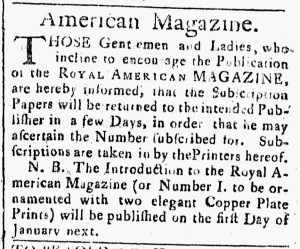
An advertisement that made its first appearance in some newspapers in the final week of October accounted for most of the notices that ran in November.  That advertisement advised “gentlemen and ladies, who incline to encourage the publication of the ROYAL AMERICAN MAGAZINE” that “Subscription Papers will be returned to the intended Publisher in a few Days.”  That notice ran thirty-two times in November, supplementing its five appearances in October.  It became Thomas’s most widely disseminated newspaper advertisement for the proposed magazine.  The Maryland Gazette, published in Annapolis, carried the notice four times in November, the first time any of Thomas’s advertisements ran in the public prints that far south.  Previously, only newspapers in New England, New York, and Pennsylvania carried it.  The Norwich Gazette, a newspaper established in Connecticut in October, also ran the advertisement in late November.  It may have featured the advertisement earlier, but the first issues of that newspaper have not survived.  This advertisement did not appear in any newspapers published in Massachusetts.  Thomas relied on his other advertisements there.  Overall, the “Subscription Papers will be returned” advertisement ran in fourteen newspapers published in ten cities and towns in six colonies.

Thomas devised one more advertisement in November 1773.  It first appeared in the Massachusetts Spy, but by the end of the month the Boston-Gazette and the Massachusetts Gazette and Boston Post-Boy both heeded Thomas’s plea for “PRINTERS of all the Public Papers in America … to insert this Advertisement.”  In it, Thomas stated that the first issue of the Royal American Magazine “will undoubtedly appear on the first of January next.”  He solicited essays to include in the new publication.  He also made another appeal to prospective subscribers to send their names “if they chuse not to be disappointed” by missing the first issue.

Launching the only magazine published in the colonies at that time was a significant undertaking.  That Thomas would eventually take the magazine to press was not inevitable.  He needed to cultivate a community of subscribers that extended beyond Boston.  To achieve that goal, he devised an extensive advertising campaign, one surpassed only by Robert Bell in his efforts to create an American literary market.

**********

Newspaper Advertisements for November 1773

To be, or not to be” Update

  • November 1 – Boston Evening-Post (first appearance)
  • November 1 – Massachusetts Gazette and Boston Post-Boy (second appearance)

“Subscription Papers will be returned” Update

  • November 1 – Newport Mercury (first appearance)
  • November 1 – Pennsylvania Chronicle (first appearance)
  • November 1 – Pennsylvania Packet (first appearance)
  • November 2 – Connecticut Courant (first appearance)
  • November 3 – Pennsylvania Journal (first appearance)
  • November 4 – Maryland Gazette (first appearance)
  • November 4 – New-York Journal (second appearance)
  • November 8 – Newport Mercury (first appearance)
  • November 8 – New-York Gazette and Weekly Mercury (first appearance)
  • November 8 – Pennsylvania Chronicle (second appearance)
  • November 8 – Pennsylvania Packet (second appearance)
  • November 9 – Connecticut Courant (second appearance)
  • November 10 – Pennsylvania Gazette (first appearance)
  • November 10 – Pennsylvania Journal (second appearance)
  • November 11 – Maryland Gazette (second appearance)
  • November 11 – New-York Journal (third appearance)
  • November 12 – New-Hampshire Gazette (second appearance)
  • November 12 – New-London Gazette (second appearance)
  • November 15 – Newport Mercury (second appearance)
  • November 15 – New-York Gazette and Weekly Mercury (second appearance)
  • November 15 – Pennsylvania Chronicle (third appearance)
  • November 18 – Maryland Gazette (third appearance)
  • November 18 – Norwich Packet (first known appearance)
  • November 20 – Providence Gazette (first appearance)
  • November 22 – New-York Gazette and Weekly Mercury (third appearance)
  • November 22 – Pennsylvania Chronicle (fourth appearance)
  • November 24 – Pennsylvania Gazette (second appearance)
  • November 25 – Maryland Gazette (fourth appearance)
  • November 25 – Norwich Packet (second appearance)
  • November 26 – New-Hampshire Gazette (third appearance)
  • November 27 – Providence Gazette (second appearance)
  • November 29 – Pennsylvania Chronicle (fifth appearance)

“subscription papers in their hands” Update

  • November 4 – Massachusetts Spy (first appearance)
  • November 11 – Massachusetts Spy (second appearance)
  • November 18 – Massachusetts Spy (third appearance)

“generous Patrons” Update

  • November 18 – Massachusetts Spy (first appearance)
  • November 22 – Boston-Gazette (first appearance)
  • November 22 – Massachusetts Gazette and Boston Post-Boy (first appearance)
  • November 26 – Massachusetts Spy (second appearance)
  • November 29 – Boston-Gazette (second appearance)
  • November 29 – Massachusetts Gazette and Boston Post-Boy (second appearance)

October 31

What was advertised in a colonial American newspaper 250 years ago this month?

Boston-Gazette (October 25, 1773).

“American Magazine. ‘To be, or not to be.’”

In the summer and fall of 1773, Isaiah Thomas advertised widely in his efforts to attract subscribers for the Royal American Magazine, a proposed publication that would become the only magazine published in the colonies at the time if the printer managed to generate enough interest to make it a viable venture.  On October 25, he placed advertisements in the Boston-Gazette and the Massachusetts Gazette and Boston Post-Boy with a secondary headline that proclaimed “To be, or not to be,” a familiar quotation from Shakespeare’s Hamlet, to indicate that the prospects of the publication remained uncertain.  In both newspapers, Thomas requested that anyone who recruited subscribers return the subscription papers with the lists of names by the middle of November “as by that Time he shall be able to determine, whether the said Magazine will be Published or not.”  The advertisement in the Boston-Gazette also included a nota bene in which Thomas confided that “by the Appearance of the Subscription papers, in his Possession, there is the greatest Probability of its going forward.”  Thomas would indeed publish the first issue in January 1774, though the magazine lasted only sixteen months due to the disruptions of the imperial crisis and, eventually, the war that began with the skirmishes at Lexington and Concord in April 1775.

The Adverts 250 Project has traced the advertising campaign that promoted the Royal American Magazine in June, July, August, and September.  An even greater number of advertisements appeared in colonial newspapers in October than in any previous month, a total of twenty advertisements in ten newspapers in eight towns in six colonies.  Three of those advertisements ran in Thomas’s own Massachusetts Spy, while other newspapers carried the vast majority of them. Fourteen of the advertisements appeared in newspapers published beyond Boston.  Thomas sought subscribers who read newspapers published in Salem, Massachusetts; Portsmouth, New-Hampshire; Newport, Rhode Island; New Haven and New London in Connecticut; and New York and Philadelphia.  Previously, the Connecticut Courant, published in Hartford, and the Providence Gazette also carried the subscription proposals for the Royal American Magazine.  Thomas knew the number of prospective subscribers in Boston alone would not justify an investment of the time and resources required to publish a magazine.  He devised an advertising campaign that extended to all of the colonies in New England as well as New York and Pennsylvania.

Newport Mercury (October 4, 1773).

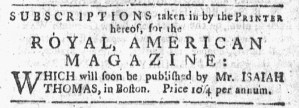
In October 1773, the subscription proposals appeared once again in the Connecticut Journal and the Pennsylvania Journal.  The printer’s update addressed “To the Public made additional appearances in the Boston-Gazette and the Massachusetts Spy.  It also ran for the first time in the Essex Gazette, published in Salem, and had two more insertions during the month.  Having published the subscription proposals in July and August, the Newport Mercury carried a unique advertisement, likely devised by Solomon Southwick, the printer and Thomas’s local agent for collecting the names of subscribers, rather than by Thomas himself.  It announced, “SUBSCRIPTIONS taken in by the Printer hereof, FOR THE ROYAL AMERICAN MAGAZINE: WHICH will soon be published by Mr. ISAIAH THOMAS, in Boston.  Price 10s4 per annum.”

Connecticut Journal (October 22, 1773).

That advertisement expressed greater certainty about the prospects for the magazine than Thomas’s “To be, or not to be” notice that ran in Boston later in the month, as did another update that Thomas placed in newspapers in Connecticut, New Hampshire, and New York near the end of the month.  That advertisement informed “Gentlemen and Ladies, who incline to encourage the Publication of the ROYAL AMERICAN MAGAZINE … that the Subscription Papers will be returned to the intended Publisher in a few Days, in order that he may ascertain the Number subscribed for.”  Those who had not yet submitted their names to the local printing office had only a limited time to do so.  As an enticement to those still contemplating whether they wished to subscribe, a nota bene promoted “two elegant Copper Plate Prints” that would accompany the first issue of the magazine.  The nota bene also indicated a publication date, “the first Day of January next.”  Along with the magazine, prospective subscribers did not have much time to qualify for these premiums.  If they decided to subscribe at some time in the future, they would miss out on the gift given to those who supported the magazine even before the first issue went to press.

Thomas hoped to publish the Royal American Magazine, but first he needed to determine if a market existed to support it.  His subscription proposals and other advertisements served a dual purpose: they incited demand for the magazine while also assessing interest and determining the total number of subscribers willing to pay for the publication.  Some subscription proposals, no matter how widely they circulated, never resulted in publishing the proposed book, magazine, map, or other item.  Over the course of several months, Thomas managed to identify and incite sufficient demand to publish the Royal American Magazine.

**********

Newspaper Advertisements for October 1773

Subscription Proposals

  • October 8 – Connecticut Journal (second known appearance; fourth possible appearance)
  • October 20 – Postscript to the Pennsylvania Journal (second appearance)

To the PUBLIC” Update

  • October 4 – Boston-Gazette (third appearance)
  • October 7 – Massachusetts Spy (third appearance)
  • October 12 – Essex Gazette (first appearance)
  • October 14 – Massachusetts Spy (fourth appearance)
  • October 19 – Essex Gazette (second appearance)
  • October 21 – Massachusetts Spy (fifth appearance)
  • October 26 – Essex Gazette (third appearance)

“SUBSCRIPTIONS” Notice

  • October 4 – Newport Mercury (first appearance)
  • October 11 – Newport Mercury (second appearance)
  • October 18 – Newport Mercury (third appearance)
  • October 25 – Newport Mercury (fourth appearance)

“Subscription Papers will be returned” Update

  • October 22 – Connecticut Journal (first appearance)
  • October 22 – New-Hampshire Gazette (first appearance)
  • October 22 – New-London Gazette (first appearance)
  • October 28 – New-York Journal (first appearance)
  • October 29 – Connecticut Journal (second appearance)

To be, or not to be” Update

  • October 25 – Boston-Gazette (first appearance)
  • October 25 – Massachusetts Gazette and Boston Post-Boy (first appearance)

September 26

What was advertised in a colonial American newspaper 250 years ago this week?

Massachusetts Gazette and Boston Post-Boy (September 20, 1773).

“The Royal American Magazine is likely in a short Time to make its Appearance.”

Throughout September 1773, Isaiah Thomas, printer of the Massachusetts Spy, continued marketing the Royal American Magazine.  He hoped to attract enough subscribers to make the publication a viable venture.  Although printers from New Hampshire to Georgia supplied colonizers with more than two dozen newspapers, including five printed in Boston, none of them published a magazine.  Instead, printers, booksellers, and shopkeepers imported magazines from England.  Realizing that he likely needed subscribers from beyond Massachusetts if he wished to take the magazine to press, Thomas advertised in several colonies.

In the first half of September, Thomas ran the proposals for the Royal American Magazine six more times, inserting them in four newspapers in two colonies.  The proposals appeared for the first time in the Connecticut Journal, published in New Haven, on September 3 and in the Pennsylvania Journal, published in Philadelphia, on September 8. By the end of the month, they had their second and third insertions in the Connecticut Courant, published in Hartford, and the New-London Gazette.  The proposals may have run again in the Connecticut Journal on September 17 and 24.  Those issues are not available via America’s Historical Newspapers.  While Thomas may have sent subscription papers in the form of broadsides, handbills, or pamphlets to local agents in other colonies, he did not arrange to have the proposals printed in newspapers south of Pennsylvania.  The proposals did state that “the printers and booksellers in Americas” accepted subscriptions.

Starting on September 9, Thomas circulated an update, a much shorter notice that first appeared in the Massachusetts Spy and then in other newspapers published in Boston.  This announcement, addressed “To the PUBLIC,” advised readers that the magazine “is likely in a short Time to make its Appearance” as a result of the “generous Encouragement of a great Number of Gentlemen in this Province.”  Thomas requested that “those Gentlemen and Ladies, who incline to be Promoters of this useful Undertaking” submit their names “with all convenient Speed” because he planned to commenced publication “as soon as he hears what Numbers of Subscribers there are in the other Colonies.”  Subscribers did not need to send any payment “until the delivery of the first Number.”  Thomas published and distributed the first issue of the Royal American Magazine in January 1774.

The printer devised an extensive advertising campaign in preparation of launching the magazine, coordinating newspaper advertisements in several colonies and corresponding with printers and other local agents.  Other printers pursued similar strategies when they set about new projects, using subscription proposals to incite demand.  Those advertisements simultaneously served as market research, informing printers whether they should take a project to press and, if so, how many copies to produce.

**********

Subscription Proposals

  • September 3 – Connecticut Journal (first appearance)
  • September 3 – New-London Gazette (second appearance)
  • September 7 – Connecticut Courant (second appearance)
  • September 8 – Pennsylvania Journal (first appearance)
  • September 10 – New-London Gazette (third appearance)
  • September 14 – Connecticut Courant (third appearance)
  • September 17 – possible second appearance in Connecticut Journal
  • September 24 – possible third appearance in Connecticut Journal

To the PUBLIC” Update

  • September 9 – Massachusetts Spy (first appearance)
  • September 13 – Boston Evening-Post (first appearance)
  • September 13 – Massachusetts Gazette and Boston Post-Boy (first appearance)
  • September 16 – Massachusetts Spy (second appearance)
  • September 20 – Boston-Gazette (first appearance)
  • September 20 – Massachusetts Gazette and Boston Post-Boy (second appearance)
  • September 27 – Supplement to the Boston-Gazette (second appearance)
  • September 27 – Massachusetts Gazette and Boston Post-Boy (third appearance)

September 14

What was advertised in a colonial American newspaper 250 years ago today?

Sep 14 - 9:14:1767 Boston Evening-Post
Boston Evening-Post (September 14, 1767).

“Just opened and now read for Sale, by Jolley Allen.”

A week ago I examined Jolley Allen’s extraordinary full-page advertisement in the September 7, 1767, edition of the Boston-Gazette. Given that Allen was prone to inserting the same advertisement in all four Boston newspapers, I noted that he had not placed that particular advertisement in the other two local newspapers distributed on the same day, nor the other one printed later in the week. The expense may have explained Allen’s decision, but space constraints may have played a role as well. The printers may not have been able to accommodate him at that time; after all, other advertisers had also contracted their services. It very well could have been a combination of the two factors, expense and limited space.

Allen’s full-page advertisement did not run a second time in the Boston-Gazette, but the following week a similar advertisement appeared in both the Boston Evening-Post and the Boston Post-Boy on September 14. In each case, the notice contained the same content, the same extensive list of merchandise, but had been condensed to two columns instead of three. Allen shared the page with other advertisers, reducing both expense and space. While the revised format may not have had the same impact as a full-page advertisement, taking up two columns was still an impressive feat that deviated from the vast majority of newspaper advertisements published in eighteenth-century America. Allen’s advertisement eventually ran in the Massachusetts Gazette, again condensed to two columns, on September 24, two and a half weeks after the full-page advertisement occupied the entire final page of the Boston-Gazette. It continued to appear sporadically in some, but not all, of Boston’s newspapers in October.

The two-column version lacked Allen’s signature decorative border in all three newspapers, but it did add an ornate printing device that flanked Allen’s name (itself printed in larger font than anything else in any of those newspapers, with the exception of the mastheads). In the absence of a border, Allen still managed to achieve visual consistency in his advertisements across three of Boston’s four newspapers.

Jolley Allen, a prolific advertiser, did not merely place notices in newspapers. Instead, he developed marketing campaigns that included advertising in multiple newspapers and consistent use of graphic design elements across those publications. He usually launched new advertisements through simultaneous publication in all of Boston’s newspapers, but the ability to do so with a full-page advertisement in September 1767 eluded him. Various factors may have been at play, yet Allen still managed to devise an advertising campaign of much greater magnitude than anything attempted by his competitors in Boston or his counterparts elsewhere in the colonies.

Bonus: Edward Pole’s Advertising Campaign

Yesterday evening I discovered that the American Antiquarian Society included a newspaper advertisement in its Instagram feed earlier in the day, a delightful surprise made even better by a generous reference to the Adverts 250 Project.  Please visit the AAS Instagram feed to see the advertisement and their commentary.

I was also excited because I recognized the advertiser, Edward Pole, a “Fishing-Tackle-Maker” who also operated a wholesale and retail grocery store in Philadelphia in the 1770s and 1780s.  Unlike most newspaper advertisements featured in the Adverts 250 Project so far, Pole’s advertisement (from fifteen years later, June 1781) included a woodcut to catch readers’ attention:  a striking image of a fish, certainly appropriate for an entrepreneur who peddled fishing tackle.  Woodcuts accompanying newspaper advertisements became more common during the last third of the eighteenth century.  Some advertisers, like Pole, used them as brands for their products and businesses.

Pole’s woodcut probably looked familiar to consumers in Philadelphia in 1781.  It appeared regularly in the Pennsylvania Packet (at least as early as May 1774), but that was not the only newspaper that included a woodcut of a fish with Pole’s commercial notices.  Pole placed advertisements for fishing tackle, including a very similar fish (this time with a decorative border), in the Freemen’s Journal in 1784.

Pole Newspaper Advert
Advertisement from the Freemen’s Journal (March 24, 1784).  Historical Society of Pennsylvania.

In addition,the savvy Edward Pole made use of multiple advertising media.  He distributed an engraved billhead for his receipts as early as the 1770s.  The billhead’s elaborate engraving featured a triptych logo in the upper left corner of the sheet, complete with rococo-style frames surrounding casks, crates, and scales on the left and right and the words “Edwd Pole’s GROCERY STORE Wholesale & Retail” in the center.  This billhead, with manuscript notations from 1771, is part of the Norris Papers at the Historical Society of Pennsylvania.

Sometime in the late 1770s or early 1780s, he also distributed engraved trade cards featuring a rectangular vignette of two gentlemen fishing in a stream above a description of the wares stocked in his shop.  Pole eventually resorted to broadsides (or, in modern terms, posters) for his business ventures.

Edward Pole Trade Card
Edward Pole’s Trade Card (ca. 1780).  Historical Society of Pennsylvania.

In addition to trade cards, billheads, and broadsides, Pole most prolifically advertised in several of Philadelphia’s newspapers, often distinguishing his advertisements from others on the page by including a woodcut of a fish, as we have seen.  Pole’s use of multiple media allowed him to publicize his wares widely.  Most advertisements relied exclusively on newspapers for their marketing, but Pole took an innovative approach by experimenting with other forms as he encouraged potential customers to visit his shop.