October 1

What was advertised in a revolutionary American newspaper 250 years ago this week?
Pennsylvania Ledger (September 30, 1775).

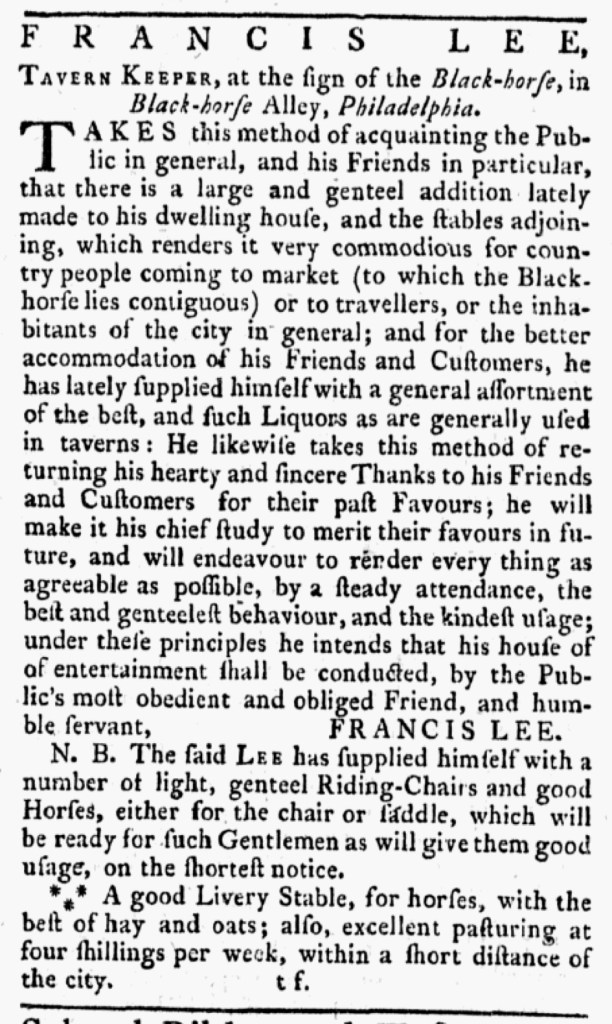
“Genteel Riding-Chairs … ready for Gentlemen as will give them good usage, on the shortest notice.”

In the fall of 1775, Francis Lee operated a tavern “at the sign of the Black-horse, in Black-horse Alley, Philadelphia.”  In an advertisement in the September 30 edition of the Pennsylvania Ledger, he advised readers about a “large and genteel addition lately made to his dwelling house, and the stables adjoining, which renders it very commodious for country people coming to market.”  His tavern was conveniently located “contiguous” to the market.  In addition to those prospective patrons, Lee also wanted travelers and “the inhabitants of this city in general” to know about the improvements he made at his tavern.  He also promoted his “general assortment of the best, and such Liquors as are generally used in taverns.”  That was all part of providing a pleasant and enjoyable experience for his guests.

Lee also provided other services for the convenience of his “Friends and Customers.”  They included a “good Livery Stable, for horses, with the best of hay and oats” or pasturing by the week, just outside the city, for those staying for a length of time.  He also made a point of highlighting the “genteel Riding-Chairs and good Horses, either for the chair or saddle” that he made available “on the shortest notice.”  In other words, Lee offered an eighteenth-century version of car rentals.  His customers could borrow a horse to ride (the reference to “saddle”) or a horse and fashionable carriage (the “genteel Riding-Chairs”) to transport them to their destination.  Travelers who arrived in Philadelphia on foot, via stagecoach, or on a ship could avail themselves of this service for getting around the city.

The tavernkeeper may have been especially interested in attracting the attention of visitors in the city to attend the Second Continental Congress.  With delegates from throughout the colonies converging on Philadelphia, Lee likely hoped that some of them would visit his “house of entertainment” to enjoy the “best and genteelest behaviour, and the kindest usage” from their host while they enjoyed the amenities of the establishment.  Lee pledged “to render every thing as agreeable as possible” for his customers.  Why not continue discussions or just relax at Lee’s “commodious” tavern after a busy day of meetings to discuss the imperial crisis that had become a war?

February 25

What was advertised in a colonial American newspaper 250 years ago today?

Norwich Packet (February 24, 1774).

“CLOCKS and WATCHES, if left with Mr. JOHN CHAMPLIN, in New-London, will be carefully forwarded to the said HARLAND, and returned with all Expedition.”

In February 1774, Thomas Harland, “WATCH & CLOCK MAKER, From LONDON,” ran an advertisement in the Norwich Packet “to acquaint the public, that he has opened a Shop … in Norwich.”  In it, he incorporated some of the appeals commonly advanced by artisans who migrated across the Atlantic.  In particular, Harland emphasized the quality of his work, declaring that he “makes, in the neatest manner, and on the most improved principles, horizontal, repeating, and plain watches.”  Like others in his trade, he also “cleans and repairs watches and clocks with the greatest care and dispatch.”  Harland devoted a nota bene to engraving and finishing clock faces and cutting and finishing parts, such as watch wheels and fusees, as “neat as in LONDON and at the same price.”  Harland suggested that he offered the sort of superior workmanship available in the largest and most cosmopolitan city in the empire.

Connecticut Gazette (February 25, 1774).

Residents of Norwich and surrounding towns were not the only prospective customers that Harland sought to attract.  He simultaneously ran the same advertisement, with a few modifications, in the Connecticut Gazette, published in New London.  His notice appeared on the front page of the February 25, 1774, edition, supplemented with a short paragraph that informed readers, “CLOCKS and WATCHES, if left with Mr. JOHN CHAMPLIN, in New-London, will be carefully forwarded to the said HARLAND, and returned with all Expedition.”  In his own advertisement on the fourth page of that issue, Champlin, a “GOLDSMITH and JEWELLER,” promoted the work he undertook in his shop and “likewise informs his Customers and others that they may have Clocks and Watches repaired at his Shop as usual.”  Harland’s advertisement suggests that those repairs did not take place in Champlin’s shop, that he instead sent them to Norwich.  Champlin had a history of partnering with associates to provide ancillary services to attract customers to his shop.  The previous fall, Champlin and Daniel Jennings jointly advertised in the New-London Gazette.  In April 1772, Champlin placed a notice in which he stated that he “employed a Person well acquainted” with “Clock and Watch making, mending, cleaning and repairing.”  In December 1769, James Watson advertised that he moved from one silversmith’s shop to Champlin’s shop “where he makes, mends and repairs all kinds of clocks and watches.”  Harland and Champlin mutually benefited from their partnership.  Harland, a newcomer, had an established artisan generating business for him, while Champlin continued providing the same array of services to current and prospective customers.

Champlin may have also played a role in Harland’s marketing efforts.  The watch- and clockmaker in Norwich may have sent his advertising copy to Champlin as part of their regular correspondence rather than directly to the printing office in New London.  An advertisement that had a rather plain appearance in the Norwich Packet featured a variety of embellishments in the Connecticut Gazette.  That version had greater variation in fonts as well as a decorative border.  Champlin’s advertisement also had a decorative border, while most paid notices in the Connecticut Gazette did not.  The compositor could have been responsible for sprucing up Harland’s advertisement, but the connection between Champlin and Harland suggests that the changes may have resulted from specific instructions from one of the advertisers.

July 1

What was advertised in a colonial American newspaper 250 years ago today?

Supplement to the New-York Journal (July 1, 1773).

“Advice to the cautious, who are about to buy, swop, and little jobs to the wise for nothing.”

On July 1, 1773, watchmaker John Simnet placed a new advertisement in Rivington’s New-York Gazetteer.  On that day, another of his advertisements appeared in the New-York Journal for the tenth time.  While not uncommon for merchants, shopkeepers, and artisans to advertise in more than one newspaper simultaneously, they usually submitted identical notices to each printing office.  Prospective customers usually encountered the same advertisement no matter which publication they happened to read.

Simnet’s advertisements in the two newspapers were not that much different.  In each, he informed the public that he recently “removed” to a new location.  He also proclaimed that he charged “half the price” of his competitors when it came to cleaning and repairing watches, in addition to offering a service plan in which he would “keep them in order at his own trouble, without expence (except abused).”  In other words, as long as clients treated their watches well, Simnet provided small repairs free of charge.  The watchmaker, a frequent advertiser, had been promoting these aspects of his business for quite some time, even before one of his current advertisements first ran in the New-York Journal on April 29.

Rivington’s New-York Gazetteer (July 1, 1773).

He made additional appeals in his new advertisement in Rivington’s New-York Gazetteer.  In particular, he offered “advice to the cautious, who are about to buy, swop, and little jobs to the wise for nothing.”  With the exception of small jobs undertaken gratis, these services had not previously been part of Simnet’s marketing efforts in the public prints.  The description he deployed closely replicated the language that Thomas Hilldrup, a watchmaker in Hartford, used in advertisements that ran in all three newspapers published in Connecticut.  In those notices, Hilldrup declared that he offered “advice to those who are about to buy, sell or exchange, and any other jobbs that take up but little time gratis.” Simnet almost certainly saw those advertisements, especially considering that he advertised in the Connecticut Courant for the first time in January 1773.  He had been active in the greater New York market for more than two years, after relocating from Portsmouth, New Hampshire, but had not considered it necessary to advertise in any of the newspapers published in Connecticut until Hilldrup arrived in the colony in the fall of 1772 and then devised an extensive advertising campaign over the next several months.

One other aspect of Simnet’s new notice merits attention, especially considering that he placed it in a newspaper that served Connecticut, New Jersey, the Hudson River, and Quebec.  Simnet asserted that he was the “ONLY regular Watchmaker here, of the London Company,” a claim that he frequently made in other advertisements as a means of denigrating his competitors.  In addition, he had a long history of picking fights and engaging in public feuds in his newspaper advertisements, first in Portsmouth and then in New York.  It comes as little surprise that he would appropriate the marketing strategies of a competitor while simultaneously contending that he possessed superior skill and training, especially in a newspaper that he anticipated that competitor was likely to read.  The cantankerous watchmaker often seemed as interested in taunting his competitors as attracting clients to his shop.

December 22

What was advertised in a colonial American newspaper 250 years ago today?

Connecticut Courant (December 22, 1772).

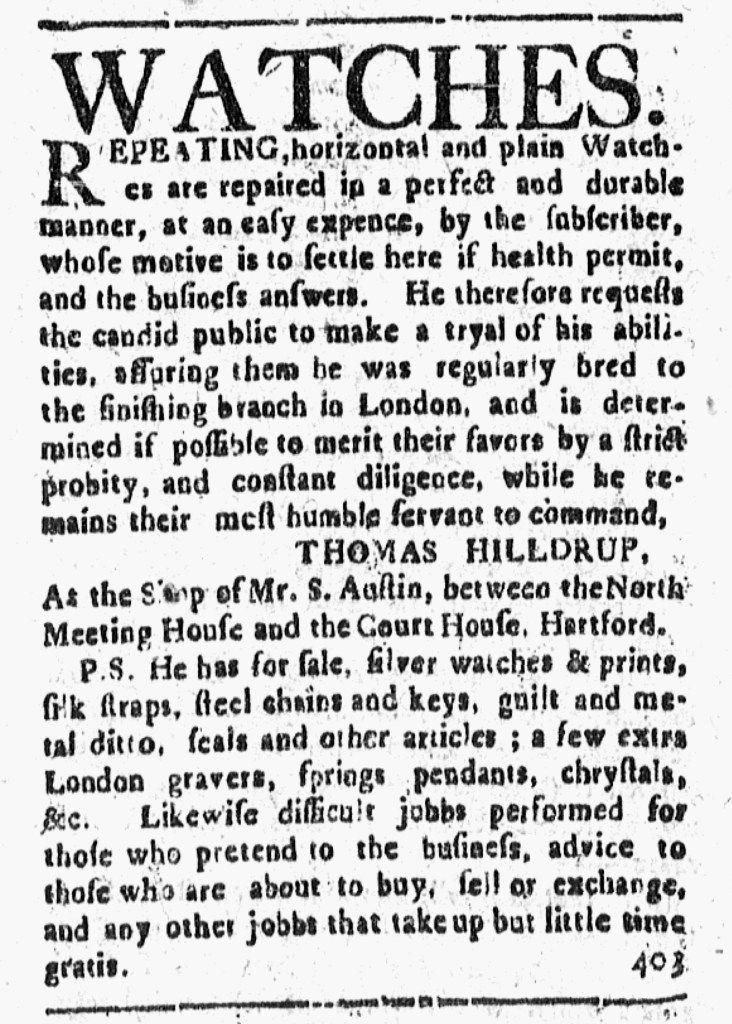
“WATCHES … Advice to those who are about to buy, sell or exchange.”

When Thomas Hilldrup arrived in Hartford in the fall of 1772, he commenced an advertising campaign in hopes to introduce himself to prospective customers who needed their watches repaired.  He first advertised in the September 15 edition of the Connecticut Courant.  That notice ran for three weeks.  On October 13, he published a slightly revised advertisement, one that appeared in every issue, except November 10, throughout the remainder of the year.  Although many advertisers ran notices for only three or four weeks, the standard minimum duration in the fee structures devised by printers, Hilldrup had good reason to repeat his advertisement for months.  He intended to remain in Hartford “if health permit[s], and the business answers.”  If he could not attract enough customers to make a living, then he would move on to another town.

Hoping to remain in Hartford, he asked prospective customers “to make a trial of his abilities” to see for themselves how well he repaired watches.  Satisfied customers would boost his reputation in the local market, but generating word-of-mouth recommendations would take some time.  For the moment, he relied on giving his credentials, a strategy often adopted by artisans, including watchmakers, who migrated from England.  Hilldrup asserted that he “was regularly bred” or trained “to the [watch] finishing branch in London.”  Accordingly, he had the skills “to merit [prospective customers’] favors” or business, aided by his “strict probity, and constant diligence.”  In addition, Hilldrup offered ancillary services in hopes of drawing customers into his shop.  He sold silver watches, steel chains, watch keys, and other merchandise.  He also provided “advice to those who are about to buy, sell or exchange” watches, giving expert guidance based on his professional experience.  Hilldrup concluded his advertisement with an offer that he likely hoped prospective customers would find too good to dismiss.  He stated that he did “any other jobbs that take up but little time gratis.”  Doing small jobs for free allowed the watchmaker to cultivate relationships with customers who might then feel inclined or even obligated to spend more money in his shop.

By running an advertisement with the headline “WATCHES” in a large font larger than the size of the title of the newspaper in the masthead, Hilldrup aimed to make his new enterprise visible to prospective customers in and near Hartford.  He included several standard appeals, such as promising low prices and noting his training in London, while also promoting ancillary services to convince readers to give him a chance.