March 29

What was advertised in a colonial American newspaper 250 years ago today?
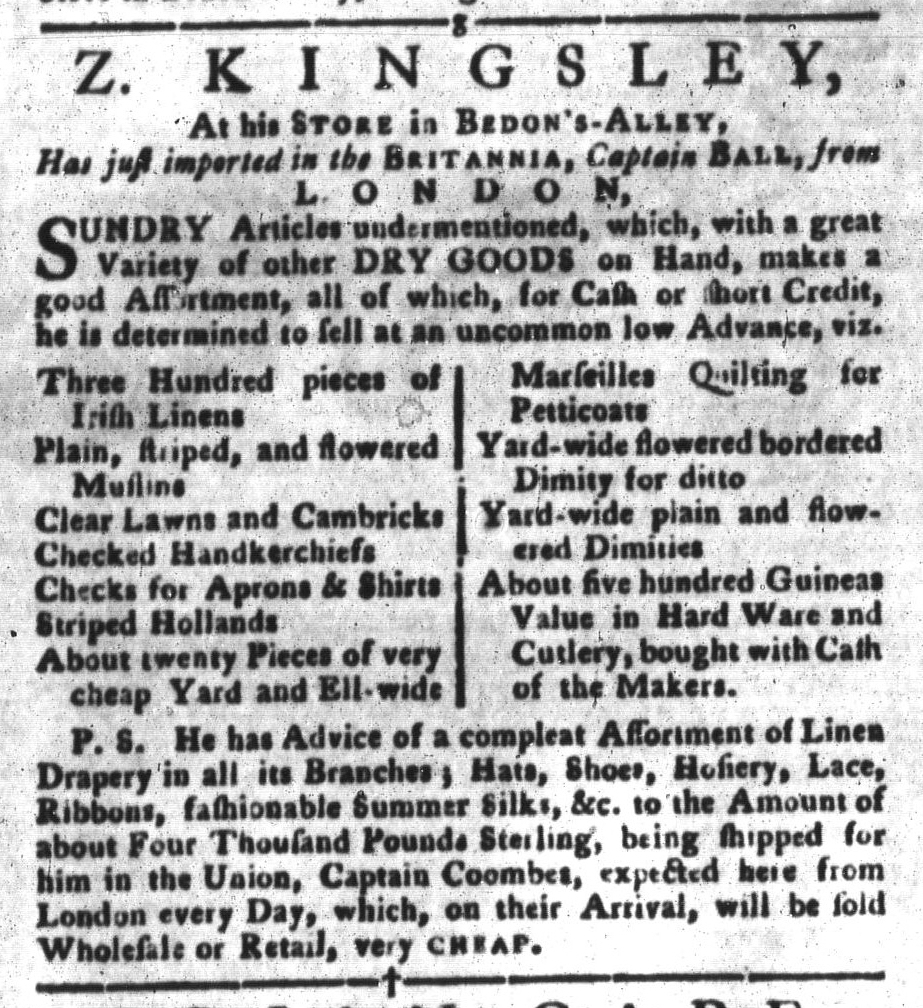
South-Carolina Gazette and Country Journal (March 29, 1774).

“He has Advice of a compleat Assortment … expected here from London every Day.”

Zephaniah Kingsley trumpeted the magnitude of the inventory “At his STORE in BEDON’S-ALLEY” in an advertisement in the March 29, 1774, edition of the South-Carolina Gazette and Country Journal.  He promoted the “SUNDRY Articles undermentioned” in a list of items “just imported … from LONDON” as well as a “great Variety of other DRY GOODS on Hand” from previous shipments.  All together, they constituted a “good Assortment” that offered a vast array of choices to consumers in Charleston.  He even took the unusual step of the total worth of some of his merchandise, declaring that he stocked “About five hundred Guineas Value in Hard Ware and Cutlery.”  That certainly signaled that he had indeed acquired a “good Assortment” of those items to satisfy the desires of just about any prospective customer.

The merchant opted for a postscript (rather than the more common nota bene) to alert readers that he “has Advice of a compleat Assortment of Linen Drapery in all its Branches; Hats, Shoes, Hosiery, Lace, Ribbons, fashionable Summer Silks,” and other goods “being shipped for him in the Union, … expected here from London every Day.”  As if his current inventory was not enough, Kingsley encouraged a sense of anticipation for new items that matched the most current fashions in London, the most cosmopolitan city in the empire.  In so doing, he once again deployed a marketing strategy that he used a couple of months earlier.  In early February, he proclaimed that he “intends having ready to open as soon as possible in the spring, an elegant assortment of Linen Drapery … with a quantity of the most fashionable summer Silks.”  The new advertisement served as an update for customers whose attention Kingsley caught with that preview.  In his effort to sell all his merchandise, including goods already “on Hand,” the merchant emphasized new items and even those that had not yet arrived but that he would make available to consumer imminently.  Curiosity about those goods, he likely reasoned, could help in moving older inventory out of his store once he got customers through the doors.

February 19

What was advertised in a colonial American newspaper 250 years ago today?

Providence Gazette (February 19, 1774).

“He has procured an European Dyer.”

Stephen Potter, a clothier in Coventry, Rhode Island, gave the public advance notice about a service he would soon offer.  In an advertisement that first appeared in the February 12, 1774, edition of the Providence Gazette and then continued on February 19 and 26, he advised “his old Customers, and all others” that he “begins colouring the first of March next.”

That expanded the range of services that the fuller provided when he processed woolen cloth “at his Clothier’s Works,” but Potter did not do so on his own.  Instead, he hired an employee (or perhaps acquired an indentured servant) who possessed skills that he did not.  As he explained to prospective customers, Potter “procured an European Dyer” who could “dye any Colour in Cloth or Yarn.”  The clothier highlighted the fact that his new dyer produced “a compleat Green.”

Entrepreneurs did not usually credit others who worked in their shops when they ran advertisements in colonial newspapers, but a few did so when they believed that acknowledging those who labored beside them or on their behalf helped in marketing the goods and services they sold.  In this instance, Potter’s “old Customers,” in particular, “and all others,” in general, likely knew that dying woolen goods was not a skill that he possessed.  As he sought to expand his business, Potter deemed it necessary to credit the “European Dyer” who recently joined “his Clothier’s Works.”

That did not prevent Potter from promoting his own contributions to the business, declaring that he “engages to dress his Work in the neatest Manner.”  Customers could expect the highest quality of both the fulling and the dying of cloth entrusted to Potter.  That Potter offered dying as an ancillary service distinguished his operation from other clothiers in the area.  That included John Waterman, a competitor who simultaneously ran advertisements in the Providence Gazette.

February 1

What was advertised in a colonial American newspaper 250 years ago today?

South-Carolina Gazette and Country Journal (February 1, 1774).

“He intends having ready to open as soon as possible in the spring, an elegant assortment of Linen Drapery in all its branches, with a quantity of the most fashionable summer Silks.”

Z. Kinsley inserted a lengthy advertisement promoting the “large STOCK of DRY GOODS” available at his store in Charleston in the South-Carolina Gazette and Country Journal several times in the winter of 1773 and 1774. Unlike most advertisements that ran for several consecutive weeks before being discontinued, this one appeared sporadically in December and January. Kingsley even placed it once again on February 1, perhaps in a final effort to move his current inventory before making a trip to London.  He made it known throughout his advertising campaign that “he intends going for London the beginning of February.”  With that departure in mind, he sold his wares for cash (or “ready Money”) or “short Credit.”  He set attractive prices, marking up his costs only slightly (or what he and other advertisers called “a very low Advance”).  As much as possible, he hoped to clear out his store to make room for new goods that he would acquire on his trip.

The merchant apparently did not envision staying in London for too long.  In a nota bene, he declared that he “intends having ready as soon as possible in the spring, an elegant assortment of Linen Drapery in all its branches, with a quantity of the most fashionable summer Silks” and other items.  In addition to marketing an assortment of textiles, hardware, cutlery, and ironmongery already in stock, Kingsley encouraged consumers to anticipate his summer selections well before they arrived.  Like so many other advertisers, he declared that he imported his merchandise “in the very last Ships from England,” but he devised an innovation on that popular appeal by prompting prospective customers to imagine what he would carry in his store after his trip.  Months in advance, he attempted to persuade consumers to think of his store as the place to purchase “fashionable summer Silks” and other goods appropriate for the season before his competitors began a chorus of claims about importing the newest and most fashionable items via the vessels that most recently arrived in port.  In addition, readers realized that making a trip to London meant that Kinsley could eliminate the middlemen who drove up prices.  That meant another “very low Advance” when he presented that “elegant assortment of Linen Drapery” for sale in the spring.

Most merchants and shopkeepers focused on selling the wares they already had in stock.  Kinsley devoted significant space in his advertisement to doing so, but he did not stop there.  At various points throughout the winter, he urged consumers in Charleston to anticipate the merchandise that he would select during his trip to the cosmopolitan center of the empire where he would observe the latest fashions himself.  His marketing efforts incorporated both shopping in the present and shopping in the future, priming customers to visit his store when they needed or desired to purchase from among his spring and summer selections.

October 20

What was advertised in a colonial American newspaper 250 years ago today?

Pennsylvania Gazette (October 20, 1773).

Sprogell is, and will be, constantly supplied with every article upon the very best terms.”

In the fall of 1773, Lodowick Sprogell took to the pages of the Pennsylvania Gazette to advertise a “GENERAL and neat assortment of GOODS, suitable to the present and ensuing season” available at his store on Second Street in Philadelphia.  To give prospective customers a sense of the selection, he listed some of his merchandise, including “mens, womens, boys, girls, and childrens stockings, of various colors,” “black silk mitts,” “worsted caps,” and “scarlet, light and dark blue, copper, London brown, copper and dark mixtures, and pearl coloured superfine, fine and coarse broadcloths.” He stocked many other kinds of textiles as well as accessors, like “buttons, buckles, [and] ribbons,” as well as “a variety of other articles.”  Like many other advertisers, Sprogell presented some of his wares and encouraged readers to use their imaginations to conjure what else they might discover when they visited his store.

The merchant also made appeals to price, noting that he acquired his inventory “upon the very best terms” and would pass along the bargains to his customers.  Before listing any of the goods, Sprogell suggested that readers could indeed afford them by stating the he was “determined to sell … at the most reasonable rates.  In a nota bene at the end of his advertisement, he reiterated this appeal, declaring that he had been “supplied with every article upon the very best terms” and, as a result, “he flatters himself that it is in his power to sell as low as can possibly be purchased elsewhere in the city.”  Among the many merchants and shopkeepers who hawked their wares in the largest city in the colonies, Sprogell vowed to set prices that matched or beat his competitors.

He also attempted to entice prospective customers with promises of future shipments, asserting that he “will be, constantly supplied” with new merchandise.  Most merchants and shopkeepers focused exclusively on goods already in their stores when they advertised, but some occasionally strove to create a sense of anticipation among prospective customers.  This also signaled that shoppers would not encounter leftovers in the coming months because Sprogrell already had a plan in place to regularly update his inventory.  In his advertisement, he looked to the future, not just the present, as an additional means of convincing consumers to take advantage of the large selection and low prices at his store.

September 7

What was advertised in a colonial American newspaper 250 years ago today?

South-Carolina Gazette and Country Journal (September 7, 1773).

“She expects a large and neat Assortment of Millinary from London soon.”

Jane Thomson, “SOLE-DEALER AND SEPARATE TRADER,” ran her own business in Charleston in the 1770s.  The milliner took to the pages of the South-Carolina Gazette and Country Journal to inform current and prospective clients that she “has removed from Tradd-Street to Old Church-Street, next Door to Mr. Sarazin, Silversmith,” and invited them to visit her at her new location.  She wished to maintain her clientele, expressing “grateful Thanks to her Friends and Customers for their past Favours” and stating that she “will be much obliged to her former Customers for the Continuance of their Commands.”  The milliner also hoped to expand her share of the market, promising “steady Attention” to all orders that would “give Satisfaction to all who are pleased to employ her.”

In addition to exemplary customer service, Thomson emphasized the hats as well as fabrics, ribbons, laces, other adornments, and supplies she stocked for making hats.  She declared that she “has a neat Assortment of Goods suitable for her Business.”  To further entice current and prospective clients, the milliner did not rely on her current inventory alone.  Rather than settle for leftovers that she moved from one shop to another, her customers would soon have access to a “large and neat Assortment of Millinary from London.”  Thomson expected a delivery that would replenish her supplies and keep her current with the latest fashions in the most cosmopolitan city in the empire.  On occasion, merchants, shopkeepers, tailors, milliners, and other advertisers previewed new merchandise as a means of generating excitement among prospective customers.  They leveraged anticipation to market goods not yet available, encouraging consumers to watch for subsequent advertisements or visit their shops frequently to find out what kinds of new goods recently arrived.  On another occasion, Thomson promoted “A fresh Supply of MILLINARY GOODS” that she imported from London, naming the ship and captain that delivered them to demonstrate that she did indeed carry goods recently arrived in the colony.  Like many other advertisers, she recognized that consumers placed a premium on the newest arrivals … and might even find promises of imminent arrivals even more alluring.

September 1

What was advertised in a colonial American newspaper 250 years ago today?

Pennsylvania Gazette (September 1, 1773).

“He expects in a general Assortment of other Goods, by the first Ships from London, Liverpool, Bristol, and Glasgow.”

Abraham Usher wanted prospective customers to know that he had new inventory at his store on Front Street in Philadelphia.  In an advertisement that ran in both the Pennsylvania Gazette and the Pennsylvania Journal on September 1, 1773, the merchant informed readers that he “just imported, in the Charming Nancy, Captain Tyrie, and the Caesar, Captain Miller, from LONDON, a large and general Assortment of Woollens, suitable for the Fall Sale” as well as “an Assortment of Birmingham and Sheffield Wares.”  Merchants and shopkeepers often opened their advertisements with a narrative about which ships transported their merchandise across the Atlantic.  Stephen Collins began his own advertisement in the Pennsylvania Gazette with “JUST IMPORTED, in the Caesar, Captain Miller, from London.”  This technique allowed consumers to make their own assessments about how recently the sellers acquired their goods, knowing from their own observation, word of mouth, or the entries from the customs house published in the newspaper when vessels arrived in port.

Usher did not merely promote goods that he recently stocked at his store.  He also attempted to create a sense of anticipation around the imminent arrival of new inventory.  He confided that he “expects in a general Assortment of other Goods, by the first Ships from London, Liverpool, Bristol, and Glasgow.”  Customers did not need to wait to glimpse another advertisement in the public prints before visiting Usher’s store.  There was a good chance he would have even more new inventory on hand whenever shopkeepers and others contacted him about acquiring goods for the fall season.  Usher likely hoped that previewing those arrivals would give him an advantage over his competitors.  Most did not advertise merchandise that had not yet arrived, but that was not the case for all of them.  William Miller, who also placed notices about goods “suitable for the approaching season” in the Pennsylvania Gazette and the Pennsylvania Journal, similarly stated that he “daily expects a further supply in the first vessels from London, Liverpool and Bristol.”  Given that every newspaper published in Philadelphia at the time came out only once a week, Miller suggested that he could have new wares on the shelves before prospective customers even saw the next edition of the Pennsylvania Gazette or the Pennsylvania Journal.  As other merchants highlighted goods recently added to their inventory, Usher and Miller sought to eclipse their advertisements with promises of even larger selections that would soon be available to customers.

July 23

What was advertised in a colonial American newspaper 250 years ago today?

Maryland Gazette (July 23, 1772).

“He intends for Annapolis … with a neat Assortment of Fire Dogs.”

In the summer of 1772, Daniel King, a brass founder, attempted to incite anticipation for his wares among consumers in Annapolis.  He had a workshop “At the Sign of the Bell and Brand, in … Philadelphia,” but did not run his operation solely from that location.  Instead, he announced his intention to visit Annapolis in late July or early August.  In an advertisement in the July 23 edition of the Maryland Gazette, he informed prospective customers that they could find him “at Mr. John Warren’s Tavern in Annapolis, where Orders will be received and punctually complied with.”

King hoped to encounter customers eagerly awaiting his arrival in Annapolis.  To increase the chances of that happening, he described his “neat Assortment of Brass Fire Dogs and Fenders, Fire Shovels and Tongs, and Chimney Backs.”  He confidently asserted that the items produced in his workshop “are neater and more to Order than any yet made on the Continent,” including those made by any competitors in Annapolis.  In addition, he considered his brass andirons “equal in Strength to any Iron Fire Dogs, and much easier kept clean.”

Like many artisans who advertised in colonial newspapers, King emphasized his training and experience in England prior to migrating across the Atlantic.  He declared that he “served his Apprenticeship in London, and worked in some of the best Shops in England.”  As a result, he produced andirons, shovels, tongs, and other items of the same quality and low prices as imported alternatives.  The brass founder stated that his consumers would derive “as much Satisfaction” from items form his workshop as any imported from England.

King and his andirons were likely both unfamiliar to “the Ladies and Gentlemen of Maryland” that he wished to attract as customers during an upcoming trip from his workshop in Philadelphia.  He sought to stoke anticipation for his arrival by convincing prospective customers that his wares were superior to any others, whether imported or made in the colonies.  He hoped that readers of the Maryland Gazette would at least visit Warren’s Tavern to examine his wares and compare them to others that merchants, shopkeepers, and artisans made available in Annapolis, giving him an opportunity to engage prospective customers in conversation and make his appeals in greater detail.

May 31

What was advertised in a colonial American newspaper 250 years ago this week?

South-Carolina Gazette (May 28, 1771).

“He shall receive another CARGO … so that at all Times the Public may be assured of seeing the greatest Variety.”

Philip Tidyman, a jeweler and goldsmith, alerted prospective customers in Charleston that he imported “A LARGE ASSORTMENT OF PLATE, JEWELS,” and other merchandise.  His inventory included gold watches, “Pearls in all Fancies,” tea kettles, and coffee pots.  His wares matched current tastes in London, “all new-fashioned” for discerning consumers.  Tidyman hoped that the items he already stocked would entice readers to visit his shop, but he did not focus exclusively on his current inventory.  Instead, he emphasized that he constantly received new merchandise.  Customers did not have to worry about the selection in his shop stagnating.

Tidyman proclaimed that he “shall receive another CARGO per Captain WILSON” in the near future as well as “Patterns of all new Goods in every London Ship” that arrived in the busy port.  That meant that “at all Times the Public may be assured of seeing the greatest Variety in every Branch of his Business.”  Rather than wait for Tidyman to publish subsequent advertisements, customers could keep current by making repeat visits to his shop.  The jeweler suggested that they were bound to discover something new on each trip.  In so doing, he attempted to create a sense of anticipation among consumers, not only desire for his current merchandise but also longing for whatever might arrive via the next vessels from London.

This strategy may have helped Tidyman distinguish his advertisement from one that Jonathan Sarrazin placed for a “LARGE and ELEGANT Assortment of PLATE and JEWELLERY” in the same issue of the South-Carolina Gazette.  Like Tidyman, Sarrazin stated that he “just imported” this merchandise, but he did not give any indication that he expected additional shipments to keep his inventory fresh.  He published an advertisement for the moment, while Tidyman crafted a marketing strategy intended to endure for quite some time after his notice ran in the newspaper.

March 28

What was advertised in a colonial American political magazine 250 years ago today?

The Censor (March 28, 1772).

The hurry of our other business prevents giving the Publick an additional half sheet.”

When Ezekiel Russell began publishing The Censor, a political magazine, in the fall of 1771, he did not include advertising as a means of generating revenue.  Each weekly issue of the publication consisted of four pages, two printed on each side of a broadsheet then folded in half.  In that regard, The Censor resembled newspapers of the period, but it did not carry short news articles reprinted from other newspapers, prices current, shipping news from the customs house, poetry, advertisements, and other content that appeared in other newspapers.  Instead, Russell used The Censor to disseminate political essays that expressed a Tory perspective on current events in Boston, often only one essay per issue.  Sometimes essays spanned more than one issue.  After a few months, Russell began distributing a half sheet Postscript to the Censor with content, including advertising, that more closely resembled what appeared in other newspapers published in Boston.

Russell devoted the entire March 28, 1772, edition of The Censor to a letter from a correspondent who defended Ebenezer Richardson, the customs official who killed eleven-year-old Christopher Seider.  On the night of February 22, 1770, Richardson fired into a crowd of protestors who objected to merchants bringing an end to their nonimportation agreement before Parliament repealed import duties on tea.  His shots killed Seider.  The boy’s funeral became an occasion for further anti-British demonstrations.  Less than two weeks later, heightened tensions overflowed into the Boston Massacre.  A jury convicted Richardson of killing Seider, but the authorities chose to imprison rather than execute him.  The king eventually pardoned Richardson and offered him a new post in Philadelphia in 1773, but he was still imprisoned in 1772 when a correspondent of The Censor examined his case.

That correspondent’s letter did not fit in a single issue of The Censor.  Russell concluded with a brief note that “The Remainder must be omitted until next Week.”  He further explained that “the hurry of our other business prevents giving the Publick an additional half sheet” with other news, advertising, and other content.  He did find space, however, to insert a short teaser about a forthcoming publication.  “It is with pleasure the Printer can promise his Customers,” Russell declared, “that in a few days will be published, a PAMPHLET, intimately connected with the present Times, and perhaps one of the most agreeable Entertainments ever offered the sensible Publick.”  He did not further elaborate on the topic of that pamphlet, but his announcement suggested that he could be savvy in his efforts to incite interest and anticipation among consumers.  In this instance, Russell emphasized his own marketing but did not tend to the paid notices that would have appeared in the “additional half sheet.”  Isaiah Thomas, the patriot printer of the Massachusetts Spy and author of The History of Printing in America (1810), claimed that The Censor quickly failed because Russell published unpopular political views.  While that may have been the primary reason, it also looks as though Russell did not sufficiently attend to the business aspects of publishing it.  Not distributing the “additional half sheet” meant delayed advertising revenues and dissatisfied advertisers.

October 17

What was advertised in a colonial American newspaper 250 years ago today?

Oct 17 - 10:17:1768 New-York Gazette Weekly Mercury
New-York Gazette and Weekly Mercury (October 17, 1768)

“I also expect by the first vessels from London and Bristol, a number of other articles suitable for the season.”

In the fall of 1768 Eleazer Miller, Jr., placed an advertisement in the New-York Gazette and Weekly Mercury to promote the “neat assortment of Goods fit for the Season” that he had “just imported.” Miller’s inventory included a variety of textiles, garments, and adornments, including an “assortment of silk handkerchiefs, mens black cravats, [and] womens Barcelona handkerchiefs.” Like many other merchants and shopkeepers, he indicated the English ports where shipments of those goods had originated. Some had arrived “from London, per Capts. Gilchrist, Farquhar, Mund, & Miller” and others via the “last vessels from Bristol.” Doing so helped to confirm that Miller carried new merchandise. He assumed that readers would be familiar with the vessels that had recently arrived in port. Those who were not could compare Miller’s list to the shipping news, a list of ships, captains, and ports of origin provided by the customs house.

Yet Miller did not solely market goods “just imported” from English cities. He also encouraged prospective customers to anticipate other merchandise that would arrive soon. After listing dozens of items already in stock, Miller noted, “I also expect by the first vessels from London and Bristol, a number of other articles suitable for the season, which will also be sold cheap.” Perhaps Miller hoped that prospective customers would make their way to his store in Hanover Square regularly to see what kinds of new items had arrived since their last visit. Announcing that he expected additional shipments let consumers know that he did not allow the inventory on his shelves to stagnate, nor did he expect shoppers to accept whatever goods happened to remain. Instead, he refreshed his wares to better serve his customers … at least for the moment.

In addition to such concerns, Miller also faced a deadline of sorts. On August 27, “nearly all the Merchants and Traders in Town” had subscribed to a nonimportation agreement in response to the taxes levied by the Townshend Act. Their resolution appeared in the September 8, 1768, edition of the New-York Journal. The first resolution stated that they “will not send for from Great-Britain, either upon our own Account or on Commission, any other Goods than what we have already ordered.” By underscoring that he expected the imminent arrival of new merchandise via vessels from London and Bristol, Miller could claim that these were goods that he had “already ordered” and that they did not violate the nonimportation agreement. Furthermore, the second resolution stated that the city’s merchants and traders “will not import any kind of Merchandise from Great-Britain, either on our own Account or on Commission … that shall be shipped from Great-Britain after the First Day of November.” Again, by emphasizing that any new merchandise in his shop would arrive on “the first vessels from London and Bristol” Miller suggested that he abided by the parameters of the nonimportation agreement.

Merchants and shopkeepers in New York subscribed to their nonimportation agreement only after stockpiling goods to sell to local consumers. By skating right up to the deadlines for ceasing orders and deliveries, Miller did not explicitly mention the nonimportation agreements but he did send a message to prospective customers with a wink and a nod. Even as colonists extolled the virtues of resistance through their endorsements of nonimportation they could continue many of their usual habits of consumption. The new merchandise at Miller’s store provided the means for doing so.