May 11

What was advertised in a revolutionary American newspaper 250 years ago today?
Rivington’s New-York Gazetteer (May 11, 1775).

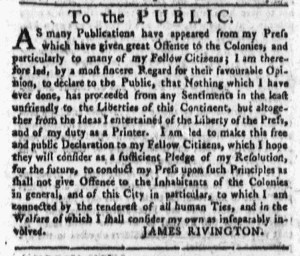
“Many Publications have appeared from my Press which have given great Offence to the Colonies.”

James Rivington seemed to change his tune about what he printed and sold at his printing office on Hanover Square in New York.  On April 20, the day after the battles at Lexington and Concord, the printer of Rivington’s New-York Gazetteer once again advertised “several pamphlets on the Whig and Tory side” of “THE AMERICAN CONTEST.”  Word of what had occurred in Massachusetts the previous day had not yet arrived in New York, but Rivington had other news concerning the imperial crisis to report.  That included residents of New Brunswick, New Jersey, hanging “an effigy, representing the person of Mr. Rivington … merely for acting consistent with his profession as a free printer.”  A rare woodcut depicting the scene accompanied the combination article and editorial about his “OPEN and UNINFLUENCED PRESS.”

A week later, Rivington’s New-York Gazetteer carried news of Lexington and Concord.  The printer chose not to insert his advertisement hawking pamphlets representing both Whig and Tory perspectives in that issue.  In the next issue, two weeks after the battles in Massachusetts, Rivington ran a new advertisement, one that took a different tone than his coverage of the effigy.  “AS many Publications have appeared from Press which have given great Offence to the Colonies, and particularly to many of my Fellow Citizens,” the printer declared, “I am therefore led, be a most sincere Regard for their favourable Opinion, to declare to the Public, that Nothing which I have ever done, has proceeded from any Sentiments in the least unfriendly to the Liberties of this Continent, but altogether from the Ideas I entertained of the Liberty of the Press, and of my duty as a Printer.”  That being the case, “I am led to make this free and public Declaration to my Fellow Citizens, which I hope they will consider as a sufficient Pledge of my Resolution, for the future, to conduct my Press upon such Principles as shall not give Offence to the Inhabitants of the Colonies in general, and of this City in particular, to which I am connected by the tenderest of all human Ties, and in the Welfare of which I shall consider my own as inseparably involved.”  Rivington stopped short of offering an apology or stating that he regretted printing and selling newspapers and pamphlets that advanced Tory views, but he did take a less defiant tone in his effort to explain his editorial decisions.  He suggested that he would adopt a new approach, though he did not go into detail about that.  Perhaps he hoped that critics would notice that he did not advertise the problematic pamphlets.  Even if they did not, Rivington refrained from publishing an advertisement that ran counter to the message he delivered in his notice clarifying his prior actions.

That notice appeared in three consecutive issues of Rivington’s New-York Gazetteer, none of which carried advertisements for political pamphlets.  The events unfolding in Massachusetts may have encouraged the printer to take greater caution, though the masthead of his newspaper continued to proclaim that he operated an “OPEN and UNINFLUENCED PRESS.”  As far as the Sons of Liberty were concerned, however, the printer could not redeem himself.  On May 10, a week after Rivington first published his notice assuring the public that he would “conduct [his] Press upon such Principles as shall not give Offence to the Inhabitants of the Colonies,” the Sons of Liberty attacked his home and printing office.  Rivington fled to a British ship in the harbor.  Assistants maintained uninterrupted publication of the newspaper, continuing to run Rivington’s notice, while the printer petitioned the Second Continental Congress for pardon.  As Todd Andrlik documents, Rivington explained that “however wrong and mistaken he may have been in his opinions, he has always meant honestly and openly to do his duty.”  The Continental Congress forwarded the petition to the New York Provincial Congress.  Rivington received his pardon, but his reformation was not so complete as to avoid further notice from the Sons of Liberty.  In November 1775, Sons of Liberty from New Haven destroyed his press and reportedly melted down his types to make shot, bringing an end to Rivington’s New-York Gazetteer.
April 27

What was advertised in a revolutionary American newspaper 250 years ago today?

Norwich Packet (April 27, 1775).

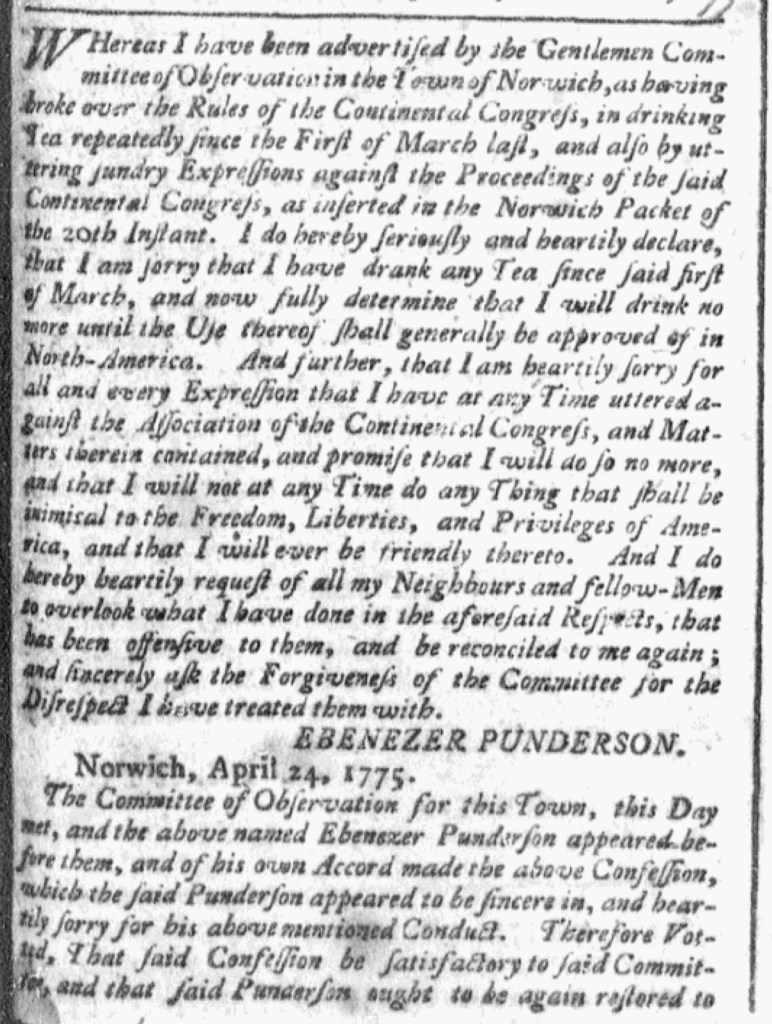
I am sorry that I have drank any Tea.”

Ebenezer Punderson had the misfortune of appearing in an advertisement placed in the Norwich Packet by the local Committee of Inspection in the issue that carried the first newspaper coverage of the battles of Lexington and Concord.  The committee accused him of drinking tea in violation of the Continental Association, disparaging the First Continental Congress, and refusing to meet with the committee to discuss his conduct.  In turn, the committee advised the public not to carry on any “Trade, Commerce, Dealings or Intercourse” with Punderson.

Perhaps Punderson would have weathered that sort of public shaming under other circumstances, but news of events at Lexington and Concord made his politics even more unpalatable and his situation more dire.  From what ran in the newspaper, it did not take him long to change his tune, meet with the committee, and publish an apology for his behavior.  In a missive dated four days after the committee’s advertisement, Punderson reiterated the charges against him and “seriously and heartily” declared the he was “sorry I have drank any Tea since the first of March” and “will drink no more until the Use thereof shall generally be approved in North-America.”  In addition, he apologized for “all and every Expression that I have at any Time uttered against the Association of the Continental Congress.”  Furthermore, Punderson pledged that he “will not at any Time do any Thing that shall be inimical to the Freedom, Liberties, and Privileges of America, and that I will ever be friendly thereto.”  He requested that his “Neighbours and fellow-Men to overlook” his transgression and “sincerely ask[ed] the Forgiveness of the Committee for the Disrespect I have treated them with.”

Norwich Packet (April 27, 1775).

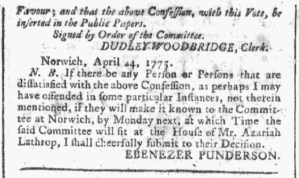
Punderson apparently convinced the committee to give him another chance.  Dudley Woodbridge, the clerk, reported that Punderson “appeared before them, and of his own Accord made the above Confession” and seemed “heartily sorry for his … conduct.”  In turn, the committee voted to find Punderson’s confession “satisfactory” and recommended that he “be again restored to Favour” in the community.  The committee also determined that “the above Confession, with this Vote, be inserted in the Public Papers,” perhaps less concerned with restoring Punderson’s good name than the example his recantation set for other Tories.  When the notice appeared in the Norwich Packet, Punderson inserted an additional note that extended an offer to meet with anyone “dissatisfied with the above Confession” and asserted that he would “cheerfully submit” to any further decisions the Committee of Inspection made in response.

Yet what appeared in the Norwich Packet did not tell the whole story.  According to Steve Fithian, Punderson “attempted to flee to New York but was captured and returned to Norwich where he spent eight days in jail and only released after signing a confession admitting to his loyalist sympathies.”  He did not stay in Norwich long after that.  “Several weeks later he fled to Newport, Rhode Island and boarded a ship which took him to England where he remained for the entire Revolutionary War.”  Apparently, he convincly feigned the sincerity he expressed, well enough that the committee accepted it.  While imprisoned, Punderson wrote a letter to his wife about his ordeal.  After arriving in England, he published an account with a subtitle that summarized what he had endured: The Narrative of Mr. Ebenezer Punderson, Merchant; Who Was Drove Away by the Rebels in America from His Family and a Very Considerable Fortune in Norwich, in Connecticut.  Just as the Committee of Inspection used print to advance a version of events that privileged the patriot cause, Punderson disseminated his own rendering once he arrived in a place where he could safely do so.

**********

The Committee of Inspection’s notice appeared with the advertisements in the April 20, 1775, edition of the Norwich Packet.  Punderson’s confession, however, ran interspersed with news items in the April 27 edition.  It may or may not have been a paid notice, but it was certainly an “advertisement” in the eighteenth-century meaning of the word.  At the time, according to the Oxford English Dictionary, an advertisement was a “(written) statement calling attention to anything” and “an act of informing or notifying.”  Advertisements often delivered local news in early American newspapers.  Punderson definitely made news as the imperial crisis became a war.

February 7

What was advertised in a colonial American newspaper 250 years ago today?

Essex Gazette (February 7, 1775).

“He had no Intention of injuring his Country, or of defending any one unfriendly to its Cause.”

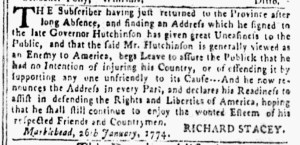
It was yet another public disavowal of an address honoring Thomas Hutchinson, the former governor of Massachusetts, that many colonizers signed when he returned to England.  This time, Richard Stacey inserted his recantation in the February 7, 1775, edition of the Essex Gazette.  Similar advertisements began appearing in that newspaper and sometimes newspapers printed in Boston as early as July 1774.  Stacey explained that he waited several months because he “just returned to the Province after long Absence” and only upon his arrival did he discover “an Address which he signed to the late Governor Hutchinson has given great Uneasiness to the Public.”  He further explained that the former governor “is generally viewed as an Enemy to America.”

That being the case, Stacey “begs Leave to assure the Publick that he had no Intention of injuring his Country, or of offending it by supporting any one unfriendly to its Cause.”  Accordingly, “he now renounces the Address in every Part, and declares his Readiness to assist in defending the Rights and Liberties of America.”  With such a proclamation, disseminated far and wide in the newspaper, Stacey desired “that he shall still continue to enjoy the wonted Esteem of his respected Friends and Countrymen.”  He considered the prospects of reconciling with friends, neighbors, and associates worth the expense of placing an advertisement in the Essex Gazette.

Was Stacey sincere?  Or did he merely seek to return to the good graces of his community and simply get along during difficult times?  That is impossible to determine from his advertisement.  It did differ from some that previously appeared in the public prints.  For instance, Stacey did not attempt to blame his error on having quickly read the address without considering its implications before signing it.  Instead, he did not comment on what had occurred at the time he signed the address but focused on the harm he had done by doing so.  Others offered lukewarm assurances that they did not truly support Hutchinson or the policies he had enforced, while Stacey proclaimed his “Readiness to assist in defending the Rights and Liberties of America.”  In addition, some signers published advertisements that clearly copied from the same script.  Stacey’s was entirely original.  That may have been the result of the time that had passed since others inserted their advertisement or the political situation deteriorating and thus requiring stronger assertions from signers of the address branded as Tories.  William Huntting Howell suggests that for some readers Stacey’s sincerity may have mattered much less than the fact that he felt compelled to express support for the “Cause” of “his Country” in print.[1]

**********

[1] William Huntting Howell, “Entering the Lists: The Politics of Ephemera in Eastern Massachusetts, 1774,” Early American Studies 9, no. 1 (Winter 2011): 191, 208-215.

December 5

What was advertised in a colonial American newspaper 250 years ago today?

Boston Gazette (December 5, 1774).

James Bruce of Boston … was never in Company with a Captain Lovett.”

James Bruce resorted to an advertisement in the December 5, 1774, edition of the Boston-Gazette in hopes of rehabilitating his reputation.  From London, the mariner sent a sworn statement that addressed a story about him relayed “by a Paragraph in the Boston Journal, dated 28 July, last.”  He referred to an update from a Captain Lovett published in the Massachusetts Spy on that day.  Lovett had recently arrived in Boston from Antigua, by way of Portsmouth, New Hampshire.  He delivered news that the “merchants and planters” in Antigua “were in great consternation on learning about proposals to suspend trade with Britain and its Caribbean colonies in response to the Boston Port Act and other Coercive Acts.

Despite anticipating hardships, those merchants and planters supposedly supported the American cause, even to the point of intervening when an “old troubler of Boston, Capt. Bruce, was railing against this town in a large company at a principal tavern.”  According to Lovett’s account, Bruce “expatiated largely on the abuse he had suffered for bringing his blessed cargo of Tea” to Boston aboard the Eleanor, one of the ships involved in the Boston Tea Party, and “hoped the next freight he brought them would be soldiers.”  At that point, a “gentleman” confronted him, noting how ungrateful he sounded toward a town that had contributed to his livelihood for so many years, and “caught Bruce by the nose and led him out of the company, requiring him to keep his distance, as a dirty ingrate, unworthy of any gentleman’s company or countenance.”

That story from July came to Bruce’s attention in September, prompting him to compose the statement that appeared in the Boston-Gazette in December.  Whether or not the incident in the tavern in Antigua occurred, Bruce apparently realized that he “got his bread” from the people of Boston and attempted to undo the damage.  He asserted that he “was never in Company with a Captain Lovett … at a Tavern in Antigua” and “the Contents of the Paragraph” inserted in the Massachusetts Spy “in order to hurt him” were “groundless and void of Truth.”  He “never made use of any such Expressions.”  Furthermore, he claimed that he “did not think or know at the Time he took the East India Company’s Tea on Board the Ship Eleanor, that the same would have been either detrimental, or displeasing to the Town of Boston.”  Had he been more aware of the circumstances, “himself and [the] owners would not have suffered any of the said Tea to have been shipt on Board the said Ship Eleanor.”  Bruce not only backtracked from the story told by Lovett but from his involvement in the events that culminated in the Boston Tea Party.

Just as many colonizers who signed an address to Governor Thomas Hutchinson upon his departure from Massachusetts later ran advertisements apologizing for having done so and claiming that they had not fully considered the contents of that address before affixing their signatures, Bruce paid to have his account of recent events run as an advertisement.  Among the five newspapers published in Boston at the time, he most likely chose to submit it to the Boston-Gazette because of that publication’s reputation for supporting patriots and opposing Parliament, thus placing his message before the eyes of those most offended by the reports of his conduct.  In placing such an advertisement, Bruce contributed to shaping the news that readers encountered, though that did not guarantee that anyone believed his version of events or the sincerity of his regret.

November 3

What was advertised in a colonial American newspaper 250 years ago today?

Massachusetts Spy (November 3, 1774).

“I am now sensible that my signing the said Address was altogether improper and imprudent.”

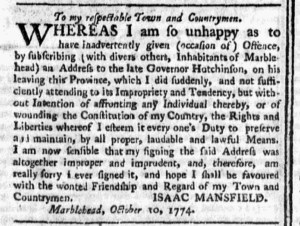
Yet another colonizer who signed “an Address to the late Governor Hutchinson, on his leaving this Province” took to the public prints to recant and apologize.  Isaac Mansfield of Marblehead published his message to “my respectable Town and Countrymen” in the November 3, 1774, edition of the Massachusetts Spy.  Like others who claimed that they regretted their actions, he asserted that he had endorsed the address “suddenly, and not sufficiently attending to its Impropriety and Tendency.”  In other words, he had carelessly affixed his name without giving the contents or their implications much thought.  Upon further reflection, realizing what he had done (and facing the consequences of giving “Offence”), he declared that he had no intention of “affronting any Individual” or, especially, “wounding the Constitution of my Country, the Rights and Liberties whereof I esteem it every one’s Duty to preserve and maintain, by all proper, laudable and lawful means.”  Mansfield had strayed in expressing Tory sympathies, but he had seen the light.  He described signing the address as improper and imprudent, following immediately with an apology and a request for the “Friendship and Regard of my Town and Countrymen.”

Similar disavowals and retractions had been appearing in newspapers in Massachusetts and neighboring colonies for some time.  Much shorter versions by J. Fowle and John Prentice, both of Marblehead, that ran in three newspapers published in Boston and another in Salem during the past week also appeared in the November 3 issue of the Massachusetts Spy.  Some printers treated them as letters to place among news items, while others placed them with advertisements, making unclear which genre these letter-advertisements represented and whether printers charged for inserting them in their newspapers.  Isaiah Thomas, the printer of the Massachusetts Spy, ran the letter-advertisements from Fowle and Prentice below a letter to the editor from “A PROPRIETOR” and above Donald McAlpine’s advertisement for fencing lessons, similar to their placement in the Boston-Gazette three days earlier.  Had the men from Marblehead submitted their letter-advertisements to Thomas’s printing office?  Or had the patriot printer decided to reprint news from another newspaper?  In this instance, the double line separating different kinds of content appeared above the letter-advertisements, signaling to readers that they had finished with the news and began the advertisements.  The placement of Mansfield’s letter-advertisement was less ambiguous.  It ran on the final page, embedded among advertisements.  A notice from Silent Wilde, a post rider, appeared above it and an advertisement for William Hunter’s “Auction-Room” below it.  Does that mean that Thomas charged for printing Mansfield’s letter-advertisement?  Perhaps, though he may have been more interested in publicizing that another member of the community had seemingly come into conformity with patriot politics than generating revenue from Mansfield’s missive.  Either way, readers encountered news about current events as they perused the portion of the Massachusetts Spy that contained advertisements.

November 1

What was advertised in a colonial American newspaper 250 years ago today?

Essex Gazette (November 1, 1774).

“WHEREAS I the Subscriber signed an Address to the late Governor Hutchinson — I wish the devil had had said Address before I had seen it.”

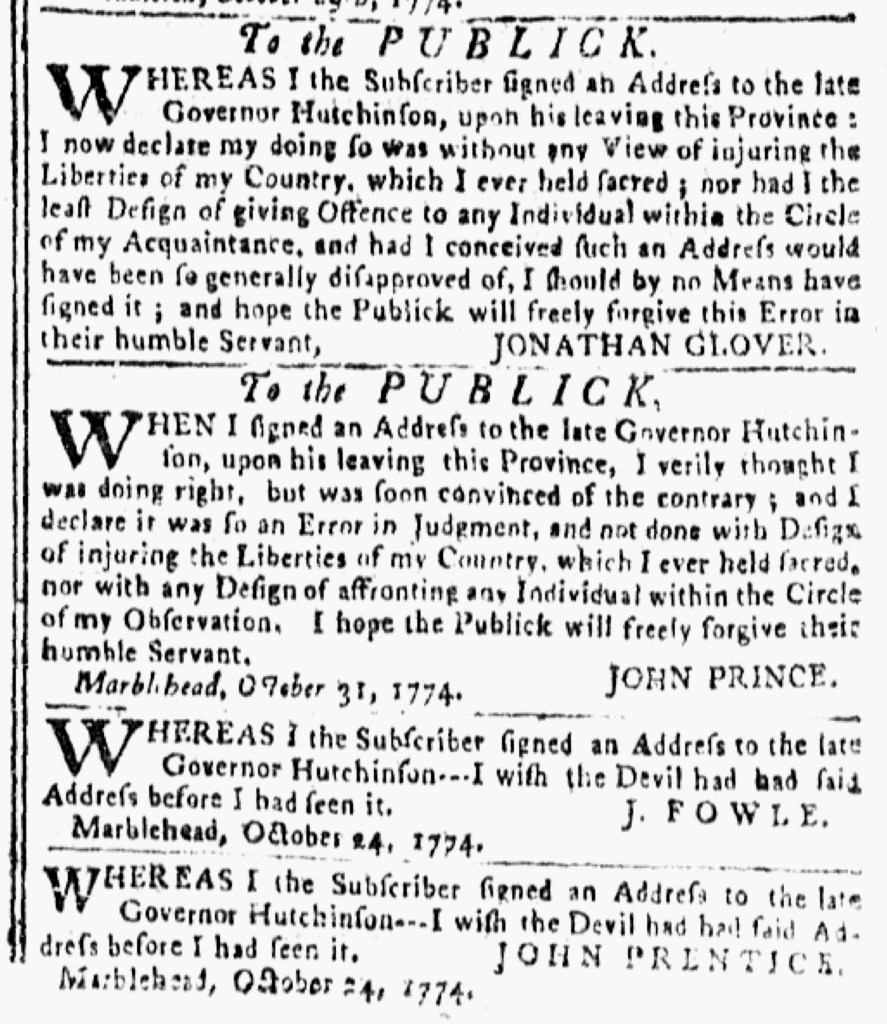
More advertisements from men who wished to recant after signing “an Address to the late Governor Hutchinson, upon his leaving the Province” appeared in the November 1, 1774, edition of the Essex GazetteJohn Stimpson’s letter to that effect ran as an advertisement a week earlier, joined now by letters from Jonathan Glover, John Prince, J. Fowle, and John Prentice.  The printers, Samuel Hall and Ebenezer Hall, positioned them one after another at the end of a column, following an advertisement about a stray cow.  Their position on the page indicated that the Halls considered these letters to be advertisements.  In that case, they would have charged to run them in their newspaper.

Other printers, however, treated some of these same letters differently.  The short missives from Fowle and Prentice each appeared in the Boston Evening-Post, the Boston-Gazette, and the Massachusetts Gazette and Boston Post-Boy the previous day.  In two of those newspapers, they ran with local news, while in the Boston-Gazette the printers placed them between news and advertisements.  They could have been the final news items or the first advertisements in that column.  Even if the printers considered them advertisements, they delivered news to readers.

In the Boston Evening-Post, Thomas Fleet and John Fleet, the printers, provided commentary, reporting that they “have received the Declarations and Acknowledgments of several Deputy Sheriffs, and other Persons, who by signing an Address to Governor Hutchinson had rendered themselves obnoxious to the People.”  They did not have room to publish all of them in that issue, but considered two of them “so concise we can’t omit obliging our Readers with them, as they may serve for a Specimen to other Addressers whose Principles are such as not to incline them to make long Confessions, even when they know they were to blame.”  Samuel Flagg had offered one of those “long Confessions” in the Essex Gazette a month earlier.

Fowle’s letter-advertisement succinctly stated, “WHEREAS I the Subscriber signed an Address to the late Governor Hutchinson — I wish the devil had had said Address before I had seen it.”  Prentice’s letter-advertisement contained an identical message.  Among the others that ran in the Essex Gazette, Glover asserted that he signed the address “without any View of injuring the Liberties of my Country, which I ever held sacred.”  Prince declared that he made “an Error in Judgment” without any “Design of injuring the Liberties of my Country, which I ever held sacred.”  Those two letter-advertisements had variations in wording yet had a similar structure.  For instance, Glover concluded with expressing his “hope the Publick will freely forgive this Error in their humble Servant,” while Prince stated, “I hope the Publick will freely forgive their humble Servant.”

In “Entering the Lists: The Politics of Ephemera in Eastern Massachusetts, 1774,” William Huntting Howell examines other recantations that were either similar or identical.  He questions whether any of them expressed sincerely held beliefs given that they seemed to be “performing by rote.”[1]  That aspect of Fowle’s letter-advertisement calls into question Glover’s invocations of “the Liberties of my Country, which I ever held sacred” and Flagg’s much more extensive reflection on his role in what had transpired. Furthermore, Howell argues, “recantations like these might have kept the Committee of Safety away from one’s house, or signaled to one’s neighbors that one no longer wished to disagree, but they cannot possibly have represented a legitimate conversion or deeply held belief.”[2]  That being the case, the signatories made public apologies in hopes of getting along with others.  By offering the identical letter-advertisements by Fowle and Prentice as prescriptive models for others to copy when ready to make their own “Declarations and Acknowledgments,” the Fleets also signaled that they also believed, as Howell puts it, that “the rote expression of allegiance is not the antithesis of ‘true patriotism,’ but rather its very essence.  The public spectacle of apology or ‘patriotic’ conversion – especially one that follows a pattern – better serves the larger cause than a private change of heart.”[3]

**********

[1] William Huntting Howell, “Entering the Lists: The Politics of Ephemera in Eastern Massachusetts, 1774,” Early American Studies 9, no. 1 (Winter 2011): 214.

[2] Howell, “Entering the Lists,” 215.

[3] Howell, “Entering the Lists, 215-6.

October 25

What was advertised in a colonial American newspaper 250 years ago today?

Essex Gazette (October 25, 1774).

“By Signing an Address to Governor Hutchinson … I have given just Cause of Offence.”

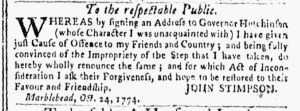
It was another plea for forgiveness for exercising poor judgment, at best, or expressing unsavory political views by signing an address to Thomas Hutchinson that thanked him for his service as governor of Massachusetts.  At the end of October 1774, John Stimpson of Marblehead took to the pages of the Essex Gazette to a acknowledge to “the respectable Public” that he had “given just Cause of Offence to my Friends and Country” when he had done so.  He explained that he “was unacquainted” with Hutchinson’s character the previous spring, but in the time that elapsed since then he became “fully convinced of the Impropriety of the Step that I have taken.”  That being the case, he placed an advertisement to “wholly renounce the same” as well as seek forgiveness for that “Act of Inconsideration.”  Ultimately, Stimpson “hope[d] to be restored to their Favour and Friendship.”

He was not the first to insert an open letter in the Essex Gazette or other newspapers for that purpose.  Thomas Kidder published a similar apology in the Boston-Gazette in July 1774.  Samuel Flagg and Joseph Lee each did so in the Essex Gazette three weeks before Stimpson did.  Flagg’s extensive message to his “Fellow Citizens and Countrymen” incorporated an editorial on the “unjust and oppressive” legislation imposed by Parliament.  Others published similar missives explaining their error, assuring the public that they were not admirers of Hutchinson (and, by extension, the Tory perspective on current events), and asking for forgiveness so they could restore their standing within their communities.

Stimpson’s version of what was becoming a familiar feature in the newspapers did not appear among the news and editorials.  Samuel Hall and Ebenezer Hall, the patriot printers of the Essex Gazette, did not treat it as a letter to the editor to include alongside local news.  Instead, it ran between an advertisement offering a reward for the capture and return of an enslaved man, Caesar, who liberated himself from his enslaver, and a real estate notice announcing the sale of a house and land in Long Wharf Lane in Salem.  Stimpson’s message to “the respectable public” was an advertisement, a paid notice.  The Halls did not extend the opportunity to seek absolution for free.  They may have experienced a bit of satisfaction in generating revenue from someone who made such a poor decision in initially offering support to the royal governor so unpopular among Patriots.

October 20

What was advertised in a colonial American newspaper 250 years ago today?

Rivington’s New-York Gazetteer (October 20, 1774).

“We [were] suddenly and unwarily drawn in to sign a certain paper published in Mr. Rivington’s Gazetteer.”

Abraham Miller, William Crooker, James Jameson, and a dozen other men from the town of Rye had second thoughts about signing their names to an open letter that appeared as the first item on the first page of the October 13, 1774, edition of Rivington’s New-York Gazetteer.  That letter, initially endorsed by more than eighty men, stated, “WE … being much concerned with the unhappy situation of public affairs think it our duty to our King and country to declare, that we have not been concerned in any resolutions entered into, or measures taken, with regard to the disputes at present at present subsisting with the mother country.”  As other colonizers had participated in protests or proposed responses to the Coercive Acts, these men claimed that they had remained neutral, not taking any action or expressing any views on the matter.  Furthermore, they did not appreciate what they had observed happening in their communities and in the public prints.  “[W]e also testify,” the letter continued, “our dislike to many hot and furious proceedings, in consequence of said disputes, which we think are more likely to ruin this once happy country, than remove grievances, if any there are.”  In conclusion, they declared “our great desire and full resolution to live and die peaceable subjects to our gracious sovereign King George the third, and his laws.”

That letter apparently elicited responses that at least some of the men who affixed their signatures did not expect … and they experienced those unhappy responses very quickly.  Just four days after the letter appeared in print, Miller, Crooker, Jameson, and others signed another letter, that one backpedaling on the sentiments expressed in the first one.  The new letter ran as an advertisement, not a letter to the editor, in the October 20 edition of Rivington’s New-York Gazetteer.  The men who signed it moved quickly to submit it in time to appear in the first issue published after the one that carried the initial letter.  In addition, they paid to make sure that it found a place in the newspaper.  They claimed that they had been “suddenly and unwarily drawn in to sign a certain paper published in Mr. Rivington’s Gazetteer.”  When he published an advertisement in the Boston-Gazette to apologize for signing an address to Governor Hutchinson a few months earlier, Thomas Kidder claimed that he had sone so “suddenly and inadvertently.”  Colonizers who regretted expressing Tory sympathies suggested that they did not hold those views but had only signed their names in haste without taking the time to read and contemplate what they were signing.  After “mature deliberation,” Miller, Crooker, Jameson, and others realized “that we acted preposterously, and without adverting properly to the matter in dispute, between the mother country and her colonies.”  They apologized, asserting that they “are therefore sorry that we ever had any concern in said paper,” the original letter, “and we do by these presents utterly disclaim every part thereof, except our expressions of loyalty to the Kind, and obedience to the constitutional laws of the realm.”  They calculated that disavowal would be sufficient to satisfy most patriots who had made their lives difficult.  After all, few clamored for declaring independence in the fall of 1774.  Most colonizers still wanted a redress of their grievances with Parliament and looked to the king to intervene on their behalf.  They believed that the “constitutional laws of the realm” supported their cause, if applied appropriately.  Miller, Crooker, Jameson, and others did not go as far as endorsing “any resolutions entered into, or measures taken” in protest, but they did run an advertisement to advise the public that they did not discourage or disdain such actions.
October 4

What was advertised in a colonial American newspaper 250 years ago today?

Essex Gazette (October 4, 1774).

“Forgive my Error [and] restore me to their Favour and Friendship.”

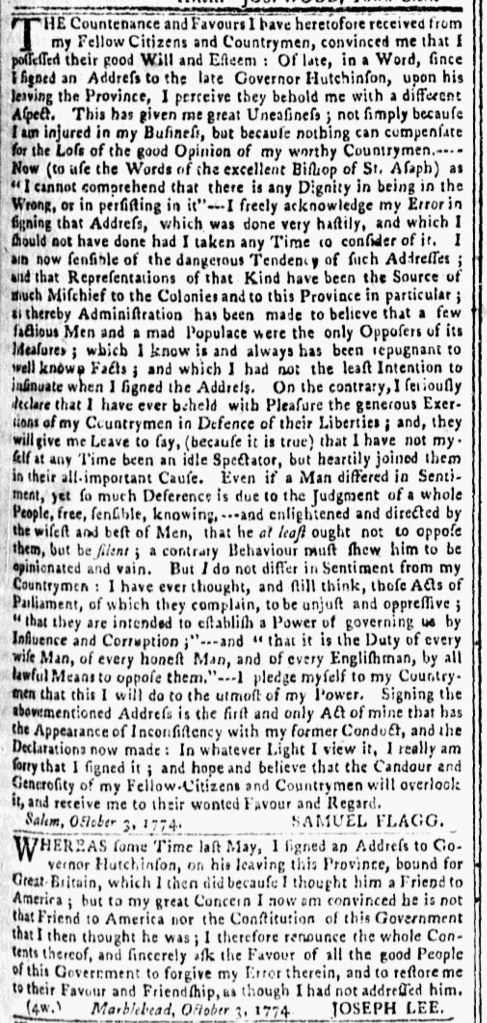
Samuel Flagg of Salem and Joseph Lee of Marblehead needed to do damage control and rehabilitate their reputations after signing “an Address to Governor Hutchinson, on his leaving this Province” in May 1774.  Like Thomas Kidder had done in July, they took to the public prints to confess their error and beg for the forgiveness of their friends and neighbors who believed they did not support the American cause.  The reaction they experienced became so overwhelming that they recanted a position that they claimed they never firmly held.  Lee, for instance, stated that he signed the address because at the time he “thought [Hutchinson] a Friend to America,” yet he had since reconsidered.  He expressed “great Concern” while confessing that “I am now convinced he is not that Friend to America nor the Constitution of this Government that I then thought he was.”  To that end, Lee renounced the entire address and “sincerely ask[ed] the Favour of all the good People of this Government to forgive my Error therein, and to restore me to their Favour and Friendship.”  His plea, dated October 3, first appeared in the October 4 edition of the Essex Gazette, with a notation that it would run for four weeks.  Rather than submitting a letter to the printer that might get printed once, Lee paid to run an advertisement that would present his story and his apology to readers multiple times.

Lee’s notice was brief compared to the one that Flagg inserted on the same day.  He had formerly been in good standing in the community, having the “good Will and Esteem” of his “Fellow Citizens and Countrymen,” but perceived “they behold me with a different aspect” after he signed an address in honor of the Governor Hutchinson upon his return to England.  Flagg confessed that this “has given me great Uneasiness; not simply because I am injured in my Business, but because nothing can compensate for the Loss of the good Opinion of my worthy Countrymen.”  Flagg acknowledged that his livelihood had suffered; apparently customers refused to shop at his store in Salem.  Yet participating in the marketplace was not the only or even the primary reason that Flagg wished to correct the record.  He desired the “Favour and Regard” that he had once enjoyed in relationships with other colonizers, plus he wanted to assure the public that he indeed supported the patriot cause.  He admitted his error while disavowing the address as “the Source of much Mischief to the Colonies and to this Province in particular,” but did not end there.  “I seriously declare,” he wrote, “that I have ever beheld with Pleasure the generous Exertions of my Countrymen in Defence of their Liberties.”  Furthermore, Flagg claimed that “I have note myself at any Time been an idle Spectator, but heartily joined them in their all-important Cause.”  In his advertisement for an “Assortment of ENGLISH and INDIA GOODS” on the next page, he indicated that he “is determined not to import any more Goods at Present,” signaling his support for nonimportation agreements as a means of protesting the Coercive Acts.

Beyond his confession and apology, Flagg incorporated an editorial into his advertisement seeking forgiveness from his “Fellow Citizens and Countrymen.”  He asserted, “I do not differ in Sentiment from my Countrymen; I have ever thought, and still think, those Acts of Parliament, of which they complain, to be unjust and oppressive.”  To demonstrate that point, he inserted quotations that made familiar arguments: “‘that they are intended to establish a Power of governing us by Influence and Corruption’” and “‘that it is the Duty of every wise Man, of every honest Man, and of every Englishman, by all lawful Means to oppose them.’”  Flagg thus had a duty to fulfill, prompting him to “pledge myself to my Countrymen that this I will do to the utmost of my Power.”  He reiterated that he regretted signing the “abovementioned Address,” insisting that it was “the first and only Act of mine that has the Appearance of Inconsistency with my former Conduct, and the Declarations now made.”  He apologized once again, requesting the “Candour and Generosity” of others in overlooking the entire incident.

Signing the address to Governor Hutchinson had been a lapse in judgment; at least that was how some of those who signed it depicted their actions when they repeatedly encountered hostile reactions.  Both Flagg and Lee sought to remedy the damage done to their reputations by placing advertisements in which they confessed their error.  Flagg did even more: he spilled a lot of ink in support of the American cause, hoping that doing so would convince the public of his sincerity and return him to their good graces.  News and editorials could not contain the politics of the period. Instead, advertisements became sites for participating in debates and controversies as the imperial crisis intensified in 1774.

July 18

What was advertised in a colonial American newspaper 250 years ago today?

Boston-Gazette (July 18, 1774).

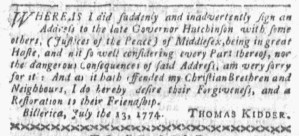
I did suddenly and inadvertently sign an Address to the late Governor Hutchinson.”

When he published an advertisement in the July 18, 1774, edition of the Boston-Gazette, Thomas Kidder of Billerica attempted to extricate himself from a difficult situation.  He explained that he had “suddenly and inadvertently sign[ed] an Address to the late Governor Hutchinson with some others, (Justices of the Peace) of Middlesex.”  Thomas Hutchinson, the outgoing governor, had received several letters praising his administration of the colony, each of them signed by dozens of colonizers.  Some of those letters found their way into print, revealing to the public which members of the community approved of the way the unpopular royal governor had participated in Parliament’s efforts to establish greater control over Boston, the rest of Massachusetts, and all the colonies.

That garnered the wrong kind of attention for Kidder and others, especially those who then professed that they did not actually harbor loyalist sympathies but had instead been “inadvertently” embroiled in the controversy.  Kidder explained that he had signed the letter to Hutchinson “in great Haste, and not so well considering every Part thereof, nor the dangerous Consequences of said Address.”  He did not enjoy the reception he received from colonizers who supported the patriot cause, prompting him to apologize.  He confessed that he was “very sorry” for signing the letter and “as it hath offended my Christian Brethren and Neighbours, I do hereby desire their Forgiveness, and a Restoration of their Friendship.”  Apparently, Kidder’s seeming endorsement of Hutchinson caused so many difficulties in his daily interactions with others that he found it necessary to take to the public prints to disavow an address that he claimed he had not fully considered or understood when he signed it.  It was no mistake that he ran his advertisement in the Boston-Gazette, a newspaper noted for advocating the political views of patriots who opposed the policies enacted by Parliament and Hutchinson’s collaboration in executing them.

In “Entering the Lists: The Politics of Ephemera in Eastern Massachusetts, 1774,” William Huntting Howell documents which newspapers published addresses to Hutchinson and broadsides printed in response, some of them identifying the occupations and places of business of the signatories.  That amounted to an eighteenth-century version of doxing people based on their political views.  Howell argues that such a response was designed “to coerce and secure individual compliance.”  He examines several “RECANTATIONS” that appeared in the newspapers as signatories of addresses to Hutchinson attempted to restore their standing among their fellow colonizers.[1]  Over the next several months, the Adverts 250 Project will feature advertisements, like the one place by Kidder, placed for similar purposes, demonstrating the pressure that patriots managed to bring to bear against real and perceived loyalists as the imperial crisis intensified in 1774.

**********

[1] William Huntting Howell, “Entering the Lists: The Politics of Ephemera in Eastern Massachusetts, 1774,” Early American Studies 9, no. 1 (Winter 2011): 191, 208-215.