August 29

What was advertised in a colonial American newspaper 250 years ago today?
Dunlap’s Pennsylvania Packet (August 29, 1774).

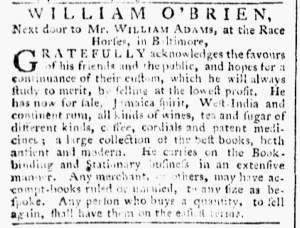
“He carries on the Bookbinding and Stationary business in an extensive manner.”

Among the many advertisements that ran in the August 29, 1774, edition of Dunlap’s Pennsylvania Packet, one from William O’Brien offered several goods and services.  He first offered several varieties of alcohol and popular groceries, including “Jamaica spirit, West-India and continent rum, all kinds of wines, tea and sugar of different kinds, coffee, cordials and patent medicines.”  In addition to that inventory, he also stocked “a large collection of the best books, both antient and modern.”  Yet O’Brien also identified himself as a bookbinder and stationer, promoting in particular custom-made account books, ruled or unruled, to any size as bespoke.”  He offered those items to both merchants and retailers who might buy in volume “to sell again.”

Although O’Brien advertised in Dunlap’s Pennsylvania Packet, published in Philadelphia, he lived and worked in Baltimore.  He likely did not expect that his notice would generate much business among readers in Philadelphia; instead, he sought customers in his own town and the surrounding area, realizing that for many years the Pennsylvania Gazette, the Pennsylvania Journal, Dunlap’s Pennsylvania Packet, and other newspapers printed in Philadelphia served as local newspapers for towns in Pennsylvania, Delaware, New Jersey, and Maryland.  O’Brien could have chosen to advertise in the Maryland Journal, Baltimore’s first newspaper, in addition to or instead of one of the newspapers in Philadelphia, though he may have had doubts about the efficacy of doing so.  Commencing publication on August 20, 1773, the Maryland Journal had just marked its first year, yet its appearance had been sporadic during that time rather than sticking to a weekly schedule.  O’Brien turned to a more reliable newspaper, likely familiar with its circulation in Maryland and, as a result, having greater confidence in the money he invested in advertising in Dunlap’s Pennsylvania Packet. William Goddard, the printer of the Maryland Journal, still had work to do to win over prospective advertisers in Baltimore.
May 28

What was advertised in a colonial American newspaper 250 years ago today?

Maryland Journal (May 28, 1774).

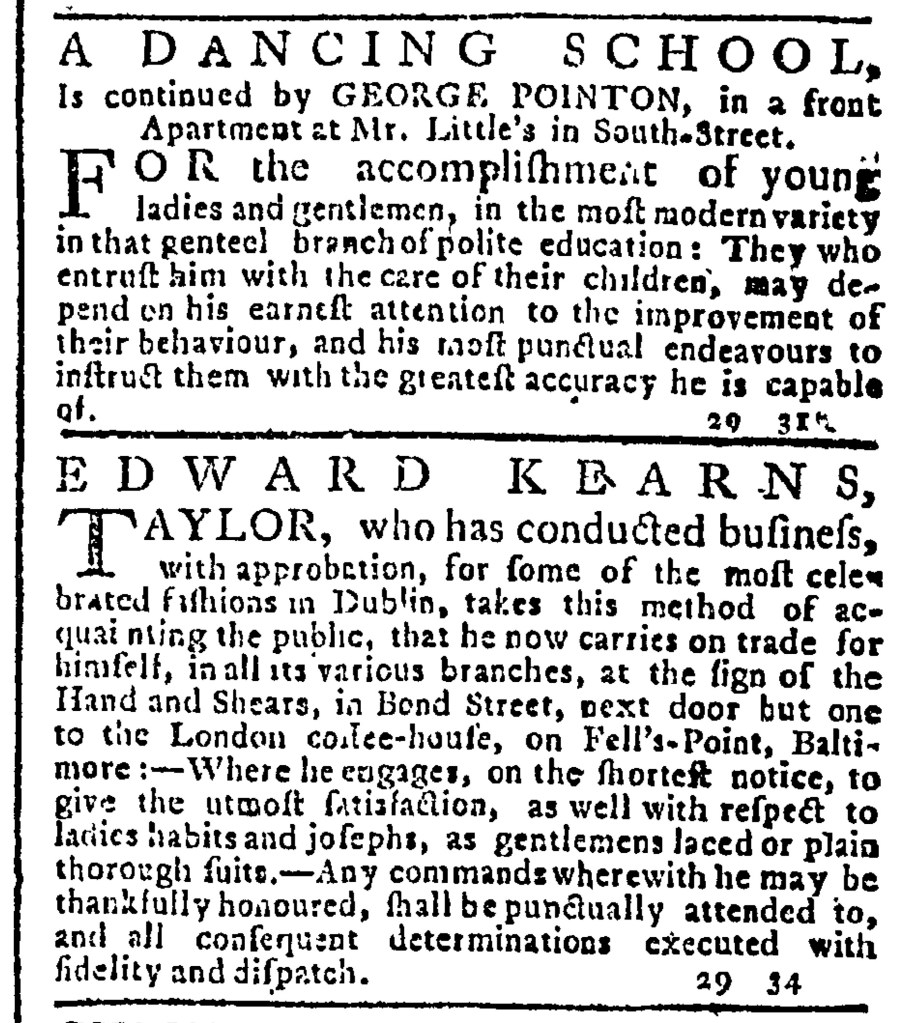
“Next door but one to the London coffee-house, on Fell’s-Point, Baltimore.”

Baltimore was growing in importance on the eve of the American Revolution, though the port did not yet rival or surpass Annapolis.  In August 1773, William Goddard launched the Maryland Journal, the first newspaper printed in Baltimore.  Joseph Rathell attempted to establish a circulating library in the fall of 1773, but in the end could not compete with bookseller William Aikman’s library in Annapolis.  Still, the advertisements in the Maryland Journal testified to other amenities available in Baltimore, a town that offered a style of life becoming increasingly sophisticated.

Among the advertisements in the May 28, 1774, edition, one promoted a “Stage … between the city of Philadelphia and Baltimore-Town.”  Instead of directing their attention solely toward Annapolis, residents of Baltimore also cultivated connections with Philadelphia, the largest and most cosmopolitan city in the colonies.  In addition to transporting passengers, the operators of the “stage wagon” and “stage boat” also carried goods.  Yet consumers in Baltimore did not need to rely on placing orders with merchants and shopkeepers in Philadelphia or any other city.  Retailers in their own town carried all sorts of imported goods.  Christopher Johnson and Company advertised their “neat and general assortment of goods, just imported … from LONDON,” listing an array of textiles and housewares comparable to the selection available in towns of all sizes throughout the colonies.  In his advertisement, William O’Bryan previewed a “fresh supply of Books, of the latest Publication, from London, Dublin, and Edinburgh.”

Yet it was not solely the availability of goods that marked Baltimore’s participation in the transatlantic consumer revolution.  Residents also appreciated the latest fashions, aiming to demonstrate that even at a distance they kept up with current styles.  Edward Kearns, a tailor, trumpeted that he “has conducted business, with approbation, for some of the most celebrated fashions in Dublin.”  Clients could find his shop “at the sign of the Hand and Shears, … next door but one to the London coffee-house.”  That establishment also represented connections to the metropolis that elevated Baltimore’s standing as more than a distant outpost.  In addition, George Pointon ran a “DANCING SCHOOL … FOR the accomplishment of young ladies and gentlemen, in the most modern variety in that genteel branch of polite education.”  The dancing master also tended to the comportment of his pupils, pledging “his earnest attention to the improvement of their behaviour.”  His description of his services corresponded with newspaper notices placed by dancing masters in major urban ports like Philadelphia, New York, and Charleston.  Displays of gentility mattered as much to colonizers in Baltimore as in other cities and towns.  Not only did they acquire clothing and goods that matched the latest fashions, they also developed manners that confirmed their status … or at least had opportunities to do so, according to the goods and services represented among the advertisements in the Maryland Journal.

February 23

What was advertised in a colonial American newspaper 250 years ago today?

Pennsylvania Journal (February 23, 1774).

“A RIDER between Philadelphia and that place.”

William Stenson played a part in establishing and maintaining the communication infrastructure that connected Baltimore and Philadelphia and points in between in the mid 1770s.  Though it had not displaced Annapolis, Baltimore became an increasingly significant urban port on the eve of the American Revolution.  In August 1773, William Goddard launched the Maryland Journal, the city’s first newspaper.  At about the same time, Joseph Rathell attempted to establish a subscription library, but could not manage to generate sufficient interest to compete with William Aikman’s circulating library in Annapolis.  For a small fee, Aikman delivered books to subscribers in Baltimore.

Still, Baltimore was becoming an increasingly important commercial center, a place of interest for merchants and others in Philadelphia.  That created an opportunity for Stenson.  On February 23, 1774, he informed readers of the Pennsylvania Journal that he was “employed by a number of Gentlemen in Baltimore, &c. as a RIDER between Philadelphia and that place” and offered his services during his weekly transit.  He left Philadelphia “early every Thursday morning” and arrived in Baltimore “on Friday evening.”  He stayed until Monday morning and returned to Philadelphia “on Tuesday evenings.”

Stenson attempted to hire his services by the year, suggesting how regularly he believed some prospective clients in Philadelphia wished to contact correspondents in Baltimore and towns on the way.  He offered a “yearly subscription,” pledging that “whatever affairs may be committed to the care of the subscriber, will be performed with all possible fidelity and dispatch.”  For those not ready to pay for his services for an entire year, the rider promised that they “may have their business done at reasonable rates.”  Clients could contact him or leave orders “at Mr. WILLIAM GRAHAM’s, at the sign of the Black Horse” on Market Street.  Alternately, a “subscription paper now lies at the London Coffee-House,” a popular gathering place for Philadelphia’s merchants to conduct business.  Stenson aimed to make procuring his services as convenient as possible for his prospective clients.

July 18

What was advertised in a colonial American newspaper 250 years ago this week?

Virginia Gazette (July 15, 1773).

“He hath provided every Thing for the Accommodation of Gentlemen, their Servants, and Horses.”

Daniel Grant, the proprietor of the “INN and TAVERN, at the Sign of the Fountain” in Baltimore, expanded his advertising campaign.  That city did not yet have a newspaper, though subscriptions proposals circulated in hopes of establishing one, so the proprietor of the inn and tavern resorted to advertising in newspapers published in Annapolis and Philadelphia.  Even if Baltimore did have a newspaper at the time that Grant opened his doors to “the Publick,” he likely would have placed notices in newspapers published in other cities in the region.  Colonizers in and near Baltimore would have learned of the new inn and tavern as they traversed the streets of the city and conversed with friends and acquaintances.  Advertisements in newspapers published in Annapolis and Philadelphia, on the other hand, helped to entice readers who might travel to Baltimore.  In addition, Grant previously “kept TAVERN at the Sign of the BUCK, near PHILADELPHIA.”  Advertisements in the Pennsylvania Packet likely reached former patrons familiar with his reputation.

Prospective patrons in Williamsburg and throughout the rest of Virginia may not have been familiar with the tavern at the Sign of the Buck, unless they had happened to travel to Philadelphia, but Grant likely expected that the fact that he had experience operating a tavern would resonate with colonizers in Virginia who might have cause to venture to Baltimore.  His expression of “grateful Thanks to the Gentlemen who did him the Honour to frequent his former House” doubled as a testimonial to his experience.  Noting that he had regulars at the Sign of the Buck suggested that he provided satisfactory service that convinced patrons to return.  In his new establishment, he needed to cultivate a new clientele, both locals and travelers.  To thatend, the innkeeper and tavernkeeper invested in an advertisement in Purdie and Dixon’s Virginia Gazette, extending the reach of his marketing to readers served by that newspaper.  The copy matched what already appeared in the Maryland Gazette and the Pennsylvania Packet, promising that Grant “hath provided every Thing for the Accommodation of Gentlemen, their Servants, and Horses, in the best Manner.”  Rather than seek out food and lodging when they arrived in Baltimore, Grant wanted travelers from Virginia to anticipate staying at the Sign of the Fountain.

June 3

What was advertised in a colonial American newspaper 250 years ago today?

Maryland Gazette (June 3, 1773).

“He hath opened an inn and tavern, at the sign of the Fountain … in Market-street, Baltimore.”

As summer arrived in 1773, Daniel Grant opened a new inn and tavern in Baltimore.  To attract patrons, he inserted advertisements in the Maryland Gazette, published in Annapolis, and the Pennsylvania Packet, published in Philadelphia, to supplement word-of-mouth news of his establishment in Baltimore.  That city did not yet have its own newspaper, though William Goddard had recently opened a printing office there and distributed subscription proposals for the Maryland Journal.  Even if Grant could have advertised in a local newspaper, it benefited him to alert colonizers throughout the regions served by the Maryland Gazette and the Pennsylvania Packet that they could avail themselves of his services if they had occasion to travel to Baltimore.  Besides, those newspapers were the local newspapers, at least for another few months until Goddard commenced publication of the Maryland Journal near the end of August.

As part of his marketing efforts, Grant emphasized his experience running a tavern “at the sign of the Buck, near Philadelphia.”  He extended “his most grateful thanks to the gentlemen who did mum the honour to frequent his former house.”  In addition, he declared that “it shall ever be his study to please” and “he hopes for a continuance of their favours” when they visited Baltimore.  Such sentiments communicated to those who had not previously visited the tavern “at the sign of the Buck” that Grant had successfully cultivated a clientele and would offer the same quality of service to patrons at the inn and tavern “at the sign of the Fountain … in Market-street, Baltimore.”  He pledged that “those who choose to favour him with their custom, may be assured of his best endeavours to merit their approbation.”  To that end, he promoted the “late and commodious house” that he converted into an inn and tavern and asserted that he “hath provided everything for the accommodation of gentlemen, their servants, and horses, in the best manner.”  Apparently, Grant also operated a stable or made arrangements with a nearby associate to provide hosteling services.  Whatever their needs and desires, Grant promised prospective patrons a pleasant stay at his inn and tavern.

November 14

What was advertised in a colonial American newspaper 250 years ago today?

Pennsylvania Chronicle (November 14, 1772).

“BALTIMORE COFFEE-HOUSE and TAVERN.”

In the fall of 1772, William Goddard proposed publishing a newspaper in Baltimore as soon as he recruited enough subscribers.  Robert Hodge and Frederick Shober also announced their intention to establish a newspaper in Baltimore.  Hodge and Shober left the city just a couple of months later.  Goddard did not take the Maryland Journal and Baltimore Advertiser to press until August 1773.  Until then, the town did not have its own newspaper.  Instead, residents relied on the Maryland Gazette, published in Annapolis, and the various newspapers published in Philadelphia as their local newspapers.

That meant that advertisers in Baltimore sent their notices to printing offices in other towns.  Goddard, the printer of the Pennsylvania Chronicle, may have determined that Baltimore could support its own newspaper in part as a result of the number of advertisements he received from that town.  The November 14, 1772, edition of the Pennsylvania Chronicle, for instance, carried several advertisements that concerned Baltimore, including two on the front page.  In one, Sarah Chilton invited prospective patrons to the “BALTIMORE COFFEE-HOUSE and TAVERN,” an establishment she recently opened in a “large and commodious brick house” and kept stocked with “excellent liquors and other necessaries.”  In another, John Gordon described Robert Lewis, an indentured servant who ran away before his contract ended, and offered a reward for his capture and return to Gordon’s residence on Gay Street in Baltimore.  Recognizing both Lewis’s mobility and the reach of the Pennsylvania Chronicle, Gordon adjusted the award depending on whether Lewis was “within ten miles” of Baltimore, “out of the county,” or “out of the province.”  A third advertisement promoted a “STAGE from the city of Philadelphia to Baltimore-Town” and provided a schedule, including the transfers between the “stage-waggon” and the “stage-boat,” for travel in both directions.

Even if Baltimore had its own newspaper in 1772, each of these advertisements would have been of interest to many readers of the Pennsylvania Chronicle in Philadelphia and other towns.  The coffee house and the stage, however, also testified to the growth of Baltimore as a commercial center that had the potential to support its own newspaper, especially if a publisher could enlist merchants and shopkeepers to advertise their wares and other residents to submit the various kinds of notices that comprised a significant portion of the content of newspapers published in other cities and towns.

July 10

What was advertised in a colonial American newspaper 250 years ago this week?

Pennsylvania Chronicle (July 8, 1771).

“A small warehouse … in Baltimore.”

The Pennsylvania Chronicle, like other American newspapers published prior to the American Revolution, served a large region.  Published in Philadelphia, it circulated in Pennsylvania, Delaware, New Jersey, Maryland, and New York.  Some copies certainly made their way to even more distant places, but it was residents of those colonies that considered the Pennsylvania Chronicle a local newspaper in terms of subscribing and advertising.

Such was the case for James Clarke, a woolen manufacturer in Baltimore, when he wished to inform “all Merchants and Traders, that he has just imported … A NEAT assortment” of merchandise “which he purposes to dispose of by wholesale.”  He invited “any merchant or tobacco planter” to contact him or visit his warehouse “at the sign of Pitt’s Head, in Baltimore.”  When he placed his advertisement in the Pennsylvania Chronicle in July 1771, Baltimore did not yet have its own newspaper.  Just over two years later, William Goddard, the printer of the Pennsylvania Chronicle, would commence publishing the Maryland Journal and Baltimore Advertiser, but for the time being Clarke and others in Baltimore read and advertised in newspapers published elsewhere.  In addition to the Pennsylvania Chronicle, they had several options, including the Maryland Gazette published by Anne Catherine Green in Annapolis, the Pennsylvania Gazette published by David Hall and William Sellers in Philadelphia, and the Pennsylvania Journal published by William Bradford and Thomas Bradford in Philadelphia.  Henry Miller also published a German-language newspaper, the Wochentliche Pennsylvanische Staatsbote, in Philadelphia.  By the end of 1771, John Dunlap launched yet another newspaper in Philadelphia, the Pennsylvania Packet, giving Clarke and others in Baltimore another option for a regional newspaper in the absence of one printed locally.

Advertisements like those placed by Clarke testified to the regional character of the Pennsylvania Chronicle and other newspapers.  Many of them included datelines that helped readers navigate the notices and determine which were most relevant to them, such as “Baltimore, July 1, 1771” at the top of Clarke’s advertisement.  The woolen manufacturer understood that the publication circulated widely and expected that prospective customers in Baltimore and the surrounding area would see his notice among the greater number of advertisements placed by merchants, shopkeepers, artisans and others who ran businesses in Philadelphia.

June 5

What was advertised in a colonial American newspaper 250 years ago this week?

Jun 5 - 6:2:1768 Pennsylvania Journal
Pennsylvania Journal (June 2, 1768).

“JOHN BOYD, Druggist, Has just imported, and now sells, at BALTIMORE TOWN.”

John Boyd placed an advertisement for “A Neat and general assortment of Drugs, and Medicines” in the June 2, 1768, edition of the Pennsylvania Journal.  Unlike many others who advertised consumer goods and services in the Journal, Boyd did not operate a business in Philadelphia.  Instead, he sold his array of remedies “at BALTIMORE TOWN” in neighboring Maryland. Residents of Philadelphia were not the intended audience for Boyd’s advertisement, especially since several druggists and shopkeepers who stocked medicines among their general merchandise served that busy port city.  Some of them, including Nathaniel and John Tweedy and John Sparhawk, advertised in the same issue that carried Boyd’s notice.

Instead, Boyd sought the patronage of other residents of “BALTIMORE TOWN” as well as colonists who lived in the hinterlands between Baltimore and Philadelphia.  He depended on the wide distribution of the Pennsylvania Journal as a regional newspaper that served readers in Pennsylvania, New Jersey, Delaware, Maryland, and beyond. He expected that readers outside Philadelphia would at least skim the advertisements for local content in addition to reading news items that reported on events throughout the colonies, Europe, and the Atlantic world.  Yet he also realized that other advertisers, especially direct competitors who specialized in medicines, often provided mail order services. Accordingly, he assured potential customers that “The Prices will be the same, or as low as in Philadelphia.” Henry Stuber, a druggist in Lancaster, Pennsylvania, made the same promise in his own advertisement that ran once again in the supplement that accompanied the June 2 edition.

Boyd in Baltimore and Stuber in Lancaster vied for local and regional clients by advertising in a newspaper published in Philadelphia, seizing the best option available to them in the middle of the eighteenth century.  Yet that would not be the case for much longer.  Throughout the years of the imperial crisis and the American Revolution the number of newspapers printed in the colonies and the new nation fluctuated yet expanded over time, a trend that only intensified in the final decade of the eighteenth century as printers in an increasing number of cities and towns published local newspapers.  After all, the fate of the republic, an experiment with an uncertain outcome, relied on educated and informed citizens.  Both before and after the Revolution, the revenues from advertisements contributed to the publication and dissemination of the news, even though conceptions of what counted as a local newspaper for the purposes of advertising changed over time.