December 26

What was advertised in a colonial American newspaper 250 years ago this week?

Massachusetts Spy (December 23, 1773).

“The above teas were imported before the East India Company’s teas arrived, or it was known that they would send any here on their own account.”

A week after colonizers in Boston dumped tea into the harbor in an event now known as the Boston Tea Party, Cyrus Baldwin continued to advertise “CHOICE Bohea and Souchong Teas, best Hyson ditto.”  His advertisement on the December 23, 1773, edition of the Massachusetts Spy, like his advertisement that ran in the Boston Evening-Post three days earlier, concluded with a nota bene declaring that the “teas were imported before the East India Company’s teas arrived, or it was known that they would send any here on their own account.”  That previous advertisement ran below a “NOTIFICATION” that called on “all the Dealers in, and Venders of Teas” to attend a meeting on December 21 for the purpose of “determining on suitable Measures to be adopted, and to cooperate with a great number of respectable Inhabitants of this Province, express’d by a Vote of their late Assembly to suppress the Use of that detested Article.”  Those who attended did not reach any final decisions.  Instead, a notice dated December appeared in the Massachusetts Spy, advising the “Traders in TEA … that their meeting stands Adjourned to THIS Evening at 5 o’clock, at the Royal-Exchange Tavern.”

In addition to that brief notice, the December 23 edition of the Massachusetts Spy, the first published since the Boston Tea Party, included several articles and editorials about tea.  Among the local news in the first column on the first page, readers learned that East India Company’s tea commissioners remained at Castle William on an island in the harbor.  Mixing news and editorial, this update stated, “Their obstinacy has rendered them infinitely more obnoxious to their countrymen than even the Stamp-Masters were.”

Elsewhere on the first page, a letter to the printer, Isaiah Thomas, signed by “A WOMAN,” objected to the recitation “a great number of arguments used to persuade the ladies to leave off the use of [tea].”  The correspondent inquired, “If Tea has been really known to be a baneful weed, a poisonous draught, &c. why were not these arguments used against the use of it in former times, before it was thought a political evil?”  She also noted that “gentlemen as well as ladies” enjoyed drinking tea and derived benefits to their health from doing so.  However, she did not make these arguments to justify continuing to consume the beverage.  Instead, she wished to be presented with a rationale for boycotting tea “such as will convince persons who are capable of using their reason,” whether male or female.  To that end, she recommended that “the gentlemen who are fully acquainted with all the political reasons for discarding the use of Tea … to publish a full and plain narrative of fact, so that we might see how it comes to pass that the use of Tea is a political evil in this country.”  If men were to instruct women “in all they know” about the political implications of drinking tea “it would be a much more probable method to make us leave off the use of it than the calling it hard names, and telling us scare-crow stories about it.”  Women participated in politics through their decisions in the marketplace.  When treated as capable of understanding rational arguments, the correspondent suggested, women would join with men in more effective and powerful resistance to Parliament’s abuses.

Three other letters to the printer expressed outrage over tea, while a news article offered an overview of the town meetings that occurred in the days before colonizers disguised as Indians boarded three ships and destroyed the tea they carried.  Another article described that event: “A number of brave and resolute men, determined to do all in their power to save their country from the ruin which their enemies had plotted, emptied every chest of tea on board the three ships … without the least damage done to the ships or any other property.”  According to this article, “The masters and owners are well pleased that their ships are thus cleared; and the people are almost universally congratulating each other on this happy event.”

Among the advertisements, Baldwin was not the only shopkeeper who promoted tea in the December 23 edition of the Massachusetts Spy, though he alone inserted an explanation about when he acquired the tea in hopes of convincing the community that he could sell it in good conscious and prospective customers that they could purchase and drink it in good conscious.  Even as many colonizers in Boston and other towns called for a boycott of tea, many retailers and consumers did not immediately cease buying and selling the popular beverage.
December 23

What was advertised in a colonial American newspaper 250 years ago today?

New-York Journal (December 23, 1773).

“John Hancock, Esq; has neither directly, or indirectly, imported any tea from Great Britain.”

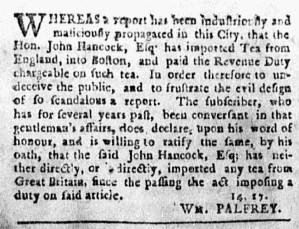
As news of the Boston Tea Party reached New York and appeared in the December 23, 1773, edition of the New-York Journal, an advertisement in that newspaper took on new significance.  Starting on December 9 and continuing for four weeks, William Palfrey inserted an advertisement that addressed a “report [that] has been industriously and maliciously propagated in this City, that the Hon. John Hancock, Esq. has imported Tea from England, into Boston, and paid the Revenue Duty chargeable on such tea.”  Such rumors had the potential to tarnish the reputation of one of the merchants who had been most vocal in opposition to the provisions of the Tea Act, decrying Parliament’s attempts to meddle in affairs that he believed rightly belonged to colonial legislatures.

Palfrey, one Hancock’s clerks, took to the public prints to “undeceive the public, and to frustrate the evil design of so scandalous a report.”  He noted that he had “been conversant in that gentleman’s affairs” for “several years past” and, as a result, could vouch for Hancock.  In late 1773, many readers of the New-York Journal may not have been as familiar with the merchant as residents of Boston, though Hancock regularly appeared in articles reprinted from newspapers published in Massachusetts.  Five months before Palfrey’s advertisement appeared, the New-York Journal printed one of Governor Thomas Hutchinson’s letters from June 1768 that described the seizure of the Liberty, “a sloop belonging to Mr. Hancock, a wealthy merchant, of great influence over the populace,” for “a very notorious breach of the acts of trade.”  (The July 8, 1773, edition of the New-York Journal carried the entire letter and other private correspondence by the governor.)  Contrary to abiding by Parliament’s attempts to regulate colonial commerce and tax imported goods, Hancock had a history of smuggling tea and other items to avoid paying duties.  According to Palfrey, neither Hancock’s public position nor his private actions had changed.  The clerk declared “upon his word of honour” (and expressed his willingness to “ratify the dame, by his oath”) that Hancock had “neither directly, or indirectly, imported any tea from Great Britain, since the passing the act imposing a duty on said article” and most certainly had not paid import duties on tea.  As Jordan E. Taylor has recently demonstrated in Misinformation Nation: Foreign News and the Politics of Truth in Revolutionary America (2022), Patriots and Loyalists vied to establish narratives that fit their politics and their purposes, whether in newspapers, other printed materials, letters, or conversation.  That contest over the truth extended to advertisements, including Palfrey’s notice in the New-York Journal.

December 20

What was advertised in a colonial American newspaper 250 years ago today?

Boston Evening-Post (December 20, 1773).

“The above Teas were imported before any of the East-India Company’s Tea arrived, or it was known they would send any on their own Account.”

Cyrus Baldwin hoped to sell the “Choice Bohea and Souchong Teas” that he stocked at his shop in Boston while he still had a chance.  Tea had become a lightning rod for political discourse throughout the fall of 1773, thanks to the Tea Act and the arrival of ships carrying tea on behalf of the East India Company.  That discourse erupted into a protest that involved the destruction of the tea on those ships when colonizers disguised as Indians tossed the tea into the harbor, an event now known as the Boston Tea Party.  That put Baldwin in a difficult position, especially as discussions about boycotting tea occurred at the town meeting.  When he advertised bohea, souchong, and hyson tea in the December 20 edition of the Boston Evening-Post, just four days after the East India Company’s tea went into the harbor, Baldwin appended a nota bene to inform prospective customers and the general public that “[t]he above Teas were imported before any of the East-India Company’s Tea arrived, or it was known they would send any on their own Account.”  Baldwin justified selling the tea he already stocked.  He also sought to give consumers a reasonable justification for purchasing his tea before the situation became any more volatile and they faced condemnation from the community.

Massachusetts Gazette and Boston Post-Boy (December 20, 1773).

Baldwin’s advertisement ran immediately below a “NOTIFICATION” that summarized a meeting “of some of the principal Venders of TEAS in Boston” that took place on Friday, December 17, the day after the protest on the docks.  The same notification ran in all three newspapers published in Boston on Mondays, the Boston Evening-Post, the Boston-Gazette, and the Massachusetts Gazette and Boston Post-Boy.  It reported that “Venders of TEAS” met for the purpose of “consulting and determining in suitable Measures to be adopted, and to cooperate with a great number of respectable Inhabitants of this Province, express’d by a Vote of their late Assembly to suppress the Use of that detested Article.”  They did not, however, reach any conclusions.  Instead, they “agreed that a general and full Meeting should be convened” on December 20 “where it is desired and expected that all the Dealers in, and Venders of Teas will punctually attend.”  That included Baldwin as well as Archibald Cunningham, William Jackson, Samuel Allyne Otis, and Elizabeth Perkins, all of whom advertised tea in the December 20 edition of the Boston Evening-Post, though none of the others included the same sort of disclaimer that Baldwin carefully inserted in his advertisement.  A nota bene warned, “It is earnestly desired, that those concerned would not fail of giving attendance at the Time fix’d.”

The notice in the Massachusetts Gazette and Boston Post-Boy included an additional note: “A common Cause is best supported by a common Association.—The Defence and Maintenance of our Rights and Liberties is the common Cause of every American; and therefore all should unite, Hand in Hand, in one common Association in order to support it.”  Answering the abuses perpetrated by Parliament, this note suggested, did not depend on a uniform response by “Venders of TEAS” alone but rather the support and concerted efforts of consumers to abide by whatever measures colonizers in Boston adopted when they voted at town meetings.  Everyone had a duty to defend American liberties via the choices they made about how they participated in the marketplace.  For the moment, however, Cyrus Baldwin just wanted to sell the tea that he claimed he imported before the crisis commenced.

December 18

What was advertised in a colonial American newspaper 250 years ago today?

Maryland Journal (December 18, 1773).

“Fine hyson and bohea tea.”

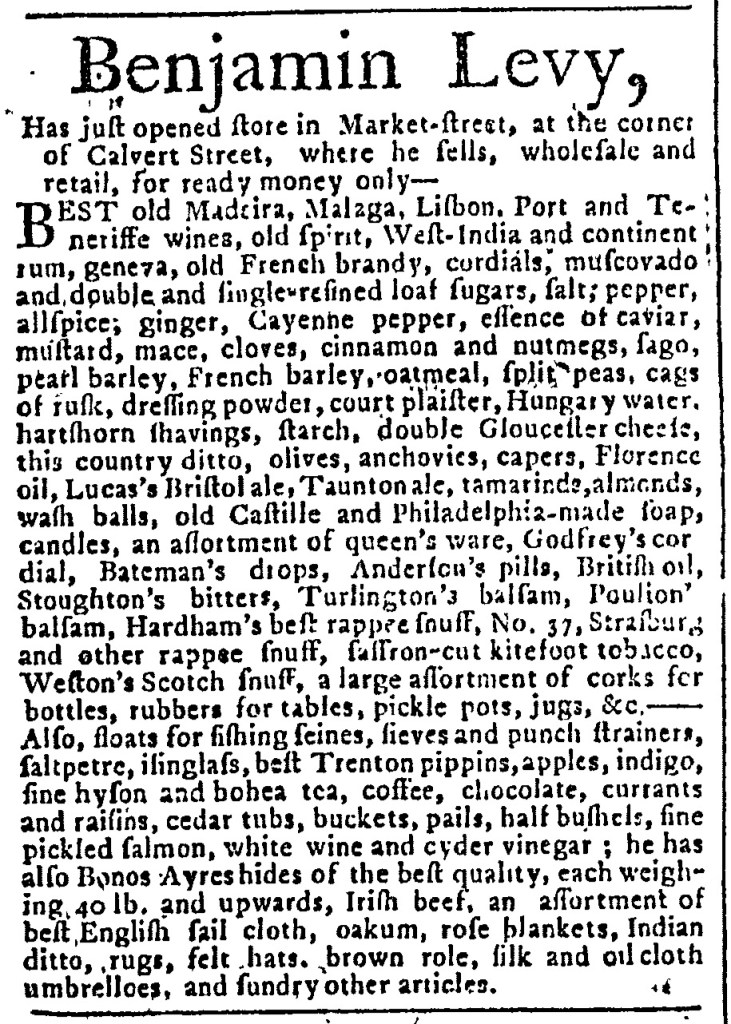
Benjamin Levy advertised a variety of groceries, including “fine hyson and bohea tea,” available at his store on Market Street in Baltimore in the December 18, 1773, edition of the Maryland Journal.  Two nights earlier, colonizers disguised as Indians boarded ships in Boston and tossed tea shipped by the East India Company into the harbor to protest the Tea Act.  While it would take a little time for that news to reach Baltimore, the newspaper carried other news about the escalating crisis.

The first page featured news from Boston, dated November 29: “Yesterday morning arrived here the ship Dartmouth, Capt. Hall, in 8 weeks from London, with 114 chests of the long expected and much talked of TEA.”  The following morning, a handbill posted around town proclaimed, “FRIENDS!  BRETHREN!  COUNTRYMEN!  THAT worst of plagues, the detested TEA, shipped for this port by the East-India Company, is now arrived in this harbour; the hour of destruction or manly opposition to the machinations of tyranny stares you in the face.”  In the face of this threat, “every friend to his country, to himself and posterity, is now called upon to meet at Faneuil Hall … to make a united and successful resistance to this last, worst and most destructive measure of administration.”  The remainder of the page and two columns on the second page provided an overview of the meeting, a response from the governor and Loyalist merchants, and a resolution from the town meeting stating that “if any person or persons shall hereafter import Tea from Great-Britain … until the said unrighteous Act shall be repealed, he or they shall be deemed by this body, an enemy of his country.”  In addition, “we will prevent the landing and sale of the same, and the payment of any duty thereon.  And we will effect the return thereof to the place from whence it shall come.”  Another resolution called for “the foregoing vote to be printed and sent to England, and all the sea-ports in this province.”  That news made it far beyond other ports in Massachusetts.

A much shorter piece followed the accounts from Boston.  A condescending note to women suggested that their enjoyment of tea played a significant role in precipitating the crisis, ignoring the fact that both men and women, poor, middling, and wealthy, all consumed tea.  “LADIES,” it declared, “HOWEVER coolly some of you may now esteem your husband, it might be worth your while to consider, whether by abandoning the accursed TEA, you will preserve your country and posterity in peace and good order, or expose twenty-five thousand of them to spill their blood, in defence of their undoubted birth-right.”  The anonymous correspondent anticipated an armed conflict over the English liberties that colonizers were supposed to possess, arguing that if that did indeed come to pass then women would be at fault for not abstaining from tea.  This echoed a sentiment so often expressed among the editorials in newspapers during the imperial crisis:  women presented dangers both political and cultural through their consumption of tea and other goods.

The Maryland Journal even included an inaccurate account of what occurred in Massachusetts: “A Gentleman just come to Town from Boston assures us, That the East India Company’s TEA, lately arrived at that Place, in several Ships, from London, for the Purpose of enslaving and impoverishing, if not poisoning, the People, was all sent back to the Proprietors, conformable to the noble and Spirited Resolves of the brave Inhabitants of the Town of Boston.”  That was not what happened at all, as colonizers in Baltimore would soon learn.  Even as Benjamin Levy advertised “fine hyson and bohea tea” for sale at his store in Baltimore, tea shipped by the East India Company floated in Boston Harbor.  A new stage of the imperial crisis was brewing as colonizers faced repercussions from Parliament for that act of protest.