April 1

GUEST CURATOR: Evan Sutherland

What was advertised in a colonial American newspaper 250 years ago today?
Apr 1 - 4:1:1767 Georgia Gazette
Georgia Gazette (April 1, 1767).

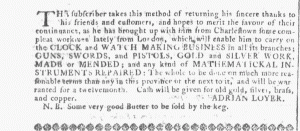
“The CLOCK and WATCH MAKING BUSINESS in all its branches.”

Adrian Loyer announced that he “carr[ied] on the CLOCK and WATCH MAKING BUSINESS in all its branches.” However, watchmaking was not as common as making clocks in colonial America, despite some colonists from England with the necessary skills and tools. Many colonists with watchmaking skills usually repaired watches, rather than creating them. Many of the watches used in colonial America were imported from England instead.

Clockmaking was much more common during the eighteenth century. Clocks were typically made of brass for the dial and wood for the case, including oak, walnut, and mahogany. Some clocks were made with expensive satinwood for inlays. Tall-case clocks made during the eighteenth century were typically expensive; their owners were usually wealthy. As a result, tall-case clocks were usually handed down through generations.

Individual clockmakers typically did not produce more than an average of four to five clocks per year. This was most likely due to the expensiveness of the materials required to produce clocks. Large clocks with tall cases required more materials and more time to produce. Despite these drawbacks, some clockmakers still managed to make a decent living.

**********

ADDITIONAL COMMENTARY: Carl Robert Keyes

Adrian Loyer seemed to be expanding the business he operated in Savannah, thanks to the assistance of “some compleat workmen lately from London” that he recruited on a recent trip to Charleston in neighboring South Carolina. As Evan indicates, Loyer was set “to carry on the CLOCK and WATCH MAKING BUSINESS in all its branches” at his shop, but he offered a variety of other services as well. He and his assistants also repaired mathematical instruments and performed metalwork on weapons and other items.

Residents of Savannah were apparently familiar with Loyer’s work and his reputation: he opened his advertisement by acknowledging “his friends and customers.” Former and potential customers, however, did not know much about Loyer’s new assistants and their work beyond the brief description that appeared in the advertisement. Accordingly, Loyer offered assurances to anyone who visited his shop. He pledged that any work contracted and completed in his shop “will be warranted for a twelvemonth.” In other words, Loyer offered a guarantee that lasted for a year.

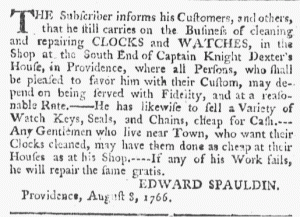
Loyer did not provide further details about how his guarantee worked. Was it a money back guarantee? Or did he not charge to repair items that failed within the specified period? Or did he offer customers a choice? Edward Spauldin, who “carries on the Business of cleaning and repairing CLOCKS AND WATCHES” in Providence, explained how his guarantee worked in an advertisement published the previous summer. “If any of his Work fails,” Spauldin stated, “he will repair the same gratis.”

Loyer seemed quite conscious that potential patrons might choose his competitors in Savannah or even send their work to workshops in Charleston. That being the case, it seems most likely that he followed Spauldin’s example and made repairs for free. Doing so gave him the opportunity to satisfy customers rather than relinquish them to other clockmakers and smiths. Whatever the mechanisms of the guarantee, Loyer underscored that he took responsibility for any work that left his shop, whether undertaken by himself or by any of the “compleat workmen” he now employed.
February 6

What was advertised in a colonial America newspaper 250 years ago today?

feb-6-261767-south-carolina-and-american-general-gazette
South-Carolina and American General Gazette (February 6, 1767).

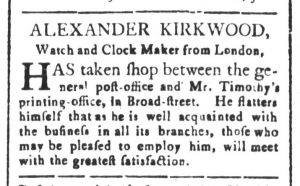
“ALEXANDER KIRKWOOD, Watch and Clock Maker from London, HAS taken shop.”

A print of An Exact Prospect of CHARLESTOWN, the Metropolis of the Province of SOUTH CAROLINA, “Engrav’d for the London Magazine” in the early 1760s, depicted a bustling colonial port city. It provided a view of the waterfront, including the wharves where vessels took on cargoes of rice, indigo, and other local products after unloading commodities imported from Europe and the West Indies, slaves arriving directly from Africa or transshipped through other ports in the New World, and migrants from Europe looking for new opportunities.

08835v
An Exact Prospect of Charlestown, the Metropolis of the Province of South Carolina (ca. 1762).  Courtesy Library of Congress.

Alexander Kirkwood, a “Watch and Clock Maker from London,” made the journey across the Atlantic at some point, though his advertisement in the South-Carolina and American General Gazette did not indicate how recently he had arrived in the colony. Whenever he made the voyage, he likely chose to settle in Charleston because it was indeed “the Metropolis” of South Carolina (though readers of the London Magazine may have chuckled a bit over that characterization when they viewed the print), the largest settlement in Britain’s North American colonies south of Philadelphia. The “Watch and Clock Maker from London” needed a sufficient customer base to succeed, making a prosperous settlement the size of Charleston an attractive place to set up shop.

Most likely Kirkwood was a relatively new arrival when he placed this advertisement, given that he stated that he “has taken shop” rather than “removed” from one shop to another. Like shopkeeper David Conkie in Boston, who placed his own advertisement earlier the same week, Kirkwood needed to make prospective customers aware of his business. To that end, he placed notices in both the South-Carolina and American General Gazette and the South Carolina Gazette, published by his neighbor, “Mr. Timothy’s printing-office, in Broad-street.” Residents may not have been familiar with Kirkwood’s shop just yet, but they certainly knew where to find the businesses on either side of him, Timothy’s printing office and the “general post-office.” Not only did his advertisements serve to garner attention, Kirkwood’s location certainly yielded a fair amount of visibility for his shop.

August 24

What was advertised in a colonial American newspaper 250 years ago this week?

Aug 24 - 8:23:1766 Providence Gazette
Providence Gazette (August 23, 1766).

“THE Subscriber … still carries on the Business of cleaning and repairing CLOCKS and WATCHES.”

Publication of the Providence Gazette lapsed for more than a year from May 11, 1765, to August 9, 1765 (with the exception of two “extraordinary issues” on August 24, 1766, and March 12, 1766). The Stamp Act played a role in temporarily suspending the newspaper, but in the revival issue Sarah Goddard and Company indicated that an “inadequate Number of Subscribers” had delayed its return after the hated legislation had been repealed.

When the Providence Gazette once again commenced publication, it included an advertisement from clock- and watchmaker Edward Spauldin, an advertisement that appeared in all four issues published in August 1766. This advertisement had previously appeared in the most recent extraordinary on March 12, 1766. For the August iterations, a nota bene promoting compasses for mariners had been removed and the date listed below Spauldin’s name had been updated. Otherwise, the advertisement was the same, from the text to some rather curious line breaks. It’s possible that the type may not have been reset at all; it may have been sitting in the form for months.

Edward Spauldin made a decision to advertise in the extraordinary issue published nearly half a year earlier. Upon learning that the Providence Gazette would be revived, did he once again decide to place an advertisement in hopes of attracting customers? Or did the Providence Gazette publish his advertisements in order to fulfill a bargain that had been made months earlier? The reappearance of his advertisement can be interpreted in more than one way. It might indicate an enthusiastic advertiser who saw returns from his marketing efforts earlier in the year and hoped to make similar gains once again. Alternately, since the printer had been attempting to revive the newspaper for some time, it might have merely been the continuation of a set number of insertions that had been delayed.