March 5

What was advertised in a colonial American newspaper 250 years ago today?

Massachusetts Spy (March 5, 1772).

“MATHEMATICAL INSTRUMENTS … At the Head of the Long-Wharf, King-Street, BOSTON.”

Thick black mourning borders enclosed the columns of the March 5, 1772, edition of the Massachusetts Spy.  Isaiah Thomas, one of the most ardent patriots among the printers in Boston, commemorated the second anniversary of the Bloody Massacre, the Massacre in King Street, better known today as the Boston Massacre.  Colonial printers most often used mourning borders when announcing the death of an official (including Francis Fauquier, lieutenant governor of Virginia, in March 1768) or a prominent figure (including George Whitefield, a minister associated with the revivals now known as the Great Awakening, in September 1770), but in the 1760s and 1770s American printers also deployed mourning borders to lament the death of liberty, doing so in response to the Stamp Act and the “HORRID MASSACRE! Perpetrated in King-street.”

On the second anniversary of the Boston Massacre, Thomas did more than frame the content of the Massachusetts Spywithin mourning borders.  A woodcut depicting a skull and bones, familiar from the Stamp Act protests, appeared near the top of the first column on the front page, just below several lines about massacre that Thomas attributed to Shakespeare.  The printer also inserted a letter written on the occasion of the anniversary of the “fifth of March … to appear with the labours of those able and assiduous patriots, who have rendered the Spy the terror of tyrants, the scourge of traitors, and expositor of the violent and fraudulent usurpations of a set of villains partaking largely the nature of both.”  Thomas also published a memorial to “FIVE of your fellow countrymen, GRAY, MAVERICK, CALDWELL, ATTUCKS and CARR … most inhumanly MURDERED … By a Party of the XXIXth Regiment, Under the command of Capt. Tho. Preston.”  The memorial linked the Boston Massacre to the murder of Christopher Seider, an “innocent youth,” by Ebenezer Richardson, “Informer, And tool to Ministerial hirelings,” on February 22, 1770, just two weeks before the events in King Street.  The memorial expressed dismay that even though Richardson “was found guilty By his Country On Friday April 20th, 1770,” he “Remains UNHANGED” on “This day, MARCH FIFTH! 1772.”  The memorial concluded with a proclamation that “the PRESS” should “Remain FREE” as “a SCOURGE to Tyrannical Rulers.”

The mourning borders did not enclose just the memorial, editorials, and other content related to the Boston Massacre.  Instead, they appeared on all four pages, enclosing even the advertisements for cookbooks, “ENGLISH GOODS,” almanacs, and mathematical instruments.  Even if readers chose to skip over the dense essays that appeared elsewhere in the newspaper, they could not miss the mourning borders when they perused the advertisements.  Merely reading the advertisements on the final page of the Massachusetts Spy required colonizers to engage with the politics of the period.

May 7

What was advertised in a colonial American newspaper 250 years ago today?

Supplement to the South-Carolina Gazette and Country Journal (May 7, 1771).

“Booksellers in Boston, New-York, Philadelphia, or … Charles-Town.”

Like many other colonial printers, Charles Crouch also sold books, pamphlets, and broadsides.  In the pages of the South-Carolina Gazette and Country Journal, he advertised titles available at his “Great Stationary and Book Shop.”  He also acted as a local agent for printers and booksellers in other cities, publishing subscription notices and handling local sales.  He did so on behalf of Robert Bell, the flamboyant bookseller responsible for publishing a three-volume American edition of “ROBERTSON’s celebrated History of CHARLES the Fifth.”  Bell coordinated an advertising campaign that extended from New England to South Carolina.  Local agents simultaneously published his subscription notice inviting readers to participate in an “elegant XENOPHONTICK BANQUET” through purchasing his American edition.

When Wells inserted that advertisement in the South-Carolina Gazette and Country Journal and listed himself as a local agent, he contributed to the creation of a community that extended far beyond Charleston.  Yet settling in for the “XENOPHONTICK BANQUET” was not the only means of joining a larger community that Wells offered to readers and prospective customers.  He appended to Bell’s subscription notice a brief note that he also sold “The Trial of the Soldiers of the 29th Regiment, for the Murders committed at Boston,” printed by John Fleeming in Boston, and “A Funeral Sermon on the Death of the Rev. Mr. Whitefield, by the Rev. Mr. Zubly,” printed by James Johnston in Savannah.  Those two items commemorated two of the most significant events of 1770, the Boston Massacre on March 5 and the death of George Whitefield on September 30.  Both events received extensive coverage in the colonial press.  Both of them also generated commemorative items ranging from broadsides and prints to sermons and orations.

In a single advertisement, Wells linked consumers in South Carolina to geographically dispersed communities that shared common interests not defined by the places individual members resided.  Colonists from New England to Georgia mourned Whitefield, just as they expressed outrage over British soldiers firing into a crowd and killing several people in Boston.  Many colonists also sought to participate in genteel communities defined in part by the books they read, joining in the “grand Feast of historical Entertainment” that booksellers in Boston, New York, Philadelphia, Charleston, and other towns offered to them.  Wells did not merely advertise three titles available at his shop; he marketed a sense of community.

May 6

What was advertised in a colonial American newspaper 250 years ago today?

Boston-Gazette (May 6, 1771).

“AN ORATION … to COMMEMORATE the BLOODY TRAGEDY.”

In the spring of 1771, colonists had several opportunities to purchase memorabilia that marked the first anniversary of the Boston Massacre.  For the fourth consecutive week, Benjamin Edes and John Gill advertised James Lovell’s “ORATION … to COMMEMORATE the BLOODY TRAGEDY” in the May 6 edition of the Boston-Gazette.  Edes and Gill, printers of that newspaper, also printed the oration “by Order of the Town of BOSTON,” according to the imprint on the title page.

Lovell delivered the first oration commemorating the Boston Massacre sanctioned by the town of Boston on April 2, 1771, though Thomas Young also gave an address on the same theme a few weeks earlier and closer to the first anniversary of British soldiers firing into a crowd and killing several colonists.  No copy of Young’s address survives, but Edes and Gill took Lovell’s oration to press less than two weeks after he spoke to the residents of Boston.  Starting on April 15, they promoted the oration in the Boston-Gazette, informing readers that they could acquire copies of this commemorative item.  A week later, Samuel Hall, printer of the Essex Gazette, advised residents of Salem and its environs that he also carried Lovell’s oration.

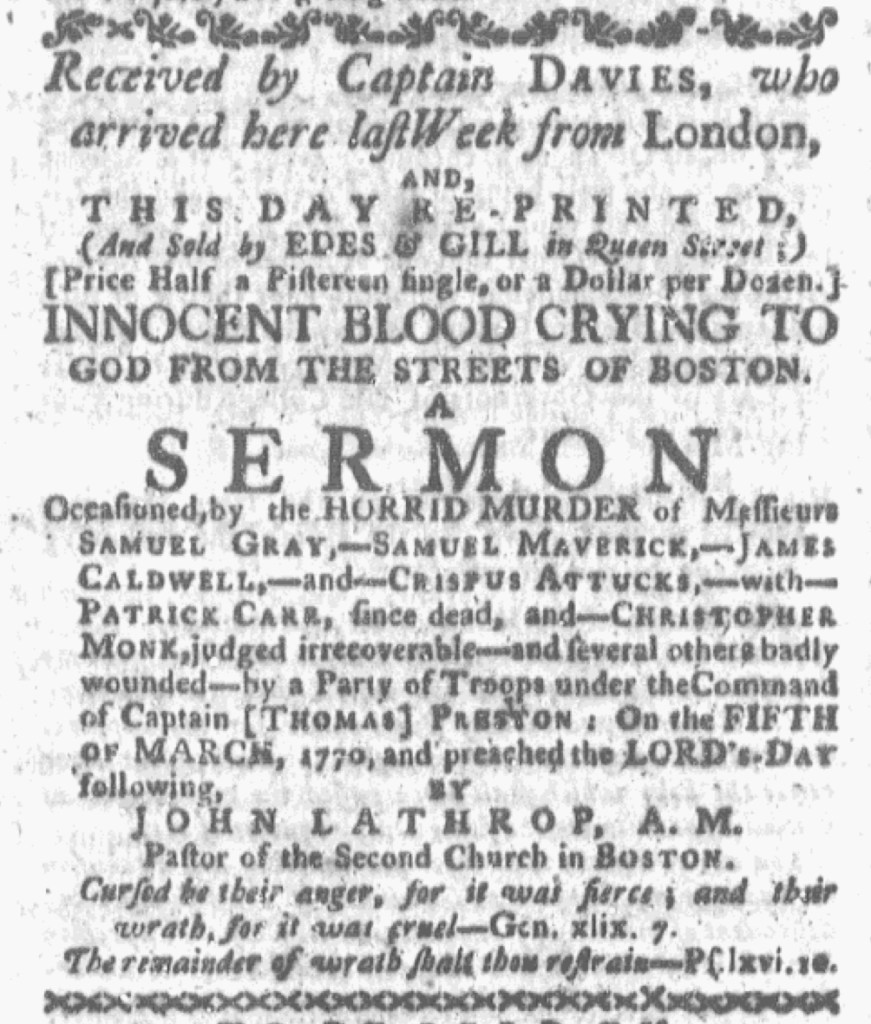
Edes and Gill simultaneously marketedINNOCENT BLOOD CRYING TO GOD FROM THE STREETS OF BOSTON,” a sermon that John Lathrop, “Pastor of the Second Church in BOSTON,” delivered just days after the Boston Massacre.  Edes and Gill reprinted a London edition delivered to them by a ship captain who carried both news and consumer goods across the Atlantic.  In the case of the sermon, news and merchandise came packaged in a single pamphlet, ready for reprinting and dissemination throughout the busy port and into the countryside.  According to their advertisement, Edes and Gill sold the sermon single and by the dozen, an invitation to retailers to purchase and sell it in their shops.

Civic leaders in Boston encouraged a culture of commemoration around the Bloody Massacre, just as colonists in many towns marked the anniversary of the repeal of the Stamp Act.  Printers like Edes and Gill eagerly participated in that process, inspired by both their political principles and their desire to generate revenues.  Printing and marketing orations and sermons about the Boston Massacre helped to keep the event fresh in popular memory by making those addresses readily accessible long after the speakers delivered them.

April 29

What was advertised in a colonial American newspaper 250 years ago today?

Boston-Gazette (April 29, 1771).

“INNOCENT BLOOD CRYING TO GOD FROM THE STREETS OF BOSTON.”

When ships from England arrived in American ports in the spring of 1771, they delivered news of reactions to George Whitefield’s death from the other side of the Atlantic.  The prominent minister died in Newburyport, Massachusetts, on September 30, 1770.  It took several weeks for news to reach England and even longer, given the difficulty and dangers of crossing the North Atlantic in winter, before colonists learned how that news was received.  In addition to newspaper accounts, colonists also received commemorative items produced in England, including sermons dedicated to the memory of the minister.  Yet that was not the only memorabilia associated with major news events that vessels from England carried to the colonies on the spring of 1771.  They also delivered items that commemorated the Boston Massacre.

Benjamin Edes and John Gill, printers of the Boston-Gazette, received a London edition of “INNOCENT BLOOD CRYING TO GOD FROM THE STREETS OF BOSTON,” a sermon “Occasioned by the HORRID MURDER” of several colonists “by a Party of Troops under the Command of Captain [THOMAS] PRESTON” on March 5, 1770.  John Lathrop, “Pastor of the Second Church in BOSTON,” gave the sermon on the Sunday following the Boston Massacre.  Lathrop or an associate apparently sent a manuscript copy to London.  Printers there took the sermon to press.  The sermon then crossed the Atlantic in the other direction.  When Edes and Gill received it, they published an American edition of a sermon originally delivered in their own city, further disseminating it to consumers in Boston and beyond.  In so doing, they expanded the simultaneous commemoration and commodification of the Boston Massacre already underway in the colonies.

Edes and Gill intended to place copies of Lathrop’s sermon in the hands of as many readers as possible.  They offered discounts to buyers who purchased a dozen or more copies for retail sales, though they also sold single copies.  As entrepreneurs, they wished to generate revenues, but that did not comprise their sole motivation.  Edes and Gill were perhaps the most vocal of Boston’s printers when it came to supporting the patriot cause.  Their newspaper provided extensive coverage of current events, both news accounts and editorials with a patriot slant, during the imperial crisis that culminated in the American Revolution.  Both profits and their principles likely guided their decision to print and distribute Lathrop’s sermon on “INNOCENT BLOOD CRYING TO GOD FROM THE STREETS OF BOSTON.”  In so doing, they helped cultivate a culture of remembrance of significant events.  For several years, colonists had been marking the anniversary of the repeal of the Stamp Act.  In 1771, residents of Boston commenced a new tradition of commemorating the Massacre on or near its anniversary.  Edes and Gill participated, printing both James Lovell’s oration occasioned by the first anniversary and Lathrop’s sermon delivered just days after the Boston Massacre.

April 23

What was advertised in a colonial American newspaper 250 years ago today?

Essex Gazette (April 23, 1771).

“A few of Mr. Lovell’s ORATIONS on the Massacre in Boston.”

In the spring of 1771 colonial printers advertised a variety of items commemorating the death of George Whitefield the previous fall.  At the same time that John Dunlap in Philadelphia, John Fleeming in Boston, Daniel Fowle and Robert Fowle in New Hampshire, and John Holt in New York advertised Whitefield memorabilia, Samuel Hall informed residents of Salem that he carried an item that commemorated the other major news story of the previous year.  “A few of Mr. Lovell’s ORATIONS on the Massacre in Boston, to be sold by the Printer hereof,” Hall noted in an advertisement in the April 23 edition of the Essex Gazette.

Hall referred to “An Oration Delivered April 2d, 1771. At the Request of the Inhabitants of the Town of Boston; To Commemorate the Bloody Tragedy of the Fifth of March, 1770.”  James Lovell delivered this oration on the occasion of the first anniversary of the Boston Massacre.  As the Massachusetts Historical Society explains, “From 1771 until 1783, when the commemoration of the Massacre was superseded by the celebration of independence on the Fourth of July, a leader of the patriot movement gave an address each year on or near the date of the anniversary.”  On the first anniversary of the Boston Massacre, local leaders determined that “there needed to be a public oration to remember the event.”  Lovell gave the first official oration sanctioned by the town, but, as Samuel A. Forman notes, Thomas Young “delivered a speech … on the same theme a few weeks prior and closer to the first anniversary of the Boston Massacre.”  No copy of Young’s address survives, but Lovell’s oration was “Printed by Edes and Gill, By Order of the Town of Boston.”

Benjamin Edes and John Gill, printers of the Boston-Gazette and vocal supporters of the patriot cause, quickly took Lovell’s oration to press.  They made it available to consumers in Boston and beyond, disseminating copies to fellow printers and booksellers in other towns.  Hall, Edes and Gill, and patriot leaders in Boston all encouraged a culture of commemoration around the Boston Massacre, participating in rituals of remembrance and the commodification of those rituals in order to make a lasting impression well before the skirmishes at Lexington and Concord.  They cultivated reverence for this significant event considered one of the causes of the American Revolution in the years prior to the colonies declaring independence.  Marketing items like Lovell’s “Oration” and prints of the “Bloody Massacre” likely contributed to the cultivation of patriotic sentiment as many colonists shifted their attitudes from resistance to revolution.

**********

The Massachusetts Historical Society provides access to a digitized copy of Lovell’s “Oration.”