December 23

What was advertised in a revolutionary American newspaper 250 years ago today?

Virginia Gazette [Dixon and Hunter] (December 23, 1775).

“A large and exact VIEW of the late BATTLE at CHARLESTOWN.”

Like other printers, John Dixon and William Hunter sold books, pamphlets, almanacs, stationery, and other merchandise to supplement the revenues they generated from newspaper subscriptions, advertisements, and job printing.  They frequently placed advertisements in their newspaper, the Virginia Gazette, to generate demand for those wares.  The December 23, 1775, edition, for instance, included three of their advertisements, one for “SONG BOOKS and SCHOOL BOOKS For SALE at this OFFICE” and another for the “Virginia ALMANACK” for 1776 with calculations “Fitting VIRGINIA, MARYLAND, [and] NORTH CAROLINA” by “the ingenious Mr. DAVID RITTENHOUSE of Philadelphia,” the same mathematician who did the calculations for Father Abraham’s Almanack marketed in Philadelphia and Baltimore.

Their third advertisement promoted memorabilia related to the hostilities that erupted at Lexington and Concord earlier in the year.  “Just come to Hand, and to be SOLD at this PRINTING-OFFICE,” Dixon and Hunter proclaimed, “A large and exact VIEW of the late BATTLE at CHARLESTOWN,” now known as the Battle of Bunker Hill.  The copies they stocked were “Elegantly coloured” and sold for “one Dollar.”  Dixon and Hunter apparently carried a print, “An Exact View,” engraved by Bernard Romans and published by Nicholas Brooks, rather than a striking similar (and perhaps pirated) print, “A Correct View,” that Robert Aitken included in a recent issue of the Pennsylvania Magazine, or American Monthly Museum and sold separately.  Romans and Brooks had advertised widely and designated local agents to accept subscriptions for the print.  Dixon and Hunter also advertised another collaboration between Romans and Brooks, “an accurate MAP of The present SEAT of CIVIL WAR, Taken by an able Draughtsman, who was on the Spot at the late Engagement.”  The map also sold for “one Dollar.”  Previous efforts to market the map included a broadside subscription proposal that listed local agents in various towns, including “Purdie and Dixon, Williamsburgh.”  Romans and Brooks apparently had not consulted with all the printers, booksellers, and other men they named as local agents when they drew up the list or else they would have known that Alexander Purdie and John Dixon had dissolved their partnership in December 1774.  Dixon took on Hunter as his new partner while Purdie set about publishing his own Virginia Gazette.  Those details may have mattered less to Romans and Brooks than their expectation that printers, booksellers, and others with reputations for supporting the American cause would indeed aid them in marketing and selling a map depicting the conflict underway in Massachusetts.  Whether or not Purdie or Dixon and Hunter collected subscriptions, local agents in Williamsburg did eventually sell the print and the map that supplemented newspaper accounts and encouraged feelings of patriotism among the consumers who purchased them.
November 1

What was advertised in a revolutionary American newspaper 250 years ago today?

Pennsylvania Journal (November 1, 1775).

“A NEAT Mezzotinto print of the Hon. JOHN HANCOCK.”

“A large and exact VIEW of the late BATTLE at CHARLESTOWN.”

“An accurate map of the present seat of CIVIL WAR.”

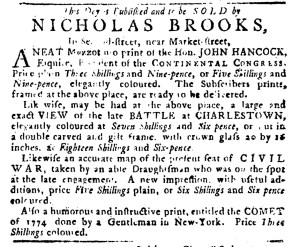
Nicholas Brooks produced and marketed items that commemorated the American Revolution before the colonies declared independence.  In an advertisement in the November 1, 1775, edition of the Pennsylvania Journal, for instance, he packaged together three prints previously advertised separately, each of them related to imperial crisis that had boiled over into a war.  For this notice, Brooks presented them as a collection of prints for consumers who wished to demonstrate their support for the American cause by purchasing and displaying one or more of them.

Brooks announced that a “NEAT Mezzotinto print of the Hon JOHN HANCOCK, Esquire, President of the CONTINENTAL CONGRESS,” that had previously been proposed in other advertisements had been published and was now for sale at his shop on Second Street in Philadelphia.  The subscribers who had reserved copies in advance could pick up their framed copies or arrange for delivery.  Others who had not placed advanced orders could acquire the print for three shillings and nine pence or pay two extra shillings for one “elegantly coloured.”

“Likewise, may be had at the above place,” Brooks reported, “a large and exact VIEW of the late BATTLE at CHARLESTOWN,” depicting what has become known as the Battle of Bunker Hill.  This print competed with an imitation bearing a similar title, “a neat and correct VIEW of the late BATTLE at CHARLESTOWN,” that Robert Aitken inserted in the Pennsylvania Magazine and sold separately.  Brooks, who had long experience selling framed prints, offered choices for his “exact VIEW.”  Customers could opt for an “elegantly coloured” version for seven shillings and six pence” or have it “put in a double carved and gilt frame, with glass 20 by 16 inches,” for eighteen shillings and six pence.  The eleven shillings for the frame, half again the cost of the print, indicated that Brooks anticipated that customers would display the “exact VIEW” proudly in their homes or offices.

He also promoted “an accurate map of the present seat of CIVIL WAR, taken by an able Draughtsman,” Bernard Romans, “who was on the spot of the late engagement.”  Brooks revised copy from earlier advertisements: “The draught was taken by the most skillful draughtsman in all America, and who was on the spot at the engagements of Lexington and Bunker’s Hill.”  The map showed a portion of New England that included Boston, Salem, Providence, and Worcester.   This print, he declared, was a “new impression, with useful additions,” though he did not specify how it differed from the one he previously marketed and sold.  As with the others, customers had a choice of a plain version for five shillings or a “coloured” one for six shillings and six pence.

Brooks added one more item, “a humorous and instructive print, entitled the COMET of 1774, done by a Gentleman in New-York.”  Did this print offer some sort of satirical commentary on current events?  Or was it unrelated to the prints of Hancock, the Battle of Bunker Hill, and the “CIVIL WAR” in New England?  Whatever the additional print depicted, Brooks made the prints that commemorated the American Revolution the focus of his advertisement, gathering together three items previously promoted individually.  In so doing, he not only offered each print to customers as separate purchases but also suggested that they could consider them part of a collection.  Consumers who really wanted to demonstrate their patriotism could easily acquire all three at his shop.

October 4

What was advertised in a revolutionary American newspaper 250 years ago today?

Pennsylvania Journal (October 4, 1775).

“A NEAT MEZZOTINTO PRINT of the HON. JOHN HANCOKC, ESQ; PRESIDENT of the CONTINENTAL CONGRESS.”

On October 4, 1775, Nicholas Brooks took to the pages of the Pennsylvania Journal to announce that he “JUST PUBLISHED … An Exact VIEW of the Late BATTLE at CHARLESTOWN,” now known as the Battle of Bunker Hill.  Brooks had previously distributed subscription proposals for the project that he pursued in collaboration with Bernard Romans.  Brooks and Romans had recently worked together on a map of Boston that depicted the siege of the city following the battles at Lexington and Concord.  Brooks described the new print now ready for purchase as a “Large Elegant PIECE, beautifully Coloured, and much superior to any pirated copy now offered or offering to the public.” Apparently, Brooks had not worked with Robert Aitken in making a version to accompany the Pennsylvania Magazine.  It was not the first time that one colonizer pirated the work of another when producing items that commemorated the imperial crisis that eventually became a war for independence.  Paul Revere had done the same with Henry Pelham’s image of the Boston Massacre, advertising his copy in Boston’s newspapers before Pelham marketed the original.

Despite his frustration with the situation, Brooks must have considered prints commemorating the people and events related to the current crisis viable business ventures.  Immediately below his advertisement for “An Exact View of the Late BATTLE at CHARLESTOWN,” he inserted another advertisement, that one proclaiming, “It is PROPOSED to PRINT, in about ten days, A NEAT MEZZOTINTO PRINT of the HON. JOHN HANCOCK, ESQ; PRESIDENT of the CONTINENTAL CONGRESS.”  Brooks collected subscribers’ names and reserved copies of the print for them at his shop on Second Street in Philadelphia.  Interested parties could also visit the London Coffee House, a popular spot for socializing, conducting business, and talking politics.  Brooks’s advertisement did not give details about what to do at the London Coffee House.  Subscribers may have given their names to an employee who recorded them on a list or they may have signed their own names (and indicated the number of copies they wished to purchase) on a subscription proposal posted alongside other advertisements.  They very well may have perused the names of other patriots who ordered the print as they committed to acquiring their own copy.  Brooks hoped that they would also purchase “Frames and Glasses” to display the prints from his shop, just as he marketed a “Double Carv’d and Gilt Frame … with Crown Glass” for the print depicting the battle.  Brooks certainly wanted commemorative items to become fashionable items that consumers believed that they not only wanted but needed as the imperial crisis intensified.

December 4

What was advertised in a colonial American newspaper 250 years ago today?

Essex Gazette (December 4, 1770).

“JUST PUBLISHED … Dr. Whitaker’s SERMON On the DEATH of the Reverend George Whitefield.”

George Whitefield, one of the most prominent ministers associated with the eighteenth-century religious revivals now known as the Great Awakening, died in Newburyport, Massachusetts, on September 30, 1770.  The next day, articles appeared in newspapers published in Boston and the news radiated to other towns throughout the colonies over several weeks.  In addition to news items, many newspapers printed and reprinted poems that eulogized the minister.  Almost immediately, some printers and booksellers advertised commemorative items that commodified Whitefield’s death.  Through concentrated primarily in New England, such advertisements also ran in newspapers in New York, Pennsylvania, and South Carolina.

As winter approached, printers and booksellers continued to produce and market new items related to Whitefield and his death.  On November 27, Samuel Hall, printer of the Essex Gazette in Salem, Massachusetts, advertised that “On Thursday or Friday next will be published … The Rev. Dr. Whitaker’s SERMON, on the Death of the late Rev. Mr. WHITEFIELD.”  In the next issue, Hall inserted an updated advertisement that announced he had indeed “JUST PUBLISHED” the sermon and offered it for sale at the printing office.  This advertisement, unlike most others, included thick black bands at the top and bottom, a widely recognized symbol of mourning in eighteenth-century America.  Usually, black bands or borders were reserved for news articles or they adorned an entire page or issue.  By incorporating them into this advertisement, Hall elevated Whitaker’s sermon on Whitefield’s death and, by extension, his marketing of that item, to news.  In addition, he placed the advertisement at the top of the first column devoted to advertisements in the December 4 edition of the Essex Gazette, making it a transition between news and advertising.

In the year that saw the Boston Massacre and the repeal of most of the Townshend duties on imported goods, the death of George Whitefield was one of the most significant stories that circulated in the colonial American newspapers.  Yet coverage of the minister’s death was not confined to news alone.  Printers and booksellers seized opportunities to produce commemorative items and offer them for sale, simultaneously consoling the general public and seeking to profit from their grief.

October 12

What was advertised in a colonial American newspaper 250 years ago today?

New-Hampshire Gazette (October 12, 1770).

“The Character of … George Whitefield … worthy a place in every House.”

By October 12, 1770, newspapers published in Boston and Salem, Massachusetts; Portsmouth, Rhode Island; Newport and Providence, Rhode Island; Hartford, New Haven, and New London, Connecticut; New York; and Philadelphia, Pennsylvania informed readers of the death of minister George Whitefield at Newburyport, Massachusetts, on September 30, 1770.  Coverage originated in Boston on the day after Whitefield’s death and then radiated outward as other newspapers published their own articles but mostly reprinted items that originally ran in one of the five newspapers printed in Boston.

It did not take long for commemoration to turn to commodification inspired by the influential minister’s death.  Almost immediately, printers notified the grieving public that they intended to publish Whitefield memorabilia.  Whether or not they had heard Whitefield preach while he was still alive, consumers could purchase broadsides that featured his words or documented his life and good works.  Through the marketplace they could acquire a connection to one of the most prominent ministers associated with the religious revivals of the Great Awakening.

Such advertisements continued to supplement news coverage in the October 12, 1770, edition of the New-Hampshire Gazette.  Between news items, poetry honoring the preacher, and advertisements for memorabilia, Daniel Fowle and Robert Fowle devoted an entire column to Whitefield, out of only twelve columns over four pages that comprised the entire issue.  The Fowles inserted three items reprinted from the October 8 edition of the Massachusetts Gazette and Boston Post-Boy.  A longer news article, a poem dedicated to Whitefield, and a shorter news article all ran in the order that they appeared in the Boston newspaper.  The Fowles included another poem, that one taken from the October 4 edition of the Massachusetts Gazette and Boston Weekly News-Letter.

Immediately following those items, they ran an advertisement for two commemorative broadsides.  One featured “A Hymn composed by the Rev. Mr. WHITEFIELD, and intended to be sung over his Corps.”  Printers in Boston and Salem had already advertised a similar piece of memorabilia.  The Fowles also advertised an item that had not yet been marketed in the public prints, a broadside about “The Character of the late worthy, pious, learned and Reverend George Whitefield.”  The Fowles stressed that this memorial was “properly put in mourning,” meaning that thick black borders enclosed the text and separated the columns.  It also featured an image of Whitefield’s coffin with “the Names of the Bearers, placed on each side of it.”  (Examine the Library of Congress’s copy of this broadside.)  In an effort to incite demand and increase sales, the Fowles proclaimed that this broadside in memory of Whitefield was “worthy a place in every House.”  Consumers could demonstrate their rectitude and continue to be instructed by the minister and his good example after his death.

Like other printers who produced and marketed similar broadsides, the Fowles participated in the commodification of Whitefield’s death.  Such a significant event presented an opportunity to increase revenues in their printing office by publishing and selling commemorative items.