September 24

What was advertised in a colonial American newspaper 250 years ago today?

Sep 24 - 9:24:1768 Providence Gazette
Providence Gazette (September 24, 1768).

Want of Room has obliged us to omit some Advertisements, and sundry Articles of European Intelligence, to which a due Regard will be paid in our next.”

The compositor who set type for the Providence Gazette inserted a series of instructions to aid readers in navigating the September 24, 1768, edition. Like all other newspapers published in the American colonies in the 1760s, a standard issue of the Providence Gazette consisted of four pages distributed once a week. This required a single broadsheet, folded in half. Some newspapers in largest port cities did regularly circulate an additional two-page supplement printed on a half or quarter sheet tucked inside the standard issue but often numbered sequentially as the fifth and sixth pages. The majority of newspapers, however, issued supplements, postscripts, and extraordinaries only rarely.

Printers and compositors produced four-page issues by printing two pages on each side of a broadsheet. The second and third pages were printed side-by-side on one side. In the final issue, they appeared next to each other across the center fold. The first and fourth pages were printed on the other side of the sheet, with the fourth page on the left and the first page on the right. This put each page in the proper position once both sides had been printed and the broadsheet folded in half.

The instructions the compositor inserted in the September 24, 1768, edition of the Providence Gazette make the order for setting the type clear, though not necessarily the order for printing the two sides of the broadsheet. Except for the masthead, the “Commission of the Board of Commissioners for this Continent, now held at Castle-William” in Boston harbor occupied the entire first page. The final line of the third column instructed readers to “[See the last Page.]” The “Commission” continued there, filling the entire page except for the colophon at the bottom. Again, the final line of the third column gave instructions: “[For the Remainder, turn to the second Page.]” The “Commission” continued there, in the middle of a word, and concluded after approximately one-quarter of a column. Other news from Boston rounded out the second page and a portion of the third page. The editors selected one column of local news. Only five advertisements appeared in the issue, confined to the bottom of the second and the entire third column on the third page. A short note from the printers followed the paid notices: “Want of Room has obliged us to omit some Advertisements, and sundry Articles of European Intelligence, to which a due Regard will be paid in our next.” The printers opted not to issue a supplement but instead held off on publishing additional content for a week.

These various instructions make it clear that the compositor set the type for the first and fourth pages first and only after that for the second and third pages. They also indicate that reading the issue start to finish required subscribers to jump around the pages, starting with the first, then the fourth, and finally the second and third. The technologies of printing led to readers experiencing the material text in ways that seem unfamiliar and counterintuitive to modern readers.
August 29

What was advertised in a colonial American newspaper 250 years ago today?

Aug 29 - 8:29:1768 New-York Gazette Weekly Mercury
New-York Gazette and Weekly Mercury (August 29, 1768).

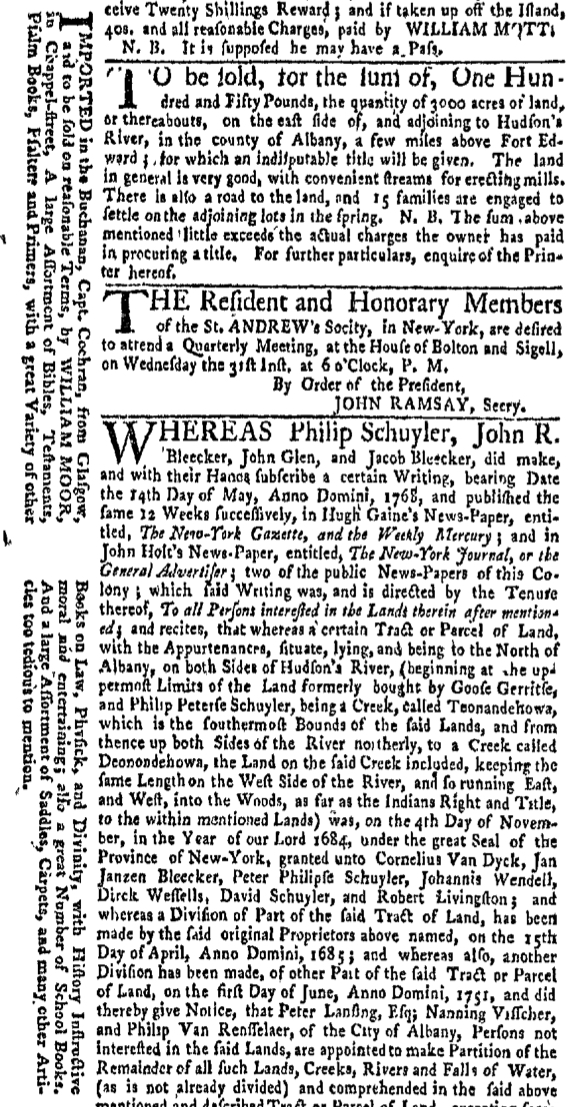
“Many other Articles too tedious to mention.”

In a brief notice in the August 29, 1768, edition of the New-York Gazette and Weekly Mercury, William Moor advertised “a great Number of School Books” as well as “A large Assortment of Bibles, Testaments, Psalm Books, Psalters and Primers, with a great Variety of other Books on Law, Physick, and Divinity.” In addition, he stocked “a large Assortment of Saddles, Carpets, and many other Articles too tedious to mention.”

That Moor designated some of his merchandise “too tedious to mention” rather than publishing an extensive list of goods (an alternate strategy adopted by several other retailers whose advertisements appeared on the same page) had the unintended effect of influencing the placement of his advertisement in that issue. Moor’s entire notice extended only eight lines, making it short enough that the compositor could divide it into columns of four lines each, both printed perpendicular to the rest of the content on the page.

Compositors sometimes deployed this strategy as a means of squeezing more items, especially paid advertisements, into current issues rather then delay publication until the following week. Even though a two-page supplement devoted entirely to advertising accompanied this particular issue, it did not offer space to insert all of the advertising. Not so much remained to justify adding an additional page to the supplement. Instead, the compositor looked to the margins.

The standard issue consisted of four pages, each with three columns. The compositor converted the outer margin, away from the fold, of the first, third, and fourth pages into advertising space by dividing short notices into multiple columns of no more than four lines each and then positioning them perpendicular to the columns that ran the length of the page. In addition to Moor’s advertisement on the fourth page, a sixteen-line advertisement for a runaway servant appeared on the first page, divided into four columns of four lines each and positioned along the outer margin to the right of the masthead and essay that comprised the rest of the page. A bankruptcy notice, eight lines divided into four columns, ran in the outer margin of the third page. A short estate notice divided into two columns ran alongside Moor’s advertisement on the fourth page.

Moor likely had no choice concerning the unusual placement of his advertisement in the New-York Gazette and Weekly Mercury. All the same, the compositor’s efforts to find more space for paid notices may have served Moor’s interests by producing the unconventional format since readers may have been especially curious to see what sorts of items had been consigned to the margins. Rather than becoming marginal, the advertisements in the margins may have evoked additional notice.

March 4

What was advertised in a colonial American newspaper 250 years ago today?

Mar 4 - 3:4:1768 South-Carolina and American General Gazette
South-Carolina and American General Gazette (March 4, 1768).

“LIVE WILD TURKIES.”

An advertisement seeking “LIVE WILD TURKIES” occupied a strange place on the sixth and final page of the March 4, 1768, edition of the South-Carolina and American General Gazette. The text was rotated and printed near the bottom of the page, nestled between another advertisement and the colophon that advised readers that the newspaper had been “Printed by ROBERT WELLS, at the Old Printing-House, Bookseller’s and Stationer’s Shop on the BAY.” Indeed, this advertisement was one of several that gave the page a strange appearance, though one not completely uncommon in eighteenth-century newspapers. In an attempt to squeeze as much content as possible onto the fifth and sixth pages, two sides of a single sheet, the compositor had rotated several advertisements already set in type. This created a fourth column of text perpendicular to the other three columns on the page.

Compositors deployed this trick when using paper that deviated from the usual size for their newspapers. Although the digitized images of the South-Carolina and American General Gazette are not supplemented with metadata that indicates the measurements of each page, it is possible to reach some reasonable conclusions through close examination of the contents. First, this newspaper usually ran four columns per page. That was the case for the first four pages of the March 4 issue, all of which would have been printed on a single sheet and folded in half to yield four distinct pages. The fifth and sixth pages, however, featured only three columns plus the narrow column of rotated text. Viewed on a screen as part of a database of digitized images of eighteenth-century newspapers, the fourth page and the sixth page appear the same size. When printing those images, both take on the standard size of a sheet of office paper. Further examination of the contents, however, suggests that the originals were different sizes. Upon comparing several advertisements on the fifth and sixth pages of the March 4 issue to their appearance in previous issues, it seems that the compositor used type that had already been set when preparing the new pages. The sheet must have been smaller, wide enough for only three columns with just enough space to rotate some of the short advertisements and squeeze them into an extra narrow column at the edge of the page. Not wanting to waste any space, the compositor did have to set two advertisements, each approximately half as wide as the standard column. The advertisement concerning “LIVE WILD TURKIES” thus found a spot near the bottom of the sixth page. Another advertisement of a similar size mirrored its location on the other side of the sheet, that one announcing “To be Let, A Genteel LODGING ROOM and a very good Cellar, by WILLIAM GOWDEY.”

The last two pages of the March 4 issue may appear unusual to twenty-first century eyes, but eighteenth-century readers would have been familiar with this strategy. The printer and compositor of the South-Carolina and American General Gazette selected a sheet just large enough to contain the news and advertisements for publication that week. At a time when imported paper was taxed under the Townshend Act, this may have been an especially important method of lowering the costs of publication.

Mar 4 - South-Carolina and American General Gazette Page 6
Final page of the March 4, 1768, edition of the South-Carolina and American General Gazette.