February 25

What was advertised in a colonial American newspaper 250 years ago today?

Connecticut Courant (February 25, 1772).

No Advertisements will for the future be published in this paper, without the money is first paid.”

Colonial printers frequently inserted notices into their newspapers to advise subscribers to make payments or face legal action.  Usually those were empty threats.  After all, printers depended on subscribers, even those who did not actually pay, to bolster circulation and, in turn, make their newspapers attractive places to run advertisements.  Many historians assert that the most significant revenues associated with publishing newspapers in colonial America came from advertising rather than subscriptions.  That has prompted some to assume that printers required advertisers to pay upfront even though they extended credit to subscribers.  That may have often been the case, but in many of their notices printers did call on subscribers and others indebted to the printing office (perhaps including advertisers) to settle accounts.

Ebenezer Watson, printer of the Connecticut Courant, inserted a notice that directly addressed paying for advertising in the February 25, 1772, edition.  He advised the public that “No Advertisements will for the future be published in this paper, without the money is first paid, unless it be for such persons as have open accounts with The Printer.”  In so doing, he did not invoke a blanket policy.  New advertisers, perhaps colonizers unknown to Watson prior to placing advertisements in his newspaper, had to submit payment at the same time that they provided the printing office with the copy for the advertisements.  Existing customers, however, those advertisers who “have open accounts,” could apparently continue to publish advertisements with the intention of paying later.

Such business practices likely differed from newspaper to newspaper.  Notices published in newspapers reveal some of the particulars, but printers’ records still extant likely help to tell a more complete story.  Like Watson’s notice in the Connecticut Courant, however, account books require careful examination to reconstruct relationships to determine how printers actually put policies into practice.  Further investigate should incorporate working back and forth between ledgers and newspapers to compare dates advertisers made payments and dates their notices appeared in the public prints.

February 4

GUEST CURATOR: Alex Devolve

What was advertised in a colonial American newspaper 250 years ago today?

Connecticut Courant (February 4, 1772).

“Wanted Immediately, a number of settlers, to remove and settle … in New Hampshire.”

I have chosen an advertisement about settling a town called Relham in New Hampshire. The reason I chose this advertisement is because the idea of settling and expanding within and outside of the colonial borders was not only part of colonial dreams in the eighteenth century, but was similar to Manifest Destiny in the nineteenth century.

According to the Office of the Historian of the Foreign Service Institute of the United States Department of State, “The settlement of the lands west of the Appalachians brought inevitable tension and conflict between settlers and indigenous peoples” during the years prior to the American Revolution. Colonists’ hopes for expansion seemed to end after the French and Indian War due to the Proclamation Line of 1763, put in place in response to Pontiac’s Rebellion. This move was one of many that sent colonists into a rebellious state.  They believed they were deprived of lands promised to them and that many had died for in the French and Indian War. The colonists’ felt their own interests were not being recognized by Britain. Even in places already settled by colonists, such as New Hampshire, they wanted their own land and opportunities.

This advertisement made me think about how important land was to colonists … and how their desire to create settlements had an impact on the events of the American Revolution and long after, impacting millions of lives.

**********

ADDITIONAL COMMENTARY: Carl Robert Keyes

When they enter my Revolutionary America class, most students attribute the cause of the Revolution to “taxation without representation” and events like the Boston Massacre.  That gives us a chance to discuss how that narrative tells an incomplete story, one that largely leaves out Indigenous peoples and the territories that Britain gained in the Seven Years War.  As Alex notes, many colonizers, including land speculators, had their sights on territory previously claimed by the French.  Neither the British government nor the colonizers, however, took into account the wishes of Indigenous peoples who already inhabited the region.  That prompted an uprising, Pontiac’s War.  Pontiac and his Indigenous allies captured most British forts in the Great Lakes, but not key outposts like Detroit.  The uprising ultimately collapsed, but it convinced the British to establish the Proclamation Line in hopes that forbidding westward expansion would prevent further turmoil in the region.  Colonizers promptly ignored the Proclamation Line, except to add it to a list of grievances that spurred them to declare independence.

Starting our examination of the era of the American Revolution with the outcome of the Seven Years War and the repercussions of Pontiac’s War makes sense chronologically, but, more significantly, it also introduces settler colonialism as an important theme for understanding the founding of the nation.  As we consider events from 1763 to 1815 – before, during, and after the Revolution – we assess the extent that European colonizers and, later, American citizens sought to displace Indigenous Americans.  This requires broadening the geographic scope of traditional narratives of the American Revolution.  We do not focus solely on events in the thirteen colonies on the Atlantic coast. To aid in that endeavor, we work our way through Tiya Miles’s The Dawn of Detroit: A Chronicle of Slavery and Freedom in the City of the Straits.  Miles tells the story of Detroit and the Great Lakes between 1760 and 1815, allowing us to move back and forth between the coast and the interior.  She carefully recovers and incorporates the experiences of Indigenous people, enslaved and free, and Black people, enslaved and free, as well as French and English colonizers and American citizens.  As my students and I discuss the political philosophy and the grievances against the king in the Declaration of Independence or the events that caused the War of 1812, often considered a second war for independence, we take into account settler colonialism within the thirteen colonies that became a new nation and in territories coveted and claimed by those colonizers and that nation.

Alex selected an advertisement that contributed to those discussions.  Settler colonialism continued within the colonies in the early 1770s as colonizers responded to advertisements about “remarkable rich” land, moving from Connecticut to what would have been considered a frontier in New Hampshire.  This advertisement in the Connecticut Courantproclaimed that “inhabitants are removing fast from this and the other colonies” to settle towns and possess land in territory already claimed by colonies.  Examining settler colonialism during the era of the American Revolution helps us achieve a better understanding of the past than we achieve if we just retell the familiar story of “taxation without representation” and the Boston Massacre.

November 26

What was advertised in a colonial American newspaper 250 years ago today?

Connecticut Courant (November 26, 1771).

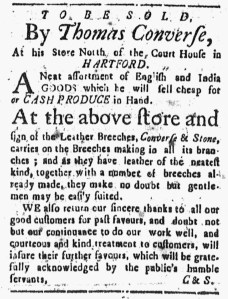
“WE also return out sincere thanks to all our good customers.”

In the fall of 1771, Thomas Converse placed an advertisement in the Connecticut Courant to inform prospective customers that he stocked a “Neat Assortment of English and India GOODS” at his store in Hartford.  In addition, he and a partner continued to make breeches at the same location, conveniently marked by the “sign of the Leather Breeches.”  Converse and Stone had on hand “a number of breeches already made” as well as “leather of the neatest kind,” both options sure to suit the “gentlemen” of the town.

Converse and Stone devoted a significant portion of the advertisement to expressions of gratitude directed at both current and prospective customers.  “WE also return our thanks,” the partners declared “to all our good customers for past favours, and doubt not but our continuance to do our work well … will insure their further favours.”  In addition, Converse and Stone emphasized customer service, stating that they provided “courteous and kind treatment.”  Eighteenth-century advertisers, especially artisans who produced the goods they sold, regularly acknowledged their customers in their advertisements.  Doing so suggested to those who had not yet availed themselves of the goods and services being offered that an advertiser already had an established clientele.  In the case of Converse and Stone, prospective customers may have felt more confident engaging their services if they believed that their “good customers” were also satisfied customers.  This served as an invitation to join a community of consumers that the breeches makers already cultivated.  Extending “sincere thanks” in print also contributed to the customer service that Converse and Stone purported to practice at the “sign of the Leather Breeches,” demonstrating to current and prospective customers that their attention to their patrons continued after they departed their store.  Converse and Stone sought to be “the public’s humble servants” if customers would give them the opportunity.

November 5

What was advertised in a colonial American newspaper 250 years ago today?

Connecticut Courant (November 5, 1771).

“Stolen … a small pair of mens worsted black stockings.”

Several advertisers placed notices in the November 5, 1771, edition of the Connecticut Courant to inform readers that they carried a variety of items.  Thomas Hopkins, for instance, hawked a “fresh & general assortment of English & India GOODS” at his shop in Hartford.  Similarly, P. Verstille promoted a “neat and universal assortment of English and East India GOODS … at his Store in Weathersfield.”  Daniel Cotton and Nathaniel Goodwin, both in Hartford, inserted similar advertisements.

Even in small towns in Connecticut, colonists had many opportunities to participate in the consumer revolution by shopping at local stores.  Yet visiting those shops and paying in “Cash or Produce in hand,” as each of the advertisers specified, was not the only means for acquiring new goods.  In the same issue, Walter Hyde of Lebanon placed an advertisement that a “thief or thieves” stole “a small pair of mens worsted black stockings, & two pieces of claret colour’d homespun serge.”  The shopkeeper suspected that “some other articles are taken away that are not missed yet.”  Hyde offered a reward in hopes of apprehending the culprits and recovering his merchandise.

The thieves may have stolen the stockings and textiles for their own use, but they might also have sold them to others who were unaware or did not care that they were stolen.  An informal economy, a black market of sorts, emerged in eighteenth-century America, running parallel to the legitimate transactions that took place in the shops and stores that appeared in so many newspaper advertisements.  For the poor and marginalized who could not afford or could not gain access to those spaces, purchasing secondhand or stolen goods became a viable alternative that allowed them to participate in the consumer revolution.  Such was the situation not only in the largest urban ports but also in small towns like Lebanon, Connecticut.  The consumer revolution and the informal economy both had long reaches.

September 10

What was advertised in a colonial American newspaper 250 years ago today?

Connecticut Courant (September 10, 1771).

“The Staffordshire and Liverpool Ware House, In King Stret BOSTON.”

As summer turned to fall in 1771, Ebenezer Bridgham, the proprietor of the “Staffordshire and Liverpool Ware House” on King Street in Boston, attempted to cultivate a regional reputation for his store.  Not content seeking customers in Boston and the surrounding towns, he also placed advertisements in newspapers published in other places in New England. On September 7, for instance, he inserted an advertisement in the Providence Gazette, informing prospective customers that he stocked “a very large and elegant Assortment of China, Glass, Delph and Stone Ware” that he imported “directly from the several Manufacturers in Staffordshire and Liverpool.”  Three days later, the same advertisement also ran in the Connecticut Courant, published in Hartford, and the Essex Gazette, published in Salem.  Bridgham disseminated information about the Staffordshire and Liverpool Warehouse far more widely than if he had placed his notice solely in the several newspapers published in Boston.  To entice customers in towns throughout New England to place orders from his store, he pledged to part with his wares “as low as they were ever sold in America.”

Essex Gazette (September 10, 1771).

The appearance of Bridgham’s advertisement in several newspapers demonstrated a division of responsibilities in the creation of marketing materials in the eighteenth century.  As the advertiser, Bridgham supplied the copy.  The composition, however, made decisions about the format.  In each newspaper, the graphic design of Bridgham’s advertisement looked consistent with other paid notices in that publication.  In the Essex Gazette, for example, the advertisement promoted “a very large and elegant Assortment of CHINA, GLASS, DELPH and STONE WARE,” the various categories of goods in capital letters.  Other advertisements in the Essex Gazette also featured key words in all capitals.  On the other hand, notices in the Connecticut Courant did not tend utilize that means of drawing attention to particular goods, reserving capitals for names of advertisers and towns.  Similarly, “Staffordshire” and “Liverpool” appeared in italics in the headline in the Essex Gazette, but “King Street” appeared in italics in the Connecticut Courant.  The compositors made decisions independently when they set type.  As a result, Bridgham’s advertisement had variations in design, but not copy, when it ran in multiple newspapers.

August 27

Who was the subject of an advertisement in a colonial American newspaper 250 years ago today?

Connecticut Courant (August 27, 1771).

“I think it high time to clip the wings of these public spirited gentlemen, that make so great an appearance in our weekly papers.”

A trio of advertisements about “runaway wives” appeared in the August 13, 1771, edition of the Connecticut Courant, each of them describing the misbehavior of a woman who absconded from her husband and warning others not to extend credit because their aggrieved husbands refused to pay any debts they contracted.  Richard Smith placed one of those advertisements, claiming that his wife, Hannah, “makes it her business to pass from house to house with her [busy] news, tattling and bawling and lying.”  In addition, he accused her of “carrying out things out of my house, things contrary to my knowledge.”

Such advertisements told only part of the story.  In most instances, wives did not possess the same access to the press as their husbands, especially once husbands published notices that they refused to make payments on behalf of recalcitrant wives, so runaway wife advertisements largely went unanswered in the public prints.  Occasionally, however, women defended their behavior and their reputations by publishing notices of their own.  When Hannah Smith did so, she told a very different story than the one her husband previously presented in the Connecticut Courant.

Hannah blamed both her husband and his children from a previous marriage for the discord in their household.  She first pointed to the “perfidious instigation” of his children that “represented me in a false and ungenerous light, to be wastful, tattling, and wilfully absenting myself.”  Problems arose, Hannah claimed, because she had a husband “who keeps himself (for the most part) intoxicated ten degrees below the level of a beast.”  She also experienced emotional and physical abuse, reporting that Richard “allows some of his children to treat a step mother with the most abusive, ignominious language, not sparing to kick her.”  None of these details appeared in Richard’s advertisement!

Since Richard made accusations against her in a public forum, Hannah in turn insisted that the situation “absolutely necessitated” that she “ask the public, how a woman ought to behave” in such circumstances.  At the same time, she critiqued advertisements for runaway wives more generally, perhaps reacting to the three that appeared one after the other and concluded with Richard’s advertisement concerning her alleged misconduct.  “As the woman is the weaker vessel,” Hannah asserted, “I think it high time to clip the wings of these public spirited gentlemen, that make so great an appearance in our weekly papers.”  Richard Smith had not told an accurate or complete story in his advertisement; neither had Samuel Pettibone and John Savage in their notices.  In a rare rebuttal that appeared in print, Hannah Smith defended not only herself but also Mary Pettibone, Nancy Savage, and other women targeted by runaway wife advertisements.

August 14

What was advertised in a colonial American newspaper 250 years ago this week?

Connecticut Courant (August 13, 1771).

“I am so unhappy in my last marriage.”

Samuel Pettibone, John Savage, and Richard Smith had something in common.  Each of them experienced marital discord and failed to exercise proper patriarchal authority to maintain order in their households.  The situation for each spiraled so far out of control that all three men resorted to placing advertisements in the Connecticut Courant to instruct others in their communities not to extend credit to their wives.

“I am so unhappy in my last marriage,” lamented Pettibone, “as to inform the public that my wife Mary has privately run me in debt at many places, and has absented herself from my bed and board.”  Furthermore, she “carried off with her all she bro’t with her” to the marriage “and thirty pounds or upwards of my estate.”  Smith told a similar tale about his wife, Hannah, who “makes it her steady business to pass from house to house with her [busy] news, tattling and bawling and lying.”  Just as Mary Pettibone supposedly had done to her husband, Richard accused Hannah of “carrying out things out of my house, things contrary to my knowledge.”  Savage was not nearly as animated in his account, instead resorting to standardized language that appeared in many “runaway wife” advertisements.  “Whereas Nancy the wife of me the subscriber,” he stated, “has eloped from my bed an[d] board and has run me in debt … I utterly refuse paying any debt contracted by her after this date.”  Pettibone and Smith could have also deployed formulaic accounts; that they did not testifies to the exasperation they felt in the face of such recalcitrance and disobedience by their wives.

Pettibone, Savage, and Smith intended for others to view them as aggrieved husbands.  They published unflattering narratives about their wives, using the power of the press to frame events according to their understanding or liking.  Eighteenth-century readers, especially those who knew the families or heard gossip, certainly realized that none of these men provided all of the details of what transpired in their households.  Arranged one after another, these advertisements served as a catalog of misbehaving women, but they also demanded readers ask questions about how the men who placed the notices comported themselves.  In what ways did the husbands contribute to the turmoil in their households?

August 13

What was advertised in a colonial American newspaper 250 years ago today?

Connecticut Courant (August 13, 1771).

“Catalogue of BOOKS.”

Like purveyors of consumer goods who provided elaborate lists of their merchandise, colonial booksellers frequently published lists of the books available at their shops in their newspaper advertisements.  Those lists often amounted to book catalogs adapted to a different format.  In the case of an advertisement that Lathrop and Smith placed in the August 13, 1771, edition of the Connecticut Courant, the booksellers even described their notice as a “Catalogue of BOOKS.”

Arranged in five columns with a headline extending across the entire page, the impressive list occupied most of the third page.  It accounted for almost one-quarter of the issue.  The first three columns filled the space allotted to two columns on the other pages.  The fourth and fifth columns, however, were even more narrow in order to fit in the space of a single column.  That allowed the compositor to insert four additional advertisements, all of them unrelated to the book catalog, in the lower right corner of the page.  By maintaining the standard column width, those advertisements could be moved within the newspaper to appear in other places in subsequent editions without needing to set the type all over again.  This configuration suggests that Lathrop and Smith did not invest in broadsheet catalogs to disseminate separately, but instead relied solely on the Connecticut Courant to reach prospective customers.

Although they neglected one marketing innovation, the booksellers did adopt another.  To aid readers and prospective customers in finding items of interest, the booksellers divided their inventory into several genres, including Divinity; Law; Physic, Surgery, &c.; School Books; History; and Miscellany.  Within each genre, they listed the books in alphabetical order by author or, in the case of some popular works, by title.  Readers perusing the Divinity section spotted “Edwards on Original Sin” and “Whitefield’s Hymns.”  Those browsing books about Law encountered “Blackstone’s Commentaries” and “Every Man his own Lawyer.”

Filling nearly an entire page, this advertisement likely attracted attention.  Readers could hardly have ignored it, nor could they have ignored Lathrop and Smith’s names in a larger font than even the name of the newspaper in the masthead on the first page.  Published in Hartford, the Connecticut Courant usually devoted less space to advertising than newspaper printed in larger towns and cities.  That made Lathrop and Smith’s “Catalogue of BOOKS” all the more noteworthy.

Connecticut Courant (August 13, 1771).

August 6

What was advertised in a colonial American newspaper 250 years ago today?

Connecticut Courant (August 6, 1771).

Many Gentlemen are enquiring concerning the situation, circumstances, &c of Dartmouth College.”

Colonial printers sometimes blurred the lines between news and advertising.  Such was the case with an item that appeared in the August 6, 1771, edition of the Connecticut Courant.  As the last item among the news in that issue or as the first item among the advertisements, Ebenezer Watson inserted a notice that functioned as both.  “Whereas many Gentlemen are enquiring concerning the situation, circumstances, &c of Dartmouth College,” Watson announced, “this may inform the public, That A Continuation of the Narrative of the Indian Charity-School in Lebanon in Connecticut; From the Year 1768 to the Incorporation of it with Dartmouth-College, and removal and settlement of it in Hanover, in the Province of New Hampshire, 1771 is lately published.”  The notice seemed to provide an overview of the recent history of Dartmouth College, but, like many advertisements for books, it simply listed the extensive title of the publication it promoted.

Eleazar Wheelock, president of Dartmouth College, penned the volume.  Watson, printer of the Connecticut Courant, printed the book and, in the notice that he placed in his own newspaper, informed readers that copies “may be had at the Printing Office in Hartford.”  He exercised his prerogative as printer to place his advertisement in a place that it looked like news, likely hoping to increase the number of readers who would take note of it even if they did not peruse other advertisements.  The items that appeared after it all had a format that readily identified them as advertisements, but Watson’s notice was more difficult to distinguish from the news items that filled most of the page.

In addition to using this advertisement as a transition between news and paid notices, Watson also made a request of other newspaper printers.  In a nota bene, he declared that “If the Printers in general would be so kind as to insert the above in their respective paper, the favor will be gratefully acknowledged, and possibly the public benefited.”  In asking his counterparts in other cities and towns to reprint his advertisement, Watson continued to treat it as a news item that delivered information for the purpose of better informing the public, not merely a commercial endeavor and means of generating revenue at his printing office in Hartford.  He apparently hoped that other printers would similarly present his advertisement as news of interest to their readers.

April 16

What was advertised in a colonial American newspaper 250 years ago today?

Connecticut Courant (April 16, 1771).

“All gentlemen passengers, [who are] inclined to favour him with their custom[, will] meet with good usage, from their humb[le ser]vant.”

From the early spring through the late fall, Jeremiah Lord operated a “Passage-Boat” or ferry that transported passengers along the Connecticut River and crossed the Long Island Sound, connecting the inland village of Middletown, Connecticut, and the coastal towns of Saybrook, Connecticut, and Sag Harbor, New York.  The passage boat sailed from Middletown on the first and third Monday each month and returned from Sag Harbor the following Thursday, “winds and weather permitting.”  Each passenger paid “half a Dollar” if on foot and twice as much if transporting a horse.

Though dated “March 1771,” Lord’s advertisement first appeared in the Connecticut Courant, printed in Hartford, on April 9.  It then ran for two more weeks.  That it appeared more than once allows historians and other modern readers to discover many of the details obscured in the April 16 edition as a result of collection and preservation practices.  Many eighteenth-century newspapers currently in the collections of research libraries have not been preserved as single issues but instead have been bound together with others.  Depending on the size of the newspaper and its frequency of publication, those volumes include six months, an entire year, or even more issues.  Because they have been bound, the newspapers can no longer be laid flat.  For newspapers with generous margins, this does not matter, but for this with narrow margins it means that often some of the text has been absorbed into the binding.  Often this affects only a small portion of the text, perhaps the last couple of letters at the edge of the column, but in other instances even more text remains hidden by the binding.  Such is the case with the rightmost column on the first and last pages and the leftmost column on the second and third pages of the April 16 edition of the Connecticut Courant.

Modern readers interested in advertising overcome this obstacle by examining other issues.  Advertisements ran multiple times, their placement on the page usually changing.  Lord’s advertisement, for instance, did not appear in the column adjacent to the binding in the April 9 and April 23 editions.  It is more difficult to recover the contents of news accounts, letters, and other items usually printed only once.  Even when most of the print remains legible, other aspects of the production or preservation of historical newspapers conceal portions of the contents.