August 4

What was advertised in a colonial American newspaper 250 years ago today?

Aug 4 - 8:4:1766 Connecticut Courant
Connecticut Courant (August 4, 1766).

“All those who owe small trifling Debts, must discharge them before the End of August.”

Thomas Davidson wanted to settle accounts and catch up on his bookkeeping. To those ends he published an advertisement with a timetable for customers to pay their debts. Those with “small trifling Debts” had four weeks (“before the End of August”) to pay up, while others who owed more substantial amounts had nearly twice as long (“before the latter End of September next”). Davisdon warned that customers in both categories needed to be punctual or else he would take a step he considered “very disagreeable.” He threatened to sue those who did not heed his call to pay what they owed.

Davidson preferred cash, but he was more interested in settling accounts. If necessary, he was willing to accept a variety of goods that his customers presumably produced on their own farms: “Wheat, Rye, Indian-Corn or Pork.” Cash, credit, and barter all served as modes of exchange in the economy of colonial Connecticut as buyers and sellers negotiated final reckonings for their exchanges.

Although the primary purpose of Davidson’s advertisement seems to have been settling accounts, he also sought to generate more business. After warning customers with outstanding debts that he would sue them “without further Notice,” he announced that he sold “WEST-INDIA RUM, by the Hogshead, or smaller Quantity.” Apparently he did not want to find himself in a similar situation with prospective sales. He declared that he sold the rum “for Cash only.” Such was the tradeoff for purchasing the rum “very cheap.” Customers had to pay in cash.

Eighteenth-century account books, ledgers, and letters are the best sources for revealing business practices of merchants and shopkeepers, but advertisements often provide useful supplements that also demonstrate the public face that entrepreneurs presented to customers and their communities.

July 14

What was advertised in a colonial newspaper 250 years ago today?

Jul 14 - 7:14:1766 Connecticut Courant
Connecticut Courant (July 14, 1766).

“Cheap for Cash, Wheat, Rye or Indian Corn.”

Many eighteenth-century consumers bought a variety of goods – including sugar, shoes, tobacco, and handkerchiefs – on credit. Ebenezer Hazard, however, did not seem inclined to extend credit to potential customers. At least, he did not raise that as a possibility in his advertisement in the Connecticut Courant. Instead, he offered to sell this diverse assortment of goods either “for Cash” or in exchange for “Wheat, Rye or Indian Corn.”

All sorts of colonists participated in the transatlantic consumption of goods in the eighteenth century, so many that English visitors to the colonies frequently expressed dismay over how many things, the so-called “baubles of Britain,” that were present in even the most humble households in rural villages and on the frontier. Colonists of modest means found a variety of ways to get their hands on some of the same items as the elites, though perhaps not always in the same quantity or of the same quality.

Barter was one of those means. When merchants and shopkeepers like Ebenezer Barnard offered to trade the “BEST Sort of double refin’d Loaf Sugar, Calimanco Shoes, best Kippen’s Snuff, [or] Barcelona Hankerchiefs, of different Colours,” they opened the marketplace to colonists who might not otherwise have had the means to participate. Such consumers came into possession of products produced in far away places (like sugar from colonies in the Caribbean or textiles from Europe) by trading the raw materials and supplies that they produced on their own farms and in their own communities. Barnard sought to incite even greater demand by making it possible for potential customers to imagine the possibilities they might experience as a result of alternate forms of payment beyond cash and credit.

May 19

What was advertised in a colonial newspaper 250 years ago today?

May 19 - 5:19:1766 Connecticut Courant
Connecticut Courant (May 19, 1766).

“Sundry Sett of the largest and best Size of POTT ASH Kittles and Coolers.”

By 1760, “potash was an important farm and home industry. … It was worth silver in the foreign markets, where the textile industry desired tons and tons of it to make the scouring and bleaching agents they needed. … There were entrepreneurial storekeepers accepting ashes in payment for their goods, and operating an ashery in conjunction with their stores,” according to Ralmon Jon Black, author of Colonial Asheries: Potash, an Eighteenth-Century Industry.

Black contends that nearly every family that settled the New England frontier in the second half of the eighteenth century participated in the potash industry to some extent, “even if only to save the ashes from the fireplace to pay their taxes.” He depicts an economy in which bartering was a standard practice and potash sometimes substituted for currency.

This advertisement helps to illustrate those circumstances. John-Pantry Jones, Oliver Pomroy, and Benjamin Henshaw sold sets of potash kettles (thick-walled iron pots used in the small-scale manufacture of potash) and coolers. They accepted cash or bartered for “Pot-Ash, or Country Produce.” Henshaw also sold a variety of imported goods. He may or may not have operated an ashery of his own as part of his commercial venture, but he certainly incorporated potash production into his business enterprise.

March 31

GUEST CURATOR:  Mary Aldrich

What was advertised in a colonial newspaper 250 years ago today?

Mar 31 - 3:31:1766 Connecticut Courant
Connecticut Courant (March 31, 1766).

“Augustus Deley, … CONTINUES to carry on the Business of manufacturing TOBACCO.”

I find it interesting that this advertisement starts by stating that the advertiser “CONTINUES to carry on the Business of manufacturing TOBACCO, in all its Branches.” This makes me wonder if something happened to cast doubt in the minds of his customers about whether they would be able to continue purchasing their tobacco from him or not. This advertisement has the air of someone reassuring his customers that he was indeed still in business.

The fact that Deley mentioned that he needed sufficient notice from those wishing to purchase large quantities of tobacco makes me think that he was not a minor tobacconist. To have customers purchase large amounts of tobacco must have occurred often enough for him to specifically ask those who wished to purchase those amounts to let him know beforehand. It must have been inconvenient for him to have a customer come in and take most of his supply because afterward he would have to potentially turn other customers away while he waited for a new shipment.

**********

ADDITIONAL COMMENTARY:  Carl Robert Keyes

Augustus Deley certainly wanted residents of Hartford and its hinterland to know that he continued to sell tobacco, that he was still in business, but his advertisement also alluded to a notice that he posted in the Connecticut Courant nearly three months earlier. Perhaps Deley had recently moved to Hartford and was settling in. After all, his earlier advertisement announced that he was a “Tobaconist (from New-York),” but he dropped that description in his updated advertisement. He may have become an increasingly familiar face in Hartford, but he likely wanted to let potential customers not yet aware of his shop or uncertain of its success that he did indeed “CONTINUE to carry on the Business of manufacturing TOBACCO.”

Among the various updates to his advertisement, Deley listed a location: “At the Sign of the Black Boy, Near the North Meeting-House in Hartford.” It was no coincidence that a tobacconist set up shop “At the Sign of the Black Boy.” After all, slaves provided the labor involved in cultivating tobacco in the Chesapeake colonies. Just as many trade cards or tobacco wrappers from the era featured images of enslaved men and women at work on plantations or interacting happily with white masters and overseers, Deley selected a shop sign that reduced a “Black Boy” to the colonial equivalent of a mascot or a brand to market his product.

March 11

What was advertised in a colonial newspaper 250 years ago this week?

Mar 11 - 3:10:1766 Connecticut Courant
Connecticut Courant (March 10, 1766).

“Just Published … The Necessity of Repealing the American STAMP-ACT.”

Protesting the Stamp Act continued to occupy many American colonists in March 1766. It was certainly a primary concern of the printer of the Connecticut Courant and many of that newspaper’s readers. The Connecticut Courant was a more modest publication than some of its counterparts in larger cities – its four pages featured only two columns rather than three – but it opposed the Stamp Act with the same vigor as many more robust publications.

The first two (of four total) pages of the March 10, 1766, issue were devoted to coverage of the Stamp Act, including a letter from London (dated November 1 and reprinted from the Public Ledger), an extract of another letter from London (dated December 14 and reprinted from a Boston newspaper published February 27), and several shorter reports about the reactions of colonial officials near and far.

Advertisements of any sort did not appear until the third page. Today’s featured advertisement demonstrates that the commercial notices took on a political valence during the Stamp Act crisis. Printers, authors, and other members of the book trades marketed books and pamphlets about “The Necessity of Repealing the American STAMP-ACT.” And this particular advertisement should not be considered an isolated example. It appeared immediately above a similar advertisement for a pamphlet about “THE RIGHTS of the COLONIES TO THE PRIVILEGES Of British SUBJECTS.” The former was published in Boston and the latter in New York.

Mar 11 - Connecticut Courant Third Page 3:10:1766
Third page of the Connecticut Courant (March 10, 1766).

Both appeared in a column headed with an announcement that “THE last Tuesday of this Month (being the 25th Day) there is to be a General Congress of the SONS OF LIBERTY, in this Colony, to meet in Hartford, by their Representatives chosen for that Purpose.” (Was this an advertisement? It appeared alongside other advertisements, but given the printer’s political proclivities it is quire possible he inserted this notice gratis.) News coverage of the Stamp Act continued in the column to the left.

The content of the newspaper provides important context for understanding today’s advertisement. The other items formed a narrative that may have influenced potential customers to purchase one or both of the pamphlets offered for sale.

Boycotts of imported goods certainly gave decisions about which goods to purchase (or not) political valence in the 1760s and 1770s, but advertisements for books and pamphlets defending the “RIGHTS of the COLONIES” encouraged colonists to become readers who were better informed and who could better articulate why the actions of Parliament were so dangerous.

February 22

GUEST CURATOR:  Mary Aldrich

What was advertised in a colonial newspaper 250 years ago this week?

Feb 22 - 2:17:1766 Connecticut Courant
Connecticut Courant (February 17, 1766).

“The above Goods will be sold … for Cash or Country Produce.”

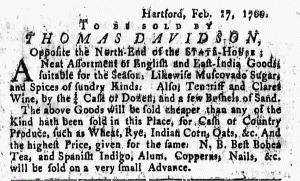
It is interesting that Davidson starts his advertisement assuring his potential customers that the “neat assortment of English and East-India Goods [were] suitable for the season.” He is letting them know that the products he was currently carrying could be used immediately and did not need to be stored until their use was required.

Davidson also mentioned that if people did not have cash on hand he would be more than happy to barter. He even went beyond mentioning his openness to bartering; he listed specific items that he would accept in lieu of cash. He would have accepted country produce and a list of other products that costumers from the town would likely have gotten from another source or grown themselves.

By accepting items other than cash in exchange for goods, he interested a larger audience because hard currency was not as common at this time. Davidson appealed to a larger constituency than if he had advertised cash only.

**********

ADDITIONAL COMMENTARY:  Carl Robert Keyes

Mary notes that Davidson described his stock of “A Neat Assortment of English and East-India Goods” as “suitable for the Season.” This was one of many appeals the shopkeeper incorporated into his advertisement, along with mentioning price, quality, and the possibility of bartering. This advertisement also includes several stock phrases, including “Neat Assortment” and “suitable for the Season,” among its attempts to woo potential customers.

Davidson inserted one element that did not always appear in eighteenth-century advertisements: the date. While it was not exceptional for an advertiser to include a date, it was not the standard practice either. In this case, the date of the advertisement matched the date of the issue in which it appeared. (The type would have been set and the newspaper printed before February 17, so most likely Davidson intentionally specified that the date of his commercial notice would bear the same date as the issue in which it appeared.) Davidson, like other newspaper readers of the period, would have realized that sometimes an advertisement might be repeated for weeks or even months. Including the date in his advertisement buttressed his claim that his “Assortment of English and East-India Goods” was indeed “suitable for the Season,” or at least allowed readers and potential customers to better assess that claim.

January 21

What was advertised in a colonial newspaper 250 years ago this week?

Jan 21 - 1:20:1766 Connecticut Courant
Connecticut Courant (January 20, 1766)

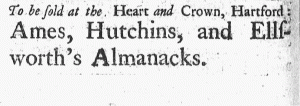
“To be sold at the Heart and Crown, Hartford:  Ames, Hutchins, and Ellsworth’s Almanacks.”

Historians who study newspapers in colonial America usually argue that if printers made any money at all from publishing newspapers that the profits derived from the advertisements rather than subscriptions.  Given the number of advertisements that appeared in many colonial newspapers, this is not hard to believe.

That being the case, did Thomas Green make any money when he printed this issue of the Connecticut Courant?  Only two advertisements appeared in the broadsheet folded in half to create four pages.  One was a legal notice; the other was this advertisement for almanacs, seemingly placed by the printer himself and thus not generating any revenue except for whatever sales might result from its inclusion.  Still, it is an odd advertisement:  presumably most consumers would have purchased almanacs much earlier, not nearly three weeks into the new year.  In addition, the lower edge of the advertisement is not even with the column on the left (unlike the two columns on the other three pages in this issue), suggesting that the advertisement was included as filler, and hastily at that.  Did Green have a bit of extra space and decide to fill it with an attempt to get rid of merchandise that was going out of date with each passing week?

Much of this is speculation.  This advertisement interests me because it raises so many questions about printers and their practices in the 1760s.

Jan 21 - 1:20:1766 - Connectictu Courant - full page
Final Page of Connecticut Courant (January 20, 1766)

January 7

What was published in a colonial newspaper 250 years ago this week?

Jan 7 - 1:6:1766 Connecticut Courant
Connecticut Courant (January 6, 1766)

“Augustus Deley, Tobaconist (from New York) … keeps constantly for Sale, ALL Sorts of TOBACCO.”

I suggested that yesterday’s advertisement for Yorkshire muffins (Yorkshire pudding) used words to evoke some of the smells of a colonial port city.  This advertisement does so as well.  It also prompts readers to imagine other goods that consumers needed to purchase or possess.  Just as sugar nippers were necessary for consuming the sugar loaves featured earlier this week, “Chewing, or Smoaking” tobacco required various accoutrements.

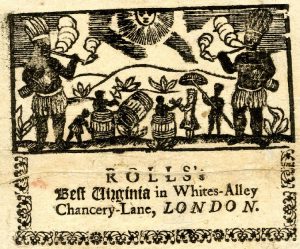
Daley notes he supplies “Hog-Tail, Pig-Tail, and Shagg in Papers.”  These wrappers were likely unadorned, marking a significant deviation from tobacco advertising on the other side of the Atlantic.  By the turn of the eighteenth century, as Catherine Molineux notes, “Tobacconists and other tradespeople began commissioning local artisans to engrave or etch trade cards, billheads, and what the British Museum characterizes as tobacco papers, or wrappers.” [1]  Although trade cards and billheads became increasingly common among other occupational groups in America as the eighteenth century progressed, either tobacconists did not provide wrappers that advertised their wares or such printed ephemera has not survived.

If you have encountered eighteenth-century tobacco wrappers distributed by American tobacconists, I would very much appreciate knowing about them!

Rolls's_Best_Virginia_tobacco_advertisement
An eighteenth-century tobacco advertisement from the collections of the British Museum, London.

[1] Catherine Molineux, “Pleasures of the Smoke:  ‘Black Virginians’ in Georgian London’s Tobacco Shops,” William and Mary Quarterly, 3rd. ser., 64, no. 2 (April 2007): 343.