March 20

What was advertised in a colonial American newspaper 250 years ago today?
Dunlap’s Pennsylvania Packet (March 20, 1775).

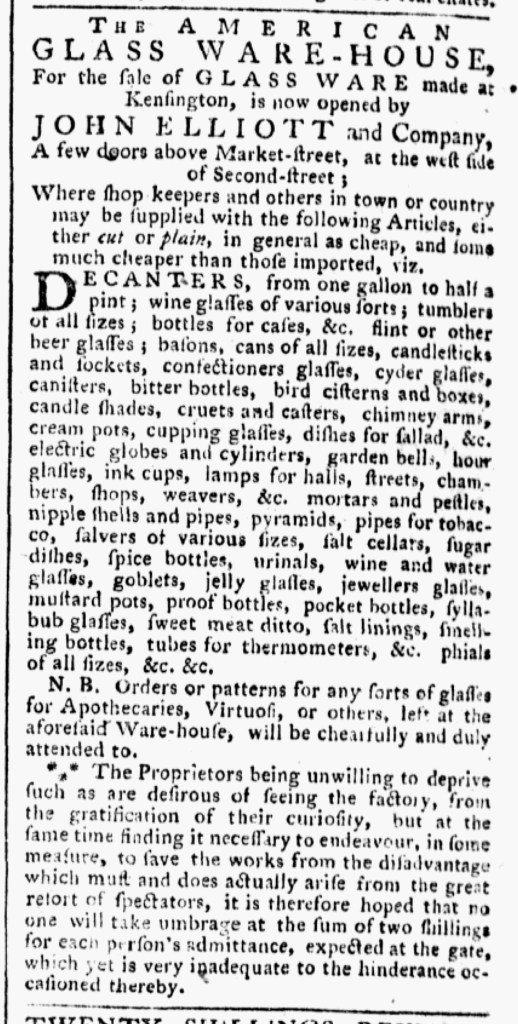
“The Proprietors being unwilling to deprive such as are desirous of seeing the factory, from the gratification of their curiosity.”

John Elliott and Company advertised items made at the “AMERICAN GLASS WARE-HOUSE” in Kensington, Philadelphia, as soon as the Continental Association went into effect in December 1774.  Nearly four months later, the company ran another advertisement that listed a variety of glassware – including “wine glasses of various sorts,” “tumblers of all sizes,” “hour glasses,” “tubes for thermometers,” “mustard pots,” and “lamps for halls, streets, chambers, shops, [and] weavers” – that “shop keepers and others in town or country” could purchase “as cheap [as] those imported.”  Some items were “much cheaper.”  Colonizers who abided by the nonimportation agreement did not have to pay more to acquire glassware made in the colonies; instead, they got a bargain!  Elliott and Company also informed apothecaries and others that they accepted orders and would follow patterns “left at the aforesaid Ware-house.”

Yet this enterprise did more than manufacture glassware.  Elliott and Company’s operation became a destination for the curious who wanted to witness the production of “AMERICAN GLASS” for themselves.  That had the potential to become disruptive, so the proprietors devoted the final paragraph of their advertisement to instructions for visiting.  They explained that they struck a compromise, “being unwilling to deprive such as are desirous of seeing the factory, from the gratification of their curiosity, but at the same time finding it necessary to endeavour, in some measure, to save the works from the disadvantage which must and does actually arise from the great resort of spectators.”  Accordingly, Elliott and Company charged “two shillings for each person’s admittance, expected at the gate.”  Even that fee, they claimed, “is very inadequate to the hinderance occasioned thereby,” yet, once again, the company offered a bargain.  In the process, Elliott and Company monetized visits to their production facility.  Perhaps it had not been as popular a destination as they implied.  Perhaps they exaggerated in hopes of drumming up interest in such a novelty, especially as the imperial crisis intensified and the Continental Association became even more meaningful to many colonizers.  An advertisement with instructions for visiting the factory, no matter how many people had previously been there, gave readers ideas about an outing they could make themselves.  Attracting visitors to see the works, after all, would likely translate into additional sales.
May 4

What was advertised in a colonial American newspaper 250 years ago today?

Pennsylvania Journal (May 4, 1774).

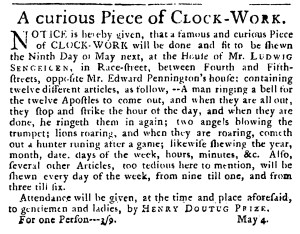
“A famous and curious Pieces of CLOCK-WORK.”

Advertisements in colonial newspapers sometimes testified to popular culture and entertainment options in port cities.  Such was the case with an advertisement about, as the headline proclaimed, a “curious Piece of CLOCK-WORK” that ran in the May 4, 1774, edition of the Pennsylvania Journal.  Henry Doutug Prize announced that he was in the process of assembling a “famous and curious Piece” to display “at the House of Mr. LUDWIG SENGEIGEN” on Race Street in Philadelphia.  Viewings would commence on May 9, but Prize took to the public prints in advance to incite interest and anticipation for this novelty.

The complex piece of machinery featured various figures, including a “man ringing a bell for the twelve Apostles to come out, and when they are all out, they stop and strike the hour of the day, and when they are done, he ringeth them in again.”  If that was not to delight viewers, the clockwork also had “two angels blowing the trumpet” as well as “lions roaring, and when they are roaring, cometh out a hunter running after a game.”  The animals that the hunter chased showed “the year, month, date, days of the week, hours, minutes,” and more.  Prize did not wish to reveal all the surprises that were part of the experience of viewing the clockwork.  Instead, he promised “several other Articles, too tedious to mention,” though his advertisement suggested that those figures were not “tedious” at all.  Readers had to see them to satisfy their curiosity.

In the next issue of the weekly Pennsylvania Journal, the proprietor of this mechanical wonder confirmed that assembly “is done, and fit to be seen” on any day of the week “from nine till one, and from three till six.”  For admission, he charged three shillings and nine pence per person for “gentlemen and ladies” to witness the clockwork in action, the angels with their trumpets, the apostles with their bells, the hunter with the animals, and everything else.  Prize offered a diversion to entertain audiences, something out of the ordinary that deserved their attention.  Even as he marketed a “curious Piece of CLOCK-WORK,” he appealed to the curiosity of readers who saw his advertisement and others who heard about mechanism as word spread.

October 13

GUEST CURATOR: Jordan Russo

What was advertised in a colonial American newspaper 250 years ago today?

oct-13-10131766-new-york-mercury
New-York Mercury (October 13, 1766).

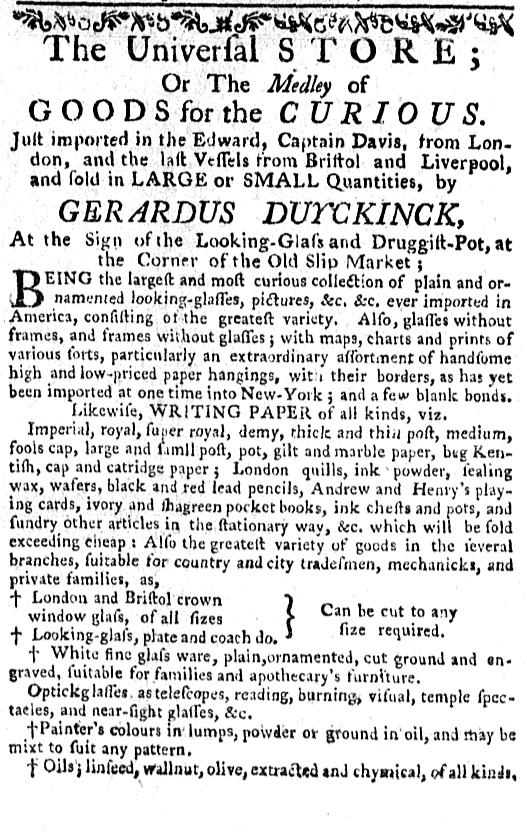
“BEING the largest and most curious collection …”

In this advertisement Gerardus Duyckinck described the merchandise in his “Universal STORE” as a “Medley of GOODS for the CURIOUS.” Duyckinck sold “plain and ornamented looking-glasses” and “maps, charts and prints of various sorts.” I imagine the items in Duyckinck’s store were not sold everywhere else or else it would not have made sense to call them “GOODS for the CURIOUS.”

Duyckinck sold items for a variety of customers. Some of merchandise was high end while others was not. For example, his glassware was “plain” or “ornamented.” The differences in merchandise meant that the prices varied between items. Duynkinck said that he had “high and low-priced paper hangings.” Duycknick was not attempting to sell his items to one type of customer; he had items and prices welcoming to all.

T.H. Breen notes that “British imports initially flowed into the households of the well-to-do. These are the goods that catch our eyes in modern museums and restored colonial homes.”[1] When we visit museums today, we are most likely to see the sort of chic merchandise that Duynkinck sold to elite customers.

**********

ADDITIONAL COMMENTARY: Carl Robert Keyes

Historians of eighteenth-century consumer culture and material culture frequently discuss the sense of wonder that colonists experienced as they encountered an expanding array of goods that they purchased and put to use for a variety of purposes. Some goods were completely utilitarian; others were luxury items. Some denoted conspicuous consumption; most testified to the identity of the consumer in one fashion or another.

In some instances historians have carefully excavated the sense of excitement that colonists felt when confronted with new consumer choices. For instance, the standard list advertisement (with its heavy and dense format) may not seem especially exciting when viewed through modern eyes, but thick descriptions of how such lists presented a new world of imagination, sensation, and possession to eighteenth-century consumers uncover raucous enthusiasm.

Jordan has chosen an advertisement that does not require quite as much excavation. Gerardus Duyckinck verbalized the sense of wonder and excitement that he knew consumers felt, mobilizing it to bring customers into his “Universal STORE.” He offered a variety of specialty goods among his “Medley of GOODS for the CURIOUS.” He deployed hyperbole to describe his wares, which included “the largest and most curious collection” of looking glasses “ever imported in America, consisting of the greatest variety.” He stocked paper hangings (wallpaper today): “an extraordinary assortment … as has yet been imported at one time into New-York.” His general merchandise included “the greatest variety of goods in the several branches, suitable for country and city tradesmen, mechanicks, and private families.”

What would it have been like to visit Duyckinck’s shop? Was he as much of an entrepreneur, an early modern carnival barker, in person as he sounded in his advertisement? Interacting with the shopkeeper may have been an important part of the entertainment involved in shopping at his establishment, just as significant as the pleasures of inspecting his merchandise and exercising choice in selecting among his wares.

**********

[1] T.H. Breen, “An Empire of Goods: The Anglicization of Colonial America, 1690-1776,” Journal of British Studies 25, no. 4 (October 1986): 487.