May 2

What was advertised in a revolutionary American newspaper 250 years ago today?
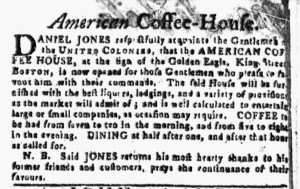
New-England Chronicle (May 2, 1776).

American Coffee-House.”

Not long after British forces departed from Boston on March 17, 1776, and the siege of the city ended, Daniel Jones opened the “American Coffee-House.”  At about the same time, Samuel Hall, the printer of the New-England Chronicle, moved his printing office from “Stoughton-Hall, HARVARD-COLLEGE,” in Cambridge into Boston “next to the OLIVER CROMWELL TAVERN, in SCHOOL-STREET.”  He printed the first issue in the formerly occupied city on April 25.  A week later, Jones ran a notice in which he “respectfully acquaints the Gentlemen of the UNITED COLONIES, that the AMERICAN COFFEE HOUSE, at the sign of the Golden Eagle, King Street, BOSTON, is now opened for those Gentlemen who please to favour him with their commands.”

As much as Jones hoped to offer a place of respite for patrons who joined him for coffee and dining, that opening sentence testified to the uncertainty of the times.  The war had entered its second year.  When it began, most colonizers sought a redress of their grievances within the imperial system, but over time more and more of them advocated for declaring independence, especially following the publication of Thomas Paine’s Common Sense in Philadelphia in January 1776 and the widespread dissemination of local editions in the following months.  In the past, establishments like the one that Jones advertised were often known as the London Coffee House, a nod to the largest and most cosmopolitan city in the empire and, especially, to the transatlantic and even global networks of commerce that converged there.  Yet Jones named his establishment the “American Coffee-House” and addressed the “Gentlemen of the UNITED COLONIES,” privileging their American identity and acknowledging that the diverse colonies had banded together.  A Continental Congress organized resistance.  A Continental Army defended American liberties.  Even though Jones associated his new establishment with the American cause, it happened to be located on King Street (which would be renamed State Street shortly after the Treaty of Paris officially ended the Revolutionary War).  The “sign of the Golden Eagle,” a familiar device in several towns, one that did not have revolutionary significance, marked the coffeehouse’s location.  That the “Gentlemen of the UNITED COLONIES” gathered at the “AMERICAN COFFEE HOUSE” on King Street exemplified the transition taking place as colonizers moved from engaging in resistance to embracing revolution in 1776.
February 11

What was advertised in a colonial American newspaper 250 years ago this week?

Feb 11 - 2:8:1770 Massachusetts Gazette and Boston Weekly News-Letter
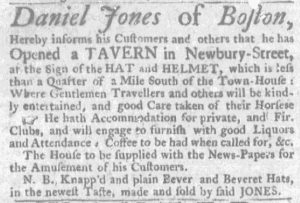
Massachusetts Gazette and Boston Weekly News-Letter (February 8, 1770).

“The House to be supplied with the News-Papers for the Amusement of his Customers.”

When Daniel Jones opened a tavern “at the Sign of the HAT and HELMET” on Newbury Street in Boston, he placed an advertisement in the February 8, 1770, edition of the Massachusetts Gazette and Boston Weekly News-Letter. He listed many amenities that he provide for “Gentlemen Travellers and others,” including coffee, “good Liquors,” and “good Care” taken of their horses. Jones also indicated, “The House to be supplied with the News-Papers for the Amusement of his Customers.”

In making that pledge, Jones revealed that he offered a service available in many eighteenth-century coffeehouses and taverns. Colonists did not need to subscribe to newspapers in order to gain access to them. Instead, they could patronize establishments that maintained subscriptions expressly for the purpose of serving their clientele. Jones stated that customers at the Hat and Helmet would be bale to read “the News-Papers,” indicating that he planned to acquire more than one publication. He likely subscribed to several local newspapers, choosing among the Boston Chronicle, the Boston Evening-Post, the Boston-Gazette, the Massachusetts Gazette and Boston Post-Boy, and the Massachusetts Gazette and Boston Weekly News-Letter. Yet he probably did not limit the selection solely to local newspapers. In addition to the New-Hampshire Gazette, the Newport Mercury, the Providence Gazette, and other newspapers published in New England, he may have subscribed to newspapers printed in New York and Philadelphia or even publications from the southern colonies or London.

Circulation numbers do not tell the entire story when it comes to the dissemination of information via the colonial press in the era of the American Revolution. Jones could have subscribed for a single copy of the Massachusetts Gazette and Boston Weekly News-Letter, yet dozens of customers at his tavern may have read the issues he made available. Some patrons may not even have read the newspaper itself but instead heard portions of it read aloud at the tavern. In both cases, newspapers had a much greater reach than the number of subscribers considered alone would indicate.

July 28

What was advertised in a colonial newspaper 250 years ago today?

Jul 28 - 7:28:1766 Boston Post-Boy
Boston Post-Boy (July 28, 1766).

“Daniel Jones INFORMS his Customers and others … that he has Removed … to a Corner Shop.”

Like many shopkeepers and other advertisers, Daniel Jones used his advertisements to communicate with different groups of readers: “his Customers and others,” those who had previously purchased his wares and those that he hoped to entice to visit his shop as new patrons.

In order for customers of all sorts to buy his merchandise, they first needed to know where to find Jones. He opened his advertisement by announcing that he had recently moved “to a Corner Shop” (a location that likely increased the foot traffic moving past his door and window). In an age before standardized street numbers, he listed his location as “the Easterly side of Newbury-Street,” sufficient directions to find the shop. To further aid former customers familiar with his previous location, however, he added that his new shop was “situated about three Rods to the Southward of that he Removed from.”

Such directions may have also been helpful to readers who had not previously made purchases from Jones. Even if they had not visited his shop, many likely knew where it was (or had been). Boston was, after all, a fairly compact city despite being a busy port. Customers who had not been to the Jones’s previous location may have also been intrigued to check out his “Corner Shop (which was lately improved by Capt. John Smith).” Even if the list of goods for sale did not draw them in, curious readers may have wanted to check out what kinds of improvements had been made to the shop itself.

In addition, Jones also addressed readers “both in Town and Country.” For former customers who lived outside Boston yet visited his shop when they came into town, an announcement about the new location and where it was located relative to his previous establishment was imperative. Jones did not want to risk disrupting his relationship with existing customers by having them arrive at a location he no longer maintained and not know how to find him. Especially if another shopkeeper set up business in Jones’ former location, he wanted former customers to know that he still kept shop in the same neighborhood.