March 1

What was advertised in a revolutionary American newspaper 250 years ago today?
Connecticut Gazette (March 1, 1776).

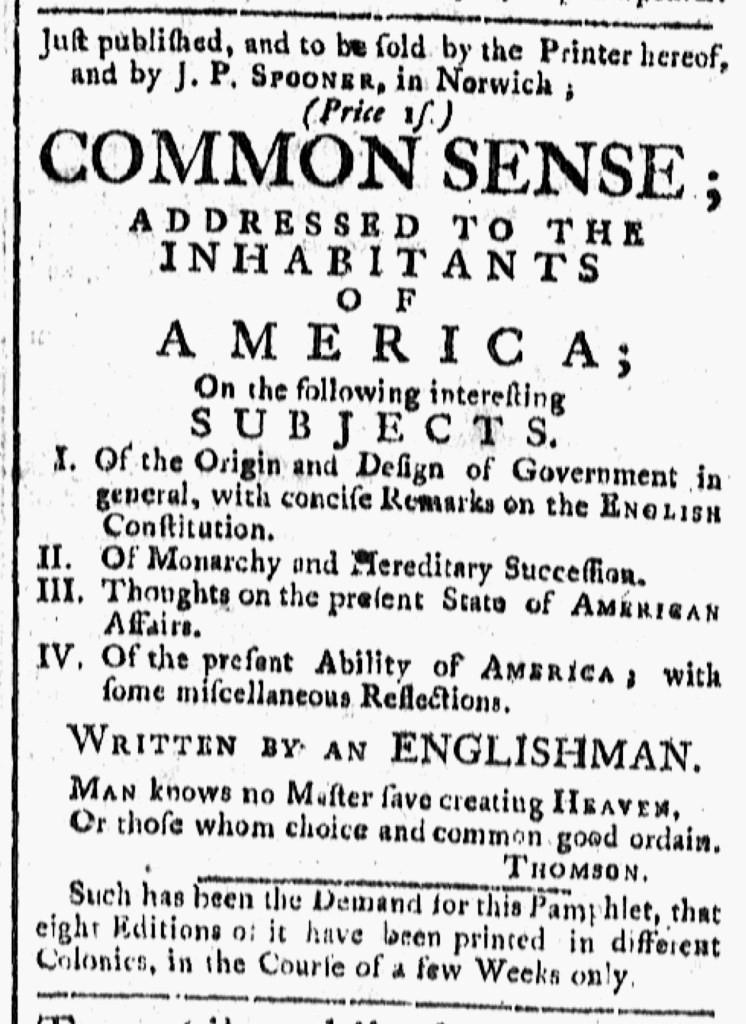
“Such has been the Demand for this Pamphlet, that eight Editions of it have been printed.”

Timothy Green, the printer of the Connecticut Gazette in New London, updated his advertisement for a local edition of Thomas Paine’s Common Sense that he jointly published with Judah P. Spooner, his brother-in-law and former apprentice who ran a printing office in Norwich.  A week earlier, Green announced the imminent publication of the pamphlet in short advertisement: “To-morrow will be published, and sold by the Printer hereof, and by J.P. Spooner in Norwich; COMMON SENSE; ADDRESSED TO THE INHABITANTS OF AMERICA.”  Green hoped to incite a sense of anticipation among prospective customers.

Once he had copies available for sale at his printing office in New London, Green ran a more extensive advertisement, one that resembled advertisements in other newspapers placed by publishers and booksellers who sold editions published in Philadelphia, New York, and Providence.  In addition to the title of the pamphlet, the advertisement listed the “following interesting SUBJECTS” that Paine covered, replicating section headings that included “Of Monarchy and Hereditary Succession” and “Thoughts on the present State of AMERICAN Affairs.”  Since Paine remained anonymous at that time, the advertisement stated that the pamphlet was “WRITTEN BY AN ENGLISHMAN.”  Green also included the epigraph, two lines of “Liberty,” a poem by James Thomson, that appeared on the title page of the first edition and in advertisements for that and other editions.

In general, Green did not generate new copy for his advertisement for this edition of Common Sense, but he did add an original note at the end: “Such has been the Demand for this Pamphlet, that eight Editions of it have been printed in different Colonies, in the Course of a few Weeks only.”  For those who had not heard about the incendiary pamphlet and the bold ideas that Paine presented, Green hoped that its popularity in other places would convince them not to miss reading it for themselves by purchasing a local edition.  His tabulation of “eight Editions” suggested that he closely examined the advertisements in newspapers printed in other cities and towns delivered to his printing office as part of a network for sharing information and reprinting content from newspaper to newspaper to newspaper.  Green did not peruse just the news accounts and editorials.  He apparently took note of the competing editions published in Philadelphia and local editions advertised in other places.  Bringing attention to such demand, he reasoned, would spur sales of a local edition of Common Sense in New London.

March 5

What was advertised in a colonial American newspaper 250 years ago this week?

Supplement to the New-York Journal (March 2, 1775).

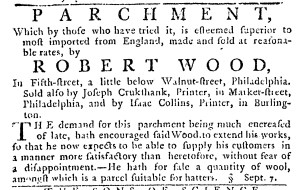
“PARCHMENT … Made and sold … [in] Philadelphia.”

In the early 1770s, Robert Wood made and sold parchment in Philadelphia, yet he did not confine his marketing or distribution of his product to that city and its hinterland.  As spring approached in 1775, he ran an advertisement in the supplement that accompanied the March 2 edition of the New-York Journal, advising prospective customers that they could acquire his parchment from local agents.  John Holt, the printer of the New-York Journal, and Hugh Gaine, the printer of the New-York Gazette and Weekly Mercury, each stocked Wood’s parchment along with books, stationery, and writing supplies at their printing offices.  In addition, Joseph Dunkley, a painter and glazier, also supplied Wood’s parchment at his workshop “opposite the Methodist Meeting House.”  The New-York Journal circulated beyond the city, so some prospective customers would have found it more convenient to acquire Wood’s parchment from Isaac Collins, a printer in Burlington, New Jersey.  According to previous advertisements, Collins had been peddling Wood’s parchment to “friends to American Manufactures” for several years.

Wood asserted that the “Demand for this Parchment [was] much increased of late,” though he left it to readers to imagine why that was the case.  Most would assume that the Continental Association, a nonimportation agreement that went into effect on December 1, 1774, played a role in increased demand for parchment produced in the colonies.  Wood likely intended for prospective customers to draw the conclusion that the quality of his product, not merely its availability, contributed to the demand.  He declared that “those who have tried it … esteemed [it] superior to most imported from England.”  He was bold enough to resort to superlatives, claiming that customers considered his parchment better than any imported to the colonies, yet he offered firm assurances about it quality.  Wood had recently met with so much demand for his parchment that he “extend[ed] his Works … to be able to supply his Customers in a manner more satisfactory than heretofore, without Fear of a Disappointment.”  In other words, he stepped up production to expand his inventory so every customer who wished to purchase his parchment could do so.  Wood answered the call of the eighth article of the Continental Association with his own “Industry” in producing “Manufactures of this Country” as alternatives to imported goods.

September 14

What was advertised in a colonial American newspaper 250 years ago today?

Pennsylvania Journal (September 14, 1774).

“PARCHMENT … esteemed superior to most imported from England.”

In September 1774, Robert Wood took to the pages of Dunlap’s Pennsylvania Packet and the Pennsylvania Journal to promote the parchment that he made in Philadelphia.  To entice prospective customers, he resorted to a variety of appeals.  Most significantly, he invoked customer satisfaction, seeking to convince readers not yet familiar with his product that he already gained a positive reputation among those who had used it.  For instance, he declared that “those who have tried it” considered his parchment “superior to most imported from England.”  He previously encouraged readers to “Buy American” in another advertisement more than two years earlier.  As the First Continental Congress convened in Philadelphia to consider how to respond to the Coercive Acts, including the possibility of another round of nonimportation pacts, Wood had a head start in presenting a “domestic manufacture,” an item produced in the colonies, as an alternative to imported parchment.  Customers did not have to sacrifice quality, plus they could acquire Wood’s parchment “at reasonable rates.”

To further bolster his reputation, Wood declared that the demand for his parchment had “much encreased of late.”  Those familiar with it wished to purchase it in greater quantities, at least according to Wood, another testimonial to the quality of the product.  Wood was prepared to meet the demand, having “extend[ed] his works, so that he now expects to be able to supply his customers in a manner more satisfactory than heretofore.”  Serving his customers included establishing a distribution network for their convenience in acquiring his parchment.  Joseph Crukshank, a printer in Philadelphia, sold Wood’s parchment, as did Isaac Collins, a printer in Burlington, New Jersey.  Taking all of this into consideration, Wood confidently declared that consumers who purchased and used his parchment could do so “without fear of a disappointment.”  He did not make an argument in favor of domestic manufactures as explicitly as he had in other advertisements, but perhaps he did not consider it necessary at a time that the imperial crisis had intensified so significantly.  Stating that his parchment had been “esteemed superior” to English imports sufficiently made the connection for readers, allowing Wood to focus on the demand for his product rather than convince prospective customers of their duty to privilege American products as a means of practicing politics.

July 24

What was advertised in a colonial American newspaper 250 years ago this week?

New-York Journal (July 21, 1774).

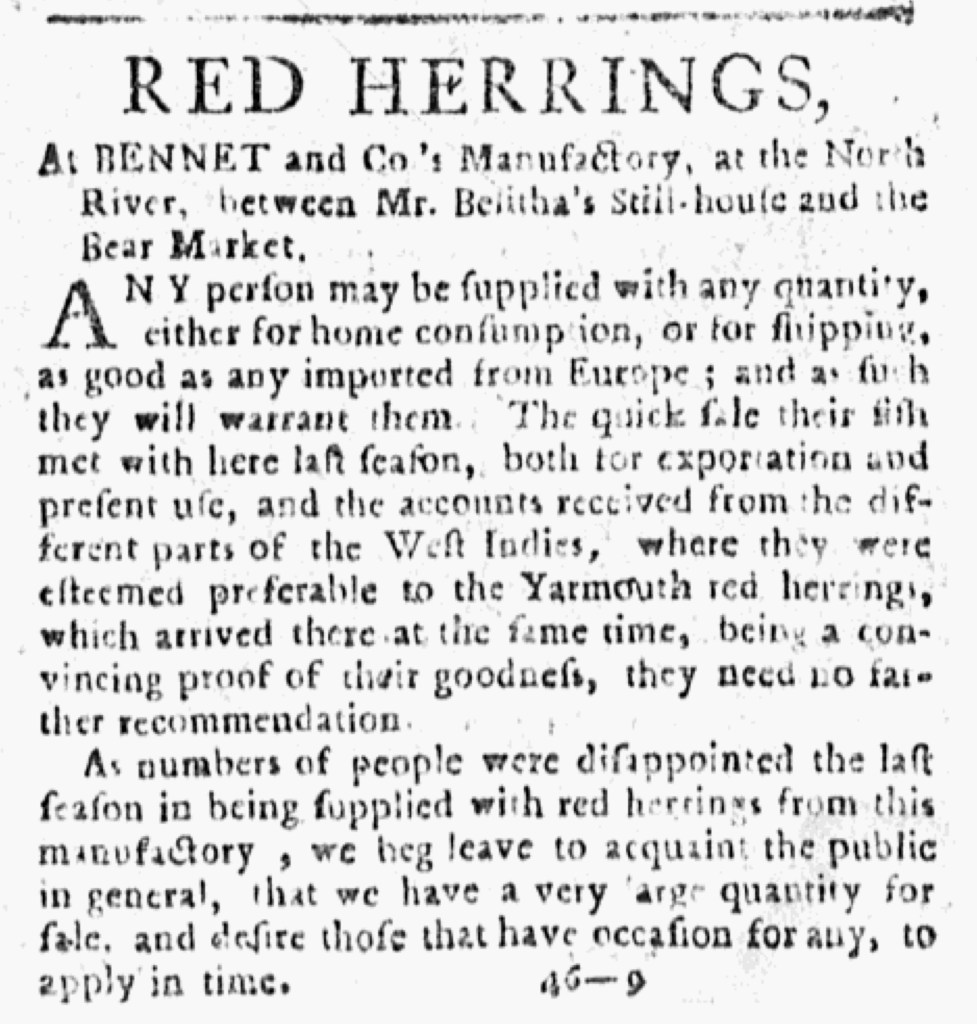
“The quick sale their fish met with here last season … being a convincing proof of their goodness.”

Bennet and Company offered a superior product that consumers did not want to miss.  That was their claim in an advertisement for “RED HERRINGS” that first appeared in the July 21, 1774, edition of the New-York Journal and continued for several weeks.  Bennet and Company began by comparing their herrings to imported alternatives, asserting that whether customers purchased them “for home consumption, or for shipping,” they would find them “as good as any imported from Europe.”  They were so confident in that claim that they “will warrant them” as such, extending a promise and a nonbinding guarantee.

Yet prospective customers did not have to take their word for it.  Bennet and Company offered other evidence to convince readers to choose their herrings over others.  They emphasized the “quick sale their fish met with here last season, both for exportation and present use.”  In addition, “the accounts received from the different parts of the West Indies … being a convincing proof of their goodness, they need no farther recommendation.”  Apparently, herrings from “BENNET and Co.’s Manufactory” in New York arrived in ports in the Caribbean at the same time as “Yarmouth red herrings” and consumers preferred the former over the latter.  Bennet and Company sought to build on that reputation.

To further make their case, they reported that “numbers of people were disappointed in the last season in being supplied with red herrings from this manufactory.”  Bennet and Company sold out before they could meet the demand for their product.  Keeping that in mind, they “acquaint[ed] the public in general, that we have a very large quantity for sale, and desire those that have occasion for any, to apply in time.”  In other words, Bennet and Company wished to serve as many customers as possible, but they could do so only while inventory lasted.  Readers had a limited time to purchase red herrings from Bennet and Company, the amount of time determined not by the producers themselves but by the speed of sales as consumers clamored for the popular product.  The advertisers highlighted demand as a strategy for inciting even greater demand.

April 16

GUEST CURATOR: Jonathan Bisceglia

What was advertised in a colonial American newspaper 250 years ago today?

Apr 16 - 4:16:1767 Massachusetts Gazette
Massachusetts Gazette (April 16, 1767).

“A Fresh Assortment of English GOODS.”

American colonists loved British goods! This gave many a sense of national pride, but some also believed that these goods gave them a boost in status. According to the public historians at Colonial Williamsburg, “As society became more mobile, houses, land, and livestock alone no longer communicated social rank. By the end of the seventeenth century, ordinary men and women began to demand consumer goods that indicated their status.” These were the roots of the consumer revolution in eighteenth-century America. “Items that once were considered luxuries reserved for the highest ranks began to ‘trickle down’ to common households.” Starting in the late seventeenth century and throughout the eighteenth century Americans purchased greater amounts of goods, such as those among the “Fresh Assortment of English GOODS” advertised by Joshua Gardner and Company. The shopkeepers may have realized the demand for these imported goods and not considered it necessary to write much about them. This advertisement demonstrates increased demand for consumer goods which became easier for all social classes – elites, middling and poorer sorts, “and occasionally even slaves” – to attain in the American colonies.

**********

ADDITIONAL COMMENTARY: Carl Robert Keyes

Jonathan’s analysis of Joshua Gardner and Company’s advertisement represents a popular interpretation of the cause of the consumer revolution. Many historians and other scholars argue that incipient demand fueled the expansion of purchasing, possessing, and displaying a vast array of goods by many different sorts of consumers in the British Atlantic world in the eighteenth century. Producers, suppliers, and retailers merely responded to the desires and demands of customers that ranked not only among the elite but also the middling sort and others who purchased what they could acquire when they could afford it (and, thanks to networks of credit, sometimes even when they could not yet afford it).

Today’s advertisement certainly lends that impression. After all, it seems to do little more than announce that Gardner and Company sold imported English goods. William Greenleaf’s advertisement, immediately above it, appeared almost identical. It informed customers that he stocked “A Fresh Assortment of Goods” imported on the same ship that carried Gardner and Company’s inventory. William Fisher’s advertisement, immediately below, stated that he sold “A General Assortment of English GOODS,” also imported “in Capt. Jenkins, who is just arrived from LONDON.” Some argue that such advertisements, which might better be described as notices given that they seem to merely announce the availability of goods that consumers already wanted, could be used to make convincing arguments about the importance of demand as the primary cause of the consumer revolution.

Doing so, however, overlooks both the innovative marketing efforts to incite demand that regularly appeared in eighteenth-century newspapers (and via other advertising ephemera, including trade cards, bill heads, catalogs, broadsides, magazine wrappers, circular letters, subscription notices, and furniture labels) and aspects of Gardner and Company’s advertisement not apparent at first glance.

For instance, note that Gardner and Company indicate their “Fresh Assortment” was imported “In the Hawk, Capt. Jenkins, from LONDON.” According to the shipping news on the previous page, the Hawk had arrived in port within the past week. Gardner and Company (as well as Greenleaf and Fisher) may not have had time to unpack all their new wares or write more extensive copy, but they did rush to Richard Draper’s printing office to have their advertisements inserted as quickly as possible. Rather than simply announce they carried goods that colonists already desired, these advertisers attempted to incite demand by noting that they sold the most current fashions and housewares from the cosmopolitan center of the empire. Furthermore, Gardner and Company engaged in other marketing efforts in their short advertisement. Promising an “Assortment” promoted consumer choice. Invoking low prices helped to convince potential customers to make purchases.

Jonathan and I place different emphasis on the importance of consumer demand in the eighteenth century. Drawing on one strand of scholarship, arguably the more prominent one, he asserts that Gardner and Company’s advertisement reacted to existing demand. That very well may have been the case, but I argue that certain aspects suggest that the shopkeepers also worked to create demand. More generally, advertising played a significant role in inciting demand throughout the eighteenth century. Early American merchants, shopkeepers, and others who produced and sold goods encouraged potential customers to desire their wares.