
What was advertised in a colonial American newspaper 250 years ago today?
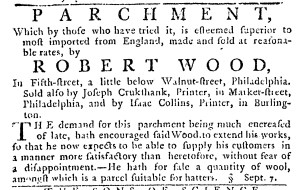
“PARCHMENT … esteemed superior to most imported from England.”
In September 1774, Robert Wood took to the pages of Dunlap’s Pennsylvania Packet and the Pennsylvania Journal to promote the parchment that he made in Philadelphia. To entice prospective customers, he resorted to a variety of appeals. Most significantly, he invoked customer satisfaction, seeking to convince readers not yet familiar with his product that he already gained a positive reputation among those who had used it. For instance, he declared that “those who have tried it” considered his parchment “superior to most imported from England.” He previously encouraged readers to “Buy American” in another advertisement more than two years earlier. As the First Continental Congress convened in Philadelphia to consider how to respond to the Coercive Acts, including the possibility of another round of nonimportation pacts, Wood had a head start in presenting a “domestic manufacture,” an item produced in the colonies, as an alternative to imported parchment. Customers did not have to sacrifice quality, plus they could acquire Wood’s parchment “at reasonable rates.”
To further bolster his reputation, Wood declared that the demand for his parchment had “much encreased of late.” Those familiar with it wished to purchase it in greater quantities, at least according to Wood, another testimonial to the quality of the product. Wood was prepared to meet the demand, having “extend[ed] his works, so that he now expects to be able to supply his customers in a manner more satisfactory than heretofore.” Serving his customers included establishing a distribution network for their convenience in acquiring his parchment. Joseph Crukshank, a printer in Philadelphia, sold Wood’s parchment, as did Isaac Collins, a printer in Burlington, New Jersey. Taking all of this into consideration, Wood confidently declared that consumers who purchased and used his parchment could do so “without fear of a disappointment.” He did not make an argument in favor of domestic manufactures as explicitly as he had in other advertisements, but perhaps he did not consider it necessary at a time that the imperial crisis had intensified so significantly. Stating that his parchment had been “esteemed superior” to English imports sufficiently made the connection for readers, allowing Wood to focus on the demand for his product rather than convince prospective customers of their duty to privilege American products as a means of practicing politics.
