November 15

What was advertised in a revolutionary American newspaper 250 years ago today?
Constitutional Gazette (November 15, 1775).

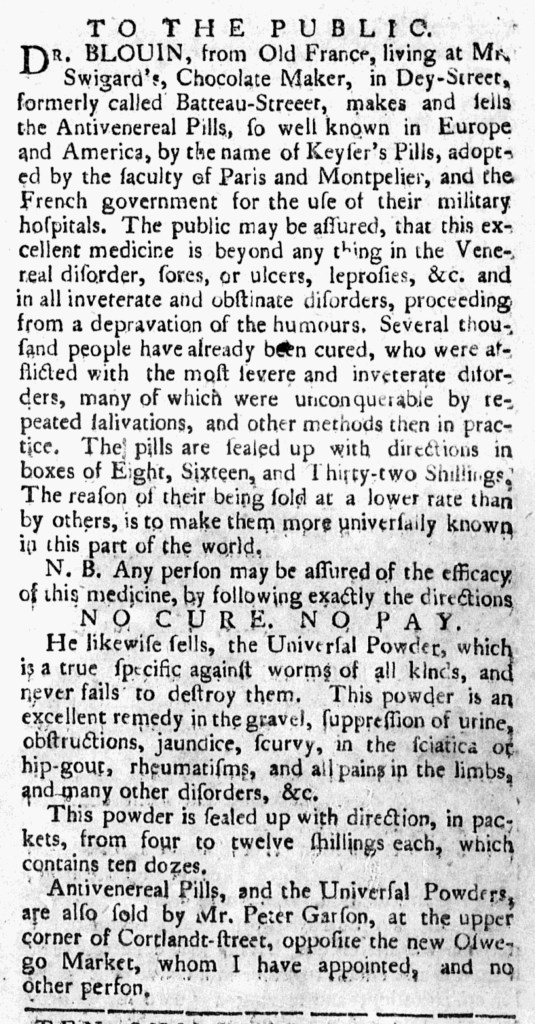
“DR. BLOUIN … makes and sells the Antivenereal Pills, so well known … by the name of Keyser’s Pills.”

It was the eighteenth-century version of offering a generic medication at a lower price than the name brand in hopes of attracting customers.  An entrepreneur who identified himself as “DR. BLOUIN, from Old France,” placed an advertisement in the November 15, 1775, edition of the Constitutional Gazette to inform readers in New York that he makes and sells the Antivenereal Pills, so well known in Europe and America, by the name of Keyser’s Pills.”  Indeed, that medication was popular in the colonies, advertised frequently by apothecaries, shopkeepers, and even printers who sold patent medicines as an alternate revenue stream.  At the same time that Blouin ran his advertisement, James Rivington, the printer of Rivington’s New-York Gazetteer, continued running his notice that proclaimed, “EVERY ONE THEIR OWN PHYSICIAN, By THE USE OF Dr. KEYSER’s PILLS.”  Rivington had been using that familiar refrain in his advertisements for years.

Blouin offered a brief history of the original medication as a means of marketing his generic version, noting that Keyser’s Pills had been “adopted by the faculty of Paris and Montpelier, and the French government for the use of their military hospitals.”  Furthermore, “[s]everal thousand people have already been cured, many of which were unconquerable by … other methods” of treatment.  Prospective customers, Blouin claimed, could not find a more effective remedy: “The public may be assured, that this excellent medicine is beyond any thing in the Venereal disorder, sores, or ulcers, leprosies, &c. and in all inveterate and obstinate disorders, proceeding from a depravation of the humours.”  He was so certain that he offered a guarantee: “NO CURE.  NO PAY.”

Readers interested in purchasing the pills that Blouin made in New York rather than imported ones would receive printed directions and could choose among boxes costing eight, sixteen, and thirty-two shillings.  The efficacy of the cure, he cautioned, depended on “following exactly the directions.”  Rivington sold Keyser’s Pills for ten, twenty, and forty shillings.  Blouin explained that he gave a discount “to make [his generic pills] more universally known in this part of the world.”  For those who wavered in choosing his pills over the name brand version, he hoped that the lower price would help convince them.  Blouin also noted that an associate, Peter Garson, “at the upper corner of Cortlandt-street, opposite the new Oswego Market,” sold the pills, but “no other person.”  Many advertisements for Keyser’s Pills warned prospective customers about counterfeits.  Blouin freely admitted that he “makes and sells” his own version … and advised readers to avoid any attributed to him but not sold by him or his appointed agent.

September 23

What was advertised in a revolutionary American newspaper 250 years ago today?

Virginia Gazette [Dixon and Hunter] (September 21, 1775).

“EVERY MAN HIS OWN DOCTOR.”

Like many other printers, John Dixon and William Hunter supplemented revenues from newspaper subscriptions, advertisements, and job printing by hawking patent medicines.  They ran an advertisement for “Dr. KEYS[E]R’s celebrated PILLS” in the September 23, 1775, edition of their newspaper, marketing a familiar remedy for “the Veneral Disorder.”  In addition to curing venereal diseases, the pills reportedly “restored Persons afflicted with dropsical Disorders, the Gravel [or kidney stones], Palsey, Apoplexy, White Swellings, Stiff Joints, and the Asthma.”

Yet, Dr. Keyser’s Pills were especially known for their efficacy in treating venereal disease, so much so that Dixon and Hunter offered a short history intended to assure prospective patients that they could depend on finding relief from their symptoms if they purchased the pills.  “His Majesty ordered the most rigid and nicest Examination, by twenty seven of the principal Physicians and Surgeons,” the printers reported.  They did so “not only immediately upon the Persons having been treated with the Medicine, but even for the Space of two Years afterwards, to see if the cures of all the numerous Patients were durable.”  This trail demonstrated that the pills were indeed effective: “to the eternal Honour of Dr. Keyser, there was not found a single Instance of Failure.”  Such an extraordinary outcome prompted the king to establish a hospital “where these Pills alone are administered.”  In addition, physicians on the continent had also “pronounced the Use of [Dr. Keyser’s Pills] superior in Efficacy, to all the Modes of Practice hitherto discovered.”

Beyond their effectiveness, the pills had another important advantage.  “EVERY MAN HIS OWN DOCTOR,” the headline proclaimed, echoing a similar headline, “Every One their own Physician,” that James Rivington, a printer in New York, previously used in promoting Dr. Keyser’s Pills.  Prospective customers, Dixon and Hunter suggested, could purchase the pills and use them without exposing themselves to the embarrassment of consulting a physician or, even worse, having their symptoms become visible to others.  “The Patient is most effectually cured,” the printers explained, “without any inconvenience to himself, or being exposed to the Shame or Confusion of his Disaster being known to the nicest Observer.”  Referring to “his Disaster” was a telling alternative to “his Disorder,” one intended to stoke anxiety in hopes of convincing readers afflicted with venereal disease to purchase Dr. Keyser’s Pills.  The printers conveniently acquired “a fresh Parcel lately from PARIS,” where the doctor’s widow continued making the pills.

May 30

What was advertised in a revolutionary American newspaper 250 years ago today?

South-Carolina Gazette and Country Journal (May 30, 1775).

“Dr. KEYSER’s GENUINE PILLS, With FULL DIRECTIONS for their Use in all CASES.”

Like many eighteenth-century printers, Charles Crouch, the printer of the South-Carolina Gazette and Country Journal, sold patent medicines as a side hustle to supplement revenues from newspaper subscriptions, advertisements, job printing, and selling books and writing supplies.  In the May 30, 1775, edition of his newspaper, for instance, he ran an advertisement for a “FRESH PARCEL of Dr. KEYSER’s GENUINE PILLS.”  He did not need to explain that the pills treated venereal diseases because they were so familiar to consumers, but that did make it necessary to assure the public that he carried the “GENUINE” item rather than imitations or counterfeits.  Crouch also stocked “Dr. BOERHAAVE’s GRAND BALSAM of HEALTH.”  Realizing that many prospective customers would have been less familiar with this “admirable Remedy,” the printer explained that they could take it for “the dry Belly-Ach, Cholic, Griping in the Bowels, [and] Pain in the Stomach.”  In addition, the balsam “cleanses the Stomach.”  Today, many consumers have favorite over-the-counter medicines for similar symptoms.

Crouch realized that treating venereal disease was a sensitive subject and that customers purchasing Keyser’s Pills wanted to use them correctly and effectively.  He promised in his advertisement that he provided “FULL DIRECTIONS for their Use in all CASES.”  Doing so also minimized the amount of contact between the purchaser and the seller.  Customers did not need to visit an apothecary and go over how to use the medication.  Instead, they could visit the printer, ask for the pills and the directions, and avoid additional interaction.  Some may have even requested Keyser’s Pills along with other items, perhaps ink powder or a recent political pamphlet, to draw attention away from a purchase that caused embarrassment or discomfort.  Crouch also assured prospective customers that the pills were effective, inviting them to examine a “NARRATIVE of the Effects of Dr. KEYSER’s MEDICINE, with an Account of his ANALYSIS, by the Members of the Royal Academy of Sciences.”  Perusing those accounts did require more interaction between buyer and seller, but Crouch may have believed that some readers would have considered it sufficient to know that they were available.  That the printer could provide documentation upon request increased trust in the remedy.

The advertisement for Keyser’s Pills and Boerhaave’s Grand Balsam appeared immediately above a notice listing more than a dozen kinds of printed blanks commonly used for commercial and legal transactions.  Beyond publishing the South-Carolina and Country Journal, Crouch generated revenue through a variety of other means, some of them more closely related to printing than others.  He could earn money with both printed blanks and patent medicines, especially when he deployed savvy marketing.

February 21

What was advertised in a colonial American newspaper 250 years ago today?

New-York Gazette and Weekly Mercury (February 21, 1774).

“☛K ☛E ☛Y ☛S ☛E ☛R’s Famous Pills.”

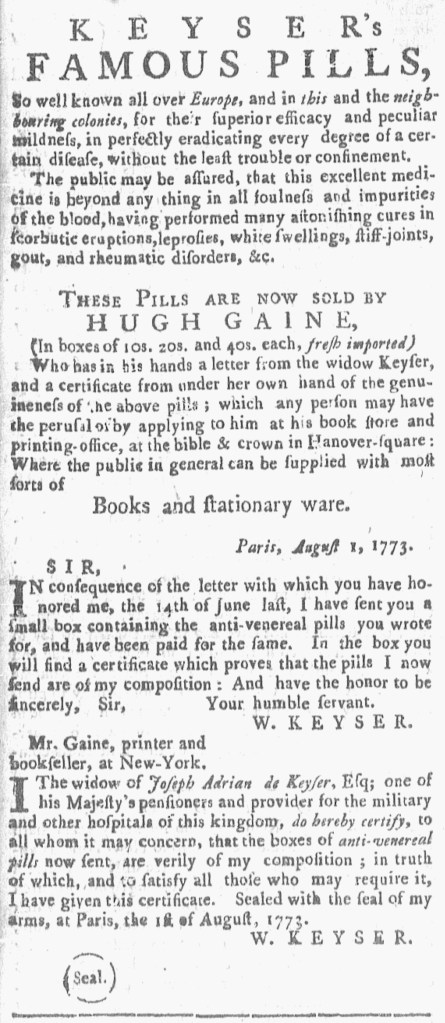
Hugh Gaine, “PRINTER, BOOKSELLER, and STATIONER” (as he described himself in the masthead of the New-York Gazette and Weekly Mercury), continued marketing “KEYSER’s Famous Pills,” a remedy for syphilis, in the February 21, 1774, edition of his newspaper.  He gave his advertisement a privileged place.  It was the first item in the first column on the first page, making it difficult for readers to miss.  The advertisement consisted of several portions, collectively extending half a column.  The first two portions, enclosed within a border composed of decorative type, provided a description of the efficacy of the pills in “eradicating every Degree of a certain DISEASE” and curing other maladies and offered an overview of “a Letter from the Widow Keyser, and a Certificate from under her own Hand” testifying to the “Genuineness” of the pills Gaine sold.  In recent months, both apothecaries and printers in New York and Philadelphia engaged in public disputes about who stocked authentic pills and who peddled counterfeits.  Even though Gaine invited the public to examine the letter and certificate at his store in Hanover Square (where they could shop for “Books and Stationary Ware”), the final two portions of his advertisement consisted of transcriptions of those items and a representation of the widow’s “Seal of my Arms.”

The decorative border, the only one in that issue of the New-York Gazette and Weekly Mercury, made Gaine’s advertisement more visible among the contents of the newspaper, yet that was not his only innovative use of graphic design.  For several weeks he had been playing with manicules as a means of drawing attention to his advertisements.  In this instance, a manicule appeared before each letter of “KEYSER,” pointing to the right.  Such had been the case when the advertisement ran on January 24 and 31 and February 7 and 14.  The first time he incorporated manicules into his advertisement for “KEYSER’s FAMOUS PILLS,” however, he had twelve pairs pointing at each other, six pairs above the name of the product and six pairs below the name of the product.  That version appeared just once, on November 1, 1773.  Subsequently, Gaine positioned manicules above each letter of “KEYSER,” pointing down, in six issues.  That arrangement ran on November 8, 15, and 22 and December 6 and 13, each time with a border.  When Gaine used it again on January 17, 1774, he did not include a border but once again had six manicules pointing down, one above each letter of “KEYSER.”  He apparently did not expect the appeals in his advertisements to do all the work of marketing the patent medicine.  Instead, Gaine believed that graphic design aided his efforts to reach prospective customers who much preferred fingers literally pointing at the name of the pills in advertisements over fingers figuratively pointing at them by others who suspected them of being afflicted with “a certain DISEASE.”

New-York Gazette and Weekly Mercury (November 1, 1773).

**********

New-York Gazette and Weekly Mercury (January 17, 1774).

February 14

GUEST CURATOR:  Caroline Branch

What was advertised in a colonial American newspaper 250 years ago today?

Boston-Gazette (February 14, 1774).

“KEYSER’s FAMOUS PILLS … eradicating every Degree of a certain Disease.”

The date of this advertisement for “KEYSER’s FAMOUS PILLS” to treat venereal disease is an ironic one, appearing on Valentine’s Day, but advertisements for these pills ran often. This advertisement displays the fear of venereal diseases throughout Europe and the colonies in the eighteenth century. Doctors agreed that mercury was the way to treat the disease, including Jean Keyser, a French military surgeon. According to Micheline Louis-Courvoisier, many doctors prescribed a mercurial ointment that patients rubbed all over their bodies for about forty days. In contrast, Keyser’s Pills “contain[ed] a combination of mercuric acid and acetic acid.”  The pills were an invention to treat venereal diseases better. In 1761 doctors in Geneva tested the two methods. Louis-Courvoisier states that “following that trial, Keyser pills were considered a good treatment.” They were deemed a success due to the improvement of side effects from previous medications. The pills became a common medication to treat syphilis and other diseases in Europe and the American colonies.

**********

ADDITIONAL COMMENTARY:  Carl Robert Keyes

Keyser’s Pills may very well have been the most popular, or at least the most widely advertised and generally recognized, patent medicine marketed in British mainland North America in the 1760s and 1770s.  Apothecaries stocked the pills, as did shopkeepers and even printers.  The Adverts 250 Project traced the competition among apothecaries and printers in New York and Philadelphia in the fall of 1773.  That competition (or was it a coordinated effort?) continued into the winter of 1774, extending to Boston as well.

Hugh Gaine, the printer of the New-York Gazette and Weekly Mercury, continued advertising Keyser’s Pills in his newspaper in the new year.  To corner as much of the market as he could, he had previously advertised in the Newport Mercury, encouraging prospective customers in Rhode Island to submit orders to “his book store and printing-office, at the bible & crown in Hanover-square” in New York.  When Benjamin Edes and John Gill, printers of the Boston-Gazette, advertised “KEYSER’s FAMOUS PILLS” on February 14, 1774, they lifted the copy for their notice directly from Gaine’s advertisement.  Edes and Gill used the same headline, followed by two paragraphs of identical text (with some variations in capitalization and italics).”  Like Gaine, they declared that declared that the remedy was “So well known all over Europe, and in this and the neighbouring Colonies, for their superior Efficacy and peculiar Mildness,” making note of the less severe side effects that Caroline discusses above.  The format continued to replicate Gaine’s advertisement, with a secondary headline distributed over three lines.  It announced, “THESE PILLS ARE NOW SOLD BY / EDES and GILL, / (In Boxes of 7s6 L.M. each, fresh imported).”  They simply traded out Gaine’s name for their own and converted the price into local currency.  In another paragraph, Edes and Gill claimed that they “have in their Hands a Letter from the Widow KEYSER, and a Certificate from under her own Hand of the Genuineness of the above Pills.”  Apothecaries, shopkeepers, printers, and other purveyors of Keyser’s Pills frequently squabbled over who sold the real remedy and who peddled counterfeits.  Edes and Gill invited “any Person” to have a “Perusal” of the letter and certificate at their printing office, once again replicating and only slightly editing as necessary Gaine’s advertisement.

Printers and others competed to sell Keyser’s Pills, sometimes even appropriating advertising copy devised by their rivals.  Edes and Gill may not have needed to resort to consulting an advertisement from the Newport Mercury published a couple of months earlier when they first ran their own notice on January 31 and again on February 7 and 14.  More recently, Gaine ran the same advertisement in his New-York Gazette and Weekly Mercury, commencing on January 17.  (He resurrected copy that previously appeared in both his own newspaper and the Newport Mercury.)  That allowed enough time for Edes and Gill to receive that issue in Boston.  Perhaps Gaine even franchised out Keyser’s Pills to Edes and Gill to sell in New England, providing them with both pills and copy for their marketing efforts.  Whatever the explanation, readers in New York and New England experienced consistent messaging about a product imported from Europe and sold in several American ports.  That likely contributed to the acclaim the pills earned in the colonies.

November 29

What was advertised in a colonial American newspaper 250 years ago today?

Newport Mercury (November 29, 1773).

“THESE PILLS ARE NOW SOLD BY HUGH GAINE.”

Colonial printers often supplemented the revenues they generated from subscriptions, advertising, and job printing by selling books, stationery, blanks, … and patent medicines.  Hugh Gaine, the printer of the New-York Gazette and Weekly Mercury, and James Rivington, the printer of Rivington’s New-York Gazetteer, competed with each other and with apothecaries to sell “KEYSER’s FAMOUS PILLS,” a cure for syphilis and other maladies, in the fall of 1773.  Rivington also supplied William Bradford and Thomas Bradford, the printers of the Pennsylvania Journal, with pills that he imported.  As he perused newspapers printed in Philadelphia, Rivington noticed that Townsend Speakman and Christopher Carter, chemists and druggists in that city, advertised that they sold Keyser’s Pills acquired directly from James Cowper, “Doctor of Physick” and “the only legal proprietor” of that medicine in England.  Rivington sent the Bradfords a letter testifying that he received the pills he forwarded to them directly from the son of the late Keyser, residing in Paris.  The Bradfords promptly published that letter in an advertisement that ran immediately below the one placed by Speakman and Carter.

Rivington was not alone in his efforts to gain as much of the market beyond New York as he could.  Gaine looked to the north, advertising in the Newport Mercury.  His notice appeared at the top of the first column on the first page of the November 29 edition of that newspaper, a place of prominence that likely garnered some attention.  A headline in a larger font than anything else on the page except the title of the newspaper in the masthead also enhanced the visibility of the product that Gaine peddled.  This advertisement replicated the copy of Gaine’s notice in the New-York Gazette and Weekly Mercury a week earlier, though it did not retain the format.  Gaine’s advertisement in the Newport Mercury lacked a decorative border and the multiple manicules that pointed to each letter in “KEYSER,” though it still featured a representation of a “Seal” at the end of the transcription of the certificate of authenticity sent to Gaine by Keyser’s widow.  Gaine did not list Solomon Southwick, the printer of the Newport Mercury, or any other associates in Newport as local agents who sold Keyser’s Pills on his behalf.  He apparently expected that readers would submit orders to him in New York, an eighteenth-century version of mail order medications.

November 22

What was advertised in a colonial American newspaper 250 years ago today?

New-York Gazette and Weekly Mercury (November 22, 1773).

“A Certificate from under her own Hand of the Genuineness of the above Pills.”

Hugh Gaine, the printer of the New-York Gazette and Weekly Mercury, and James Rivington, the printer of Rivington’s New-York Gazetteer, competed to sell subscriptions, to sell advertising, to sell books, to sell stationery, to sell printed blanks, to do job printing orders, … and to sell patent medicines.  In particular, they marketed and sold “KEYSER’s FAMOUS PILLS” for “perfectly eradicating every Degree of a certain Disease.”  Eighteenth-century readers understood that those code words referred to syphilis.

In November 1773, Gaine published a new salvo in the ongoing advertising war over Keyser’s Pills.  He expanded on his earlier advertisements, noting that he now “has in his Hands a Letter from the Widow Keyser, and a Certificate under her own Hand of the Genuineness of the above Pills.”  Furthermore, he declared that “any Person may have the Perusal of [those documents] by applying to him at his Book Store and Printing Office.”  That portion of the advertisement appeared within a decorative border.  Gaine also called attention to his notice with six manicules, one pointing to each letter of “KEYSER.”

Yet he still did not consider that sufficient to attract the attention of prospective customers and convince them to purchase the remedy from him rather than from Rivington or other purveyors.  Gaine’s primary competitor had been publishing advertisements that included descriptions of patients successfully treating that “DISEASE, not to be mentioned in a News-Paper” as well as rheumatism, apoplexies, asthma, and a “WHITE SWELLING.”  Rivington has also supplied William Bradford and Thomas Bradford, printers of the Pennsylvania Journal in Philadelphia, with a letter attesting that he supplied them with Keyser’s Pills imported “immediately from Mr. Keyser himself,” the son of the late doctor, “at Paris.”  That answered claims by Speakman and Carter, “Chemists and Druggists,” that they acquired their supply of Keyser’s Pills from James Cowper, “the only importer in London.”  In his most recent advertisement, Rivington proclaimed that he had “Certificates and Letters of the old Doctor, and Madame W. KEYSER, his Widow, and likewise of their Son, the present Monsieur Keyser, who has many Years prepared all the Pills sold by his Father.”  Like Gaine, Rivington invited the public to examine those documents at his printing office.

That apparently prompted Gaine to expand his advertisement once again.  Instead of merely presenting the option of seeing the letter and certificate he received from Keyser’s widow at his shop, he published transcriptions of both documents in his newspaper notice.  In the letter, Madame Keyser acknowledged her correspondence with Gaine and explained that the certificate “proves that the Polls I now send are of my Composition.”  The certificate was “Sealed with the Seal of my Arms, at Paris.”  Gaine included a representation of the seal to underscore the authenticity of the medicines he peddled.

When it came to advertising the goods and services available at their printing offices, Gaine and Rivington invested a significant amount of time and energy in promoting a particular patent medicine.  Their efforts suggest that Keyser’s Pills accounted for an important revenue stream to supplement their earnings from selling newspapers, advertising, books, stationery, blanks, and job printing.  They also seemed to follow and respond to advertisements placed by each other as well as others who sold the famous patent medicine.

November 3

What was advertised in a colonial American newspaper 250 years ago today?

Pennsylvania Journal (November 3, 1773).

“Dr. Keyser’s Pills … warranted genuine.”

Townsend Speakman and Christopher Carter, “CHYMISTS and DRUGGISTS,” advertised widely in October and November 1773.  They placed advertisements simultaneously in the Pennsylvania Chronicle, the Pennsylvania Gazette, the Pennsylvania Journal, and the Pennsylvania Packet.  Each of those advertisements promoted raisins, figs, and currants as well as “an Assortment of the freshest DRUGS and PATENT MEDICINES.”  They offered the “most saleable Articles in large Quantities” to shopkeepers and others who planned to retail them.  Printers, for instance, often supplemented revenues from other sources by peddling patent medicines.

On November 1, the Pennsylvania Packet ran an abbreviated version of Speakman and Carter’s advertisement.  In notices in the other three newspapers during that week, the apothecaries highlighted a “Parcel of Keyser’s famous Pills, from the Importer in London, with full Directions for their Use.”  They pledged that “the Public may be assured these Pills are the genuine Sort,” and to demonstrate that was indeed the case “they have inserted the Copy of a Certificate received with [the pills], the Original of which may be seen by any Purchaser.”  The copy of that certificate comprised the final third of the advertisement.  In it, James Cowper, “Doctor of Physic,” declared himself “the only legal Proprietor of a Medicine, called KEYSER’S PILLS, in England.”  Furthermore, he certified that Speakman and Carter, “Chymists and Druggists, in Philadelphia, are my only Correspondents to whom I send the above Pills in that Part of the World.”  Consumers did not need to worry about purchasing counterfeit pills if they acquired them from Speakman and Carter.

According to another advertisement in the Pennsylvania Journal, however, customers in Philadelphia had another option for obtaining Keyser’s Pills without worrying about getting duped by unscrupulous sellers.  That advertisement appeared immediately below Speakman and Carter’s advertisement, a rather cheeky placement considering that it listed William Bradford and Thomas Bradford, printers of the Pennsylvania Journal, as local agents who sold the pills.  Speakman and Carter paid the Bradfords to run their advertisement, complete with the certificate, and they may have expected competition but not efforts to outright undermine their marketing strategy.  The advertisement replicated James Rivington’s “Every One their own Physician” notice from Rivington’s New-York Gazetteer, along with a few additions.  In addition to listing the Bradfords as local agents, a letter from Rivington to the Bradfords followed the testimonials.

Just as Speakman and Carter reprinted Cowper’s certificate in its entirety, the Bradfords published Rivington’s entire letter.  He noted that he saw “an advertisement in the Philadelphia Papers, relating to Dr. Keyser’s Pills, importing that they were procured from Dr. Cowper, of London, and warranted genuine.”  Rivington could do one better.  “I think it very proper the Public should be assured,” he trumpeted, “that the Pills, which you have had from me, and now advertize for sale, were imported by me, immediately from Mr. Keyser himself, at Paris.”  In addition, Rivington offered to show Keyser’s “letters and correspondence for some years past … to any person, who may require a sight of them.”  Furthermore, Rivington was also vigilant about counterfeits, reporting that he “detected a counterfeit sort, exposed to sale in New-York, of which Mr. Keyser has sent me a written declaration.”  Rivington concluded by inviting the Bradfords to insert his letter in their newspaper so “the Public may be once more informed you have the Pills sent directly from Mr. Keyser” to New York and then forwarded to Philadelphia.

It was not the first time that printers who sold Keyser’s Pills became embroiled in disputes over who stocked authentic medicines.  In the summer of 1772, printers in South Carolina pursued a feud in their newspapers, sometimes alluding to notices placed by their competitors and sometimes responding to them directly.  Among the many purveyors of Keyser’s Pills, a great many claimed that they carried genuine medicines and possessed some sort of exclusive right to market them in their town.

October 24

What was advertised in a colonial American newspaper 250 years ago this week?

Rivington’s New-York Gazette (October 21, 1773).

“In a short time JAMES RIVINGTON will publish some other particulars of the efficacy of Dr. KEYSER’s PILLS.”

Like many other colonial printers, James Rivington supplemented revenues from the usual operations of his printing office by peddling patent medicines.  In particular, Rivington hawked Dr. Keyser’s Pills, one of the most popular treatments for venereal disease in eighteenth-century America.  This remedy was so popular that often name recognition alone marketed the pills to prospective customers.  For many weeks in the fall of 1773, Rivington ran a short advertisement that proclaimed, “EVERY ONE THEIR OWN PHYSICIAN, BY THE USE OF Dr, KEYSER’s PILLS.”  A border comprised of decorative type enclosed the bold headline and a promise that the medicine would “infallibly cure a DISEASE, not to be mentioned in a News-Paper, without the Knowledge of the most intimate Friends.”  For those still too embarrassed to purchase the pills, Rivington noted that they “are also wonderfully efficacious in curing the RHEUMATISM,” providing a cover story for prospective customers who wished to make use of it.

On occasion, Rivington enhanced that candid advertisement with descriptions of “CURES Performed by KEYSER’s PILLS,” giving examples to readers who still needed more convincing about whether they should invest in the medicine.  In the October 24 edition of Rivington’s New-York Gazetteer, for instance, the printer included three stories of patients who had been cured of “a fashionable disease.”  The most remarkable concerned a pregnant woman whose child “was born with the distemper.”  When the mother’s symptoms “grew very alarming,” she took the pills and recovered.  The infant’s wet nurse also took the pills and “the child, from the effect of the pills taken by the nurse, was perfectly restored to health.”  According to this story, Dr. Keyser’s Pills were so effective that they even cured a baby breastfeeding from a woman directed to take them!  The other two stories told of patients who had long suffered “with the same disease” and the “severest courses prescribed” by physicians, yet “restored” or “relieved” when they resorted to Dr. Keyser’s Pills.  Once again, Rivington avoided associating the pills exclusively with venereal disease.  To that end, he inserted other examples: “In the RHEUMATISM,” “In APOPLEXIES,” “In the ASTHMA,” and “A WHITE SWELLING.”  That swelling almost resulted in “the amputation of an arm,” but the patient experienced “a radical cure” upon taking Dr. Keyser’s Pills.”

That did not exhaust the stories of successful treatments, just the amount of space that Rivington devoted to advertising the pills in that issue of his newspaper.  He concluded his advertisement with a note that “In a short time [he] will publish some other particulars of the efficacy of Dr. KEYSER’s PILLS,” though he did not indicate if he intended to do so with newspaper advertisements, handbills, broadsides, or pamphlets.  The media mattered less than alerting prospective customers that the printer had access to similar stories.  They could wait to examine those or consider that sufficient enough justification to acquire the pills to start down their own road to recovery.

September 16

What was advertised in a colonial American newspaper 250 years ago today?

Rivington’s New-York Gazetteer (September 16, 1773).

“EVERY ONE THEIR OWN PHYSICIAN, BY THE USE OF Dr. KEYSER’s PILLS.”

Dr. Keyser’s Pills may have been the most widely advertised patent medicine in colonial American newspapers.  Apothecaries included the remedy among the lists of patent medicines that they stocked, as did merchants and shopkeepers who did not specialize in drugs and medicines.  Printers also frequently advertised a variety of patent medicines, especially Dr. Keyser’s Pills, in their efforts to supplement revenues earned from job printing, newspaper subscriptions, advertising fees, and selling books and stationery.  In the summer of 1772, printers in Charleston, South Carolina, even engaged in a feud over which of them sold genuine Dr. Keyser’s Pills and accusing the other of peddling counterfeit medicines.

James Rivington, printer of Rivington’s New-York Gazetteer, managed to avoid such controversy in the fall of 1773, though he competed with Hugh Gaine, printer of the New-York Gazette and Weekly Mercury, in selling Dr. Keyser’s Pills.  Neither of them placed the kind of extensive notice, complete with descriptions of the symptoms that the medicine alleviated and testimonials to the effectiveness of the pills, that sometimes appeared in colonial newspapers.  Gaine did briefly note that he “has now by him many Proofs of their Utility in curing Inflamations, Rheumatism, [and] White Swellings,” an invitation to readers to examine testimonials on hand in his printing office.  For his part, Rivington deployed a headline that proclaimed “EVERY ONE THEIR OWN PHYSICIAN” when they used Dr. Keyser’s Pills to treat a “DISEASE, not to be mentioned in a News-Paper.”  Consumers knew that patients afflicted with venereal disease commonly turned to Dr. Keyser’s Pills, not just those who suffered from rheumatism (though Rivington did join Gaine in stating the pills “are also wonderfully efficacious” in alleviating those symptoms).  For prospective customers seeking to protect their privacy and avoid embarrassment by acting as “THEIR OWN PHYSICIAN,” Rivington asserted that Dr. Keyser’s Pills “infallibly cure” the unnamed disease “without the Knowledge of the most intimate Friend” (or perhaps even spouses or other partners).  Like other purveyors, Rivington sold the pills in boxes of different quantities so customers could select how many pills they thought they needed to treat themselves.

In the eighteenth century, Dr. Keyser’s Pills were as widely known to consumers as many over-the-counter brands are to customers today.  Accordingly, advertisers did not always need to publish lengthy advertisements to market the pills.  Instead, Rivington and others believed that short notices with bold proclamations, like “EVERY ONE THEIR OWN PHYSICIAN” effectively marketed the popular patent medicine.