November 25

GUEST CURATOR: Patrick Keane

What was advertised in a colonial newspaper 250 years ago today?
nov-25-11251766-south-carolina-gazette-and-country-journal
South-Carolina Gazette and Country Journal (November 25, 1766).

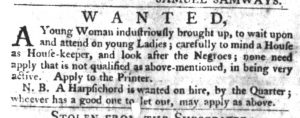
“WANTED: A Young Woman industriously brought up … carefully to mind a House.”

I liked this advertisement, especially after curating the Slavery Adverts 250 Project, as this has to do with slavery. However, the advertisement did not talk directly about the slaves. Instead, the advertiser was looking for a woman willing to work in the house and watch the master’s slaves. Only women skilled enough to do the job were asked to apply for it: “none need apply that is not qualified as above-mentioned.” The advertiser specifically wanted a woman because during the colonial period woman were expected to do the housework.

One summary of Ruth Cowan Schwartz’s More Work For Mother: The Ironies of Household Technology from the Open Hearth to the Microwave, explains that a “division of labor kept a man and a woman together or joined them in a household in some way.” Other than watching the slaves, the woman in this advertisement would do all of the housework as well, including kitchen work, cooking, cleaning, and taking care of children.

**********

ADDITIONAL COMMENTARY: Carl Robert Keyes

This employment advertisement simultaneously offers a wealth of details concerning domestic life in one South Carolina household and provides frustratingly few specifics. As Patrick indicates, the advertiser sought a young woman who would be responsible for all sorts of housework as well as overseeing slaves. In addition, the young woman was expected to be a servant to an unspecified number of “young Ladies.”

This advertisement reveals quite a bit about women’s responsibilities in early American households. Given traditional gendered divisions of domestic labor that have continued to the present, it comes as little surprise that an eighteenth-century employment advertisement positioned housework as women’s domain. Looking after a house, however, included more than cooking and cleaning, especially in a household with servants or slaves. The work of a housekeeper also included household management intended to keep everything running smoothly.

Who were “the Negroes” mentioned in this advertisement? How many slaves lived and worked in this household? What were their responsibilities? How much of the domestic labor did they perform? Was the successful applicant expected to do any cooking or cleaning herself? Or was she an overseer within the household, someone who delegated tasks and confirmed they were completed?

The advertisement also reveals little about the family that wanted to hire a young woman to join their household. Apparently it was a family of some affluence. Not only did they own slaves and intended to hire a servant, they also, according to a nota bene appended to the advertisement, wished to lease (but not buy) a harpsichord. Perhaps the young ladies of the house took lessons and entertained guests as a means of demonstrating their manners and refinement.

Despite the various details about the prospective housekeeper’s responsibilities, the advertisement does not indicate whether a mistress of the household was present. Did a wife and mother reside in this household? Did the family seek to demonstrate their wealth and status by hiring a servant to take on the tasks that the mistress of the household would have pursued in other homes? Or was the wife and mother deceased or otherwise absent, making it imperative to bring in an outsider to assume those responsibilities?

Answering those questions required applicants to “Apply to the Printer.” Unfortunately, that is not an option for modern readers. I appreciate how Patrick used this advertisement to explore women’s work in colonial America, but I remain puzzled about some of the household dynamics raised in this particular employment notice.
September 17

What was advertised in a colonial American newspaper 250 years ago today?

sep-17-9171766-georgia-gazette
Georgia Gazette (September 17, 1766).

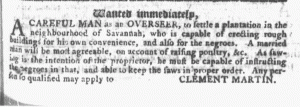
“Wanted immediately, A CAREFUL MAN as an OVERSEER. … A married man will be most agreeable.”

A week ago I examined another employment advertisement from the Georgia Gazette, noting that while some aspects had not much changed since the colonial period the specification that a single man would make a “more agreeable” candidate for the job than a married applicant would not pass muster today.

Clement Martin also sought to hire an overseer, but, unlike John Simpson, he preferred a married man for the job, indicating that “a married man will be most agreeable, on account of raising poultry, &c.” Martin listed several requirements and responsibilities. In general, he expected his overseer “to settle a plantation” near Savannah. That included managing enslaved laborers, “erecting rough buildings,” “keep[ing] the saws in proper order,” and teaching the enslaved laborers the necessary skills for using the saws.

Clement Martin probably did not expect his overseer to be “raising poultry, &c.” Most likely, he envisioned that such tasks would be undertaken by the wife of the married man that Martin considered “most agreeable.” In effect, he was looking to acquire two employees who would see to the various tasks on his plantation, though he only advertised for an overseer. The unpaid labor that an overseer’s wife provided, such as caring for small livestock or gardening, would be an added bonus to Martin.

Women’s contributions to household economies in the colonial era have sometimes been overlooked or downplayed, especially when they did not earn specific wages or other compensation for their efforts. Today’s advertisement pulls back the curtain just a little, suggesting that sometimes men’s employment was contingent, at least partially, on the mostly unseen and unpaid labor that their wives could provide.

September 10

What was advertised in a colonial American newspaper 250 years ago today?

Sep 10 - 9:10:1766 Georgia Gazette
Georgia Gazette (September 10, 1766).

“AN OVERSEER … will meet with good encouragement by applying to JOHN SIMPSON.”

When John Simpson needed to hire an overseer he placed an advertisement in the Georgia Gazette to alert potential employees that the position was available. Though brief, a mere five lines, the advertisement demonstrates both continuity and change over time when compared to modern hiring practices.

Simpson listed three necessary qualifications. A qualified overseer “understands his business” and could demonstrate both “fidelity and industry.” In other words, Simpson wanted to hire somebody who possessed expertise (likely gained through experience), who was dependable, and who worked hard. Although the advertisement did not specify, the overseer was probably expected to oversee enslaved laborers as well as other operations on Simpson’s property. To “understand his business” likely included previous experience managing (including disciplining) slaves. To demonstrate their qualifications, applicants needed to “bring proper vouchers” that stated they fulfilled these qualifications. Letters of introduction in eighteenth-century America played a similar role to letters of recommendation today.

Simpson also included an additional preference, though it was not a requirement for obtaining the position. It would be “more agreeable” for prospective overseers to be single men. Simpson did not explain why he considered this “more agreeable,” but it may have been linked to the “fidelity and industry” that could be expected of the overseer. Perhaps Simpson assumed (or had learned by experience) that single men devoted more time, energy, and attention to their work in the absence of distractions caused by wives and families. In addition, if an overseer was expected to live on the property, Simpson may have been concerned about incorporating any dependents the operations.

Whatever Simpson’s reason for finding it “more agreeable” to hire an unmarried man, that he specified any preferred marital status at all makes this notice incongruous with modern employment advertisements that make no reference at all to various personal attributes that have no bearing on an individual’s ability to do the job.

July 12

What was advertised in a colonial newspaper 250 years ago this week?

Jul 12 - 7:11:1766 Virginia Gazette
Virginia Gazette (July 12, 1766).

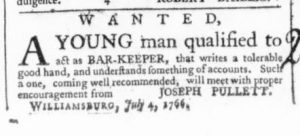
“WANTED, A YOUNG man qualified to act as BAR-KEEPER.”

Today we rely on a variety of media to connect employers and prospective employees. Many jobseekers identify potential positions via announcements or listings in online forums. Increasingly, they submit all or most of their application materials electronically. Qualified candidates may be invited for in-person interviews or those conversations might take place over the telephone or internet. The job search apparatus has changed significantly within living memory.

Today’s advertisement provides a glimpse of how some positions were filled in eighteenth-century America. When Joseph Pullett needed to hire a barkeeper, he placed a notice in the Virginia Gazette. His announcement included a series of qualifications, not unlike today’s employment listings.

Pullett expected candidates to have at least minimal education, but probably assumed that they would learn experience as well. For instance, he suggested that applicants should understand “something of accounts.” In other words, it was not necessary to know all the ins and outs of advanced bookkeeping, but Pullett wanted a barkeeper familiar enough with ledgers that (with a little eighteenth-century on-the-job training) he could assist with those responsibilities. To that end, he also needed to be able to write “a tolerable good hand” in order to effectively keep the accounts.

Reputation and recommendations also played a role in successful job searches in the eighteenth century. It was not enough to demonstrate that he possessed these skills and knowledge; any young many that applied needed recommendations testifying to his skill and his character. Many employment advertisements sought “sober” applicants, though this most likely referred to an appropriate temperament and comportment rather than abstaining from alcohol.

Although some of the methods for filling jobs have changed in the past two centuries other aspects continue to look very familiar.

February 18

GUEST CURATOR:  Elizabeth Curley

What was advertised in a colonial newspaper 250 years ago this week?

Feb 18 - 2:18:1766 New-York Gazette
New-York Gazette (February 21, 1766).

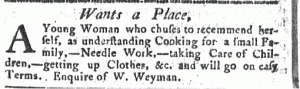
“Wants a Place, A Young Woman that is capable to attend Children.”

A woman looking for placement was not an uncommon thing in early American newspapers. Young women usually would look to be a housekeeper or cook, to care for children, or assist the women of the house. This young woman described her skills as “capable to attend Children, make up small Clothes,” and be all around helpful to the family. Our generation would describe her as a nanny.

In the American colonies, the number of servants a family had often depended on their economic status. Like the size and grandeur of a family’s house, the number of servants could be a status symbol. Not much has changed today.

Feb 18 - Masthead New-York Gazette 2:17:1766
Masthead for New-York Gazette (February 17, 1766).

For me, this advertisement was also an interesting find because normally the New-York Gazette published on Mondays. This week they published both a Monday (February 17) and a Tuesday (February 18) edition, which is were I found this advertisement. Normally for the Adverts 250 Project I would have had to go back to a Monday edition, but for this week I did not have to.

Feb 18 - Masthead New-York Gazette 2:18:1766
Masthead for New-York Gazette Extraordinary (February 18, 1766).

**********

ADDITIONAL COMMENTARY:  Carl Robert Keyes

“Not much has changed today.” Indeed, conspicuous consumption was not an invention of the twentieth or twenty-first centuries. It existed before the consumer revolution of the eighteenth century and genteel colonists engaged in it as a means of further differentiating themselves from each other as the middling and lower sorts gained greater access to consumer goods throughout the 1700s.

I believe that Elizabeth is the first guest curator to comment explicitly on the methodology used in selecting the featured advertisement for each day. She notes the same methods that I have described elsewhere in extended commentary about the project’s methodology and how it shapes the scope of the project.

As an instructor, this is an important behind-the-scenes element of students’ work. Each guest curator has compiled a census of newspapers published during his or her week based on the calendars generated by Early American Newspapers. As a result of supplements and extraordinary (“extra”) issues as well as publications starting or stopping in response to the Stamp Act or other reasons, the list of newspapers published in one week often differs from the list for the next week.

As Elizabeth indicates, many colonial American newspapers were published at the beginning of the week, on Mondays, but in most weeks no newspapers were printed on Tuesdays. As we examined this more closely, we discovered that William Weyman actually published the New-York Gazette three times during this week in 1766: the regular issue on Monday, February 17; a broadside (one-page) “Extraordinary” issue on Tuesday, February 18; and a two-page “2d Extra” on Friday, February 21.

Feb 18 - Masthead New-York Gazette 2:21:1766
Masthead for New-York Gazette 2d Extra (February 21, 1766).

This was not immediately apparent, however, due to a coding error in the metadata. The two extraordinary issues were treated as one in Early American Newspapers. As I have noted elsewhere, researchers need to be aware of faulty metadata (background information or “data that provides information about other data”) that may lead them to incorrect conclusions about digitized sources.

Feb 18 - Readex Calendar
Note that the calendar of issues generated by Early American Newspapers does not indicate that the New-York Gazette was published on February 21, 1766.  That “2d Extraordinary” has been conflated with the Extraordinary issue of February 18, 1766.

Elizabeth’s advertisement was actually published in the “2d Extra” on February 21. The February 18 Extraordinary did not include any advertisements. That means that today’s featured advertisement technically departs from the established methodology for this project.

I asked Elizabeth not to edit her original submission when we discovered this. Together we have fast forwarded three days to February 21, but this allows us to make a valuable point about the shortcomings that sometimes emerge when relying on digitized sources.

(Besides, February 18 is my birthday. I’m glad that we found a way to incorporate at least a masthead from a newspaper published 250 years ago on February 18, 1766, into the project.)

February 5

GUEST CURATOR:  Maia Campbell

What was advertised in a colonial newspaper 250 years ago this week?

Feb 5 - 2:3:1766 New-York Gazette
New-York Gazette (February 3, 1766).

Wants a Place, a Young Woman who chuses to recemmend herself, as understanding Cooking for a small family.”

This advertisement does not sell a good, per se, but a young woman is “selling” her services. I found it interesting that this sort of advertisement would be included in a colonial newspaper. To me, it is an example of a woman having a level of freedom in the colonial area. This woman was able to put herself out there to do work for others. Now, she is still doing work associated with women and the household during the colonial period, but she now has the freedom to choose who she wants to employ her. Also, she has already chosen what work she will do for whoever hires her. She has, in a sense, laid out a contract for herself.

I do not usually associate the colonial period with women having the freedom to choose any sort of work that they will do, which is why I found this advertisement to be interesting.

**********

ADDITIONAL COMMENTARY:  Carl Robert Keyes

Several scholars have demonstrated that advertisements help us to glimpse women’s work and the role of women in the marketplace in colonial America. I first began examining advertising in early America after reading Frances Manges’ “Women Shopkeepers, Tavernkeepers, and Artisans in Colonial Philadelphia” (a Ph.D. dissertation completed at the University of Philadelphia in 1958). Manges scoured newspapers published in colonial Philadelphia to find evidence of women pursuing a variety of occupations, culling a significant amount of her evidence from advertisements for goods and services. (Other sorts of advertisements, including legal notices and announcements by executors, also fleshed out women’s visible participation in commerce in colonial Philadelphia.)

Manges focused primarily on women identified by name in their advertisements and other parts of the newspaper. This anonymous “Young Woman,” however, certainly would not have been alone among the many job seekers, female and male, throughout the colonial period who placed advertisements seeking employment, listing their skills and qualifications, and giving directions for how to contact them.

Like so many other advertisements, this one hints at a story that will likely never be fully recovered. Compiling similar advertisements can produce a general sense of what some young women experienced and the labor they performed in colonial America, but broad patterns are not the same as individual stories. What kind of circumstances led this particular “Young Woman” to seek employment in someone else’s household?