December 20

What was advertised in a revolutionary American newspaper 250 years ago today?

Pennsylvania Journal (December 20, 1775).

“Any person desirous of information concerning the character … of Mrs. Brodeau, may apply to … B. FRANKLIN.”

When she arrived in Philadelphia, “Mrs. BRODEAU, from England,” placed advertisements in the Pennsylvania Gazette and the Pennsylvania Journal as a means of “acquainting her friends and the public in general, that she has opened a boarding school in Walnut-street.”  She sought pupils of a certain status, pledging that “young ladies will be genteelly boarded, and taught to read and speak the French and English language; the tambour embroidery, and every kind of useful and ornamental needle work.”  In addition to the curriculum, Brodeau promoted her supervision of her charges, stating that she “hopes to prove by her assiduity and attention to the morals and behaviour of these ladies entrusted to her care, that she in some measure merits the recommendations she has been favoured with from her native country.”  Like many other schoolmasters and schoolmistresses who advertised in Philadelphia’s newspapers during the era of the American Revolution, Brodeau emphasized moral development as well as curriculum.[1]

The parents and guardians of prospective students did not have to take Brodeau’s word for it.  Instead, she inserted a testimonial from Robert Morris, the influential merchant, and Benjamin Franklin, the retired printer turned politician and diplomat.  “Any person desirous of information concerning the character and recommendations of Mrs. Brodeau,” they stated, “may apply to either of us.”  According to Claude-Anne Lopez, associated editor of the Papers of Benjamin Franklin, that was, “so far as we know, the only time that Franklin backed an enterprise of that kind with his name.”[2]  Lopez further explains that Anna Brodeau “suddenly and rather mysteriously appeared in Philadelphia with a baby daughter in her arms,”[3] yet “[n]othing is known about a Mr. Brodeau.”  If residents of Philadelphia had any concerns about Brodeau’s background, the endorsement from Franklin and Morris likely countered their concerns.  Still, the advertisement apparently did not garner as much response as Brodeau hoped when she placed it in the December 6 edition of the Pennsylvania Gazette, the newspaper that Franklin formerly printed.  Two weeks later she placed the same advertisement in the Pennsylvania Journal.  Those efforts helped launch her boarding school.  By the end of the Revolutionary War, Franklin’s daughter, Sarah Bache, wrote to her father that Brodeau “has made a handsome fortune.”  Despite the disruptions of the war, she established her boarding school and her reputation.  Lopez chronicles other accolades for Brodeau that appeared in print, including a poem by an anonymous contributor to the Columbian Magazine in 1786 and her obituary in the National Intelligencer in 1836.  With words of support from Franklin and Morris, Brodeau soon “attracted students from the best families in Philadelphia.”[4]  Her marketing incorporated the eighteenth-century version of a celebrity endorsement.

**********

[1] Carl Robert Keyes, “Selling Gentility and Pretending Morality: Education and Newspaper Advertisements in Philadelphia, 1765-1775,” Pennsylvania Magazine of History and Biography 141, no. 3 (October 2017): 245-274.

[2] Claude-Anne Lopez, “Benjamin Franklin and William Dodd: A New Look at an Old Vause Célèbre,” Proceedings of the American Philosophical Society 129, no. 3 (September 1985): 262.

[3] Lopez, “Benjamin Franklin and William Dodd,” 262, 263.

[4]Lopez, “Benjamin Franklin and William Dodd,” 263.

November 29

What was advertised in a revolutionary American newspaper 250 years ago today?

Pennsylvania Gazette (November 29, 1775).

“We, the subscribers, do recommend the above named John Spering as a Rider.”

In the fall of 1775, John Spering, a resident of Easton, took to the pages of the Pennsylvania Gazette to announce that he “proposes to ride POST” between Philadelphia and Northampton.  Along the way he would make stops in “Germantown, Bussel-town [now Bustleton], Four-lane-end [now Langhorne], Newtown, Durham, Easton, Bethlehem, and Northampton.”  Until January 1, he would depart Philadelphia each Wednesday evening.  In January, February, and March, he planned to scale back service to “once every fortnight,” presumably due to the weather, and then resume weekly service on April 1.  He assured “All Gentlemen and ladies who are pleased to encourage this undertaking” that they “may depend upon being punctually served, and that the greatest care will be taken of such letters, or other things,” such as small parcels, entrusted to him.  Given that the Pennsylvania Gazette circulated widely beyond Philadelphia, Spering hoped that his advertisement would attract patrons in the many towns along his route.

He also realized that most prospective customers did not know him and thus might be cautious about handing over letters and packages.  To address such concerns, he included a character reference signed by nine residents of Easton.  “We, the subscribers,” they declared, “do recommend the above named John Spering as a Rider, as we believe he will perform his duty therein faithfully and honestly.”  They noted that Spering had been “a resident in Easton for upwards of thirteen years, where he has, during that time, behaved himself very well.”  Prospective clients could have confidence that he would faithfully deliver their letters without tampering with them.  The signatories would have been as unknown to most readers as Spering, but the titles that accompanied some of their names testified to their trustworthiness and standing in their community: “Lewis Gordon, Esq; Henry Fullert, Esq; Dr. Andrew Ledlie, [and] Jacob Orndt, Esq.”  That so many of his neighbors endorsed Spering at the risk of their own reputations may have helped to convince the “Gentlemen and Ladies” that Spering addressed to avail themselves of his services when they had letters to post.

March 16

What was advertised in a colonial American newspaper 250 years ago today?

Maryland Gazette (March 16, 1775).

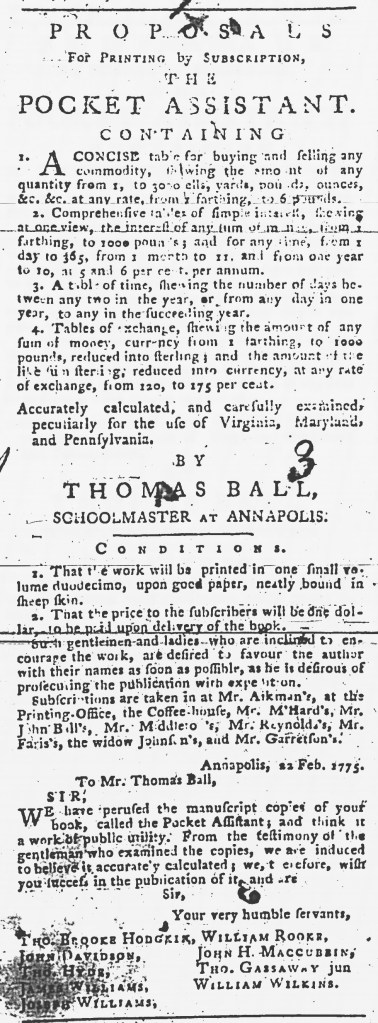
“WE have perused the manuscript copies of your book … and think it a work of public utility.”

Thomas Ball, a schoolmaster in Annapolis, had an entrepreneurial spirit.  He wrote and distributed subscription proposals for “THE POCKET ASSISTANT,” a reference manual that included a “CONCISE table for buying and selling any commodity … at any rate,” “Comprehensive tables of simple interest,” a “table of time, shewing the number of days between any two in the year, or from any day in one yea, to any in the succeeding year,” and “Tables of exchange.”  Merchants, brokers, shopkeepers, and others would certainly find each of those calculations helpful when conducting business.

Ball claimed that each table as “Accurately calculated and carefully examined” so subscribers could trust them.  To that end, he added an endorsement from nine residents of Annapolis after the “CONDITIONS” for subscribing.  “WE have perused the manuscript copies of your book, called the Pocket Assistant,” they declared, “and think it a work of public utility.  From the testimony of the gentleman who examined the copies, we are induced to believe it accurately calculated; we, therefore, wish you success in the publication of it.”  Ball engaged in a bit of sleight of hand: the signatories did not report that they had confirmed the calculations themselves, only that they trusted the unnamed “gentleman” who had looked over them.  Still, Ball considered that recognition significant enough that it might sway prospective subscribers to reserve copies so he could move forward with the project.

The schoolmaster also enlisted the assistance of several local agents who accepted subscriptions on his behalf.  Subscribers could submit their names at popular places for doing business, including the coffeehouse where merchants regularly gathered and the printing office where Anne Catharine Greene and Son published the Maryland Gazette, as well as at William Aikman’s circulating library.  Seven other men and women also took the names of subscribers, though none of them collected any money.  Subscribers only paid “upon delivery of the book,” provided that the proposals generated enough interest to justify Ball taking the “small volume” to press.  Even a carefully orchestrated marketing campaign, however, did not guarantee success.  Many subscription proposals did not result in publication.  Unfortunately for Ball, it does not appear that his Pocket Assistant made it to press.

May 12

What was advertised in a colonial American newspaper 250 years ago today?

Maryland Gazette (May 12, 1774).

“I do hereby recommend [this guide] to the several deputy commissaries within this province.”

Publishing the Deputy Commissary’s Guide took more than a year.  The first advertisement, Elie Vallette’s lengthy subscription proposal, ran in the February 25, 1773, edition of the Maryland Gazette.  It featured an excerpt and notable image depicting how each copy would be personalized for the subscriber.  The original version ran for several weeks before an abbreviated version appeared; it eliminated the excerpt but retained the image.  Such visual distinctiveness made even the shorter advertisement the focal point among other newspaper notices.  In the summer of 1773, Vallette ran a new advertisement, this one featuring an endorsement from several prominent “gentlemen of the law” who testified to the “general utility” of the volume.  At that time, Vallette stated that the work “Is now in the Press, and will be speedily published.”

Yet subscribers still had to wait for their copies.  In May 1774, Vallette ran a notice to announce that The Deputy Commissary’s Guide was “JUST PUBLISHED, And ready to be delivered to the subscribers, neatly bound, at the respective places where they were subscribed for.”  Local agents in towns throughout the colony had collected subscriptions on behalf of Vallette.  He now set about sending copies to each of them to distribute, including additional copies or “a few remaining books” for “non-subscribers” who decided that they did indeed wish to purchase this helpful guide.  To aid in selling those surplus copies, Vallette included a recommendation for The Deputy Commissary’s Guide from William Fitzhugh, the colony’s commissary general.  Fitzhugh declared that he had “perused” the work and “approving of the regulations therein made … I do hereby recommend [the book] to the several deputy commissaries within this province” to aid them in a variety of their duties.  What better endorsement could Vallette and his reference guide have received?!

Vallette had no guarantee of success when he first distributed subscription proposals for The Deputy Commissary’s Guide.  Many proposed books did not gain sufficient numbers of subscribers to make them viable ventures for authors and printers.  Even after taking the book to press, Vallette still hustled to sell leftover copies.  His latest advertisement was not as lengthy or flashy as previous ones, but he likely figured that a key testimonial provided the best incentive to acquire the book once it hit the market.

August 8

What was advertised in a colonial American newspaper 250 years ago this week?

Maryland Gazette (August 5, 1773).

“Every possessor of a copy may himself enter the proper alteration or addition, agreeable to the advertisements I shall from time to time insert in the Gazette.”

In the summer of 1773, Elie Vallette placed an advertisement in the Maryland Gazette to provide an update on The Deputy Commissary’s Guide.  Intending to publish the book by subscription, he commenced a marketing campaign several months earlier.  He successfully attracted subscribers to the project, a sufficient number that the book “Is now in the Press, and will be speedily published.”  Still, Vallette continued to promote the book, hoping to gain additional subscribers to defray the costs and generate more revenue.  To that end, he once again declared that those who subscribed in advance would have their names printed on a personalized title page, but they needed “to be speedy in their application, as none but such can have their names printed in the title page.”  In the end, that particular enticement worked out a bit differently than Vallette originally described it.

The author also presented an endorsement from several prominent colonizers, all of them “gentlemen of the law” in Maryland, publishing it with their permission.  “WE have perused your manuscript, entitled ‘The deputy Commissary’s Guide,’” the lawyers wrote, “and do much approve of it; we apprehend that performance will be of general utility, and that it well deserves the encouragement of the publick.”  Even before this endorsement, the number of subscribers “increased far beyond what was conjectured” … and Vallette still had not received lists of subscribers from all of the “gentlemen who have been so obliging to take in subscriptions” throughout the colony.  Perhaps an unexpected number of subscribers played a role in Vallette ultimately altering his plans for the title page.  In this advertisement, he confided that the subscribers exceeded his original “provision.”

Vallette balanced the popularity and demand for the book with the opportunity to become a subscriber.  It was not too late!  To help convince any prospective subscribers who might have been wavering, the author revealed another feature of the book.  He planned to include “a number of blank leaves” for manuscript additions to reflect changes in the laws.  “In some few instances,” Vallette acknowledged, “the testamentary laws now existing, may, and probably will, soon undergo the revival of the legislature.”  In such instances, “every possessor of a copy [of The Deputy Commissary’s Guide] may himself enter the proper alteration or addition.”  To aid in that endeavor, the author pledged that he would place advertisements in the Maryland Gazette to guide subscribers in updating their books “whenever any such alteration shall take place.”  Vallette’s relationship with subscribers extended beyond a single transaction.  He continued to offer services after buyers received their books.

Vallette intended for each of these marketing strategies – personalized title pages, an endorsement from six prominent lawyers, and blank pages to enter alterations to current laws – to entice even more subscribers for The Deputy Commissary’s Guide.  Other authors, booksellers, printers, and publishers sometimes included recommendations from well-known figures in their advertisements for books.  The title pages and blank pages, however, represented innovative and novel techniques for encouraging prospective subscribers to reserve their own copies of the book.

July 27

What was advertised in a colonial American newspaper 250 years ago today?

South-Carolina Gazette and Country Journal (July 27, 1773).

“ITS USES are so well known as to need no Recommendation.”

Zepheniah Kingsley marketed “BOWEN’s patent SAGO” and “BOWEN’s patent SOY” in advertisements in the South-Carolina Gazette and the South-Carolina Gazette and Country Journal in July 1773.  In an advertisement placed in the Georgia Gazette five years earlier, Samuel Bowen explained that just one pound of his sago powder “will make a mess of wholesome nourishing food for 20 men.  It is of a light and nourishing substance, proper for fluxes and other disorders in the bowels, also in consumptive and ma[n]y other cases.”  At the time Kingsley placed his advertisement, he declared that the uses of sago powder “are so well known as to need no Recommendation.”  All the same, he trumpeted that the product was “So much esteemed in the ROYAL NAVY, and in the AFRICAN TRADE, as an ANTISCORBUTIC and the only CURE for the FLUX.”  In other words, captains fed it to sailors and captive Africans to prevent scurvy and treat dysentery.

Kingsley also noted that “the ROYAL SOCIETY, the ROYAL COLLEGE of PHYSICIANS, and the SOCIETY for the Encouragement of ARTS, MAUFACTURES and COMMERCE” all “approved” of sago powder, echoing endorsements that Bowen previously listed in his advertisement.  Furthermore, Kingsley made reference to testimonials from the captain and scientists aboard the Endeavour following that vessel’s famous “Voyage round the World” from 1768 to 1771, stating that sago powder’s “good Effects are likewise vouched by Captain COOKE, … Mr. BANKES and Dr. SOLANDER, … as appears by their Report since their Return.”  English botanist Joseph Banks and Swedish naturalist Daniel Solander were among the representatives of the Royal Society on that voyage.  To underscore the acclaim earned by “BOWEN’s patent SAGO,” the royal coat of arms of the United Kingdom adorned Kingsley’s advertisement in the South-Carolina Gazette and Country Journal.  Kingsley apparently did not consider it necessary to provide more details about the uses and effectiveness of Bowen’s sago powder.  The various endorsements of the product spoke for themselves.

September 23

What was advertised in a colonial American newspaper 250 years ago today?

Pennsylvania Gazette (September 23, 1772).

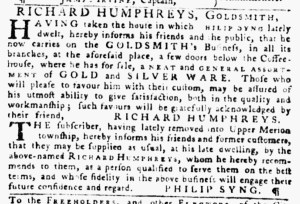
“He hereby recommends to them, as a person qualified to serve them on the best terms.”

As fall arrived in 1772, Richard Humphreys took to the pages of the Pennsylvania Gazette to inform prospective customers that he “now carries on the GOLDSMITH’s Business, in all its branches” at “the house in which PHILIP SYNG lately dwelt” near the London Coffee House in Philadelphia.  In an advertisement in the September 23 edition, he made appeals similar to those advanced by other artisans who placed notices in the public prints.  He emphasized the choices that he offered to consumers, asserting that he stocked a “NEAT and GENERAL ASSORTMENT of GOLD and SILVER WARE.”  Humphreys also highlighted his own skills, promising that customers “may be assured of his utmost ability to give satisfaction, both in the quality and workmanship” of the items he made, sold, and mended.

In addition to those standard appeals, Humphreys published an endorsement from another goldsmith, Philip Syng!  Syng reported that he recently relocated to Upper Merion.  In the wake of his departure from Philadelphia, he “informs his friends and former customers, that they may be supplied as usual, at his late dwelling, by the above-named RICHARD HUMPHREYS.”  Syng did not merely pass along the business to Humphreys.  He also stated that he recommended him “as a person qualified to serve” his former customers “on the best terms, and whose fidelity” in the goldsmith’s business “will engage their future confidence and regard.”  With this endorsement, Humphreys did more than set up shop in Syng’s former location.  He became Syng’s successor.  In that role, he hoped to acquire the clientele that Syng previously cultivated.  Syng’s endorsement also enhanced his reputation among prospective customers.

Artisans frequently stressed their skill and experience in their advertisements.  Some detailed their training or their previous employment to assure prospective customers of their abilities and competence.  Such appeals required readers to trust the claims made by the advertisers.  Endorsements also required trust, but they did not rely solely on the word of the advertisers themselves.  In this instance, another goldsmith, one known to “friends and former customers” in Philadelphia, verified the claims that Humphreys made in his advertisement.  Syng staked his own reputation by endorsing Humphreys, a marketing strategy intended to give prospective customers greater confidence in the goldsmith who now ran the shop near the London Coffee House.

August 7

What was advertised in a colonial American newspaper 250 years ago this week?

Aug 7 - 8:4:1768 Boston Weekly News-Letter
Boston Weekly News-Letter (August 4, 1768).

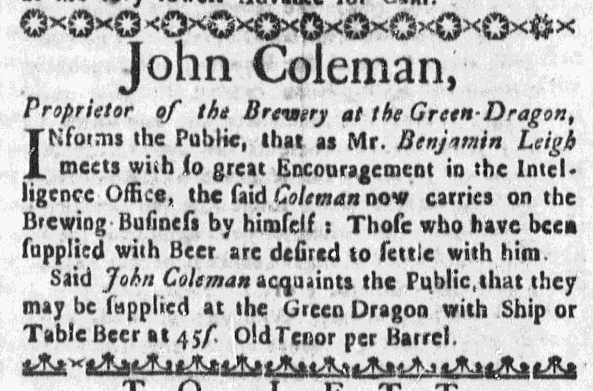
“Mr. Benjamin Leigh meets so great Encouragement in the Intelligence Office.”

In late July 1768, Benjamin Leigh began advertising an “Intelligence Office” at the Green Dragon Tavern that he opened “For the Benefit of the Public.” According to David Van Arsdale, “Intelligence offices in British North America shared many similarities with their English forebears.” Among them, they “continued operating in close relation to coffeehouses and centers of investment and commodity exchange, and continued providing employment services to the unemployed and seekers of their labor.”[1] In addition, Leigh listed a variety of other services associated with intelligence offices. He practiced discretion when facilitating transactions between those who had “money to lend” and others seeking to borrow. He also introduced those with “Merchandize Goods, Vessels, Lands, Negroes or Servants to sell,” rent, or charter with buyers or tenants. Beyond providing “employment services,” the men who operated intelligence offices were enmeshed in the slave trade, trucking in enslaved men, women, and children who were the objects rather than the beneficiaries of the assistance they provided in the world of colonial commerce.

Van Arsdale comments briefly on efforts to promote intelligence offices in the public prints, noting that Leigh and his counterparts in the colonies followed the example set in London by continuing to generate business through advertising. By the time Leigh informed readers of multiple newspapers published in Boston of his intelligence office at the Green Dragon Tavern, John Coghill Knapp had been advertising his services to residents of New York for several years. His frequent notices became a fixture in several newspapers. Van Arsdale also indicates that those who ran intelligence offices “often advertised … the success of English office as a way of establishing credibility and conjuring up business.”[2]

Leigh did not adopt that strategy in his own advertisements in the Boston-Gazette and the Boston Weekly News-Letter when he first opened his business, but evidence of the success of his new business did appear in advertisements printed elsewhere on the page. An advertisement placed by his former partner testified to the success of Leigh’s new endeavor. Shortly after Leigh began inserting his own notices, John Coleman, the “Proprietor of the Brewery at the Green-Dragon,” published a separate advertisement informing current and prospective customers that because Leigh “meets with so great Encouragement in the Intelligence Office” Coleman now ran the brewery on his own. In the August 4 edition of the Boston Weekly News-Letter, Coleman’s notice appeared one column to the right and just above Leigh’s advertisement. The proximity made it that much easier for readers to connect the messages delivered in each. Unlike many of his counterparts in the colonies, Leigh did not attempt to convince prospective clients that they should avail themselves of his services because intelligence offices on the other side of the Atlantic delivered results. Instead, another entrepreneur in Boston asserted the early success of Leigh’s enterprise, assuring potential clients that the system did indeed work in that busy port city.

**********

[1] David Van Arsdale, The Poverty of Work: Selling Servant, Slave and Temporary Labor on the Free Market (Brill, 2016), 85.

[2] Van Arsdale, Poverty of Work, 86.