December 21

What was advertised in a colonial American newspaper 250 years ago today?
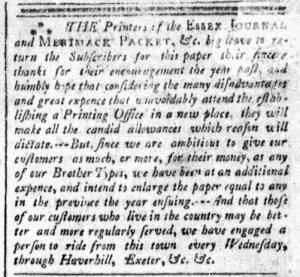
Essex Journal (December 21, 1774).

Intend to enlarge the paper equal to any in the province the year ensuing.”

The Essex Journal and Merimack Packet: Or The Massachusetts and New-Hampshire General Advertiser completed its first year of publication with its December 21, 1774, edition.  For the last time, the masthead stated, “VOL. I.”  The compositor updated that to “VOL. II” the following week.  Isaiah Thomas and Henry-Walter Tinges launched the newspaper, published in Newburyport, with a free preview issue on December 4, 1773, then commenced weekly publication on December 29.  Thomas withdrew from the partnership in August 1774, about the same time that he transferred proprietorship of the Royal American Magazine to Joseph Greenleaf.  Ezra Lunt joined Tinges in publishing the Essex Journal without a disruption in distributing the newspaper to subscribers.  Despite those disruptions and the “many disadvantages and great expence that unavoidably attend the establishing a Printing Office in a new place,” the Essex Journal made it through its first year and continued into a second.

In a notice in the final issue of Volume I, Lunt and Tinges announced their plans to improve and expand the newspaper.  They proclaimed that they “are ambitious to give our customers as much, or more, for their money, as any of our Brother Types” who published the Essex Gazette in Salem, the New-Hampshire Gazette in Portsmouth, or any of the five newspapers printed in Boston at the time.  To that end, Lunt and Tinges confided, “we have been at an additional expence, and intend to enlarge the paper equal to any in the province the year ensuing.”  Furthermore, they sought to improve the newspaper for subscribers in other ways.  In order that “those of our customers who live in the country may be better and more regularly served, we have engaged a person to ride from this town every Wednesday, through Haverhill, Exeter,” and other towns.  Lunt and Tinges published the Essex Journal on Wednesdays.  As soon as the ink dried, they gave copies to a postrider to deliver to subscribers throughout the countryside, improving on the services provided throughout the previous year.

Printers often noted when their newspapers completed another year of publication, often marking the occasion with calls for subscribers and others to settle overdue accounts.  Lunt and Tinges did not make any mention of subscribers who were delinquent in making payment.  Instead, they expressed their appreciation and sketched their plans for the next year, hoping to increase support and enthusiasm for the newest newspaper published in Massachusetts.

July 25

What was advertised in a colonial American newspaper 250 years ago today?

Jul 25 - 7:25:1769 Essex Gazette
Essex Gazette (July 25, 1769).

“THIS Day’s Paper (No. 52) compleats the first Year of the ESSEX GAZETTE.”

Samuel Hall, the printer of the Essex Gazette, participated in a familiar ritual. In the July 25, 1769, edition, he inserted a notice that announced, “THIS Day’s Paper (No. 52) compleats the first Year of the ESSEX GAZETTE.” Colonial printers often marked such occasions in the pages of their newspapers. They marked the first year but also commemorated subsequent years as a means of demonstrating the importance of newspapers to the community and promoting them to new subscribers and advertisers. These notices usually occupied a privileged place on the page, serving as a bridge between news items and advertisements. Part news, part marketing, they served more than one purpose.

Hall expressed his “sincere Thanks to the Publick” for supporting the Essex Gazette. He also promised “his Customers,” subscribers and advertisers, that he would “make it his invariable Study and Endeavour to render his Publications as agreeable to his Customers in general as he possibly can.” Unlike some other printers, he did not take the opportunity to outline proposed improvements to the newspaper in the coming year.

Before thanking “the Publick” and “his Customers,” Hall first made a pitch to prospective subscribers. It commenced with a report that some readers already experienced disappointment in their attempts to acquire “a compleat Sett” of issues of the Essex Gazette “from the Commencement of the first Volume.” A new year and a second volume of the Essex Gazette presented an opportunity for prospective subscribers, but only if they acted quickly. Hall requested that they “speedily … send in their Names to the Printer.” For the moment, he intended to print a few additional copies, starting with the “Beginning of Vol. II.” the following week. He did not mention the cost of subscribing in this notice, but the colophon running across the bottom of the following page stated that subscriber paid six shillings and eight pence, half “at Entrance.”

When the Essex Gazette survived its first year and continued into a second, the printer commemorated the occasion with a notice that informed the public of this significant milestone. Yet he did not confine his message to relaying this news and thanking those who had supported his endeavor. Instead, Hall also used the occasion to drum up more business for his newspaper, warning prospective subscribers not to repeat the mistakes of others who hesitated to subscribe during the newspaper’s first year of publication.

February 6

What was advertised in a colonial American newspaper 250 years ago today?

Pennsylvania Chronicle (February 7, 1769).

“Those Persons who are pleased to send their Advertisements to the CHRONICLE.”

When the Pennsylvania Chronicle completed its second year of publication and began its third, William Goddard, the printer, inserted a notice to mark the occasion. Colonial printers often marked such milestones, though the length of the notices varied from newspaper to newspaper.

Goddard used the occasion to express his appreciation to subscribers and advertisers. He offered “his most sincere Thanks to his kind and numerous Customers,” pledging that he would make it “his constant Study” to continue to earn their “Favours” as he tended to “their Amusement and Satisfaction.” To that end, he envisioned making “several Improvements” in the third year of publication, stating that he would do so “when a large and valuable Quantity of Materials arrive.” He did not, however, elaborate on those improvements. All of Goddard’s commentary was designed to retain current customers as well as attract new subscribers and advertisers from among readers who had not yet done business with him.

In his efforts to drum up additional advertising revenue, he emphasized the “extensive Circulation” that made choosing the Pennsylvania Chronicle “very advantageous,” though he did not make any direct comparisons to the circulation of competitors like the Pennsylvania Gazette and the Pennsylvania Journal. To aid advertisers in maximizing the impact of their notices, Goddard requested that they submit their notices “as early as possible,” thus allowing time for the “due Care” necessary to make them “appear in a correct, fair, and conspicuous Manner.” In addition, he edited advertising copy as a free service, noting that “Foreigners, and others” sometimes did not “write in a proper Manner for the Press.” This was a rare instance of an eighteenth-century printer offering to participate in generating advertising copy or suggesting that he possessed particular skills in shaping messages that advertisers wished to disseminate in the public prints.

Early American printers did not frequently comment on the business of advertising or the particular practices they adopted in their printing offices. The annual messages that marked the completion of one volume and the beginning of another, however, sometimes included acknowledgments to advertisers as well as subscribers. On such occasions, printers provided details about how they managed advertising in their newspapers.