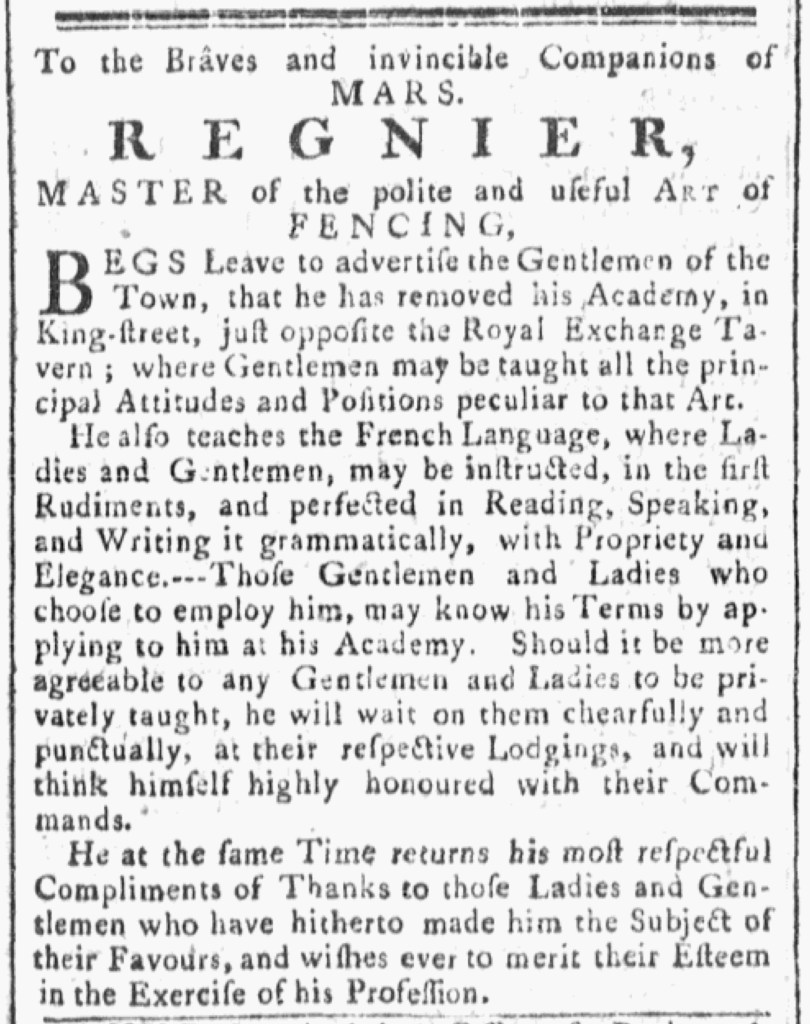
What was advertised in a colonial American newspaper 250 years ago today?
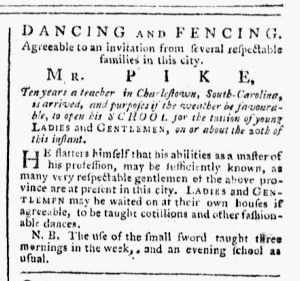
“MR. PIKE, Ten years a teacher in Charlestown, South-Carolina, is arrived.”
When Mr. Pike arrived in Philadelphia near the end of the summer of 1774, he introduced himself to his new neighbors and prospective students with an advertisement in Dunlap’s Pennsylvania Packet. He devised a headline, “DANCING AND FENCING,” to attract attention and provide a general overview of the services he offered. As a newcomer with a reputation largely unknown in the bustling urban port, he gave his résumé, declaring that he had been “Ten years a teacher in Charlestown, South-Carolina.” (The Adverts 250 Project has traced his career there throughout most of his time in that city.) For quite some time, Pike had been planning to leave Charleston, announcing his intentions in the newspapers there and publishing a farewell message in early May.
According to the dancing master, some of the gentry in Philadelphia already knew how well he had served his students and the community in Charleston. He chose Philadelphia as his new home, he explained, “Agreeable to an invitation from several respectable families in this city.” Furthermore, Pike feigned modesty, as many advertisers often did, in declaring that he “flatters himself that his abilities as a master of his profession, may be sufficiently known, as many very respectable gentlemen of the above province are at present in this city.” He likely referred to Christopher Gadsden, Thomas Lynch, Jr., Henry Middleton, Edward Rutledge, and John Rutledge, South Carolina’s delegates to the First Continental Congress. They had commenced their meetings in Carpenters’ Hall on the very day that Pike’s advertisement first ran in Dunlap’s Pennsylvania Packet. Even if Pike had not instructed any of those gentlemen or members of their families, they almost certainly were familiar with his reputation and the balls he hosted so his pupils could demonstrate their grace and proficiency in “cotillions and other fashionable dances.” The dancing master hoped that casual conversations would include inquiries about him directed to delegates and others from Charleston who happened to be in Philadelphia at the time, resulting in recommendations to supplement and support his advertisement in the public prints.