December 24

What was advertised in a revolutionary American newspaper 250 years ago this week?

Connecticut Gazette (December 22, 1775).

“All kinds of Work both in the Plain and Regimental Way.”

When Edward Davis placed an advertisement in the Connecticut Gazette in December 1775, it looked much like advertisements that other tailors ran in newspapers throughout the colonies.  He stated that he “performs in the neatest and genteelest Manner, and at the most reasonable Prices, all kinds of Work.”  In just a few words, he emphasized his skill and made appeals to quality, fashion, and price.  “Any Gentlemen who are disposed to honour him with their Commands,” Davis declared, “he will faithfully serve and with the utmost Punctuality; and will with Gratitude acknowledge the smallest Favours conferr’d on their most obedient Servant.”  Those overtures promising exemplary customer service echoed advertisements placed by many other shopkeepers and artisans.

Yet Davis’s notice also contained some distinctive features that resonated with current events.  He introduced himself as a “TAYLOR from BOSTON” who “Has taken a Shop in the Parish of Scotland, in Windham, near the Meeting House.” Newcomers often used newspaper advertisements to introduce themselves when they moved to a new town, hoping to attract the attention of prospective customers.  At other times, Davis’s previous experience in Boston would have supported his claim to make garment in the “genteelest Manner,” bringing the styles of the bustling urban port to the countryside.  In this instance, however, noting that he came “from BOSTON” might have signaled that he was a refugee who departed the city during the exchange negotiated by General Thomas Gage and the Sons of Liberty after the battles at Lexington and Concord.  At the time Davis ran his advertisement, the siege continued.  In Connecticut and Rhode Island, the frequency of advertisers describing themselves as “from BOSTON” seemed to increase, likely reflecting decisions made by many residents to leave when they had the chance.  After all, they had already experienced the distresses that ensued when Parliament passed the Boston Port Act to close the harbor until colonizers made restitution for the tea destroyed in December 1773.  Davis made another nod to the war that began the previous April.  In addition to “Plain” clothing, he also made items in the “Regimental Way” to outfit soldiers and officers.  At a glance, his advertisement looked like so many others placed by tailors, but on closer inspection it testified to the times and the transition from imperial crisis to warfare.

December 15

What was advertised in a revolutionary American newspaper 250 years ago today?
Essex Journal (December 15, 1775).

“Manufactures of all kinds in America tend to promote the welfare of it.”

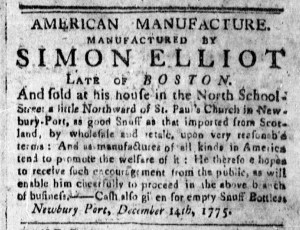
In December 1775, Simon Elliott took to the pages of the Essex Journal, printed in Newburyport, Massachusetts, to promote the snuff that he made in that town.  He published his advertisement as the siege of Boston continued, much of the copy testifying to the imperial crisis that had become a war with the skirmishes at Lexington and Concord the previous April.

The advertisement featured an elaborate headline.  Indeed, it had a primary headline and a secondary headline, like many other newspaper advertisements.  Elliot’s name, centered and all in capital letters of a larger font than anything else in that issue of the Essex Journal except the name of the newspaper in the masthead, demanded attention.  It was the second line of three, the other two also centered and in capital letters but smaller fonts: “MANUFACTURED BY / SIMON ELLIOT / LATE OF BOSTON.”  A secondary headline, “AMERICAN MANUFACTURE,” appeared above the headline that made Elliot’s name so prominent.

Like so many other artisans when they moved to new towns and introduced themselves to prospective customers, Elliot mentioned his origins.  Usually, “OF BOSTON” sufficed, but in this instance “LATE OF BOSTON” likely indicated that he had been displaced from that city recently.  Many residents chose to leave following the outbreak of hostilities.  In the early days of the siege of Boston, the Sons of Liberty and General Gage negotiated an exchange that allowed Loyalists to enter and others to depart.  In the following months, newspapers throughout New England carried advertisements by entrepreneurs “from Boston,” a diaspora of refugees displaced at the beginning of the Revolutionary War.

In addition to signaling the hardships he recently faced, Elliot also promoted the quality of the snuff that he made in Newburyport, asserting it was “as good Snuff as that imported from Scotland.”  That was no small claim since tobacco processed into snuff in Scotland had a superior reputation at the time.  Yet Elliot had more to say about his “AMERICAN MANUFACTURE” and why consumers should favor it over others.  Echoing the Continental Association, a nonimportation agreement devised by the First Continental Congress, and popular discourses of the last decade, Elliot declared that “as manufactures of all kinds in America tend to promote the welfare of it: He therefore hopes to receive such encouragement from the public” to support his new enterprise.  Supporters of the American cause, he suggested, had a civic duty to purchase the snuff that he made in Newburyport as well as support other entrepreneurs who produced domestic manufactures.

December 4

What was advertised in a revolutionary American newspaper 250 years ago today?

Connecticut Courant (December 4, 1775).

“Newest fashioned Bonnets … at the same reasonable prices that they have been accustomed to in times past.”

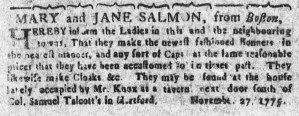
When they relocated to Hartford, milliners Mary Salmon and Jane Salmon placed an advertisement in the December 4, 1775, edition of the Connecticut Courant to introduce themselves to their new neighbors and, especially, to prospective customers.  They informed “the Ladies in this and the neighbouring towns, That they make the newest fashioned Bonnets in the neatest manner, and any sort of Caps.”  They also noted that they “make Cloaks” and other garments.  The milliners hoped to establish a clientele and earn their livelihood in a town new to them.  In the headline for their advertisement, they described themselves as “from Boston.”  The Salmons were not the only newcomers from Boston who ran an advertisement in that issue of the Connecticut Courant.  James Lamb and Son, tailors “From Boston” who had previously inserted a notice in that newspaper in September, ran a new advertisement that appeared in the same column as the Salmons’ notice.  Like the Lambs, the Salmons may have been refugees who left Boston following the outbreak of hostilities at Lexington and Concord in the spring.

In marketing their wares, the Salmons did not allow the difficulties of the war to overshadow prospective customers’ desire for hats that followed the latest styles.  They intentionally declared that they made “the newest fashioned Bonnets” and did so “in the neatest manner.”  They combined appeals to taste with a pledge about the quality of their hats and their skill as milliners.  The Salmons also incorporated promises regarding price into their brief advertisement, asserting that they charged “the same reasonable prices that [prospective customers] have been accustomed to in times past.”  The disruptions caused by the war did not cause them to raise prices.  In addition, they made a nod to the ninth article of the Continental Association: “That such as are Venders of Goods or Merchandise will not take Advantage of the Scarcity of Goods that may be occasioned by this Association, but will sell the same at the Rates we have been respectively accustomed to do so for twelve Months last past.”  The Salmons could not rely on their reputation among an existing clientele to generate business as they had done in Boston.  Instead, they devised an advertisement that said a lot in just a few lines, deploying appeals to fashion, quality, skill, and price.  They may have also expected that current events would resonate with their notice, anticipating that prospective customers would realize why they moved from Boston and their commitment to abiding by the Continental Association.

September 4

What was advertised in a revolutionary American newspaper 250 years ago today?

Connecticut Courant (September 4, 1775).

“JAMES LAMB and SON, From BOSTON, … intend to carry on the TAYLOR’s business.”

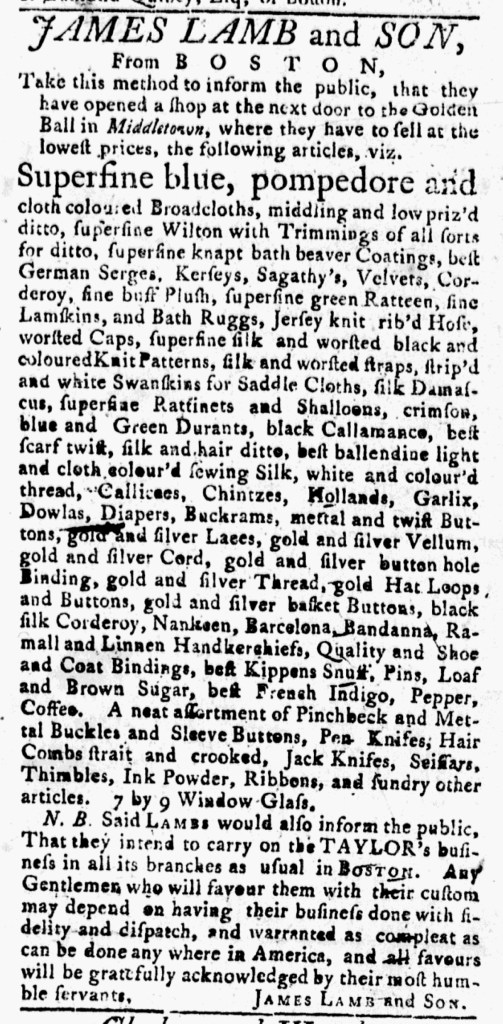
James Lamb and Son used an advertisement in the September 4, 1775, edition of the Connecticut Courant, published in Hartford, to inform the public “that they have opened a shop at the next door to the Golden Ball in Middletown.”  They listed dozens of items they stocked, mostly an assortment of textiles but also ribbons, buttons, buckles, thread, pins, sugar, indigo, and coffee.  Their inventory rivaled those that ran in newspapers prior to the Continental Association going into effect.  The Lambs did not mention when or how they acquired their wares.  Instead, the header for their advertisement focused on their origins, “From BOSTON.”  Like others “From BOSTON” who advertised that they opened shops in other cities and towns in New England in the summer and fall of 1775, the Lambs might have been refugees displaced by the siege of Boston after the battles at Lexington and Concord in April.  They could have left the city when they had an opportunity, taking merchandise with them in hopes of establishing themselves in a new place.

A nota bene indicated that they offered residents of central Connecticut the same quality and range of service that they previously provided to customers in Boston.  They were not, after all, shopkeepers but also skilled tailors who “intend to carry on the TAYLOR’s business in all its branches as usual in BOSTON.”  That last phrase meant “as they had in BOSTON,” signaling to prospective customers that the Lambs had experience as tailors.  As newcomers, they needed to start building their reputation; for the moment, their own account of their experience substituted for local clients familiar with their work.  Yet that did not prevent them from making bold claims.  “Any Gentlemen who will favour them with their custom,” the Lambs proclaimed, “may depend on having their business done with fidelity and dispatch.”  In addition to exemplary customer service, the Lambs promised the highest quality.  They “warranted” their work “as complear as can be done any where in America.”  The tailors “From BOSTON” asserted that their garments rivaled any from Charleston, New York, Philadelphia, or any other city or town in the colonies.  They hoped such claims would attract customers as they began building their business in Middletown in the first year of the Revolutionary War.

August 4

What was advertised in a revolutionary American newspaper 250 years ago today?

Connecticut Gazette (August 4, 1775).

“Thomas Tileston, HAT-MAKER from BOSTON.”

Thomas Tileston, a hatmaker, ran an advertisement in the Connecticut Gazette for several weeks in the summer and early fall of 1775.  He published it to inform prospective customers that “he has taken a Shop In WINDHAM, … Where he intends the carrying on his Business in all its Branches.”  He currently had in stock the “Best of Beaver, Beaverett, Castor and Felt HATS.”  Tileston promised exemplary customer service, asserting that they “may depend on the best Usage” and promising to undertake all orders “with Fidelity and Dispatch.”

As a newcomer to the area, Tileston introduced himself as a “HAT-MAKER from BOSTON.”  Advertisers often indicated where they previously conducted business or received their training, but this detail had new significance.  Tileston’s arrival in Windham coincided with the outbreak of hostilities at Lexington and Concord and the ensuing siege of Boston. General Thomas Gage, the governor, and the Massachusetts Provincial Congress negotiated an agreement that permitted Loyalists to enter the city and Patriots and others to depart.  After enduring the closure of the harbor a year earlier via to the Boston Port Act and the hardships that resulted, Tileston may have decided to take what might have been his last opportunity to leave the city and establish himself elsewhere before the situation deteriorated even more.  Windham was certainly a small town compared to Boston, yet Tileston did not merely suggest that he brought an elevated sense of fashion with him.  He likely expected that readers might consider him a refugee and hoped that they would believe that he merited support from consumers in his new town.

Given the stakes, Tileston went to additional lengths to draw attention to his advertisement.  A border composed of printing ornaments enclosed his notice, distinguishing it from other advertisements that appeared in the Connecticut Gazette.  Week after week, Tileston’s notice had that distinctive feature, making it easy for readers to spot.  The hatmaker would have had to make special arrangements with the printer for his advertisement to receive such treatment.  Perhaps he even had to pay more for it.  Tileston apparently considered it worth the investment as he sought to establish his business in a new town.

July 25

What was advertised in a revolutionary American newspaper 250 years ago today?

New-Hampshire Gazette (July 25, 1775).

“John Greenleaf, TAYLOR from BOSTON.”

Even though Daniel Fowle sometimes had to reduce the size of the New-Hampshire Gazette to two pages instead of four in the months following the battles at Lexington and Concord, he found space to include advertisements alongside the news of the momentous events taking place in Massachusetts where the siege of Boston continued and General George Washington took command of the Continental Army, in Philadelphia where the Second Continental Congress met to address the crisis, and throughout the colonies as everyone took stock of what occurred and made preparations for what they believed might come next.  The July 25, 1775, edition of the New-Hampshire Gazette, for instance, consisted of six columns spread over two pages.  Several advertisements filled just over half of the final column.

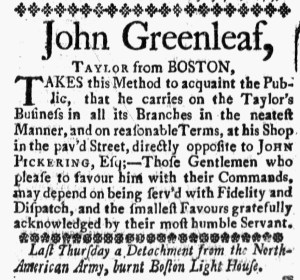
Those advertisements included one from John Greenleaf, “TAYLOR from BOSTON,” who wished “to acquaint the Public, that he carries on the Taylor’s Business in all its Branches in the neatest Manner, and on reasonable Terms, at his Shop” in Portsmouth.  After rehearsing common appeals about his skill and the quality of his work (“neatest Manner”) and the price (“reasonable Terms”), Greenleaf emphasized the sort of service that customers expected from tailors: “Those Gentlemen who please to favour him with their Commands, may depend on being serv’d with Fidelity and Dispatch, and the smallest Favours gratefully acknowledged.”  The tailor’s advertisement followed a familiar formula, one used by members of his trade from New England to Georgia.

Even listing his occupation and the place he formerly lived and worked (“TAYLOR from BOSTON”) as a secondary headline was part of that formula, yet in this instance doing so had new significance.  Greenleaf did not merely communicate that he brought his experience from one of the largest urban ports in the colonies to the smaller town of Portsmouth.  He also made a statement about how his life had been disrupted when hostilities commenced in April 1775.  He took advantage of negotiations between General Thomas Gage, the governor and king’s representative, and the Massachusetts Provincial Congress that allowed Loyalists to enter Boston and Patriots and others to depart.  In describing himself as a “TAYLOR from BOSTON,” Greenleaf declared that he was a refugee, one of many who placed advertisements when they settled in new towns.  He likely hoped that would influence prospective customers to avail themselves of his services.  The scrap of news that Fowle, the printer, inserted immediately below the tailor’s advertisement underscored Greenleaf’s status as a refugee.  “Last Thursday,” Fowle reported, “a Detachment from the North-American Army, burnt Boston Light House.”  Greenleaf did not need to elaborate on the dangers he escaped and the challenges he faced in establishing his business in a new town.  Readers already knew all about it.

July 3

What was advertised in a revolutionary American newspaper 250 years ago today?

Boston-Gazette (July 3, 1775).

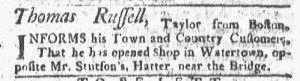
“Thomas Russell, Taylor from Boston … has opened Shop in Watertown.”

Benjamin Edes, a Patriot printer, moved the Boston-Gazette to Watertown following the battles at Lexington and Concord.  He was not the only colonizer on the move during the siege of Boston at the beginning of the Revolutionary War.  General Thomas Gage, the governor, and the Massachusetts Provincial Congress negotiated an agreement that allowed Loyalists to enter the city and Patriots and others to depart.  Each could take whatever effects they could transport, except for firearms and ammunition.  Many residents of Boston left the city for other towns and cities, some of them placing advertisements to introduce themselves to their new communities and announce their occupations to prospective clients and customers.  In the late spring and summer of 1775, the description “from Boston” took on new meaning.

While some of those refugees headed to other colonies, Thomas Russell, a “Taylor from Boston,” moved only a short distance to Watertown.  Upon arriving, he placed an advertisement in the Boston-Gazette to inform “his Town and Country Customers, That he has opened Shop in Watertown, opposite Mr. Stutson’s, Hatter, near the Bridge.”  Although framed as an update for his current customers, Russell’s advertisement also signaled to all readers that he considered himself a “Steady Friend to America,” as Edes described a correspondent in the column to the left of the notice, rather than a Tory who embraced the protection of British regulars and supported the policies enacted by Parliament.  Just above that piece, Edes relayed an account from New York about a colonizer taken into custody “who it is said had been privately inlisting men to serve under General Gage, against their country.”  Russell, in contrast, had refused to remain in Boston and lend any kind of support to the general and his officers or the residents who approved of them.  Instead, he hoped that his “Town” customers who had also departed the city would seek his services in Watertown.  Similarly, he hoped that “Country Customers,” whether they previously hired him or not, would visit his shop.

June 7

What was advertised in a revolutionary American newspaper 250 years ago today?

Connecticut Journal (June 7, 1775).

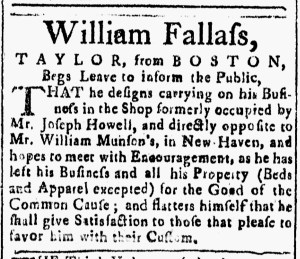
“He has left his Business and all his Property … for the Good of the Common Cause.”

In the summer of 1775, William Fallass, a “TAYLOR, from BOSTON,” relocated to New Haven, Connecticut.  Upon arriving in town, he placed a newspaper advertisement to introduce himself to his new neighbors and prospective customers.  Fallass announced that he “designs carrying on his Business in the Shop formerly occupied by Mr. Joseph Howell … and hopes to meet with Encouragement.”  The locals did not yet know him or his work by reputation, prompting him to declare that he “flatters himself that he shall give Satisfaction to those that please to favor him with their Custom.”  The newcomer pledged his best efforts for his clients.

He also offered another reason that residents of New Haven should hire his services.  He had not planned to relocate to another town but instead “left his Business and all his Property (Beds and Apparel excepted) for the Good of the Common Cause.”  The battles at Lexington and Concord and the ensuing siege of Boston upended Fallass’s life and livelihood.  In late April, the Massachusetts Provincial Congress, meeting in Watertown, negotiated with General Thomas Gage, the governor, for safe passage in or out of Boston.  Loyalists could move into the city; Patriots and others could depart.  In each instance, they could take their “Effects” with them, “excepting their Fire-Arms and Ammunition.”  The unfortunate Fallass did not manage to move most of his “Effects,” just his clothing and bedding.  He hoped that sacrifice “for the Good of the Common Cause” would endear him to prospective clients and entice them to do business with him, a refugee.

In that regard, Fallass made a more explicit appeal than Polly Allen and Lucy Allen, milliners and mantuamakers from Boston, did when they ran a newspaper advertisement in Providence earlier in the week.  In both cases, however, advertisements help in tracing the movement of men and women who departed Boston during the siege.  They did not merely leave the city for the countryside; many relocated to other colonies and attempted to revive their businesses in new places as the Revolutionary War began.  Articles and “letters of intelligence” relayed some accounts of current events, yet advertisements played another role in revealing the effects of the war on some colonizers.

October 29

What was advertised in a colonial American newspaper 250 years ago today?

Providence Gazette (October 29, 1774).

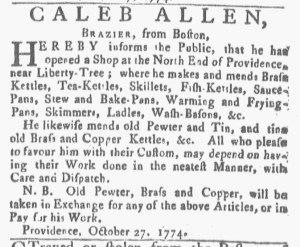
“BRAZIER, from Boston …  has opened a Shop at the North of Providence, near Liberty-Tree.”

When Caleb Allen, a “BRAZIER, from Boston,” opened a shop in Providence in the fall of 1774, he took to the pages of the local newspaper to advise the public of his new endeavor.  He announced that he “makes and mends Brass Kettles, Tea-Kettles, Skillets,” and other items and “mends old Pewter and Tin.”  Like many other artisans, he pledged that his customers “may depend on having their Work done in the neatest Manner, with Care and Dispatch.”  Braziers and other artisans often assured the public about their skill and the quality of their work.

In giving his location, Allen stated that customers could find his shop “at the North End of Providence, near Liberty-Tree.”  In so doing, he may have signaled his political views.  At the very least, he seemingly indicated that he was friendly to the patriot cause rather than holding it in disdain.  After all, he could have chosen from among many ways to give his location, including just “at the North End of Providence” without mentioning the Liberty Tree.  He could have given the name of the street, noted his shop’s proximity to a prominent resident or business, or invoked another familiar landmark.  Yet the newcomer from Boston specifically associated the Liberty Tree with his business.

Allen did not mention how recently he arrived in Providence.  He had not advertised in the Providence Gazette prior to October 29, 1774.  Perhaps he left Boston after the Boston Port Act went into effect, blockading the harbor until the residents of the town paid for the tea destroyed during the Boston Tea Party.  That legislation, along with the other Coercive Acts, disrupted commerce and everyday life in Boston.  The same issue of the Providence Gazette that carried Allen’s advertisement also featured an update from Boston that “transports, with troops, &c. on board, arrived here from New-York.”  Anticipating that things would get even more difficult in that city, the “BRAZIER, from Boston” may have determined to depart and seek his fortunes elsewhere.  In that case, the Liberty Tree in Providence would have had particular significance for him when he set up shop near it.

May 7

What was advertised in a colonial American newspaper 250 years ago today?

Providence Gazette (May 7, 1774).

“His Customers may depend on having their Work done as neat as at Boston.”

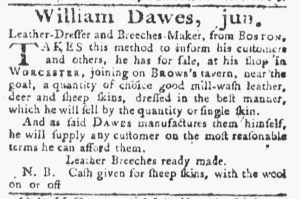
When the mononymous Wright, “TAYLOR and HABIT-MAKER, from Boston,” arrived in Providence, he ran a newspaper advertisement to introduce himself to prospective clients in and near the growing port.  He advised the public that he “has taken a Shop opposite Messieurs Joseph and William Russell’s Store,” a prime location because everyone knew where the town’s most prominent merchants did business.  Readers might not know much about Wright, at least not yet, but they could certainly find their way to his new shop if they wished to find out more.

For his part, Wright sought to incite interest that would help in cultivating a clientele by telling the public more about himself and his plans for his new enterprise.  He reported that he “served his Apprenticeship to one of the best Taylors in Boston,” but did not give a name.  Whether they arrived from the other side of the Atlantic or from another colony, artisans often promoted the training they received in their trade, hoping that would give them some standing with prospective customers while they worked to establish their reputations in the local market.  Wright also asserted that he pursued “the Taylor’s Business, in all its Branches,” indicating that he was capable of any sort of work undertaken by tailors.  His apprenticeship had been extensive and complete.

The newcomer also emphasized quality and customer service.  He promised that he produced garments “in the neatest and best Manner.”  Indeed, given his prior experience, he pledged that “His Customers may depend on having their Work done as neat as at Boston, or elsewhere.”  Just because Boston and New York and Philadelphia were larger and more cosmopolitan did not mean that their tailors produced better work, at least not according to Wright as he appealed to prospective clients in Providence.  He may have even intended for the mononym to testify to the cachet associated with hiring him.  Wright was confident that he “shall give Satisfaction to all that may please to favour him with their Custom.”  Whether or not that was actually the case could not be gleaned from his advertisement, but the tailor did demonstrate that he was familiar with the various conventions for marketing his services commonly adopted by members of his trade during the era of the American Revolution.