May 7

What was advertised in a colonial American newspaper 250 years ago today?
Providence Gazette (May 7, 1774).

“His Customers may depend on having their Work done as neat as at Boston.”

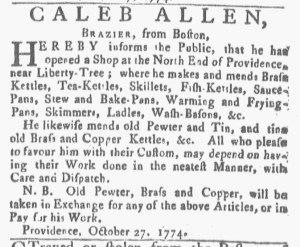
When the mononymous Wright, “TAYLOR and HABIT-MAKER, from Boston,” arrived in Providence, he ran a newspaper advertisement to introduce himself to prospective clients in and near the growing port.  He advised the public that he “has taken a Shop opposite Messieurs Joseph and William Russell’s Store,” a prime location because everyone knew where the town’s most prominent merchants did business.  Readers might not know much about Wright, at least not yet, but they could certainly find their way to his new shop if they wished to find out more.

For his part, Wright sought to incite interest that would help in cultivating a clientele by telling the public more about himself and his plans for his new enterprise.  He reported that he “served his Apprenticeship to one of the best Taylors in Boston,” but did not give a name.  Whether they arrived from the other side of the Atlantic or from another colony, artisans often promoted the training they received in their trade, hoping that would give them some standing with prospective customers while they worked to establish their reputations in the local market.  Wright also asserted that he pursued “the Taylor’s Business, in all its Branches,” indicating that he was capable of any sort of work undertaken by tailors.  His apprenticeship had been extensive and complete.

The newcomer also emphasized quality and customer service.  He promised that he produced garments “in the neatest and best Manner.”  Indeed, given his prior experience, he pledged that “His Customers may depend on having their Work done as neat as at Boston, or elsewhere.”  Just because Boston and New York and Philadelphia were larger and more cosmopolitan did not mean that their tailors produced better work, at least not according to Wright as he appealed to prospective clients in Providence.  He may have even intended for the mononym to testify to the cachet associated with hiring him.  Wright was confident that he “shall give Satisfaction to all that may please to favour him with their Custom.”  Whether or not that was actually the case could not be gleaned from his advertisement, but the tailor did demonstrate that he was familiar with the various conventions for marketing his services commonly adopted by members of his trade during the era of the American Revolution.

September 7

What was advertised in a colonial American newspaper 250 years ago today?

Sep 7 - 9:7:1770 New-Hampshire Gazette
New-Hampshire Gazette (September 7, 1770).

“MANTU-MAKER, FROM BOSTON.”

Over the past few days the Adverts 250 Project has examined the manner in which purveyors of goods and services in the colonies incorporated their origins into their advertisements as part of their marketing campaigns.  We began with James Yeoman, a clock- and watchmaker “FROM LONDON,” who sought to convince readers of the New-York Gazette and Weekly Mercury that his skills eclipsed those of competitors who had not trained or worked in the largest city in the empire.  Next we looked at George Lafong, a “French HAIR-DRESSER,” who informed the ladies and gentlemen of Williamsburg, Virginia, that he styled hair “in the cheapest manner, & TOUT A LA MODE” (all in fashion).  Injecting a few words of French into his advertisement in William Rind’s Virginia Gazette underscored the gentility and cachet associated with hiring a hairdresser from France.

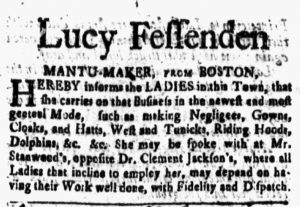
Today we consider the advertisement that Lucy Fessenden inserted into the September 7, 1770, edition of the New-Hampshire Gazette.  She introduced herself as a mantuamaker “FROM BOSTON,” asserting that she pursued her craft “in the newest and most genteel Mode.”  While Yeoman and Lafong’s advertisements testified to migration across the Atlantic, Fessenden’s notice indicated migration within the colonies.  In both instances, advertisers sought to use their origins to their advantage.  Artisans as well as tailors, milliners, and others in the garments trade, including mantuamakers like Fessenden, frequently noted that they formerly lived and worked in some of the largest port cities when they relocated to smaller towns and advertised their services.  Perceptions of skill and associations with gentility seemed to operate on a sliding scale.  Residents of Boston, Charleston, New York, and Philadelphia looked to London and other places on the far side of the Atlantic as models.  Residents of smaller towns did as well, but they also recognized the major ports in the colonies as locations that merited notice.  Unable to make a direct connection to London, Fessenden instead leveraged her time in Boston to suggest her familiarity with “the newest and most genteel Mode” and her ability to deliver on it “with Fidelity and Dispatch.”

January 29

What was advertised in a colonial American newspaper 250 years ago today?

Jan 29 - 1:29:1770 Connecticut Courant
Connecticut Courant (January 29, 1770).

“Any gentlemen … may depend upon being served as well as in Boston.”

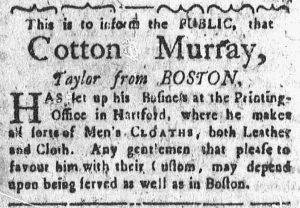
Cotton Murray, “Taylor from BOSTON,” inserted a brief advertisement in the January 29, 1770, edition of the Connecticut Courant “to inform the PUBLIC” that he recently began serving clients in Hartford, though he had not opened his own shop. Instead, he “set up his Business at the Printing-Office, where he makes all sorts of Men’s CLOATHS.” Though an unusual location for a tailor, he pledged that “Any gentleman that please to favour him with their Custom, may depend upon being served as well as in Boston.”

In making that promise, Murray played on anxieties common among colonial consumers. Those in the largest cities looked to London and other major cities on the other side of the Atlantic, comparing the goods and services available in the two locales. Similarly, consumers in smaller cities and towns in the American colonies looked to Boston, Charleston, New York, and Philadelphia as centers of fashion and refinement. Yet artisans like Murray assured prospective customers in places like Hartford that their cities and towns need not have the advantage of size in order for consumers to benefit from the same services available in the larger port cities.

Murray exerted some authority in making that claim. After all, he had formerly resided and worked in Boston. He knew the quality of service customers received there and stood ready to transfer the experience to his new clientele in Hartford and the surrounding towns. He may have also expected that his origins, “from BOSTON,” gave his enterprise additional cachet among prospective customers, just as artisans in urban ports frequently proclaimed in their newspapers advertisements that they were “from London.” Doing so simultaneously introduced and promoted artisans by associating them with places considered more cosmopolitan than their new homes. That was the primary appeal to prospective customers Murray made in his advertisement. He presented his case implicitly at the beginning of his notice, stating he was “from BOSTON,” and explicitly at the conclusion to aid readers in making the connection that if they became clients they could “depend upon being served as well” as in the largest city in New England.

August 4

What was advertised in a colonial American newspaper 250 years ago today?

Aug 4 - 8:4:1769 New-London Gazette
New-London Gazette (August 4, 1769).

“Good Work … equal to any in Boston.”

The consumer revolution of the eighteenth century extended far beyond major metropolitan centers like London and into the provinces, both the English provinces and the colonies on the other side of the Atlantic. For colonists, participating in consumer culture became part of their identity and a marker of their membership in the vast British Empire. For many, acquiring goods also testified to their status. This sometimes prompted both anxiety and competition among consumers … and advertisers cultivated both for their own purposes. Some deployed an eighteenth-century version of “keeping up with the Joneses” to stimulate demand in their goods and services.

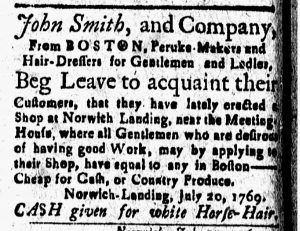
Consider the advertisement John Smith and Company placed in the August 4, 1769, edition of the New-London Gazette. Smith and Company introduced themselves as “Peruke-Makers and Hair-Dressers for Gentlemen and Ladies,” but before they specified their occupation they first proclaimed that they were “From BOSTON.” This inverted the usual order of information that commonly appeared in eighteenth-century advertisements. Most advertisers listed their occupation first and their place of origin or site of significant employment second, but Smith and Company made certain that their affiliation with Boston, the largest and most cosmopolitan city in New England, foregrounded everything else in their advertisement.

Smith and Company had recently opened a new shop at Norwich Landing, a much smaller town than the busy port of Boston. Despite the relatively bucolic setting, Smith and Company’s prospective clients could depend on “having good Work … equal to any in Boston.” This “good Work” presumably applied not only to the quality of the goods and services available from Smith and Company but also to the assistance they provided clients in demonstrating taste through adopting the latest styles, an important aspect of making wigs and dressing hair. Smith and Company encouraged readers of the New-London Gazette to consider current fashions and the services provided by wigmakers and hairdressers in Boston even though they lived at a distance from that busy port, much the same way that their counterparts in Boston, Charleston, New York, and Philadelphia urged their prospective customers to look to London or Paris and promised to deliver the current styles from those places. No matter where consumers resided, according to advertisements in colonial newspapers, purveyors of goods and services could help them achieve the fashions currently en vogue in places they considered one rung up the cosmopolitan ladder.